Contents13 sections
This guide was first published in German on handgetestet.de.
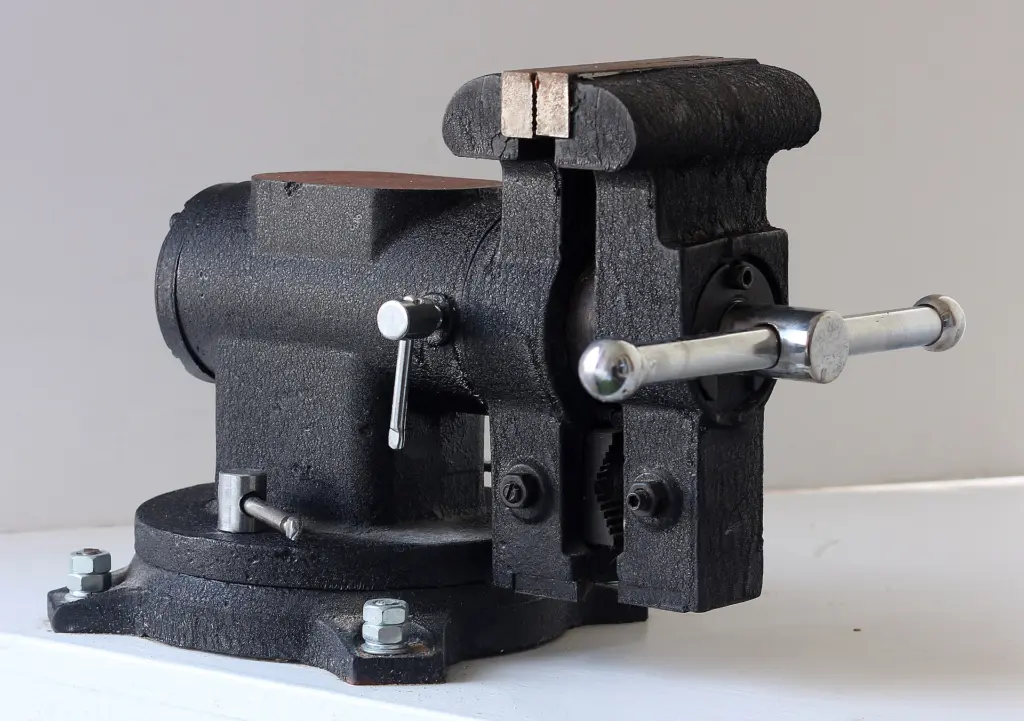
Four wood screws through the top of the bench, vise on top, done? It is not quite that simple. In its assembly instructions, Heuer recommends through bolts with nuts. For a fixed workbench at home, our choice is the Heuer Schraubstock mit Wechselbacken (vise with replaceable jaws) in 120 mm: forged steel, 150 mm opening capacity, replaceable jaws. It only swivels with the matching swivel base. On a drill press, by contrast, a flat machine vise belongs on the table.
120, 150 or 80 millimeters?
Vises are named after their jaw width. This means the width of the clamping jaws from left to right, so a „120“ has jaws 120 mm wide. For the work itself, however, the opening capacity is what matters, meaning how far it opens. On the Heuer 120, that is 150 mm, and on the Heuer 140 as much as 200 mm. The compact Heuer Compact opens only 125 mm despite the same jaw width.
Weight increases with size. For its range, Heuer states 4.5 kg for the 100 model and 27 kg for the 160 model. A 14 kg chunk like the 150 mm Gedore red needs a bench that can take that without flexing.
For hobbyists who shorten threaded rods, bend sheet metal and hold bicycle parts, we consider 120 mm the sensible size. Larger only pays off if you regularly clamp thick pipes or heavy parts. Smaller is enough for model making and electronics. Be careful when comparing data sheets: Gedore talks about „usable throat depth,“ while Heuer distinguishes between opening capacity and throat depth. The same words do not always mean the same measurement.
Forged or cast
This is where the models differ fundamentally. Heuer forges its vises from C45 steel and, by its own account, guarantees that they will not break. The manufacturer calls gray cast iron comparatively brittle, because air pockets known as shrinkage cavities can form during casting. Cast models would therefore need more mass for comparable forces. That is the view of a supplier of forged products, but it explains why a 120 model made of steel gets by with 9 kg.
Not all cast iron is the same. Gedore specifies gray cast iron for the red R93800150. Irwin builds the Record quick-release vise from spheroidal graphite iron, i.e. ductile cast iron, which according to the manufacturer provides strength and long durability, and equips it with a steel handle that, according to the manufacturer, bends before the vise is overloaded. A well-thought-out detail.
Five vises side by side
| Model | Jaw width | Specifications according to manufacturer | Swivels | Best for |
|---|---|---|---|---|
| Heuer Schraubstock mit Wechselbacken 120 (101120) | 120 mm | Forged steel, 150 mm opening capacity, 9 kg | with swivel base 103120 | fixed workbench, metalwork |
| Heuer Compact (118001) | 120 mm | 10 kN clamping force, 125 mm opening capacity, 4.8 kg | with swivel base size 100 | changing workplaces |
| Gedore red R93800150 | 150 mm | Gray cast iron, 25 kN, 14.15 kg | yes, swiveling | large workpieces, heavy bench |
| Irwin Record Schnellspann-Schraubstock 1978271 | 100 mm | Spheroidal graphite iron, quick-release lever, anvil | yes, 120° | frequent re-clamping |
| Wolfcraft Maschinenschraubstock 3423000 | 80 mm | Gray cast iron, 80 mm opening capacity, 200 kg clamping force | no | drill press table |
Heuer Schraubstock mit Wechselbacken 120
A parallel vise that opens toward the front: 150 mm opening capacity, 65 mm throat depth, pipes from 16 to 55 mm. The surface-hardened jaws are bolted on, have one serrated and one smooth side, and can be turned around or replaced. If you often weld, grind or saw, this protects the actual body. Heuer states a permissible hand clamping force of 25 to 30 kN for the 120 size.
Heuer Compact
The lighter sibling. At the push of a button on the adjusting nut, the front jaw slides freely open and closed, according to Heuer from 0 to 125 mm in three seconds. At 4.8 kg and 10 kN, it is weaker than the large 120 model. In return, it fits the Tischklammer (table clamp), which holds it on boards from 10 to 60 mm without drilling.
Gedore red R93800150
A lot of jaw straight from the factory: 150 mm wide, swiveling, 25 kN maximum clamping force and 125 mm usable throat depth according to Gedore. The body is made of gray cast iron and weighs 14.15 kg. If you clamp large profiles and want the swivel function without accessories, this is the package for you. The workbench has to carry the weight, though.
Irwin Record 1978271
A 100 model with a quick-release lever that frees the jaws without lengthy cranking. The swivel base has three mounting points and rotates through 120°, plus there is an anvil and a safety stop that prevents the slide from slipping out. According to Irwin, it is designed for medium loads and frequent re-clamping of changing materials.
Wolfcraft Maschinenschraubstock 3423000
Not a workbench vise but a machine vise, the type named in the drilling information sheet of the German statutory accident insurance. Gray cast iron, steel trapezoidal spindle, quick adjustment and V-grooves in the jaw for round stock. A clamping force of 200 kg sounds like little. Its main job, however, is to prevent the workpiece from turning with the drill.
Swivel base from the factory or retrofitted?
Gedore and Irwin build in the swivel. Heuer sells it as an accessory: the Drehteller 103120 swivel base fits the 120 model, while the Compact needs size 100. It rotates 360°, is locked with the spindle wrench and has a closed mounting plate to keep out chips. Because the base rests on three points, according to the assembly instructions it cannot become distorted when bolted down. If you only file straight parts, you can skip the swivel base. If you need to guide long workpieces at an angle to the bench, you cannot.
How to mount it firmly on the workbench
Heuer’s instructions are very specific here. The clamping surface of the fixed rear jaw should protrude beyond the front edge of the workbench so that long parts can be clamped vertically past the bench. On the Compact, it should ideally sit flush.
- Use through bolts with nuts; on the Compact, 6 mm in diameter with washers.
- Mark the holes carefully and drill them about 2 mm larger than the bolt so that nothing binds.
- Before tightening, close the jaws completely and check that the base sits flat and does not wobble.
- Tighten the four bolts evenly in a crosswise pattern, especially on wood.
Otherwise the body distorts and the jaw runs stiffly and jerkily. The bench top must withstand the drilling and the forces. Which design is suitable for this is explained in our workbench guide (in German). If you do not want to drill, use the table clamp. For welding work on a clamped part, Heuer warns that the flame must not anneal the hardened clamping surfaces. For maintenance, the manufacturer recommends oiling the guide as needed and regreasing the spindle about every two years.
And at the drill press?
There, the workpiece does not belong in your hand. In its information sheet „Sicheres Bohren“ (safe drilling), the German Social Accident Insurance (DGUV) advises securing the workpiece against turning with the drill, for example with a machine vise, and wearing safety glasses. Which machine fits is explained in our drill press guide. And if you cut profiles to length in the vise, you will find tips on cutting in our cordless angle grinder guide (in German).
Which vise for which job?
- Fixed workbench, metal, occasional welding: Heuer mit Wechselbacken 120, with swivel base 103120 if needed.
- Garage or basement, shared space: Heuer Compact with table clamp.
- Large parts and swivel base without accessories: Gedore red R93800150, provided the bench can carry 14 kg.
- Constantly changing parts: Irwin Record 1978271 with quick-release lever.
- Drilling on a drill press: Wolfcraft 3423000 in addition to the bench vise.
Frequently asked questions
What is the difference between jaw width and opening capacity?
Vises are named after their jaw width; a 120 model has jaws 120 mm wide. For the work itself, however, what counts is the opening capacity, meaning how far it opens. On the Heuer 120, that is 150 mm, while the Heuer Compact opens only 125 mm despite the same jaw width.
What size should a vise be?
For hobbyists who shorten threaded rods, bend sheet metal and hold bicycle parts, we consider 120 mm the sensible size. Larger only pays off for thick pipes or heavy parts; smaller is enough for model making and electronics. Weight increases with size: Heuer states 4.5 kg for the 100 model and 27 kg for the 160 model.
Forged or cast: what is the difference?
Heuer forges from C45 steel and guarantees that its vises will not break. The manufacturer calls gray cast iron more brittle because air pockets can form, saying cast models need more mass. That is the view of a supplier of forged products. Irwin relies on spheroidal graphite iron, i.e. ductile cast iron, for the Record.
How do you fasten a vise to the workbench?
With through bolts and nuts. The fixed rear jaw protrudes beyond the front edge of the bench. Drill the holes about 2 mm larger, close the jaws completely before tightening and check that the base sits flat. Tighten the four bolts evenly in a crosswise pattern.
Does a vise need a swivel base?
Only if you need one. For straight parts that are filed, you can do without it; for long workpieces guided at an angle to the bench, you cannot. Gedore and Irwin build in the swivel, while Heuer sells it as an accessory: the Drehteller 103120 swivel base fits the 120 model and rotates 360°.
Which vise is suitable for a drill press?
A machine vise such as the Wolfcraft 3423000 with 80 mm opening capacity and V-grooves for round stock. In its information sheet on safe drilling, the German Social Accident Insurance (DGUV) advises securing the workpiece against turning with the drill, for example with a machine vise, and wearing safety glasses. The workpiece does not belong in your hand there.
Sources
- Heuer: Schraubstock mit Wechselbacken (vise with replaceable jaws)
- Heuer: Compact
- Heuer: Drehteller (swivel base)
- Heuer: Tischklammer (table clamp)
- Heuer: Assembly and maintenance instructions (PDF)
- Heuer: Frequently asked questions on material, size and clamping force
- Heuer: Glossary of jaw width and opening capacity
- Gedore: R93800150 swiveling parallel vise
- Irwin: Quick-Adjusting Vice 4″/100 mm
- Wolfcraft: Main catalog 2025, machine vise p. 53 (PDF)
- DGUV (German Social Accident Insurance): Sicheres Bohren – safe drilling (PDF)
Where to buy
- Heuer Schraubstock mit Wechselbacken 120 (101120)Check price at Amazon.deCheck price at Amazon.co.ukCheck price at Amazon.nlCheck price at Amazon.com.beCheck price at Amazon.frCheck price at Amazon.itCheck price at Amazon.esCheck price at Amazon.plCheck price at Amazon.seAvailable in Germany: Amazon.de
- Heuer Compact 120 mm (118001)Check price at Amazon.deCheck price at Amazon.co.ukCheck price at Amazon.nlCheck price at Amazon.com.beCheck price at Amazon.frCheck price at Amazon.itCheck price at Amazon.esCheck price at Amazon.plCheck price at Amazon.seAvailable in Germany: Amazon.de
- Gedore red R93800150 Parallel-Schraubstock schwenkbarCheck price at Amazon.deCheck price at Amazon.co.ukCheck price at Amazon.nlCheck price at Amazon.com.beCheck price at Amazon.frCheck price at Amazon.itCheck price at Amazon.esCheck price at Amazon.plCheck price at Amazon.seAvailable in Germany: Amazon.de
- Irwin Record Schnellspann-Schraubstock 100 mm (1978271)Check price at Amazon.deCheck price at Amazon.co.ukCheck price at Amazon.nlCheck price at Amazon.com.beCheck price at Amazon.frCheck price at Amazon.itCheck price at Amazon.esCheck price at Amazon.plCheck price at Amazon.seAvailable in Germany: Amazon.de
- Wolfcraft Maschinenschraubstock 3423000Check price at Amazon.deCheck price at Amazon.co.ukCheck price at Amazon.nlCheck price at Amazon.com.beCheck price at Amazon.frCheck price at Amazon.itCheck price at Amazon.esCheck price at Amazon.plCheck price at Amazon.seAvailable in Germany: Amazon.de
- Heuer Drehteller 120 (103120)Check price at Amazon.deCheck price at Amazon.co.ukCheck price at Amazon.nlCheck price at Amazon.com.beCheck price at Amazon.frCheck price at Amazon.itCheck price at Amazon.esCheck price at Amazon.plCheck price at Amazon.seAvailable in Germany: Amazon.de