Contents13 sections
This guide was first published in German on handgetestet.de.
The box of a floor pump usually carries a big number: 11 bar, 16 bar, 160 psi. It says little about everyday use. What matters is whether the pump head fits every valve in the household and whether the gauge is easy to read. For a family with a city bike, a kids‘ bike and a road bike, we therefore consider a floor pump with a large gauge and a head for all three valve types the right purchase, such as the Topeak JoeBlow Sport III. The mini pump is an addition. It does not replace the floor pump.
Which valve is actually on the bike?
Three types are common in Germany. The Dunlop valve, also known as the Woods valve, is typically rated up to 6 bar, according to Wikipedia’s overview of bicycle valves. The car valve (Schrader) holds around 10 bar, and the slim Sclaverand valve, sold as Presta or French valve, around 15 bar. Rims with an 8.5 mm hole accept all three, rims with 6.5 mm only the Sclaverand valve.
On a Dunlop valve, every pump gauge has a problem. As long as air is flowing, it shows more than is actually in the tire, because pressure is lost at the valve. The slower you pump, the closer the reading is to the real value. If you want to know exactly, check afterward with a separate gauge. A newcomer is Schwalbe’s Clik Valve, presented at Eurobike 2024; with it, a dedicated small pump head without a lever clicks onto the valve.
How much pressure can go into the tire?
That is not determined by the pump. The tire manufacturer prints the permissible range on the sidewall, and Schwalbe explicitly advises against going below or above it. According to Schwalbe, a loss of about 1 bar per month is normal, and the Celle chapter of the ADFC (German Cyclists‘ Federation) gives the same figure for an airtight tube. So check at least once a month. Schwalbe considers the thumb test unreliable and recommends a floor pump with a gauge for active riders.
An example of the order of magnitude: for a 47-622 trekking tire and riders up to 80 kg, the Celle ADFC gives 2.5 bar front and 3.0 bar rear as a guideline, with around 0.5 bar of leeway. Every pump in this guide is far from that limit. Road bikes with hookless rims are trickier. According to ETRTO, road tires there are limited to a maximum of 5 bar, even if the tire carries a higher rating; if the rim rating is even lower, that applies. On such rims, Schwalbe only allows tires marked TLE or TLR. If you are working with 16 bar of pump reserve here, what you need above all is a gauge with fine enough resolution in the range up to 5 bar.
Tubeless: when a powerful blast of air is needed
On first inflation, a tubeless tire has to snap into the rim shoulder with a jolt. Schwalbe names three ways to do this: a floor pump, a compressor or a pressure tank like its own Tire Booster, which you fill with the floor pump to up to 11 bar and then release all at once. It must never be filled with a compressor, and the maximum pressure of tire and rim applies here too. If that does not help, Schwalbe recommends, among other things, unscrewing the valve core. Tubeless valves are usually Sclaverand valves with a removable core.
Floor pumps with a built-in chamber do exactly that in one device. They are only worth the space in the basement if you actually mount tubeless tires.
Seven pumps side by side
| Model | Max. pressure | Head and valves | Weight | Best for |
|---|---|---|---|---|
| Topeak JoeBlow Sport III | 11 bar / 160 psi | TwinHead DX: Presta, Schrader, Dunlop | 1.68 kg | Households with mixed bikes |
| SKS Rennkompressor | 16 bar / 230 psi | Multi-Valve head, either E.V.A. or brass nipple | not specified | Road bikes, long service life |
| SKS Rennkompressor NXT Digi | 16 bar | MV Easy: Presta, Schrader, Dunlop | 2.03 kg (weighed by TOUR) | Road and gravel, digital display |
| Topeak JoeBlow Booster | 11 bar / 160 psi, 1-liter chamber | SmartHead DX3 with bleed button | 2.9 kg | Tubeless on MTBs and gravel bikes |
| Bontrager TLR Flash Charger | 11 bar / 160 psi | Presta, Schrader | not specified | Tubeless, chamber for charging |
| Topeak Mini Dual DXG | 8 bar / 120 psi | SmartHead: Presta, Schrader | 170 g | On the road, with hose and gauge |
| Topeak Roadie DA_G | 8 bar / 120 psi | Presta only | 116 g | Road bikes, in the jersey pocket |
Topeak JoeBlow Sport III
Our recommendation for the household. According to Topeak, the TwinHead DX fits Presta, Schrader and Dunlop; the gauge measures three inches and sits at mid-height. The manufacturer states around 318 cm³ of air per stroke, and the barrel and base are made of steel. Adapters for balls and inflatables are included. At 1.68 kg, it stays light enough for the car trunk.
SKS Rennkompressor
The orange original. Steel barrel, cast iron feet, wooden handle, precision gauge, up to 16 bar: that is how the 2023 test by the German site Radclub describes the pump, and the Multi-Valve head is standard. According to SKS, it remains in the range alongside its successor. If you ride high pressures on road bikes and want a pump made of metal and wood instead of plastic, this is the one. SKS does not give a weight for the original.
SKS Rennkompressor NXT Digi
The new generation, weighed and measured in February 2026 by the German cycling magazine TOUR: 2,025 g, 73 cm tall, 117 cm hose, digital display. The tester praises its stability and readability but criticizes a noticeable lag in the display and more plastic than before. For a 29-inch tire 2.4 inches wide, he needed 38 strokes to reach 2 bar; a Topeak JoeBlow Mountain EX managed it in about 20. Shorter people find the height uncomfortable. A version with an analog dial gauge is also available.
Topeak JoeBlow Booster
In CHARGE mode, according to Topeak, you pump up an aluminum chamber holding one liter to up to 11 bar. According to the manufacturer, this charge seats the tubeless tire in the rim in one go. After that, in the INFLATE position, it works like an ordinary floor pump with 303 cm³ per stroke, and the bleed button on the head helps with fine adjustment. At 2.9 kg and 74 cm, it is a workshop tool.
Bontrager TLR Flash Charger
The same principle from the Trek brand. According to the description at Gravel Cyclist, in the Charge position you fill the tank and release it all at once via the pressure release; in the Inflate position it pumps normally. The recommended maximum is 160 psi, or a little over 11 bar, and the head takes Presta and Schrader. Bontrager has revised the pump, and the versions differ in their gauge. Check the product description when buying.
Topeak Mini Dual DXG
For the backpack or the frame. Topeak states 8 bar, 61 cm³ per stroke thanks to dual action in both directions, and a gauge in the hose. The SmartHead takes Presta and Schrader without any conversion, and a frame mount is included. Topeak does not mention Dunlop here; on an everyday bike with a Woods valve, that can be an obstacle.
Topeak Roadie DA_G
116 g, 21.8 cm, Presta head with dust cap, small analog gauge. The math behind it is sobering: 36 cm³ per stroke is a little over a ninth of what the JoeBlow Sport III moves. It is intended for narrow road bike tires. On a mountain bike, it becomes a test of patience, and the Celle ADFC sees hand and frame pumps as emergency tools only anyway.
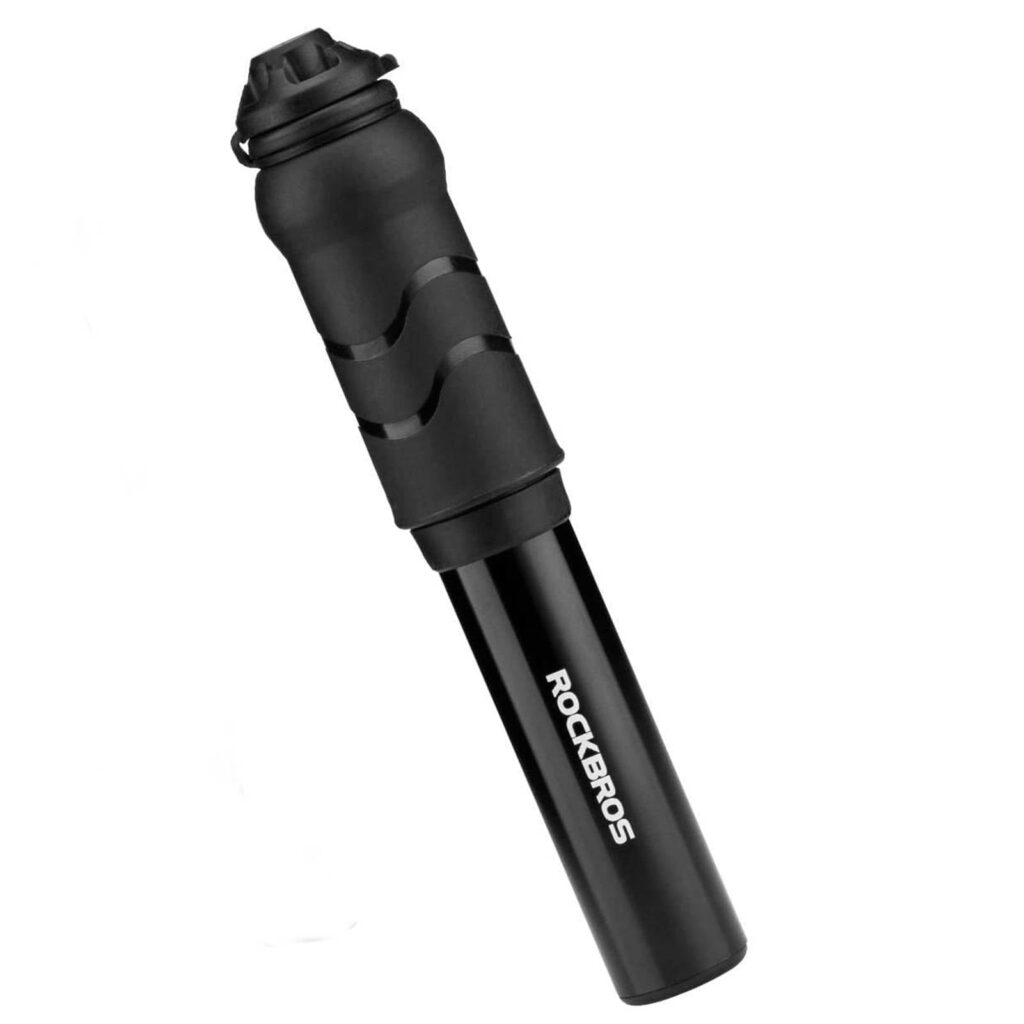
If all you want is an inexpensive second pump for the saddlebag, the mini pump from ROCKBROS is an option. The retailer lists 100 PSI as well as Presta and Schrader. Dunlop does not appear in the product name, so on an everyday bike with a Woods valve, that would need to be clarified first. We have no independent tests, and we cannot assess it beyond these retailer details. An addition for the road, not a replacement for the floor pump.
How we would decide
- Several bikes with mixed valves: Topeak JoeBlow Sport III, because Dunlop is explicitly included.
- Road bike with high pressure: SKS Rennkompressor, or the NXT Digi with a digital display. For the NXT, TOUR lists the check valve, head, hose, gauge and seals as spare parts.
- Tubeless tires on an MTB or gravel bike: JoeBlow Booster or Bontrager TLR Flash Charger. Without tubeless, both are overkill.
- On the road: Mini Dual DXG for mixed bikes, Roadie DA_G only for road bikes with Presta.
If you change tires yourself more often, a bike repair stand (in German) makes the job much more comfortable. And if you look after car tires as well as the bike, the guide to the cordless tire inflator (in German) covers the electric alternative.
Frequently asked questions
What types of bike valves are there?
Three types are common: the Dunlop valve (also called Woods valve), typically up to 6 bar; the car valve (Schrader) at around 10 bar; and the slim Sclaverand valve, sold as Presta, at around 15 bar. Rims with a 6.5 mm hole only accept the Sclaverand valve.
Why does the gauge read too high on a Dunlop valve?
As long as air is flowing, pressure is lost at the valve, so the reading is above the actual value in the tire. The slower you pump, the more accurate it becomes. If you want to know exactly, check afterward with a separate gauge.
How often do bike tires need pumping up?
According to Schwalbe, a loss of about 1 bar per month is normal, and the Celle chapter of the ADFC (German Cyclists' Federation) gives the same figure. So check at least once a month. Schwalbe considers the thumb test unreliable. The permissible pressure is set by the tire manufacturer on the sidewall, not by the pump.
Do I need a special pump for tubeless tires?
On first inflation, the tire has to snap into the rim shoulder with a jolt. Floor pumps with a chamber such as the Topeak JoeBlow Booster or the Bontrager TLR Flash Charger do this in one device. Without tubeless tires, both are overkill.
What should I watch for with hookless rims on a road bike?
According to ETRTO, road tires are limited to a maximum of 5 bar, even if the tire carries a higher rating; if the rim rating is lower, that applies. Schwalbe only allows tires marked TLE or TLR there. What matters is a gauge with fine resolution up to 5 bar.
Which mini pump suits riding on the road?
The Topeak Mini Dual DXG, with 8 bar, dual action and a gauge in the hose, takes Presta and Schrader; Topeak does not mention Dunlop. The Roadie DA_G at 116 g is only intended for Presta on road bikes. The Celle ADFC chapter sees hand and frame pumps as emergency tools anyway.
Sources
- Topeak: JoeBlow Sport III
- Topeak: JoeBlow Booster
- Topeak: Mini Dual DXG
- Topeak: Roadie DA_G
- SKS Germany: The new Rennkompressor NXT
- Radclub: SKS Rennkompressor in the test lounge (2023)
- TOUR: SKS Rennkompressor NXT Digi (2026)
- Gravel Cyclist: Bontrager TLR Flash Charger
- Schwalbe: Tire pressure
- Schwalbe: Hookless rims
- Schwalbe: Tubeless
- ADFC Celle (German Cyclists‘ Federation): Tire pressure
- Wikipedia: Bicycle valve (German)
- ROCKBROS: retailer information on the mini pump
Where to buy
- Topeak JoeBlow Sport IIICheck price at Amazon.deCheck price at Amazon.co.ukCheck price at Amazon.nlCheck price at Amazon.com.beCheck price at Amazon.frCheck price at Amazon.itCheck price at Amazon.esCheck price at Amazon.plCheck price at Amazon.seAvailable in Germany: Amazon.de
- SKS Rennkompressor Multi ValveCheck price at Amazon.deCheck price at Amazon.co.ukCheck price at Amazon.nlCheck price at Amazon.com.beCheck price at Amazon.frCheck price at Amazon.itCheck price at Amazon.esCheck price at Amazon.plCheck price at Amazon.seAvailable in Germany: Amazon.de
- SKS Rennkompressor NXT DigiCheck price at Amazon.deCheck price at Amazon.co.ukCheck price at Amazon.nlCheck price at Amazon.com.beCheck price at Amazon.frCheck price at Amazon.itCheck price at Amazon.esCheck price at Amazon.plCheck price at Amazon.seAvailable in Germany: Amazon.de
- Topeak JoeBlow BoosterCheck price at Amazon.deCheck price at Amazon.co.ukCheck price at Amazon.nlCheck price at Amazon.com.beCheck price at Amazon.frCheck price at Amazon.itCheck price at Amazon.esCheck price at Amazon.plCheck price at Amazon.seAvailable in Germany: Amazon.de
- Bontrager TLR Flash ChargerCheck price at Amazon.deCheck price at Amazon.co.ukCheck price at Amazon.nlCheck price at Amazon.com.beCheck price at Amazon.frCheck price at Amazon.itCheck price at Amazon.esCheck price at Amazon.plCheck price at Amazon.seAvailable in Germany: Amazon.de
- Topeak Mini Dual DXGCheck price at Amazon.deCheck price at Amazon.co.ukCheck price at Amazon.nlCheck price at Amazon.com.beCheck price at Amazon.frCheck price at Amazon.itCheck price at Amazon.esCheck price at Amazon.plCheck price at Amazon.seAvailable in Germany: Amazon.de
- Topeak Roadie DA_GCheck price at Amazon.deCheck price at Amazon.co.ukCheck price at Amazon.nlCheck price at Amazon.com.beCheck price at Amazon.frCheck price at Amazon.itCheck price at Amazon.esCheck price at Amazon.plCheck price at Amazon.seAvailable in Germany: Amazon.de
- ROCKBROS Fahrrad Minipumpe 100 PSI Luftpumpe Presta & Schrader VentileView at ROCKBROSAvailable in Germany: ROCKBROS