Contents12 sections
This guide was first published in German on handgetestet.de.
A boot dryer that gets too hot does more damage than an evening without a dryer. Wet leather boots and ski boot liners need moving, only moderately warm air and an automatic shut-off so that nothing heats for hours on end overnight. For ski and hiking boots plus gloves, we therefore consider a forced-air dryer with a timer such as the Alpenheat UniversalDry AD2 the sensible solution in most households; the Therm-ic Refresher is currently unavailable on Amazon. And if you only get wet feet occasionally? Cedar wood bags do the job without any electricity.
Why heat damages leather
The care instructions of the big hiking boot brands are surprisingly clear on this. Lowa writes that wet shoes should never be placed in the sun, in the bathroom, on the radiator, close to a stove or in a hot car. The wet leather could „burn,“ and the cracks could no longer be repaired. Meindl likewise warns against radiators and hot surfaces, because wet leather becomes brittle, hard and cracked. If you have just picked out new boots, for example with the help of our hiking boot guide (in German), you shouldn’t ruin them on the radiator.
Ski boots bring a second problem. Many liners are heat-moldable. Fischer specifies a maximum fitting temperature of 60 °C for its cork liners. That is not an official drying limit, but it shows the direction: a dryer should stay well below it, otherwise it may reshape the fit that was painstakingly adjusted at the shop. Atomic also advises taking the liners out after every outing and only putting them back in once they are dry. That does more than any extra watt.
Four ways to get rid of moisture
Forced warm air with a fan works fastest. A fan pushes slightly warmed air through tubes all the way into the toe box, often with a timer and heating that can be switched off. The trade-off is a quiet hum.
Without a fan, the warmth of a heating element rises into the shoe by convection. It is silent and simple, but slower, usually an overnight affair. According to retailer information, the classic Peet Original works on this principle. UV lamps are not a drying method of their own but come as an extra in forced-air or heat-based devices.
That leaves the electricity-free route. Bags of cedar wood shavings or crumpled newspaper draw moisture out of the lining. No heat, no cable. But also no speed with completely soaked boots.
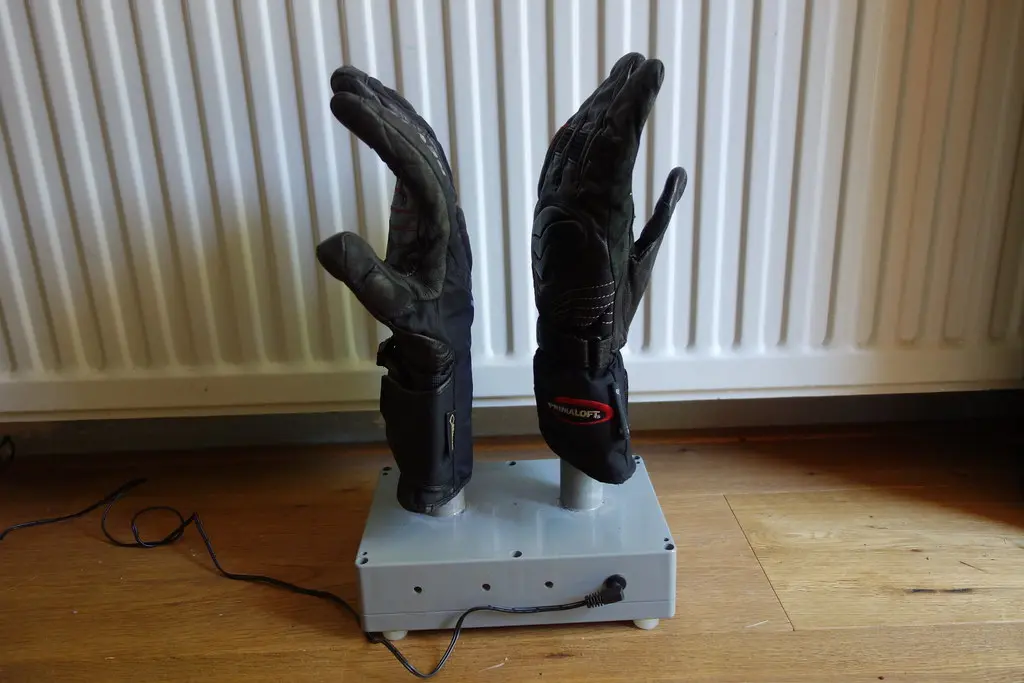
Gloves are the real test. They need tubes you can slip the cuff over, and enough airflow to reach the fingertips. Not every device is built for this, and reading the product description beforehand saves you a return.
UV against germs: what is proven and what isn’t
Several brands advertise UV light against bacteria and odors. Therm-ic, for example, states that its UV function helps reduce bacteria and germs. We are not aware of any independent measurements for individual boot dryers.
The German Federal Office for Radiation Protection (Bundesamt für Strahlenschutz) puts the principle in sober terms. UV-C radiation can kill bacteria and viruses, but the effect depends on the dose, meaning irradiance and duration. The agency does not test the effectiveness of such devices and expects manufacturers to back up their claims in a verifiable way. In addition, UV-C can damage skin and eyes. Which UV spectrum a small lamp in a boot dryer emits is often not stated in the listings at all. In a boot with folds, seams and a damp lining, it won’t reach every spot anyway. UV is an extra, not a reason to buy. Drying and airing remain what matters.
Five boot and glove dryers side by side
| Model | Type | Key specs according to the manufacturer or listing | Best for |
|---|---|---|---|
| Therm-ic Refresher (USB, EU) | Forced warm air with fan, UV function | Timer with 1, 3, 6 hours or continuous operation; air about 20 °C above room temperature; nozzles 14 to 22 cm, foldable | Ski boots and gloves, families |
| Alpenheat UniversalDry AD2 | Air dryer with LOW and HIGH settings | 230 V, 230 W; timer up to 180 minutes or continuous operation; attachments for 1 or 2 pairs of shoes or gloves, 1 pair of boots | Tall boots, several people |
| DryGuy Travel Dry DX | Fan plus convection | Runs on mains and car power (AC/DC); according to the listing not for gloves and socks | Camper van, ski trips by car |
| infactory shoe warmer with UV light | Electric drying modules with UV | 230 V with Euro plug; cable about 135 cm | Everyday street and sports shoes |
| Sidas Dryer Bag Cedar Wood | No electricity, cedar wood shavings | for ski, hiking and trail shoes; reusable | Hikers, travel, small budget |
Therm-ic Refresher (USB, EU)
According to the ski-heating specialist from France, it blows warm air directly into the interior; the arms are adjustable in length and can be used for gloves. According to the manual, the air in the shoe is about 20 degrees above room temperature, so it stays well below the 60 degrees mentioned above. If you forget the device, the timer ensures it doesn’t run all night. Buyers do, however, report an initial plastic smell and occasional failures after one to three seasons. Price-wise, it sits in the upper mid-range. Pay attention to the variant. Besides the 230 V model, there is a 12 V version for the car and one for 120 V. The EU version is currently unavailable on Amazon (as of November 9, 2026).
Alpenheat UniversalDry AD2
According to the manual, three attachments are included: for one pair of shoes or gloves, for two pairs, and for one pair of boots, with tubes that reach all the way to the toe. If you have several wet pairs standing in the hallway, this gets you further than two arms. You choose between LOW and HIGH, plus a timer of up to 180 minutes. Alpenheat does not, however, state an air temperature. With expensive leather boots, it is better to start on LOW.
DryGuy Travel Dry DX
According to the listing, the small travel version combines a fan and convection and runs from a wall outlet as well as in the car. Handy for vacation rentals and camper vans. According to the description, however, gloves and socks don’t belong on it.
infactory shoe warmer with UV light
Instead of a fan, this uses drying modules on a cable that you slide into the shoe; according to the listing, with a Euro plug and a cable of about 135 cm. The principle is good enough for sneakers and street shoes. For ski boots with thick liners and for gloves, we would choose a fan-based device, because otherwise the air hardly circulates there.
Sidas Dryer Bag Cedar Wood
Sidas fills fabric bags with cedar wood shavings that, according to the manufacturer, draw moisture out of ski, hiking and trail shoes. No electricity, no heat, and therefore no risk to leather or heat-moldable liners. For soaking-wet boots after a day of rain, it is too slow. As an inexpensive basic kit for hikers and for your travel bag, it works well.
And Peet, Klarstein or the Sidas electric devices?
According to retailer information, Peet dryers are built for 110 to 120 V, and no listing could be found on Amazon.de. Klarstein does not offer a standalone boot dryer, only a shoe attachment for its ShirtButler Pro drying and ironing system. Sidas, for its part, currently lists only the cedar wood bags in its dryer category; the group’s electric devices are sold under the Therm-ic name. Older Sidas models such as the Drywarmer do still turn up. But they are no longer clearly part of the range.
Which dryer suits which winter
- Ski vacation with the family, gloves included: Alpenheat UniversalDry AD2 with the glove attachment, starting on LOW for leather. The Therm-ic Refresher would fit this case just as well, but is currently unavailable on Amazon (as of November 9, 2026). If you are still choosing your gear, our ski boot guide (in German) gives you the right foundation.
- Tall boots, several pairs: Alpenheat UniversalDry AD2 with the matching attachment.
- On the road by car or camper van: DryGuy Travel Dry DX; plan a second device for gloves.
- Occasionally wet hiking boots: Sidas cedar wood bags plus newspaper. Most hikers don’t need more than that.
- Entire winter outfit wet: jackets, socks and hats dry faster on a heated drying rack (in German); the boot dryer only takes care of shoes and gloves.
We advise against devices that advertise „disinfection“ or „antibacterial“ without stating temperature, timer or UV specifications. If you don’t know the heat, you can’t choose it to suit the leather.
Frequently asked questions
Can I put wet shoes on the radiator?
No. Lowa writes that wet shoes should never be placed in the sun, on the radiator, close to a stove or in a hot car, as the leather can burn. Meindl warns likewise, because wet leather becomes brittle, hard and cracked.
How hot can a boot dryer for ski boots get?
Well below 60 °C. Fischer specifies a maximum fitting temperature of 60 °C for its heat-moldable cork liners, so a dryer that runs too hot may reshape the fit. According to the manual, the Therm-ic Refresher blows air about 20 degrees above room temperature. Atomic advises taking the liners out after every outing.
Which boot dryer also dries gloves?
One with tubes you can slip the cuff over, and enough airflow to reach the fingertips. The Therm-ic Refresher and the Alpenheat UniversalDry AD2 are built for this. According to the listing, the DryGuy Travel Dry DX is not intended for gloves and socks.
Does UV light in a boot dryer help against germs?
That has not been demonstrated for individual devices. According to the German Federal Office for Radiation Protection, UV-C can kill bacteria, but the effect depends on irradiance and duration. In a boot with folds and a damp lining, the lamp does not reach every spot. UV is an extra, not a reason to buy.
Is there a way without electricity?
Yes. Bags of cedar wood shavings such as the Sidas Dryer Bag Cedar Wood or crumpled newspaper draw moisture out of the lining, without heat and without risk to leather or liners. For soaking-wet boots after a day of rain, however, that is too slow.
Sources
- Lowa: Care tips
- Meindl: Care
- Fischer: Boot Intelligence (liners up to 60 °C)
- Atomic: Caring for your ski touring gear
- German Federal Office for Radiation Protection: UV-C radiation for disinfection
- Therm-ic: Refresher
- Sidas: Shoe Dryer
- Sidas: Dryer Bag Cedar Wood
- Alpenheat: UniversalDry AD2 manual
- Therm-ic Refresher: data and instructions for use (Sport Schönberger, German retailer)
- Retailer information Peet Original
Where to buy
- Alpenheat UniversalDry AD2Check price at Amazon.deCheck price at Amazon.co.ukCheck price at Amazon.nlCheck price at Amazon.com.beCheck price at Amazon.frCheck price at Amazon.itCheck price at Amazon.esCheck price at Amazon.plCheck price at Amazon.seAvailable in Germany: Amazon.de
- Therm-ic Refresher (USB, EU)Check price at Amazon.deCheck price at Amazon.co.ukCheck price at Amazon.nlCheck price at Amazon.com.beCheck price at Amazon.frCheck price at Amazon.itCheck price at Amazon.esCheck price at Amazon.plCheck price at Amazon.seAvailable in Germany: Amazon.de
- DryGuy Travel Dry DXCheck price at Amazon.deCheck price at Amazon.co.ukCheck price at Amazon.nlCheck price at Amazon.com.beCheck price at Amazon.frCheck price at Amazon.itCheck price at Amazon.esCheck price at Amazon.plCheck price at Amazon.seAvailable in Germany: Amazon.de
- infactory Schuhwärmer mit UV-LichtCheck price at Amazon.deCheck price at Amazon.co.ukCheck price at Amazon.nlCheck price at Amazon.com.beCheck price at Amazon.frCheck price at Amazon.itCheck price at Amazon.esCheck price at Amazon.plCheck price at Amazon.seAvailable in Germany: Amazon.de
- Sidas Dryer Bag Cedar WoodCheck price at Amazon.deCheck price at Amazon.co.ukCheck price at Amazon.nlCheck price at Amazon.com.beCheck price at Amazon.frCheck price at Amazon.itCheck price at Amazon.esCheck price at Amazon.plCheck price at Amazon.seAvailable in Germany: Amazon.de