Contents15 sections
This guide was first published in German on handgetestet.de.
At half past two the camera goes off, and a gray figure at the garden gate appears on your phone. Dark jacket or light? Red or blue? Infrared won’t tell you. Color night vision is meant to close exactly this gap, and it works most reliably with a large sensor, a fast lens and subdued supplementary light. For most homes, we therefore consider the Imou Titan Pro the right choice, with some caveats about size and orientation that we get to below.
Why infrared knows no colors
During the day, an ordinary security camera has a filter in front of the sensor that blocks infrared light. Otherwise colors look off. When it gets dark, this filter swings out of the way and small infrared LEDs illuminate the scene. The eye sees almost none of it, the sensor a great deal. But this light carries no color information. The result is a sharp but black-and-white image in which a dark blue jacket and a black one look the same.
For the question „Was someone there?“ that is enough. If you later have to describe who was there, you need color. There are two ways to get it, often combined: add visible light, or make better use of the residual light that is already there.
Aperture and sensor: how much residual light gets through
It is rarely completely dark outside. Streetlights, a lit window across the street, the moon. Whether that turns into a color image is decided by two components.
The f-number describes how wide the lens is open. The smaller the number, the more light passes through, and it scales with the square: a lens at f/1.0 lets in four times as much light as one at f/2.0. Reolink and TP-Link make the same comparison in their data sheets. Many basic cameras don’t state their aperture at all. Then it remains unclear how much light they can gather.
The second lever is sensor size. Figures in inches, such as 1/3″ or 1/1.8″, are an old convention and not the actual diagonal. For comparison, a rule of thumb is enough: the smaller the number below the fraction line, the larger the chip. At the same pixel count, a larger chip has larger pixels, and they gather more light. TP-Link states that the 1/1.79″ sensor of the Tapo C325WB has 2.1 times the area of a 1/3″ sensor. That is why a 4-megapixel camera with a large chip often reveals more at night than an 8-megapixel camera with a small one.
Manufacturers call it „Ultra-Low-Light,“ „ColorX,“ „ColorPro“ or „Aurora.“ Behind the names is essentially the same thing: a wide aperture, a large sensor and image processing that removes noise. TP-Link states color images down to 0.05 lux for the C325WB. Such figures come from manufacturer measurements, however, and in a backyard without any light source even the fastest lens reaches its limit.
White light, warm light or no lamp at all?
Most color cameras work with built-in spotlights. At Imou, the usual sequence is called „smart mode“: at night the camera records in black and white; when it detects motion, the lights come on and the image switches to color. Imou explicitly describes it this way for the Talos: no event, no light. The advantage: a light that suddenly comes on is a deterrent. The drawback: the first seconds of a scene stay gray, and a cat can trigger the light too.
There is also continuous light as a „full-color mode“ and pure infrared operation. A camera that offers all three modes lets you choose depending on the season and the neighborhood. How bright the spotlights are is rarely stated on the manufacturer’s page. Reolink gives the figures for the CX810: four spots of 3 watts each, together 400 lumens at 3,000 kelvin, with a range of 15 meters.
What your neighbor thinks of your light
A camera spotlight is an outdoor light. If it shines into the bedroom window across the way, that can lead to trouble. In Section 906, the German Civil Code (BGB) lists, alongside smoke and noise, „similar emissions“ from a neighboring property, which only have to be tolerated if they impair the use of the property not at all or only insignificantly. Whether, and at what brightness, a camera spotlight falls under this cannot be said across the board. Being considerate saves the dispute.
Insects react, too. BUND, a German environmental organization, advises directing light only onto the area that needs it, not letting it shine upward, using a motion sensor or dimming, and choosing warm white light with little blue content, ideally 1,700 to 2,200 kelvin. The 3,000 kelvin of the Reolink spotlights is above that, but warmer than the cool white light of many inexpensive cameras. In practice this means: spotlight on „on motion,“ brightness down, camera tilted so it points at your own path. If you want to do without supplementary light entirely, you need a camera that lives off residual light.
Seven cameras, seven lighting concepts
| Model | Night vision according to manufacturer | Sensor, aperture | Connection | Best for |
|---|---|---|---|---|
| Imou Titan Pro | Warm light, up to 30 m | 1/1.8″, f/1.0 | Wi-Fi 6 or PoE | House with driveway, cable possible |
| Imou Talos | Spotlight on motion, otherwise infrared, up to 30 m | 1/3″ (3 MP version), no aperture stated | Wi-Fi 6, Ethernet port | Porch roof, carport, indoors too |
| Imou Ranger 2C Pro | four modes with two spotlights, up to 10 m | 1/3″, no aperture stated | Wi-Fi 6, Ethernet port | Indoors |
| Imou Bullet 3C | infrared only, up to 30 m | 1/2.8″, no aperture stated | Wi-Fi 6, Ethernet port | those for whom black and white is enough |
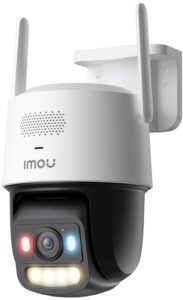
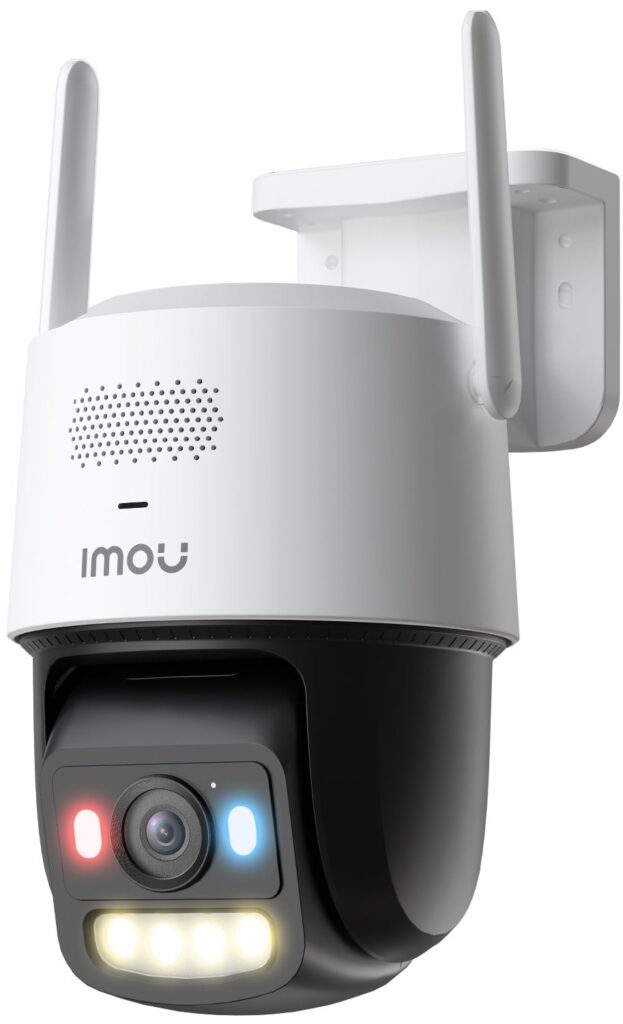
| Imou Cruiser SE+ | Color night vision with spotlight | depends on version | Wi-Fi, Ethernet port | pan-and-tilt, entry level |
| Reolink CX810 | Residual light, plus 3,000 K warm light, no infrared | 1/1.8″, f/1.0 | PoE | fixed mounting on a recorder |
| TP-Link Tapo C325WB | Residual light from 0.05 lx, no spotlight | 1/1.79″, f/1.0 | Wi-Fi or network cable | dense housing, no extra light |
Imou Titan Pro
The Titan Pro brings exactly the hardware discussed above: a 1/1.8″ sensor with 6 megapixels and a 3.6 mm lens at f/1.0. For supplementary light, Imou specifies warm light with a 30-meter range instead of cool white spots. It runs over dual-band Wi-Fi 6 or via PoE to IEEE 802.3af over a single network cable, and it pans 340 degrees and tilts 90 degrees. According to the manufacturer, privacy zones can be blacked out so they appear neither in the live view nor in recordings. That is valuable when a neighbor’s fence is in the frame. It is our recommendation because it combines light-gathering ability and a cable option in one device. The drawbacks: the dome housing measures almost 24 centimeters and weighs 724 to 790 grams depending on the source, the frame rate is 20 frames per second, and Imou does not give the brightness of the warm light in lumens or kelvin. Because it rotates, the note on orientation further down applies to it in particular.
Imou Talos
The Talos is smaller, can be mounted on a ceiling or wall or set on a table, and works on the principle of „light only on an event.“ Imou offers it with 3, 5 or 8 megapixels. The data sheet for the 3 MP version lists a 1/3″ sensor, 30 meters of night vision, 355 degrees of pan and Wi-Fi 6 in the 2.4 and 5 GHz bands. No f-number is given there. For the porch roof over the front door, where a lamp hangs anyway, that is a sensible compromise.
Imou Ranger 2C Pro
An indoor camera, but one with color night vision. Two spotlights and four modes: smart, full color, infrared and off. Imou states the range as 10 meters, which is enough for a hallway or living room. Whether you want white light switching on in a child’s bedroom at night is another question. Here, infrared mode is usually the friendlier choice.
Imou Bullet 3C
Deliberately on the list as a counterexample. According to Imou, the Bullet 3C relies on infrared night vision with 30 meters of range, is protected to IP67 and connects over Wi-Fi 6. There is no color at night. For the back of a garage without light, where all that matters is whether something moves, that can be enough.
Imou Cruiser SE+
The well-known pan-and-tilt camera with a built-in spotlight and „smart color night vision,“ protected to IP66. Resolutions differ by version. We cover it in detail in our guide to pan-and-tilt outdoor cameras (in German).
Reolink CX810
Built with a consistently different approach: according to the data sheet, infrared is missing entirely. The CX810 relies on a 1/1.8″ sensor, f/1.0 and 4K resolution and switches on its dimmable 3,000-kelvin warm light when needed, which according to Reolink brightens gradually. It is a fixed PoE camera rated IP67 and belongs on a recorder or switch, not on Wi-Fi. If you want to record several cameras centrally, our guide to NVR camera systems provides the right foundation.
TP-Link Tapo C325WB
Here, color is supposed to come about without any floodlight at all; TP-Link mentions a light only as an alarm signal together with the siren. 1/1.79″ sensor, f/1.0, 2,688 × 1,520 pixels, IP66, connection via Wi-Fi or cable. TP-Link advertises that no spotlights attract insects and trigger false alarms. In a row-house development where every lamp stands out, that is a real argument. Without residual light, though, it doesn’t work with this one either.
Color doesn’t make the footage more lawful
A sharper color image recognizes faces better, including those of passersby. The Verbraucherzentrale, Germany’s consumer advice center, makes it clear that private cameras may as a rule only capture your own property, not the sidewalk and not a shared driveway. It also points out that a rotating camera can be pointed elsewhere at any time, and that this alone can, in individual cases, give rise to injunction claims. With the Titan Pro, Talos and Cruiser SE+, you should therefore limit the pan range and set privacy zones where the app allows it. A notice sign belongs with it. More on this in our guide to outdoor security cameras.
How we would decide
If you can run a network cable to the outside wall, take the Imou Titan Pro with PoE. A cable is usually more stable than Wi-Fi, and the large optics make use of the residual light. If the camera is to point permanently at a driveway and connect to a recorder, the Reolink CX810 is the obvious alternative. If any additional lamp is a problem, the Tapo C325WB speaks for itself. For indoor use, the Ranger 2C Pro is enough.
And where there is neither power nor network on site, such as at a garden shed, none of these cameras will help. For that there are models with cellular connectivity and a battery, which we present in our guide to cameras with a SIM card.
How many pixels per meter a face or license plate needs is explained in the guide Security cameras with zoom (in German).
Frequently asked questions
Why doesn't infrared night vision show colors?
Infrared light carries no color information. At night the infrared filter swings out of the way, LEDs illuminate the scene, and the sensor delivers a sharp but black-and-white image. A dark blue jacket and a black one look identical.
What should you look for in a camera with color night vision?
Aperture and sensor size. The smaller the f-number, the more light gets in: f/1.0 lets in four times as much as f/2.0. For sensor size, the smaller the number below the fraction line, the larger the chip. Many basic cameras don't state their aperture at all.
Are more megapixels better at night?
Not necessarily. At the same pixel count, a larger chip has larger pixels that gather more light. That is why a 4-megapixel camera with a large chip often reveals more at night than an 8-megapixel camera with a small sensor.
Does color night vision work without any light?
Only with residual light from streetlights, windows or the moon. TP-Link states color images down to 0.05 lux for the Tapo C325WB; that is a manufacturer measurement. In a backyard without any light source, even the fastest lens reaches its limit.
Is the camera spotlight allowed to shine into the neighbor's window?
That can lead to trouble. Section 906 of the German Civil Code (BGB) also lists similar emissions, which only have to be tolerated if they impair the use of the property not at all or only insignificantly. Set the spotlight to motion, dim it and tilt the camera toward your own path.
What are the legal considerations for pan-and-tilt cameras?
According to the Verbraucherzentrale, Germany's consumer advice center, private cameras may as a rule only capture your own property. Even the possibility of pointing a rotating camera elsewhere can, in individual cases, give rise to injunction claims. Limit the pan range, set privacy zones and put up a notice sign.
Sources
- Imou: Titan Pro, overview (German)
- Imou: Titan Pro, technical data (German)
- Imou: Titan Pro 4MP/6MP, Specifications
- Imou: Talos, Overview
- Imou: Talos, Specifications
- Imou: Ranger 2C Pro 5MP, Overview
- Imou: Bullet 3C (German)
- Imou: Cruiser SE+ (German)
- Reolink: CX810 (German)
- TP-Link Tapo: C325WB (German)
- German Civil Code (BGB), Section 906: Introduction of imponderable substances (German)
- BUND: Light pollution, economical lighting in the garden (German)
- Verbraucherzentrale: Only film your own property with security cameras (German)
Where to buy
- Imou Titan ProView at ImouAvailable in Germany: ImouView at CoolblueAvailable in Germany: CoolblueCheck price at Amazon.deAvailable in Germany: Amazon.de
- Imou TalosView at ImouAvailable in Germany: ImouCheck price at Amazon.deAvailable in Germany: Amazon.de
- Imou Ranger 2C ProView at ImouAvailable in Germany: Imou
- Imou Bullet 3CView at ImouAvailable in Germany: Imou
- Imou Cruiser SE+View at ImouAvailable in Germany: Imou
- Reolink CX810Check price at Amazon.deAvailable in Germany: Amazon.de
- TP-Link Tapo C325WBCheck price at Amazon.deAvailable in Germany: Amazon.de