Contents9 sections
This guide was first published in German on handgetestet.de.
With DoorBird, the higher model number does not mean the better picture. According to the data sheet, the compact D1101V delivers 1080p, the larger D2101V 720p. On top of that, the D1101V comes with housing, power supply and Wi-Fi, all of which the D2101V lacks. For an older home with existing doorbell wiring, the surface-mounted D1101V is therefore our choice, provided one door opener and one call button are enough. Whether IP technology suits your home at all is covered in our guide to the video door intercom. Here, it is only about which DoorBird it should be.
Seven devices, two designs
| Model | Mounting | Camera, network | Access | Best for |
|---|---|---|---|---|
| DoorBird D1101V surface-mounted | Surface-mounted, housing included | 1080p, LAN, PoE, Wi-Fi 2.4 GHz | App, 1 relay | Retrofitting existing homes |
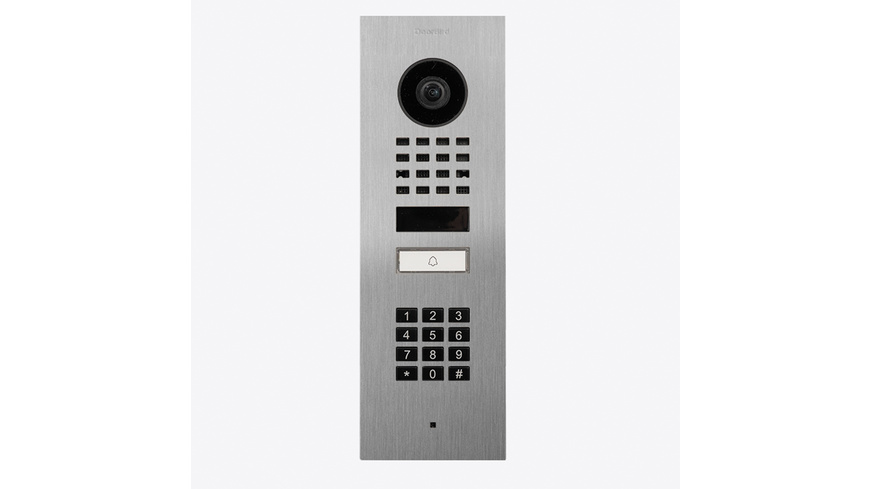
| DoorBird D1101KV surface-mounted | Surface-mounted, also available flush-mounted | 1080p, LAN, PoE, Wi-Fi | Keypad, 500 PIN codes | Keyless access |
| DoorBird D1101FV flush-mounted | Flush-mounted | 1080p, LAN, PoE, Wi-Fi | Fingerprint, 50 templates | Access without a code |
| DoorBird D2101V | Surface- or flush-mounted, housing extra | 720p, LAN only, PoE | RFID, 2 relays | New builds with network cable |
| DoorBird D2101KV | Surface- or flush-mounted, housing extra | 720p, LAN only, PoE | Keypad, RFID, 2 relays | many users, several doors |
| DoorBird D2102V | Surface- or flush-mounted, housing extra | 720p, LAN only, PoE | 2 call buttons, RFID, 2 relays | Two-family homes |
| DoorBird A1061W IP door chime | Wall or ceiling, indoors | Wi-Fi, LAN, PoE | 102 dB, over 50 tones | Doorbell inside the house |
All door stations share the 180-degree lens, IP65 protection and an operating range of minus 25 to plus 55 degrees Celsius. The lens cannot be adjusted. DoorBird advises placing the lens at least 145 centimeters high and checking the height before installation.
Only doorbell wiring in the wall: D1101V surface-mounted
That is the situation in many existing buildings. The D1101V draws its power over two wires and connects to the network via Wi-Fi. The included plug-in power supply has a 3-meter cable and has to be plugged in inside the house. You should not use other power supplies, because according to the manual they can destroy the device and void the warranty. That rules out the old doorbell transformer.
The Wi-Fi only works on 2.4 GHz. If the signal is too weak at the front door, an access point (in German) in the hallway helps more than any setting.
For the internet connection, DoorBird specifies at least 0.5 Mbit/s upload. Alternatively, the separately available A1072 two-wire converter sends data and power over the old wiring. The station has only one relay and a motion sensor with a range of up to 6 meters.
Network cable at the door: D2101V
If you are building new, run a shielded Cat.5 cable or better, up to 80 meters, and power the station via PoE according to 802.3af Mode A. That is when the strengths of the D2101V count: two relays for door and gate, RFID for up to 500 transponders, a sensor with a range of up to 10 meters and, according to the data sheet, continuous recording as well. At 253 by 131 millimeters, it is considerably larger.
But calculate the cost of the complete kit.
Housing and power supply or PoE injector cost extra, there is no Wi-Fi, and at 720p the resolution falls short of its smaller sibling. The D2101V can only be connected to doorbell wiring via the A1072 converter.
Into the house without a key: D1101KV, D2101KV, D1101FV
The D1101KV adds a 12-key keypad to the compact station, with up to 500 PIN codes, each with its own schedule. The surface-mounted version measures 241 by 65 millimeters, the flush-mounted version 263 by 85.
The D2101KV combines keypad and RFID, which is practical in a medical practice or workshop with changing access rights. It weighs 1,510 grams and shares the drawbacks of the D21 series.
On the flush-mounted D1101FV, your finger opens the door. According to the manufacturer, the reader only stores templates, up to 50 of them, and does not transmit any biometric data to the app or cloud. The sensor surface must be dry and clean.
Wet fingers in the rain are therefore a real issue, and you should always keep a backup way in.
One trap applies to all of them: the door station does not supply power to an electric door opener.
That requires its own power supply. DoorBird also warns against wiring the opener directly to the station, because someone could break it open and short-circuit the line. A security relay inside the house is recommended, such as the A1081 I/O door controller. If you would rather motorize the lock, our guide to the smart motorized lock (in German) describes the other route.
Two households in one house: D2102V
Two illuminated call buttons, two relays, plus the technology of the D2101V. DoorBird positions it for two-family homes and businesses with two units. At ELV (German retailer), it is available in V4A stainless steel; here too, the housing is not included. For more than two households, the manufacturer offers dedicated multi-family models.
You want it to ring inside the house: A1061W IP door chime
Without an add-on, only the smartphone rings. That is not enough if the phone is charging in the next room or a visitor does not have the app. The chime connects to the network via Wi-Fi or cable, offers more than 50 ringtones and, according to the data sheet, 102 dB. A plus: it also works over the local network if the internet goes down. An apartment-door call button can be connected via two-wire, so you can tell the front door and apartment door apart by sound. It is intended for indoor use only and also only works on 2.4 GHz.
Your smart home is already in place: what can be integrated
This is the real reason for choosing DoorBird. Integration is included free of charge with every station, along with a local API and a SIP module. The data sheet lists KNX, Loxone, Synology and AVM FRITZ!Fon, among others. The partner list also includes Homematic IP, where you answer calls in the app and open the door, as well as Home Assistant and openHAB. For an overview of hubs, see our guide Buying a smart home hub.
According to the manufacturer, the visitor history with snapshots costs nothing.
How we would decide
- Doorbell wiring, one door opener, no major rework: D1101V surface-mounted.
- Doorbell wiring and code entry: D1101KV.
- Network cable in place, door and gate need to be switched: D2101V.
- Two doorbells: D2102V.
- Always add it if someone in the house does not carry a phone: A1061W door chime.
DoorBird now also sells the new D22 series, which ELV does not currently carry. If you are rewiring anyway, compare it before you buy. Amazon remains the second place to look: listings there often differ in color, housing and scope of delivery, so check the exact model designation.
What belongs in the conduit before plastering in a new build is covered in our guide to the flush-mounted video door station (in German).
Frequently asked questions
What is the difference between the DoorBird D1101V and D2101V?
The higher number does not mean the better picture: the D1101V delivers 1080p, the D2101V 720p. In return, the D2101V has two relays, RFID for up to 500 transponders and a sensor with a range of up to 10 meters. It lacks housing, power supply and Wi-Fi and needs a network cable.
Does a DoorBird work with old doorbell wiring?
The D1101V draws its power over two wires and connects to the network via Wi-Fi, which only works on 2.4 GHz. The included power supply has to be plugged in inside the house; the old doorbell transformer cannot be used. Alternatively, the A1072 converter sends data and power over the old wiring.
Can the DoorBird power the electric door opener?
No, the door opener needs its own power supply. DoorBird also warns against wiring it directly to the station, because someone could break it open and short-circuit the line. A security relay inside the house is recommended, such as the A1081 I/O door controller.
Do I need a door chime with a DoorBird?
Without an add-on, only the smartphone rings. The A1061W IP door chime connects to the network via Wi-Fi or cable, offers more than 50 ringtones and 102 dB according to the data sheet. It also works over the local network if the internet goes down, but it is intended for indoor use only.
Which DoorBird opens without a key?
The D1101KV has a keypad with up to 500 PIN codes; the D2101KV combines keypad and RFID. On the D1101FV, your finger opens the door; according to the manufacturer, the reader stores up to 50 templates. The sensor surface must be dry, and you should always keep a backup way in.
Can DoorBird be integrated into a smart home?
Yes, integration is included free of charge with every station, along with a local API and a SIP module. The data sheet lists KNX, Loxone, Synology and AVM FRITZ!Fon, among others, and the partner list also includes Homematic IP, Home Assistant and openHAB.
Sources
- DoorBird: D1101V surface-mounted data sheet (PDF)
- DoorBird: D1101KV surface-mounted data sheet (PDF)
- DoorBird: D1101KV flush-mounted data sheet (PDF)
- DoorBird: D1101FV flush-mounted data sheet (PDF)
- DoorBird: D2101V data sheet (PDF)
- DoorBird: D2101KV data sheet (PDF)
- DoorBird: D2102V data sheet (PDF)
- DoorBird: A1061W IP door chime data sheet (PDF)
- DoorBird: D11x installation manual (PDF)
- DoorBird Connect: integrations
- DoorBird: homepage with visitor history and D22 series
- ELV: D2101V product page
Where to buy
- DoorBird D1101V AufputzView at ELVAvailable in Germany: ELVCheck price at Amazon.deAvailable in Germany: Amazon.de
- DoorBird D1101KV AufputzView at ELVAvailable in Germany: ELVCheck price at Amazon.deAvailable in Germany: Amazon.de
- DoorBird D1101KV UnterputzView at ELVAvailable in Germany: ELV
- DoorBird D1101FV UnterputzView at ELVAvailable in Germany: ELV
- DoorBird D2101VView at ELVAvailable in Germany: ELVCheck price at Amazon.deAvailable in Germany: Amazon.de
- DoorBird D2101KVView at ELVAvailable in Germany: ELV
- DoorBird D2102VView at ELVAvailable in Germany: ELV
- DoorBird IP-Türgong A1061WView at ELVAvailable in Germany: ELVCheck price at Amazon.deAvailable in Germany: Amazon.de