Contents14 sections
This guide was first published in German on handgetestet.de.
Three GOAT models are listed in the shop, and two of them are almost the same device. For a home garden of up to around 1,000 m² with trees, walls or awkward corners, we consider the GOAT A1600 LiDAR PRO the most sensible choice in the lineup. The O800 RTK is enough on open lawn up to about 500 m², and only those who really need more than 1,000 m² mowed need the A3000 LiDAR PRO. Steep slope? Then none of the three fits as well as an all-wheel-drive model from Worx.
What really separates the three models?
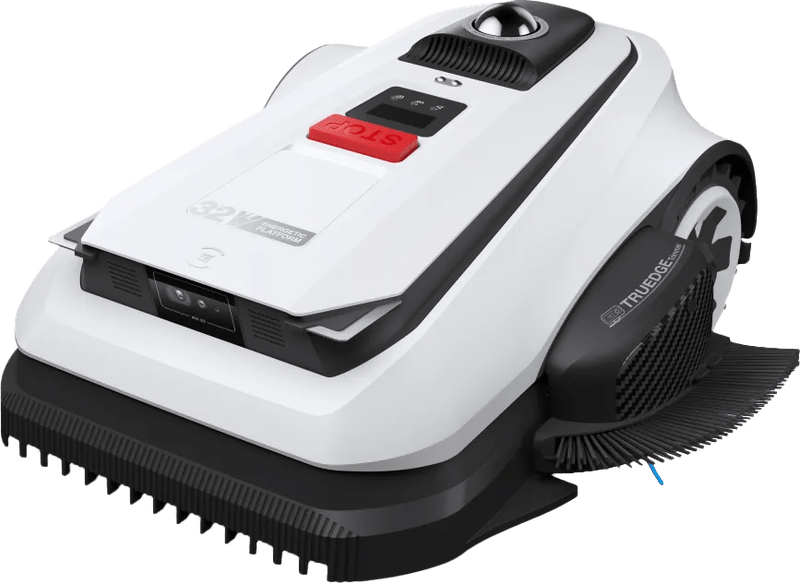
There are two designs, not three. The O800 is the small unit at 10.7 kg, with a 22 cm cutting width and satellite positioning via its own reference station in the garden. The A1600 and A3000 share the housing, cutting deck, sensors and side trimmer. They cut 33 cm wide and locate themselves by laser (LiDAR) and camera.
Compare the two large models line by line in the manual and little remains: a 3 vs. 7.5 Ah battery, 50 vs. 70 minutes of charging time, 17.8 vs. 18.3 kg and the matching power supply. The shop currently charges more than twice as much for the A3000. For 900 m² of lawn, that is money thrown away.
Pay attention to the PRO in the name. Older versions such as the A1600 RTK and A3000 LiDAR are sometimes listed by retailers alongside the current devices; our information applies only to the PRO versions. The shop currently lists the O1200 LiDAR PRO and O600 RTK as unavailable as standalone units.
How much lawn can each GOAT handle?
Less than the name suggests. Stiftung Warentest, the German consumer testing organization, reports that a robot needs up to 20 hours a day, five days a week, for the stated maximum area, and recommends a model with at least 50 percent reserve. So divide the manufacturer’s figure by 1.5. 800 m² becomes around 530 m², 1,600 m² about 1,050 m², 3,000 m² exactly 2,000 m².
By default, all three rest from 7 p.m. to 7 a.m. to protect nocturnal animals, which leaves twelve hours minus rain breaks. Ecovacs does not state an area per battery charge. According to a footnote, the 400 m² per hour of the A series come from the company’s own lab, and at around 100 minutes, the O800 takes twice as long to charge as the A1600.
Antenna or laser: what does your garden need to offer?
With the O800, everything depends on the reference station. It needs an open location, power via the charging station and firm ground, because on muddy soil the pole can tip over and accuracy suffers. According to the manual, its radio range is 140 m. Dense trees, roofs and tall house walls make satellite reception harder, writes Stiftung Warentest. A row-house garden with a large birch tree is therefore no sure thing for this device, even though the shop advertises a lab figure for stability in shade.
The A series does without an antenna but needs more room: passages must be wider than 0.9 m, while for the O800 more than 0.7 m is enough. According to the manual, the map should be created during the day in good light, even though the shop advertises navigation in the dark. And after winter, the charging station has to go back to exactly its old spot, otherwise positioning errors and an invalid map are likely. So far, no publicly available measurement shows how well the laser principle works under trees in everyday use. Of the three GOAT models, only the O800 RTK appears in Stiftung Warentest’s freely accessible list of new models. Its grade is only available for a fee, so it is not included here.
None of the GOAT models works without Wi-Fi; the manuals state it is required for operation. Our buying advice on wire-free robotic mowers (in German) explains how the technologies compare.
The trimmer: progress or noise source?
It is the real reason to move from the O800 to the A1600. The 18 cm wide module runs along walls and fences where you would otherwise need a handheld trimmer. The advertised gap of around 0 mm is a lab figure, though. And there is a price: the sound power level jumps from 62 to 82 dB(A), it must not run at night, and the line and brush are supposed to be replaced every 4 to 8 weeks.
If your lawn ends at paving or a flat lawn edging (in German) anyway, the advantage almost disappears. Then the extra cost brings little.
Six robotic mowers, calculated with reserve
| Model | Area according to the manufacturer | With reserve up to about | Positioning | Slope area / boundary | Best for |
|---|---|---|---|---|---|
| Ecovacs GOAT O800 RTK | 800 m² | 530 m² | Satellite, reference station in the garden | 45 % / 17 % | open lawn, paved edge |
| Ecovacs GOAT A1600 LiDAR PRO | 1,600 m² | 1,050 m² | Laser and camera, no antenna | 50 % (manual 45 %) / 20 % | trees, walls, home garden up to 1,000 m² |
| Ecovacs GOAT A3000 LiDAR PRO | 3,000 m² | 2,000 m² | Laser and camera, no antenna | 50 % (manual 45 %) / 20 % | a genuine 1,100 to 2,000 m² |
| Worx Landroid Vision Cloud 4WD WR341E | 1,000 m² | 650 m² | Satellite with cloud correction, camera | 84 % / not specified | steep lawn |
| eufy E15 | 800 m² | 530 m² | cameras only | 18 degrees / not specified | flat lawn without open sky |
| Gardena smart SILENO max 1.200 m² | 1,200 m² | 800 m² | Boundary wire | 30 % / 15 % | short lawn, wire not a problem |
Ecovacs GOAT A1600 LiDAR PRO
Our recommendation for most home gardens, as long as the slope cooperates. The trimmer, cutting height via app (3 to 9 cm in 1 cm steps) and 50 minutes of charging time are part of the package. On the other side are almost 18 kg that you may have to carry yourself, a figure of 50 % in the shop that the manual lowers to 45 %, and an edge that may no longer carry a boundary from 20 % upward. According to the spec sheet, the station is only protected to IPX4, the mower to IPX6. A robotic mower garage (in German) gives the station additional protection.
Ecovacs GOAT O800 RTK
The entry point into the lineup. You set the cutting height by hand, 3 to 8 cm in half-centimeter steps. There is no trimmer, and the virtual boundary must not run across gradients of more than 17 %, even though the shop states 45 %.
Ecovacs GOAT A3000 LiDAR PRO
Technically an A1600 with a battery 2.5 times the size, yet the stated area only just about doubles. It only makes sense beyond 1,100 m².
Worx Landroid Vision Cloud 4WD WR341E
The alternative for steep lawns. With all-wheel drive, Worx states 84 % (40 degrees) and obtains its correction data from the cloud, so there is no antenna in the garden. According to the manufacturer’s list price, it costs about twice as much as the A1600, and a trimmer is not included. Worx does not state a value for the boundary.
eufy E15
According to eufy, it navigates with cameras, without RTK. In return, the manufacturer limits it to flat lawns with less than 36 cm of height difference. For a shady city garden, it is worth considering.
Gardena smart SILENO max 1.200 m²
The counter-model to the GOAT lineup. Laying the wire takes a weekend, after which trees and house walls no longer matter. The cutting height tops out at 45 mm, though.
What applies to all three GOAT models, and not all of it is good
Ecovacs states a three-year warranty on the device and two years on the battery for GOAT mowers. The same terms, however, list batteries elsewhere among the excluded wear parts. That is contradictory. Damage from pressure washers is excluded, even though the lineup advertises IPX6 and simple rinsing. The battery can only be charged inside the device.
According to the manual, updates usually arrive every two months, but for devices that have been on the market for more than three years, only for significant vulnerabilities. Since January 2025, the US vulnerability database NVD has listed several entries for Ecovacs robotic mowers, including an anti-theft PIN stored in plain text. It does not name models there, so whether today’s GOAT models were affected remains open.
How we would decide
- Lawn up to 500 m², open sky, paved edge: GOAT O800 RTK.
- Lawn up to 1,000 m² with trees, walls or fences: GOAT A1600 LiDAR PRO.
- A genuine 1,100 to 2,000 m² on flat to moderately sloped ground: GOAT A3000 LiDAR PRO, measure the passages first.
- Slopes over 45 % or boundaries over 20 %: no GOAT, but the Worx WR341E.
- Narrow passage under 0.9 m plus trees: the lineup is a poor fit, so rather the eufy E15 or a wired Gardena.
This ranking is based on manuals, spec sheets and Stiftung Warentest’s reserve rule, not on an independent measurement.
How a GOAT performs in a real garden is shown in our review of the Ecovacs GOAT O1200 LiDAR PRO, with strengths in obstacle avoidance and weaknesses at edges and corners.
Frequently asked questions
What is the difference between the GOAT A1600 and A3000?
Not much. Both share the housing, cutting deck, sensors and side trimmer. According to the manual, they differ in battery (3 vs. 7.5 Ah), charging time (50 vs. 70 minutes), weight and power supply. The shop charges more than twice as much for the A3000; it only makes sense beyond 1,100 m².
How much lawn can a GOAT really handle?
Stiftung Warentest, the German consumer testing organization, recommends at least 50 percent reserve, so divide the manufacturer's figure by 1.5. 800 m² becomes around 530 m², 1,600 m² about 1,050 m², 3,000 m² exactly 2,000 m². On top of that, all three rest from 7 p.m. to 7 a.m. by default.
Does the GOAT O800 RTK work under trees?
Only to a limited extent. It locates itself by satellite via its own reference station, and according to Stiftung Warentest, dense trees, roofs and tall house walls make reception harder. The station needs an open location and firm ground. A row-house garden with a large birch tree is no sure thing for it.
Is the extra cost for the A series trimmer worth it?
Along walls and fences, yes, because the 18 cm wide module runs along the edge where you would otherwise need a handheld trimmer. The sound power level jumps from 62 to 82 dB(A), though, and the line and brush are due every 4 to 8 weeks. If the lawn ends at paving, the extra cost brings little.
How wide do passages need to be for a GOAT?
For the A series, wider than 0.9 m; for the O800, more than 0.7 m is enough. With a narrow passage under 0.9 m plus trees, the lineup is a poor fit. In that case, the eufy E15 with cameras or a Gardena with boundary wire are better options.
What applies to warranty and updates for the GOAT lineup?
Ecovacs states three years on the device and two on the battery, but elsewhere counts batteries among wear parts. That is contradictory. According to the manual, updates usually arrive every two months, but after more than three years on the market only for significant vulnerabilities.
Sources
- Ecovacs: GOAT O800 RTK (shop)
- Ecovacs: GOAT A1600 LiDAR PRO (shop)
- Ecovacs: GOAT A3000 LiDAR PRO (shop)
- Ecovacs: Manual GOAT O600 RTK and O800 RTK
- Ecovacs: Manual GOAT A1600 and A3000 LiDAR PRO
- Ecovacs: Warranty terms
- Stiftung Warentest: Robotic mowers tested (freely accessible part)
- Stiftung Warentest: Night-time ban for robotic mowers
- NIST: National Vulnerability Database, entries on Ecovacs
- Worx: Landroid Vision Cloud 4WD WR341E
- eufy: E series robotic mowers
- Gardena: smart SILENO max 1.200 m²
Where to buy
- Ecovacs GOAT A1600 LiDAR PROView at EcovacsAvailable in Germany: EcovacsCheck price at Amazon.deAvailable in Germany: Amazon.de
- Ecovacs GOAT O800 RTKView at EcovacsAvailable in Germany: EcovacsCheck price at Amazon.deAvailable in Germany: Amazon.de
- Ecovacs GOAT A3000 LiDAR PROView at CoolblueAvailable in Germany: CoolblueView at EcovacsAvailable in Germany: EcovacsCheck price at Amazon.deAvailable in Germany: Amazon.de
- Worx Landroid Vision Cloud 4WD WR341ECheck price at Amazon.deAvailable in Germany: Amazon.de
- eufy E15View at CoolblueAvailable in Germany: CoolblueCheck price at Amazon.deAvailable in Germany: Amazon.de
- Gardena smart SILENO max 1.200 m²Check price at Amazon.deAvailable in Germany: Amazon.de