Contents13 sections
This guide was first published in German on handgetestet.de.
An extension is a mechanism, and you operate it every time guests come over. For a family that wants to fit eight people around one table on holidays, we would take the Jockenhöfer Massimo: 100 centimeters deep, extendable from 180 to 260 centimeters, with a good 72 centimeters of clearance still left under the top. For a kitchen for two that sees guests three times a year, the HELA Ariana is enough.
How big a dining table should be in general, and whether ceramic or wood suits you better, is covered in our dining table guide. This article deals only with the question that gets too little attention there: what does the extension cost you in everyday life, in legroom, in effort, in storage space in the basement?
Three designs, three kinds of effort
With a butterfly extension, the additional leaf folds out of the table. The Relita Family describes this precisely: two leaves of 50 by 100 centimeters each sit under the table and are folded up individually or together after the frame has been pulled apart. So you do not need a cupboard for the leaves. You do need installation space, though, and the mechanism takes that away from your knees. More on that in a moment.
A synchronized extension pulls both halves of the table apart at the same time, and the insert goes in the middle. On the HELA Fenja, it is stored inside, and according to the retailer the extension has a locking mechanism. Nobody has to pull from the other end, at least that is the idea. That is the real advantage.
The loose insert leaf remains the simplest solution. The Home affaire Motus comes with a 40-centimeter leaf; where it lives between occasions, the listing does not say. Expect a piece measuring 40 by 90 centimeters that ends up behind the wardrobe or under the bed. In a three-room apartment without a basement, that is not a minor detail.
There is a standard for stability that hardly anyone knows. According to the DIN Consumer Council, the German standard DIN 68885 requires that the extension leaf sag permanently by no more than 1 percent of the extension length after the load test. For an 80-centimeter extension, that would be 8 millimeters. The same standard classifies surfaces by their resistance to vinegar, red wine and heat into groups 1 A to 1 D, with 1 A being the most resistant. None of the six listings mentions the standard. Ask about it, especially for a tabletop you will extend often.
The number that rarely makes the product title
We mean the height to the underside of the table. The DIN Consumer Council explicitly advises sitting down at the table, because the extension mechanism or cross braces can restrict legroom, and checking whether the armrests of your existing chairs still fit underneath. You cannot do that online. So the number is all you have.
On the narrow Olbia it is 75 centimeters, on the Motus 73, on the Ariana 72.8 and on the Massimo 72.4. Those are decent values. The Relita Family is the odd one out: there are only 65 centimeters to the underside of the apron. On a table 76 centimeters high, that leaves eleven centimeters for the top, the mechanism and the two stowed leaves. At home, measure from the floor to the top of your armrests before ordering a table like this. And measure your thighs while you are at it, because tall people sitting on a high upholstered chair will bump into it.
How many people really fit?
Retailers count generously. Table maker Anton Doll allows about 60 centimeters of length per person, subtracts 20 to 25 centimeters at each end for the legs, and recommends a width of 100 centimeters for full-fledged seats at the ends. Let’s apply that.
The Massimo has a four-leg frame. Extended to 260 centimeters, that leaves around 215 centimeters between the legs, which means three seats per long side. With both ends, we get to eight. The listing promises ten chairs. That may work for a children’s party, but for a four-course dinner we would stick with eight.
On the Motus, there is no deduction because the X-frame sits in the center: 190 centimeters gives three seats per side, so six. According to Anton Doll, the 90-centimeter-wide ends are only for emergencies. The Ariana, at 80 centimeters deep, sits exactly at the limit that the same maker cites as the minimum for people sitting opposite each other. Two seats per side, and when extended, two more at the ends at a pinch.
Do not forget the room. Leave at least 80 to 100 centimeters of free space behind the table edge, otherwise nobody can get out of their chair. A table extended to 260 centimeters therefore needs a room around 4.20 meters long if people also sit at the ends.
Six tables, sorted by length
| Model | Length from–to | Depth | Extension | Underside height |
|---|---|---|---|---|
| Relita Family | 160–260 cm | 100 cm | Butterfly, 2 × 50 cm | 65 cm (apron) |
| Jockenhöfer Massimo | 180–260 cm | 100 cm | Butterfly, 2 × 40 cm | 72.4 cm |
| Home affaire Motus | 150–190 cm | 90 cm | loose insert leaf, 40 cm | 73 cm |
| HELA Fenja | 140–180 cm | 90 cm | Synchronized extension with lock | not specified |
| HELA Ariana | 120–160 cm | 80 cm | Insert leaf | 72.8 cm |
| Jockenhöfer Olbia | 120–160 cm | round, Ø 120 cm | Butterfly | 75 cm |
All figures come from the retailer pages and are approximate dimensions.
Jockenhöfer Massimo
The big family solution in this lineup. The engineered wood top is 3.6 centimeters thick, and the frame is metal. The listing does not state a load limit, and we did not find an independent test. We recommend it for the combination of 100 centimeters of depth, two extension stages and free knee height, not because of a seal of approval.
Home affaire Motus
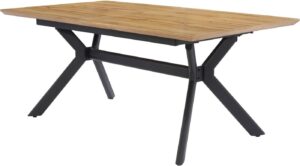
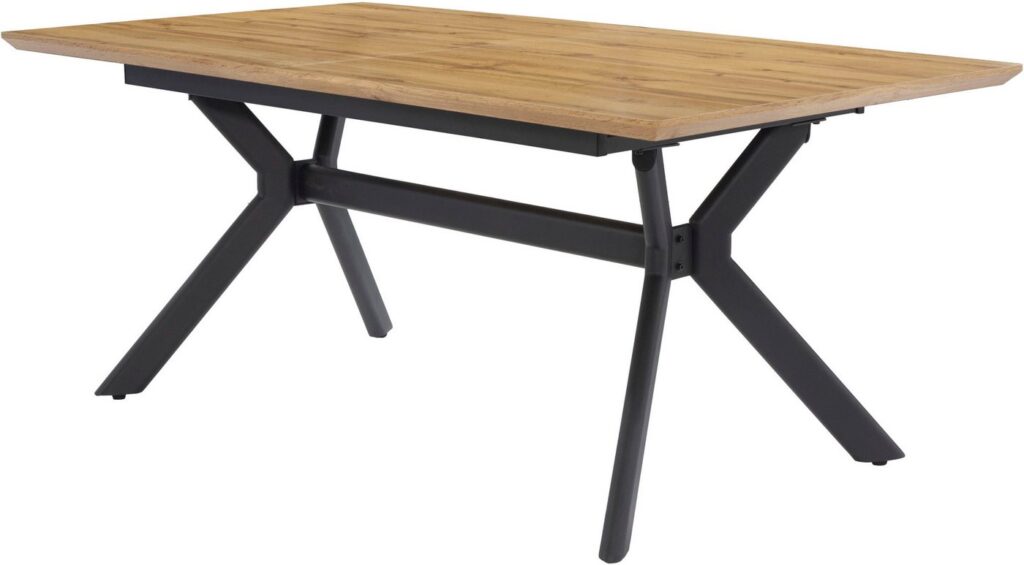
FSC-certified engineered wood, an X-frame with a base plate, and a three-centimeter-thick top. The central frame gives legroom at the ends, although the base plate can get in the way of your feet. If you have a corner to store the insert, you get a lot of length here in the mid-price range.
HELA Fenja
A glass panel just five millimeters thick with a ceramic look sits on the engineered wood. It looks like ceramic, but it is not. If you are looking for ceramic because of its hardness, you get glass here, and you should know that before ordering. The listing does not state the underside height.
Relita Family
Oak veneer on the top, solid legs measuring ten by ten centimeters. The listing calls it „solid,“ while the description then says „veneered.“ It remains interesting for oak lovers, but take the 65 centimeters under the apron seriously. By far the most expensive table in this lineup.
Jockenhöfer Olbia
A round table with a 120-centimeter diameter that stretches to 160 centimeters. The top measures only two centimeters. For an eat-in kitchen where corners get in the way, this is the more elegant shape. With six people, though, it gets tight.
HELA Ariana
Pedestal frame, melamine-coated surface, 100 kilograms load capacity according to the retailer, FSC-certified engineered wood. A kitchen table does not need more. The 80 centimeters of depth remain the compromise: sitting opposite each other works, a bowl in the middle does not.
Which extension belongs in which home
- More than six people, several times a year: Massimo. The leaves stay in the table, and the depth also holds serving platters.
- You extend it on your own and often: Fenja with synchronized extension.
- Limited knee height does not matter to you, but oak veneer does: Family, but measure your chairs first.
- Small kitchen, regular group of four: Ariana or, if it should be round, Olbia.
Christmas with more guests: delivery date and room first, then the discount
Furniture is also discounted around Black Friday on November 27, and if you are expecting more guests at Christmas, now is the time to think about an extendable table. Check the delivery date first, because a table that arrives after the holidays will not help with the festive dinner. Compare the same version in the offer, because finish, frame and length have their own prices for many models.
Measure the room, too. Extended to 260 centimeters, a table needs a room around 4.20 meters long if people sit at the ends. If a retailer advertises a price reduction, it must state the lowest price of the last 30 days (§ 11 of the German Price Indication Ordinance). For our pick, the Jockenhöfer Massimo, you can set a price alert above. What else matters when buying furniture on the sale day is covered in our guide Black Friday: sofas and furniture (in German). More deals are collected on the page Black Friday 2026 (in German).
Frequently asked questions
Which extension type is most practical on a dining table?
With a butterfly extension, the leaves are stored in the table, so you do not need a cupboard for them, but the mechanism takes up space. A synchronized extension like the one on the HELA Fenja pulls both halves apart at the same time, so nobody has to pull from the other end. The loose insert leaf is the simplest solution but needs a corner to store it in.
How much legroom does an extendable dining table have?
The height to the underside of the table tells you. On the Olbia it is 75 centimeters, on the Massimo 72.4. The Relita Family is the odd one out, with only 65 centimeters to the apron. At home, measure up to the top of your armrests before you order.
How many people fit at a 260 cm table?
Allow about 60 centimeters per person and subtract room for the legs at each end. Extended, the Massimo leaves around 215 centimeters, which means three seats per long side, or eight including the ends. The listing promises ten chairs; for a dinner, we would stick with eight.
How much room does an extended dining table need?
Leave at least 80 to 100 centimeters of free space behind the table edge, otherwise nobody can get out of their chair. A table extended to 260 centimeters therefore needs a room around 4.20 meters long if people also sit at the ends.
Is there a standard for extendable tables?
Yes, the German standard DIN 68885. Under it, the extension leaf may sag by no more than 1 percent of the extension length after the load test, which is 8 millimeters for 80 centimeters. The same standard classifies surfaces by resistance into groups 1 A to 1 D. None of the six listings mentions it, so ask about it.
What is a synchronized extension on a dining table?
With a synchronized extension, both halves of the table slide apart at the same time and the insert goes in the middle. Nobody has to pull from the other end, and that is the real advantage. In this comparison, the HELA Fenja has a synchronized extension with an internally stored insert and, according to the retailer, a locking mechanism.
Sources
- DIN Consumer Council (Germany): What to know when buying furniture
- Anton Doll: How big should a dining table be?
- BAUR (German retailer): Jockenhöfer Massimo
- BAUR: Home affaire Motus
- BAUR: HELA Fenja
- BAUR: Relita Family
- BAUR: Jockenhöfer Olbia
- BAUR: HELA Ariana
- German Price Indication Ordinance, § 11: Price reductions
Where to buy
- Jockenhöfer MassimoView at OTTOAvailable in Germany: OTTO
- Home affaire MotusView at OTTOAvailable in Germany: OTTO
- HELA FenjaView at OTTOAvailable in Germany: OTTO
- Relita FamilyView at OTTOAvailable in Germany: OTTO
- Jockenhöfer OlbiaView at OTTOAvailable in Germany: OTTO
- HELA ArianaView at OTTOAvailable in Germany: OTTO