Contents13 sections
This guide was first published in German on handgetestet.de.
Three winter jackets hang over the back of a chair in the hallway, scarves pile up on the hook rail, and the keys are somewhere underneath. A hallway wardrobe hides all that behind a door, but only if it fits the narrowest spot in your home and really holds the coats. Our starting point is the rauch Minosa: 69 cm wide, 41 cm deep, with a pull-out clothes rail and the Golden M (Goldenes M) quality mark for the manufacturer. For very narrow hallways, the Germania Adana is a solution ten centimeters narrower that also comes with anti-tip protection.
Hallway wardrobe, coat rack or bedroom wardrobe?
The open coat rack with panel and hook rail (in German) is cheaper, shallower and quicker to assemble. On the other hand, you see everything hanging there, and dust settles on the shoulders of the coats. The shoe cabinet (in German) with its flaps is limited to shoes. And the wardrobe in the bedroom is built for hangers that hang crosswise, so it is considerably deeper.
The hallway wardrobe sits in between. It is as tall as a bedroom wardrobe but only 35 to 41 cm deep, so that there is still room to pass in the hallway. That changes everything else, because at this depth the jacket hangs differently.
Why the hangers hang front to back here
Measure one of your hangers, ideally the one for your winter coat. For the Minosa, Rauch states a usable depth of 38 cm; for the Adana, the listing gives 33 cm for the compartments. If the hanger does not fit crosswise, only a pull-out clothes rail will help. It sits under the top shelf, slides out toward the front, and the hangers hang one behind the other instead of side by side.
Two small numbers are worth a look here. The rail in the Minosa is 30 cm long and rated for 6 kg; the one in the Adana is 25 cm long and rated for 5 kg. That is not much. Try putting your heaviest coat, hanger included, on the bathroom scale. If you want to fit four adult jackets, you quickly hit this limit, especially since wet coats are heavier. A single narrow wardrobe is therefore rarely enough for a family of four; it is better suited to two people who rotate their clothes by season. The rest of the winter gear belongs on the shelf above or in the bedroom wardrobe.
Is there still room to pass in the hallway?
The German standard for accessible building is a useful yardstick. Under DIN 18040, hallways without a change of direction require at least 120 cm of maneuvering space, as the specialist portal nullbarriere summarizes it. Nobody has to build their own home to this standard, and many hallways in older buildings do not even have that width when empty. But it shows how quickly things get tight: in a 120 cm wide hallway, 79 cm remain next to the Minosa. That is tight with a stroller or walker, but enough on foot.
Do not forget the doors. An open hinged door sticks out into the hallway, and whoever is standing in front of it also needs space. According to the listing, the Minosa divides its 69 cm into one wide and one narrow door. That helps, because the wide door still does not swing out as far as a single door across the full width. Also check whether the front door or a room door hits the wardrobe. That sounds trivial and is the classic problem in narrow entryways.
Assembly needs more space than the wardrobe
This point is in the fine print. For assembly, Rauch requires about 25 cm of additional space on the left, right and top. A wardrobe 197 cm tall therefore needs 222 cm of ceiling height when raised upright, and 119 cm of width instead of 69 cm. That quickly rules out narrow alcoves between two doors. Assemble it in a larger room and only carry it over when the route allows. According to the listing, the Adana weighs around 46 kg; nobody should handle that alone.
Without wall plugs, it does not stand securely
Tall and shallow is an unfavorable shape for a cabinet. If you divide the height by the depth, the Minosa comes to 4.8, the Adana to 5.3 and the Kompakta to 5.6. That is our own calculation, not a test value. It simply shows why the German home safety initiative Aktion Das Sichere Haus recommends fixing shelves and cabinets to the wall with metal brackets, and why the DIN Consumer Council (DIN-Verbraucherrat) points out the need to screw them in place. Toddlers pull themselves up on cabinets, and adults pull on the clothes rail.
For the Adana, the listing explicitly mentions anti-tip protection. For the other models, it only says „can be assembled upright“; that does not mean nothing is included, but you should ask. On drywall, you need cavity anchors, which fischer describes specifically. As a tenant in Germany, you are allowed to drill holes for ordinary furnishings, according to the Hamburg tenants‘ association (Mieterverein zu Hamburg), even in tiled walls.
If the hallway is against a poorly insulated exterior wall, a second issue comes into play. The DIN Consumer Council recommends at least 5 cm of clearance from the wall for large furniture there to allow air circulation, especially in older buildings. That eats into the walkway. Wet jackets in a closed cabinet do not improve the situation. Let them dry first.
What the Golden M means here
The German Furniture Quality Association (Deutsche Gütegemeinschaft Möbel) lists Rauch with the RAL quality mark Golden M, valid until 2027, and with the RAL mark „Möbel Made in Germany“. The listing for the Minosa cites the seal as a quality feature, and Rauch’s model list for the series also names the Blue Angel (Blauer Engel) eco-label. This makes the Minosa the only one of the four wardrobes for which we found a third-party label. For Germania and Borchardt, the listings state manufacturing in Germany, which is an indication of origin, not a quality test.
Four hallway wardrobes compared
| Model | W × H × D | Clothes rail | Storage | Special feature | Best for |
|---|---|---|---|---|---|
| rauch Minosa | 69 × 197 × 41 cm | Pull-out, 30 cm, 6 kg | 2 shelves, 10 kg each | Golden M, 2 hinged doors | Most hallways, two people |
| Germania Adana | 59 × 197 × 37 cm | Pull-out, 25 cm, 5 kg | 4 loose shelves, 10 kg each, 6 compartments | Anti-tip protection, high-gloss front | Very narrow spaces |
| borchardt Möbel Dolly | 76 × 185 × 35 cm | Pull-out, length not stated | 5 open compartments | Lower, 1 door | Open storage plus jackets |
| borchardt Möbel Kompakta | 140 × 202 × 36 cm | Not stated, 3 hooks | 6 doors, 2 drawers | Mirrored door | Wide wall, complete hallway furniture |
Manufacturer and retailer information, approximate dimensions, each for the version named.
rauch Minosa
Not a showpiece, but a wardrobe that does its job. White decor front, bow handles, MDF back panel, two adjustable shelves. According to the manufacturer, the system holes let you rearrange the rail and shelves. The listing names door dampers, a hook rail and additional shelves as accessories; none of these are included as standard. The series also includes versions with a mirrored door and dedicated shoe cabinets; if you need both, you can place two carcasses side by side. In the linked version, it is priced below the other three. The retailer also recommends assembling it with two people.
Germania Adana
Ten centimeters narrower and four centimeters shallower than the Minosa, but with more shelves. The listing mentions five shelves, four of them adjustable, and high-gloss MDF fronts with grooved milling. At 25 cm and 5 kg, the rail is the shortest. That is enough for two coats and a few jackets, but not more. High gloss shows fingerprints, and according to the DIN Consumer Council, microfiber cloths are off-limits on such surfaces. Precisely because of the anti-tip protection, it suits households with children.
borchardt Möbel Dolly
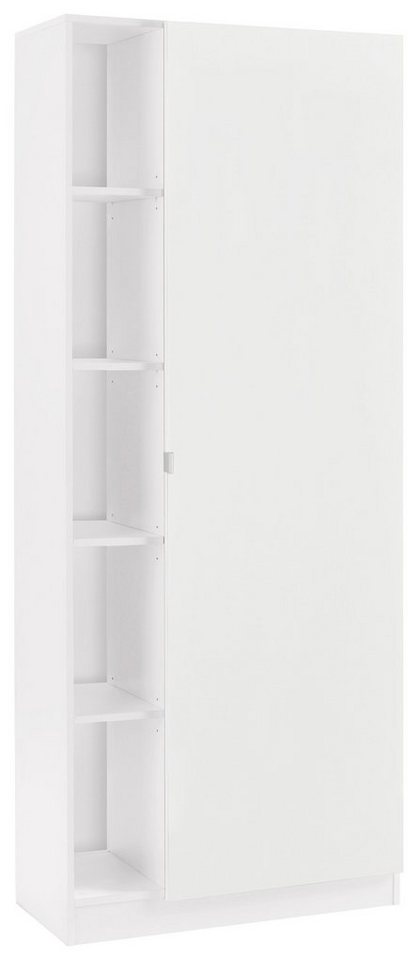
At 185 cm, the lowest, and at 35 cm, the shallowest wardrobe in the comparison, which is why it is also an option under sloped ceilings. Next to the door with the rail, it offers five open compartments measuring 19 × 33 × 33 cm for hats and bags. The listing does not state the length of the pull-out rail, and open compartments show everything inside them. Nothing is said about anti-tip protection.
borchardt Möbel Kompakta
This is not about a single wardrobe but a hallway wall: 140 cm wide, six doors, one of them mirrored, two drawers with interior dimensions of 41 × 30 × 16 cm, closed back panel. The listing does not mention a clothes rail, just three hooks. Check this before buying, otherwise you will have plenty of storage but no space for a long coat. Still a serious choice for households with lots of small items, especially since 36 cm of depth takes up little room in the hallway.
Which hallway, which wardrobe?
- Normal hallway, one or two people: Minosa.
- Alcove or very narrow strip of wall: Adana.
- Sloped ceiling or low ceiling: Dolly.
- A whole wall is free and there is lots of small stuff: Kompakta, but clarify the clothes rail first.
- Only jackets for the current season and little depth: an open coat rack is the better choice.
Frequently asked questions
How deep is a hallway wardrobe?
Usually only 35 to 41 cm, so that there is still room to pass in the hallway. At this depth, a hanger often does not fit crosswise. A pull-out clothes rail helps: it sits under the top shelf, slides out toward the front, and the hangers hang one behind the other instead of side by side. Measure your widest hanger beforehand.
How many jackets fit into a narrow hallway wardrobe?
Fewer than you might think. The rail in the Minosa is 30 cm long and rated for 6 kg; the one in the Adana is 25 cm long and rated for 5 kg. If you want to fit four adult jackets, you quickly hit this limit, especially since wet coats are heavier. A narrow wardrobe is better suited to two people who rotate their clothes by season.
Is there still enough room to walk through the hallway?
The German standard for accessible building is a useful yardstick: under DIN 18040, straight hallways require at least 120 cm of maneuvering space. In a 120 cm wide hallway, 79 cm remain next to the Minosa, which is enough on foot. Also think about the hinged doors, which stick out into the hallway when open.
Does a hallway wardrobe have to be fixed to the wall?
Yes, tall and shallow is an unfavorable shape. The German home safety initiative Aktion Das Sichere Haus recommends fixing cabinets to the wall with metal brackets; toddlers pull themselves up, and adults pull on the rail. For the Adana, the listing explicitly mentions anti-tip protection; for the others, you should ask. As a tenant in Germany, you are allowed to drill for this.
How much space does assembling a hallway wardrobe need?
More than the wardrobe itself. For assembly, Rauch requires about 25 cm of additional space on the left, right and top. A wardrobe 197 cm tall therefore needs 222 cm of ceiling height when raised upright. Assemble it in a larger room and then carry it over. Do it with two people, as the retailer also recommends.
Sources
- Rauch: Minosa model series
- Rauch: Minosa model list (PDF)
- German Furniture Quality Association: Rauch Möbelwerke
- nullbarriere: DIN 18040-2, areas and space requirements
- Das Sichere Haus: securing furniture safely
- DIN Consumer Council: useful facts about buying furniture (as of November 2017)
- fischer: wall plugs for drywall
- Mieterverein zu Hamburg: what are tenants allowed to do? (PDF)
- BAUR: rauch Minosa
- BAUR: Germania Adana
- BAUR: borchardt Möbel Dolly
- BAUR: borchardt Möbel Kompakta
Where to buy
- rauch MinosaView at OTTOAvailable in Germany: OTTO
- Germania AdanaView at OTTOAvailable in Germany: OTTO
- borchardt Möbel DollyView at OTTOAvailable in Germany: OTTO
- borchardt Möbel KompaktaView at OTTOAvailable in Germany: OTTO