Contents14 sections
This guide was first published in German on handgetestet.de.
Can a network cable reach the camera? Then Reolink comes out ahead, and we recommend the RLC-811A: it records around the clock, needs no subscription and can be managed on a computer. Without a cable, the picture flips. There, the Imou Cell PT 3C with its power-saving continuous mode is the simpler route. So the brand question is settled not by the logo, but by the cable on the outside wall.
Where do the recordings end up?
With both brands, first on the microSD card in the camera. The difference begins with the second step. Reolink offers a recorder with a hard drive, the Home Hub for multiple cameras, and the FTP route. According to the manufacturer, the RLC-811A can also be integrated into Synology’s Surveillance Station. With Imou, a Wi-Fi recorder with one hard drive bay for up to 16 TB (according to retailer information) handles this; you buy the hard drive separately. The brand’s AI Smart Hub, by contrast, only backs up event clips.
How long does that last? For the RLC-811A, Reolink states 97.1 hours on 256 GB, a good four days in 4K. On 512 GB, that calculation would give a good eight days. For the Titan Pro, Imou assumes only about 21 GB per day, which would make the same card last over three weeks. Sounds like a clear win, but it is not a fair comparison: the manufacturers calculate with different resolutions and bitrates. More data usually also means more picture. For longer retention with four cameras, Reolink states 8 days at 8 megapixels on a 2 TB recorder, and 50 days with 12 TB. The basics of cards and recording times are in our guide to camera storage (in German).
Do I have to take out a subscription?
No, with neither of them. Reolink states that PoE cameras, including person, vehicle and animal detection and local storage, work without a fee. Imou explicitly calls its Protect subscription optional; on-camera detection also works without a contract. For a single camera, both clouds cost a single-digit euro amount per month.
The details differ. Imou Protect keeps event videos for 7 days (Basic) or 30 days (Plus), every new camera gets a trial period, and there are more expensive licenses for models with two lenses. Reolink Cloud offers 30 days of history in all plans, for one, five or ten devices. The plans with text search in the videos are considerably more expensive for multiple devices than the classic ones. However, according to the manufacturer, Reolink Cloud supports all battery cameras, but only selected other models. For a wired model, it may therefore not be an option at all. Check the device list beforehand.
What does a camera without a power outlet actually record?
This is where the biggest technical difference lies. In AOV mode, the Imou Cell PT 3C saves a still image every 2 seconds when nothing is happening and switches to video when there is motion. The result is a gapless timeline, just a choppy one. For the related AOV PT, Imou calculates 160 to 170 days on a 128 GB card, as long as nothing happens.
Reolink takes two approaches. The Argus 4 Pro only records when triggered; nothing remains between the clips. The Altas PT Ultra, on the other hand, has 20,000 mAh, records continuously on request and, according to support, lasts about 96 hours per charge, or four days. With a solar panel, Reolink requires around five hours of direct sunlight per day for this. In December, that cannot be expected on most house walls in Germany, especially since, according to the manufacturer, the battery only charges from 0 degrees Celsius. For the Cell PT 3C, Imou states minus 10 degrees. One thing we find practical with Reolink is the pre-recording of 2 to 10 seconds: you see how someone enters the frame. How to calculate battery life is explained in our guide to battery life (in German).
App, computer, third-party software: which is more open?
Reolink. In addition to the free app, there is a program for Windows and macOS, and according to support, wired and plug-in cameras support RTSP and ONVIF out of the box. Battery models can only do this via the Home Hub or a recorder. The manufacturer itself makes one restriction: it does not recommend other brands‘ recorders for the RLC-811A.
Imou puts its Imou Life app at the center; that is also where the subscription and device management live. The manufacturer lists ONVIF for individual models such as the Bullet 3C and Cruiser 2, while for others the information is missing. If you want to connect a NAS or Home Assistant, read the specific data sheet before you order. Securing your account works the same way for both brands and is covered in setting up a security camera securely (in German).
Seven building blocks side by side
| Model | Power | Recording according to the manufacturer | Storage | Best for |
|---|---|---|---|---|
| Reolink RLC-811A | PoE or 12 V | 24/7, schedule, motion | microSD up to 512 GB, recorder, FTP | new build, cable in place |
| Imou Titan Pro | PoE or 12 V | continuous recording | microSD, cloud by subscription | cable possible, Imou app preferred |
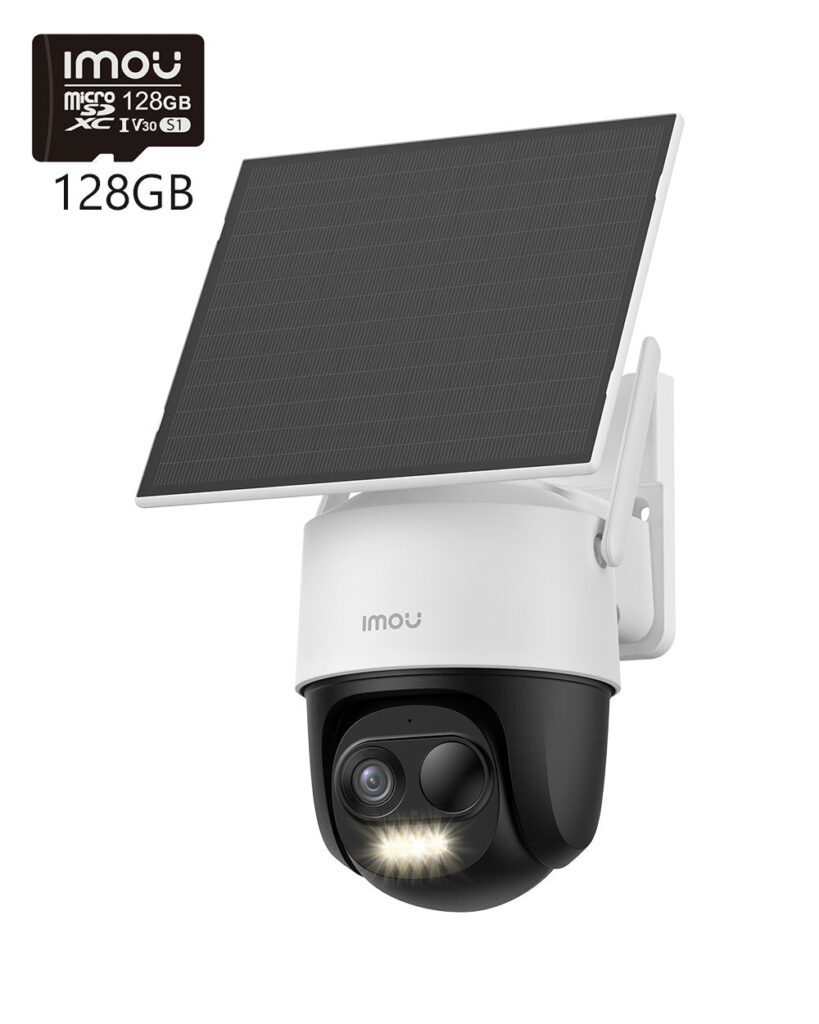
| Imou Cell PT 3C with solar panel | 5,000 mAh battery, 5 W panel | AOV: still images, video on events | microSD, cloud | outside wall without a cable |
| Reolink Altas PT Ultra | 20,000 mAh battery, panel optional | continuous, pre-recording, motion | microSD up to 512 GB, hub, cloud | sunny spot, full video |
| Reolink Home Hub | Power adapter | collects up to 8 cameras | microSD up to 2 × 1 TB, AES-128 | multiple battery cameras |
| Imou 10-Kanal Wi-Fi-6-NVR | Mains power | manual, schedule, motion | hard drive up to 16 TB, not included | multiple Imou cameras on mains power |
| TP-Link Tapo C530WS | Power adapter | microSD, cloud by subscription | microSD up to 512 GB | if neither brand fits |
Reolink RLC-811A
Our main recommendation for this question. 4K at 25 frames per second, 5x optical zoom, power and data over one cable to 802.3af. The card is enough to start with, and a recorder can be added later. It cannot pan, and without a PoE switch or power adapter, which is not included, nothing works.
Imou Titan Pro
Imou’s answer for a wired setup, and with a pan head at that: 340 degrees to the side, plus a large sensor and PoE. At the same time, it keeps Wi-Fi open as a fallback, which the RLC-811A lacks. A housing of around 24 centimeters is not exactly discreet, though.
Imou Cell PT 3C with solar panel
Our budget pick without a cable. It pans, connects on both Wi-Fi bands, and the panel can be mounted separately. No network port, protection rating only IP65. Depending on the battery level, it switches to a power-saving mode, so gaps are possible in winter.
Reolink Altas PT Ultra
Four times the battery of the Cell PT 3C, plus 4K and real video instead of still images. Whether the panel is included depends on the set, so check what comes in the box. If you are mounting on a south-facing wall and want more than a sequence of images, this is the right choice.
Reolink Home Hub
Battery cameras send their clips to a box inside the house, which according to Reolink encrypts with AES-128. If the camera is stolen, the footage stays where it is. According to the manufacturer, two Argus cameras last about a year with a 64 GB card at 300 seconds of video per day. More on such bundles in our guide to camera sets.
Imou 10-Kanal Wi-Fi-6-NVR
A sensible choice from three cameras on mains power. The technical specifications come from a retailer. Whether it uses the cameras‘ person detection for recording is not documented.
TP-Link Tapo C530WS
The third opinion: 3K, protection rating IP66, Wi-Fi or Ethernet, person and pet detection without a fee. Cloud storage is only available by subscription after a 30-day trial.
The decision in four sentences
- A cable is in place or can be laid, and recordings should stay in the house: Reolink RLC-811A, later with a recorder.
- A cable is possible, but you want a pan head: Imou Titan Pro.
- No cable, small budget, a sequence of images is enough for gapless coverage: Imou Cell PT 3C.
- No cable, lots of sun, full video: Reolink Altas PT Ultra.
What cloud plans cost over five years and what still works without a plan is covered in our guide security camera without a subscription.
Frequently asked questions
Where do Imou and Reolink cameras store their recordings?
With both, first on the microSD card in the camera. Reolink also offers recorders with a hard drive, the Home Hub and FTP, and according to the manufacturer the RLC-811A can be integrated into Synology's Surveillance Station. Imou has a Wi-Fi recorder; you buy the hard drive separately.
Do I need a subscription with Imou or Reolink?
No, with neither of them. Reolink states that PoE cameras, including person, vehicle and animal detection and local storage, work without a fee. Imou explicitly calls its Protect subscription optional. According to the manufacturer, Reolink Cloud supports all battery cameras, but only selected other models.
How long does a memory card last with continuous recording?
For the RLC-811A, Reolink states 97.1 hours on 256 GB, a good four days in 4K. For the Titan Pro, Imou assumes only about 21 GB per day. The comparison is not fair, because the manufacturers calculate with different resolutions and bitrates. More data usually also means more picture.
What does a battery camera without a power outlet record?
In AOV mode, the Imou Cell PT 3C saves a still image every 2 seconds when nothing is happening and switches to video when there is motion, resulting in a choppy but gapless timeline. The Reolink Altas PT Ultra records continuous video on request and, according to support, lasts about 96 hours per charge.
Can a Reolink or Imou camera be integrated into a NAS?
Reolink is more open: according to support, wired and plug-in cameras support RTSP and ONVIF out of the box, battery models only via the Home Hub or a recorder. Imou only lists ONVIF for individual models such as the Bullet 3C and Cruiser 2. Read the specific data sheet before ordering.
Does a solar battery camera also charge in winter?
To a limited extent. For the Altas PT Ultra, Reolink requires around five hours of direct sunlight per day, which cannot be expected on most house walls in Germany in December. According to the manufacturer, its battery only charges from 0 degrees Celsius; for the Cell PT 3C, Imou states minus 10 degrees.
Sources
- Reolink: RLC-811A
- Reolink: Altas PT Ultra
- Reolink: Argus 4 Pro
- Reolink: Home Hub
- Reolink: Cloud plans in the EU
- Reolink: Protocols by camera type
- Imou: Cell PT 3C
- Imou: Cell PT 3C, technical specifications
- Imou: Titan Pro, technical specifications
- Imou: Imou Protect
- TP-Link: Tapo C530WS
Where to buy
- Reolink RLC-811ACheck price at Amazon.deCheck price at Amazon.co.ukCheck price at Amazon.nlCheck price at Amazon.com.beCheck price at Amazon.frCheck price at Amazon.itCheck price at Amazon.esCheck price at Amazon.plCheck price at Amazon.seAvailable in Germany: Amazon.de
- Imou Titan ProView at ImouAvailable in Germany: ImouView at CoolblueAvailable in Germany: CoolblueCheck price at Amazon.deCheck price at Amazon.co.ukCheck price at Amazon.nlCheck price at Amazon.com.beCheck price at Amazon.frCheck price at Amazon.itCheck price at Amazon.esCheck price at Amazon.plCheck price at Amazon.seAvailable in Germany: Amazon.de
- Imou Cell PT 3C mit SolarpanelView at ImouAvailable in Germany: Imou
- Reolink Altas PT UltraCheck price at Amazon.deCheck price at Amazon.co.ukCheck price at Amazon.nlCheck price at Amazon.com.beCheck price at Amazon.frCheck price at Amazon.itCheck price at Amazon.esCheck price at Amazon.plCheck price at Amazon.seAvailable in Germany: Amazon.de
- Reolink Home HubCheck price at Amazon.deCheck price at Amazon.co.ukCheck price at Amazon.nlCheck price at Amazon.com.beCheck price at Amazon.frCheck price at Amazon.itCheck price at Amazon.esCheck price at Amazon.plCheck price at Amazon.seAvailable in Germany: Amazon.de
- Imou 10-Kanal Wi-Fi-6-NVRView at ImouAvailable in Germany: Imou
- TP-Link Tapo C530WSView at CoolblueAvailable in Germany: CoolblueCheck price at Amazon.deCheck price at Amazon.co.ukCheck price at Amazon.nlCheck price at Amazon.com.beCheck price at Amazon.frCheck price at Amazon.itCheck price at Amazon.esCheck price at Amazon.plCheck price at Amazon.seAvailable in Germany: Amazon.de