Contents12 sections
This guide was first published in German on handgetestet.de.
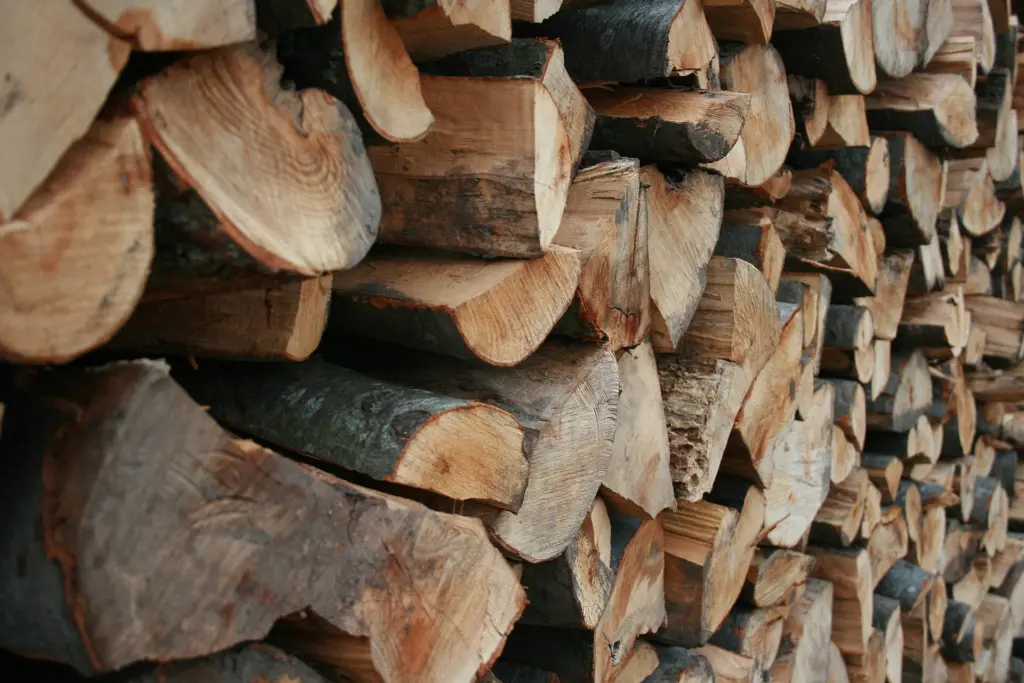
A log from the stack, the pins pressed into the gray end grain, the display reads 14 percent. Dry, you think, and put it on the fire. That exact measurement is worthless, because wood dries fastest at the cut surfaces and can still be much wetter inside. For firewood, a pin meter with wood groups such as the Bosch UniversalHumid is enough, as long as you use it correctly. If you want to investigate damp walls or mold spots, on the other hand, you need building material curves and a hygrometer, as found in the testo 606-2.
What the percentage on the display means
The devices from Bosch, testo and Laserliner do not calculate the water share of the total weight. They give the wood moisture content, meaning the weight of the water relative to the dry mass. In the manual for the UniversalHumid, Bosch explains this with an example: 100 percent wood moisture means 50 percent water content. One kilo of wood at 50 percent wood moisture contains around 333 grams of water.
That sounds like hair-splitting. It is not. In § 3, the German Ordinance on Small and Medium Combustion Plants (1. BImSchV) requires the moisture content of untreated split logs to be below 25 percent, based on the dry or oven-dry weight. That is the same reference value that Bosch and testo state for their readings. So the number on the display can be compared directly with the limit. The only exceptions are automatically fed systems that, according to the manufacturer, are suitable for damper fuel.
According to the German Environment Agency (Umweltbundesamt), freshly cut wood contains 45 to 60 percent water, depending on the season and type of wood. With good storage, the share drops to 15 to 20 percent, which takes one to two years: stacked in a sunny, airy spot, protected from rain and without contact with the ground. If you are only just planning your stove, you will find the basics in our wood stove guide (in German).
Measuring firewood: split it, three points, across the grain
Bosch and testo describe almost word for word the same procedure in their manuals. Take a log from the middle of the stack, split it and measure at three points on the freshly split surface: five centimeters from each end and once in the middle. The pins go into the wood across the grain, four to five millimeters deep. Inserted along the grain, the meter shows slightly higher readings, according to testo.
Then there is the temperature. When moving from a cold basement to a warm attic, Bosch gives up to 30 minutes for the device to adjust, and says the most accurate readings come when the wood and surroundings are at the same temperature. So if you carry logs from the woodshed into the living room in November and measure right away, your reading will be inaccurate.
The wood group also deserves a look. On the Bosch device, beech is in group B; with testo, it shares a curve with spruce. The grouping therefore follows each manufacturer’s calibration, not a fixed rule. Bosch advises choosing group A for unknown wood because it tends to show higher readings. That way, nothing goes into the stove too early.
Walls, screed and mold: why percentages are misleading here
In masonry, the same resistance measurement only works with a matching material curve. How far the readings diverge depending on the building material is shown in the data sheet for the Laserliner DampFinder Compact Plus: for C20/25 concrete, the measuring range runs from 1.1 to 3.9 percent, for aerated concrete from 2.2 to 171.2 percent. A reading of four percent is wet in one case and bone-dry in the other. A device with only one setting for all building materials therefore mainly provides comparison values.
Capacitive or dielectric devices such as the Trotec BM31 work without pins. They display digits from 0 to 100, explicitly not percent by mass or volume. Their strength is scanning a surface: where does the value rise, where is the wet spot? According to Trotec, however, nails, cables, rebar or foil-faced insulation drive the reading up, and in corners you need a distance of eight to ten centimeters.
With mold, the air counts first. According to the German consumer advice center (Verbraucherzentrale), mold can grow as soon as the relative humidity directly in front of a wall reaches about 70 to 80 percent, even without visible condensation. As a comfortable indoor climate, it gives 18 to 22 degrees at 40 to 60 percent humidity. And it warns: 50 percent in the middle of the room can already be too much at a cold exterior wall. A thermo-hygrometer is therefore part of the basic equipment; our guide to smart hygrometers presents models with an app. If the air is permanently too humid, take a look at our dehumidifier guide. Incidentally, a meter does not detect mold. It only shows where it is damp.
How accurate is „±1 percent“?
The figure on the box refers to the electrical measurement under laboratory conditions. For the UniversalHumid, Bosch explicitly adds „plus a deviation depending on use,“ and the value applies at 25 degrees. Heartwood and sapwood, varnish, knots, resin and unevenly distributed moisture shift the result. Only the oven-dry weighing method in the laboratory according to the German standard DIN 52183 delivers exact values, as Bosch itself points out. For the question „Can this log go in the stove?“, a handheld meter is still enough, as long as you measure several spots and take the highest value seriously.
Five meters side by side
| Model | Measuring principle | Materials according to the manufacturer | Accuracy according to the manufacturer | Best for |
|---|---|---|---|---|
| Bosch UniversalHumid | Resistance, two pins | Wood, 2 wood groups (7.1–74.7 % and 6.4–61.9 %) | ±1 % (conductivity, typical) | Firewood, furniture wood, parquet |
| Brennenstuhl Feuchtigkeits-Detector MD | Resistance, two tips | Wood 5–50 %, building materials 1.5–33 % | ±3 % | Occasional checks, rough assessment |
| Laserliner DampFinder Compact Plus | Resistance, two pins | 2 wood groups, 8 building materials, index | Wood ±1 % (5–30 %), building materials ±0.15 % (up to 10 %) | Wood and screed, with app log |
| Trotec BM31 | dielectric, no pins | Display 0–100 digits, 5–40 mm deep | no percentage given | Locating damp spots in walls |
| testo 606-2 | Resistance plus humidity and temperature sensor | 7 curves (2 wood, 5 building materials), dew point | ±1 % conductivity, ±2.5 % RH | Suspected mold, wall and room air in one device |
Bosch UniversalHumid
Two buttons, two wood groups, plus an indicator light: green below 12 percent, yellow from 12 to 20, red above that. For firewood, the manual gives a maximum of 22 percent, ideally below 17. The protective cap lets you run a self-test, and two readings stay on the display. According to Bosch, the device is not intended for building materials, and it does not measure material thinner than five millimeters. If you only check firewood, you need nothing more.
Brennenstuhl Feuchtigkeits-Detector MD
The MD only switches between wood and building materials; there is no selection of wood type. Brennenstuhl states the accuracy as ±3 percent, which is three times the margin of the other pin meters here. With a limit of 25 percent, that makes a difference. A tone rises in pitch as moisture increases, which helps when scanning. The 9-volt battery is not included.
Laserliner DampFinder Compact Plus
The Laserliner device covers wood and eight building materials, including cement and anhydrite screed, three types of concrete, gypsum plaster and sand-lime brick. An index mode compares spots regardless of material. According to the manufacturer, readings can be transferred to the MeasureNote app on your phone, which helps when documenting a drying process. For deeper measurements, Laserliner offers deep electrodes as an accessory.
Trotec BM31
A detector, not a percentage meter. The BM31 is placed perpendicular to the surface or moved across the wall and shows where the readings rise. Trotec itself recommends using the results only for orientation and as a preliminary check before a specialist company takes follow-up measurements with the CM method. For firewood, a pin meter is the more direct choice.
testo 606-2
Here, material moisture, humidity, temperature and dew point sit in one 90-gram housing. That lets you measure the air in front of the wall and the plaster in the wall, exactly what matters when mold is suspected. The manual contains guide values for dry, borderline and damp for each curve. According to testo, the device is TÜV-tested to the German guideline VDI 4206 Part 4; for official measurements under the 1. BImSchV, the manual requires a check by a recognized body every six months. For private use, that plays no role.
How we would decide
- Firewood only: Bosch UniversalHumid. Wood groups, clear traffic-light display, manual with measuring scheme.
- Wood and occasionally screed or plaster, with a log: Laserliner DampFinder Compact Plus.
- Damp corner, fogged-up windows, suspected mold: testo 606-2, because it measures air and wall.
- Narrowing down a wet spot in the wall without drilling holes: Trotec BM31, supplemented by a pin meter for the number.
- A rough check now and then: Brennenstuhl MD, with a buffer to the 25 percent limit.
In the case of real water damage or widespread mold, no handheld meter replaces a specialist company.
If you want to track room air over weeks, you need a logger; see our guide to temperature data loggers (in German).
How much of the rated liters is left at 10 degrees is shown in our guide to basement dehumidifiers (in German).
Which humidity is still acceptable and where sensors belong is covered in our guide Preventing mold with a sensor (in German).
Which residual moisture applies to firewood and who approves a new stove is explained in our guide Installing a wood stove.
For room air rather than walls, we tested a wireless hygrometer: the Govee H5075 in a set of three.
Frequently asked questions
How dry does firewood have to be?
The German Ordinance on Small and Medium Combustion Plants (1. BImSchV) requires a moisture content below 25 percent for untreated split logs, based on dry weight. That is the same reference value that Bosch and testo display, so the number can be compared directly. The Bosch manual gives a maximum of 22 percent for firewood, ideally below 17.
How do you measure firewood moisture correctly?
Split a log from the middle of the stack and measure at three points on the freshly split surface: five centimeters from each end and in the middle. The pins go into the wood across the grain. Wood and meter should be at the same temperature; Bosch gives up to 30 minutes of adjustment time.
How long does firewood need to dry?
According to the German Environment Agency (Umweltbundesamt), freshly cut wood contains 45 to 60 percent water. With good storage, the share drops to 15 to 20 percent in one to two years: stacked in a sunny, airy spot, protected from rain and without contact with the ground.
Can a moisture meter detect mold?
No, it only shows where it is damp. With mold, the air counts first: according to the German consumer advice center (Verbraucherzentrale), mold can grow as soon as the relative humidity directly in front of a wall reaches about 70 to 80 percent. A thermo-hygrometer is therefore part of the basic equipment.
Why are percentage readings on walls hard to interpret?
The measurement needs a matching material curve. On the Laserliner DampFinder Compact Plus, the range for C20/25 concrete runs from 1.1 to 3.9 percent, for aerated concrete up to 171.2 percent. Four percent is wet in one case and dry in the other.
How accurate is the plus or minus 1 percent figure?
It refers to the electrical measurement under laboratory conditions; Bosch explicitly adds a deviation that depends on use. Knots, resin, varnish and unevenly distributed moisture shift the result. Measure several spots and take the highest value seriously.
Sources
- 1. BImSchV (German Ordinance on Small and Medium Combustion Plants), § 3 Fuels
- Umweltbundesamt: Wood stoves, pay attention to efficiency
- Umweltbundesamt: Heating with wood
- Verbraucherzentrale: Heating and ventilating
- Bosch: UniversalHumid
- Bosch: UniversalHumid operating instructions
- Brennenstuhl: Feuchtigkeits-Detector MD
- Laserliner: DampFinder Compact Plus
- Laserliner: DampFinder Compact Plus data sheet
- Trotec: BM31
- Trotec: BM31 operating instructions
- testo: 606-2 instruction manual
Where to buy
- Bosch UniversalHumidCheck price at Amazon.deAvailable in Germany: Amazon.de
- testo 606-2Check price at Amazon.deAvailable in Germany: Amazon.de
- Laserliner DampFinder Compact PlusCheck price at Amazon.deAvailable in Germany: Amazon.de
- Trotec BM31Check price at Amazon.deAvailable in Germany: Amazon.de
- Brennenstuhl Feuchtigkeits-Detector MDCheck price at Amazon.deAvailable in Germany: Amazon.de