Contents13 sections
This guide was first published in German on handgetestet.de.
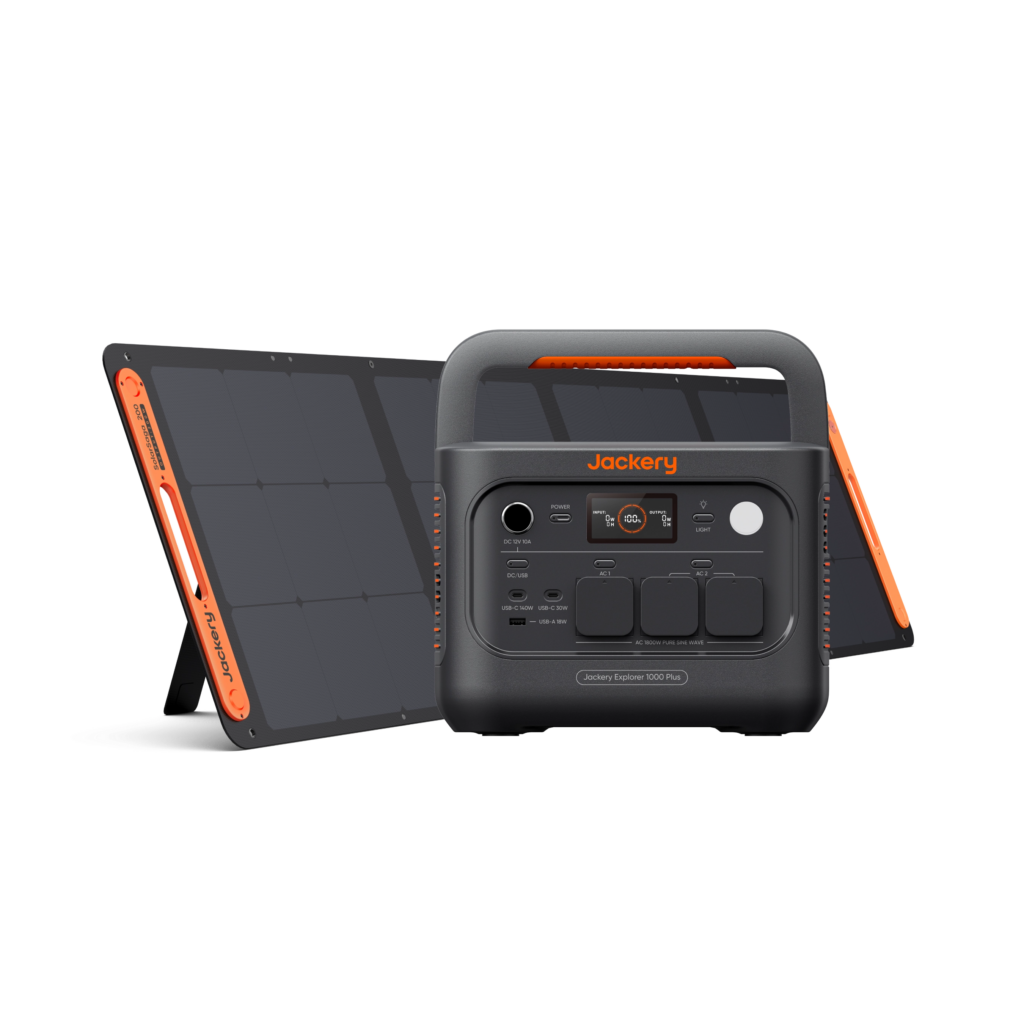
A power station ages even in the closet, and it does so at both ends of the gauge. Being kept full all the time is not good for the battery, and stored empty it can be damaged. Set the station to 60 to 80 percent, check it every three months and keep the storage spot between 10 and 25 degrees Celsius. If you are still looking for a unit for the basement or garage, the Jackery Explorer 1000 Plus v2 offers the best mix of cold-weather range and size. One caveat up front: the Explorer 1000 Plus v2 is new, and we only had information from Jackery and one retailer, no data sheet and no independent measurement. Read its figures with corresponding caution.
How full should the battery be in storage?
The figures differ. In the manual for the Explorer 2000 Pro, Jackery states 60 to 80 percent for breaks longer than three months. Anker says 50 to 80 percent. For cordless garden tools in winter, the German Environment Agency (Umweltbundesamt) reports 40 to 50 percent as the manufacturers‘ advice. Older Jackery manuals, on the other hand, want the unit fully charged before storage.
We stick to 60 to 80 percent. A backup power unit is supposed to deliver right away when it is needed, after all, and with half a battery the reserve would be thin. If the station happens to be completely full, simply run a lamp or your laptop on it before putting it away. How much energy drains under which loads is shown by the calculation in our guide to power station runtime.
How often do I need to recharge?
Check it every three months. Jackery and Anker agree on that, and the German Environment Agency sets six months as the absolute limit for lithium batteries. For the Explorer 3000 v2, Jackery states 95 percent charge retention after one year in standby. That is not a free pass. The manual for the Explorer 3000 warns that a unit stored empty can deteriorate after just three to six months and may no longer charge at all.
There is a trap in the warranty terms. In the manuals of several Explorer models, the warranty on the battery cell only applies if you fully charge it within seven days of purchase and then again at least every six months. Our recommendation is therefore: twice a year to 100 percent, with a reminder in your calendar, then back down to around 70. Check the clause in your unit’s manual, because these versions come from the US market.
What does that mean for a station on mains power?
According to the German Environment Agency, continuous operation on mains power costs batteries life, partly because of the heat. That affects the obvious solution of running the router permanently through the UPS function. Some models mitigate this. The battery care mode of the Explorer 3000 Pro limits the charge to 85 percent via the app and only recharges below 80. A similar mode is also described for the Explorer 3000. What other precautions are needed is covered in our guide backup power with a power station (in German).
Can the station go in the garage over winter?
Better not. The German Environment Agency recommends 10 to 25 degrees Celsius and names values below minus 20 and above plus 50 degrees as particularly harmful. Anker warns against the unheated garage. Jackery’s manuals set the limits differently depending on the model: minus 10 to plus 25 degrees for six months for the Explorer 100 Plus, zero to 25 degrees for one year for the Explorer 3000. A dry basement room is therefore usually the safer spot. The sunny garden shed is not, and neither is the car in summer. The manual rules out bathrooms and damp rooms.
Frost becomes critical when charging. Many stations will not accept power below zero degrees and display a warning that, according to Jackery, disappears on its own once the unit warms up. The German Environment Agency rejects the refrigerator as a storage spot because of condensation. For winter use outdoors, see our guide power in the garden shed (in German).
Which station suits which storage spot?
| Model | Capacity, weight | Charges from (retailer information) | Best for |
|---|---|---|---|
| Jackery Explorer 1000 Plus v2 | 1,024 Wh, 10.8 kg | −10 °C | cool basement, more capacity later |
| Jackery Explorer 500 v2 | 512 Wh, 5.7 kg | −20 °C | small reserve on the shelf |
| Jackery Explorer 3600 Plus | 3,584 Wh, 35 kg | −20 °C | fixed spot in the garage or basement |
| Jackery Explorer 1000 v2 | 1,070 Wh, 10.8 kg | 0 °C | heated room |
| Jackery EVA Carrying Case M | 46 × 30 × 34 cm | not applicable | protection for 1000 v2 and 2000 v2 |
| Anker SOLIX C1000 Gen 2 | 1,024 Wh, 11.3 kg | 0 °C | heated room, comparison with Jackery |
Jackery Explorer 1000 Plus v2
Lithium iron phosphate, 6,000 cycles to 70 percent remaining capacity according to Jackery, and charging from minus 10 degrees according to the retailer GreenDrive. That leaves some leeway in a cool basement. Downside: it costs more than the Explorer 1000 v2 and stores slightly less. Jackery does not list its own storage values online for this model; the rules above apply to sister models.
Jackery Explorer 500 v2
Light enough for a shelf and, according to Jackery, usable from minus 20 to plus 45 degrees. That works for a router and lights. It does not deliver more than 500 watts.
Jackery Explorer 3600 Plus
At 35 kilograms, nobody likes carrying the station back into the house. The fact that, according to the retailer, it charges down to minus 20 degrees suits a fixed spot in the garage, but it does not replace the advice on milder temperatures.
Jackery Explorer 1000 v2 and EVA Carrying Case M
It only charges from zero degrees and belongs in heated rooms. According to Jackery, the case protects against dust, scratches and moisture. According to the manufacturer, the zipper seals against splashes and light rain. It is still not suitable for damp storage rooms. In spring 2025, the German automobile club ADAC downgraded the Explorer 1000 v2 to „poor“ because its two DC inputs are not decoupled. So never charge it via solar and the car socket at the same time; otherwise damage to the 12-volt vehicle electrical system is possible.
Anker SOLIX C1000 Gen 2
The same size class with 2,000 watts and 4,000 cycles to 80 percent remaining capacity, a stricter benchmark. According to Anker, it only charges from zero degrees.
How do I transport the station correctly?
Upright and strapped down. Jackery prohibits operating or storing the unit on its side or upside down and requires it to be secured in the vehicle. Do not move it while it is charging or supplying power. Switch it off immediately after a fall. Check the housing before every use. Rust, odor or overheating mean it is time to stop, and customer service has to take over. Large stations are not allowed on airplanes anyway; the limits are in our guide to the small power station (in German).
Where does the old unit go?
To the municipal recycling center, as a whole unit. The battery is built in, so in Germany the Electrical and Electronic Equipment Act (ElektroG) applies, not the battery collection box at the supermarket. The German battery law implementation act (BattDG) explicitly exempts built-in batteries from its collection requirement. Opening the unit is not an option; Jackery prohibits it. By law, private households can drop off old devices free of charge at the municipal collection points.
Retailers take devices back too. Under German law, stores with at least 400 square meters of sales space for electrical devices must accept an old device of the same type when you buy a new one; without a purchase, only devices up to 25 centimeters edge length. A 1 kWh station is larger. For mail-order retailers, the storage and shipping areas count. If the housing is swollen, deformed or smells, stop using the station and call the recycling center before dropping it off. The German Environment Agency warns of fires caused by damaged lithium batteries. None of these devices belongs in household waste. If you want to sell it first: what buyers look for is in our guide to refurbished power stations (in German).
Which charging limits apply below zero degrees is covered in our guide to power stations in frost.
Frequently asked questions
How full should a power station be when stored?
Manufacturers give different figures: Jackery states 60 to 80 percent for the Explorer 2000 Pro, Anker 50 to 80 percent. For a backup power unit, 60 to 80 percent makes sense so that a reserve remains. If the station is completely full, run a lamp or your laptop on it before putting it away.
How often do I need to recharge a stored power station?
Check it every three months; Jackery and Anker agree on that. The German Environment Agency names six months as the absolute limit. According to Jackery, a unit stored empty can already deteriorate after three to six months. Also check the warranty clause: for several Explorer models, a full charge at least every six months is required.
Can a power station stay in the garage over winter?
Better not. The German Environment Agency recommends 10 to 25 degrees Celsius, and Anker warns against the unheated garage. A dry basement room is usually the safer spot; the manual rules out bathrooms and damp rooms. Many stations will not charge below zero degrees, and the refrigerator is out because of condensation.
Does it harm the battery if the power station is permanently plugged in?
According to the German Environment Agency, continuous operation on mains power costs battery life, partly because of the heat. Some models mitigate this: the battery care mode of the Explorer 3000 Pro limits the charge to 85 percent via the app and only recharges below 80. This mainly affects continuous use as a UPS for the router.
How do I transport a power station correctly?
Upright and strapped down. Jackery prohibits operating or storing the unit on its side or upside down. Do not move it while it is charging or supplying power, and switch it off immediately after a fall. In case of rust, odor or overheating, customer service is the place to go.
Where do I dispose of an old power station?
As a whole unit at the municipal recycling center; by law, private households can drop off old devices there free of charge. The battery is built in, so the German Electrical and Electronic Equipment Act (ElektroG) applies, not the battery collection box at the supermarket. Jackery prohibits opening the unit. If the housing is swollen or smells, call the recycling center before dropping it off.
Sources
- Product information from Jackery on the Explorer models and the EVA Carrying Case M
- German Environment Agency: Batteries and rechargeable batteries (in German)
- German Environment Agency: Lithium batteries and lithium-ion batteries (in German)
- German ElektroG Section 17: Take-back obligation of distributors (in German)
- German ElektroG Section 13: Collection by public waste management authorities (in German)
- German BattDG Section 6: Obligations of the end user (in German)
- Jackery: Explorer 2000 Pro manual (PDF)
- Jackery: Explorer 3000 Pro manual (PDF)
- Jackery: Explorer 3000 manual (PDF)
- Jackery: Explorer 100 Plus manual (PDF)
- Anker SOLIX: Storing and caring for a power station
- Anker SOLIX: C1000 Gen 2
- GreenDrive (retailer information): Explorer 1000 Plus v2
- GreenDrive (retailer information): Explorer 500 v2
- GreenDrive (retailer information): Explorer 3600 Plus
- GreenDrive (retailer information): Explorer 1000 v2
- ADAC: Portable power stations tested (spring 2025, in German)
Where to buy
- Jackery Explorer 1000 Plus v2View at JackeryAvailable in Germany: JackeryCheck price at Amazon.deAvailable in Germany: Amazon.de
- Jackery Explorer 500 v2View at JackeryAvailable in Germany: JackeryCheck price at Amazon.deAvailable in Germany: Amazon.de
- Jackery Explorer 3600 PlusView at JackeryAvailable in Germany: JackeryCheck price at Amazon.deAvailable in Germany: Amazon.de
- Jackery Explorer 1000 v2View at JackeryAvailable in Germany: JackeryCheck price at Amazon.deAvailable in Germany: Amazon.de
- Jackery EVA Tragetasche MView at JackeryAvailable in Germany: Jackery
- Anker SOLIX C1000 Gen 2Check price at Amazon.deAvailable in Germany: Amazon.de