Contents14 sections
This guide was first published in German on handgetestet.de.
You do not choose a retrofit tow hitch by brand, but by vehicle. For most cars with parking sensors, we recommend a vertically detachable hitch in a set with a 13-pin, vehicle-specific wiring kit. A fixed hitch suits vehicles that tow almost every day, a swivel hitch anyone who never wants to lift the ball head out of the trunk again.
The mistake with the biggest consequences happens before you order. You type in the name of the car and take the first set. In its 2025 catalog, Westfalia lists hitches with 85 kg tongue weight and 2,000 kg towing capacity for the Golf VIII sedan from July 2019 alone, alongside ones with 150 kg and 2,500 kg, plus notes such as „not for GTI Clubsport“ or „not for R-Line.“ Same car, different part number.
First the vehicle documents, then the shopping cart
Start by opening the vehicle registration certificate (in Germany, the Zulassungsbescheinigung Teil 1). If no towing capacity is listed there, the vehicle manufacturer has not approved the installation, and Westfalia states unambiguously in its catalog that it is then not permitted. Under field 13 you will find the tongue weight, meaning the weight that may press down on the ball from above.
The car, the hitch and the trailer each have their own values. If they are not the same, the lower one applies, according to the German automobile club ADAC. A hitch with 150 kg tongue weight therefore does not turn a car with 75 kg in its registration document into a workhorse. The D-value, the calculation figure for the permissible towing capacity, is given in kilonewtons on the hitch’s type plate.
Be careful with electric cars and plug-in hybrids. The ADAC advises clarifying beforehand whether a valid type approval exists; without factory approval, the manufacturer’s warranty on the traction battery, electric motor or other electric components may be at risk. Some of these models are approved exclusively for a bike rack.
With a bike rack, every kilo counts
Brink puts the rule clearly: the rack and bikes together must not exceed the tongue weight. Here is an example calculation. A rack weighing 18 kg and two e-bikes at 25 kg each add up to 68 kg, which leaves little margin with 75 kg in the registration document. If you want to take three or four bikes along, Brink says you should do the math carefully.
How much the rack’s own weight counts is shown in our comparison Thule EasyFold XT 934 vs. Uebler i31: the Thule weighs 23.1 kilograms, the Uebler 16. With a tight tongue weight, the lighter rack leaves more reserve for the bikes.
The ADAC raises a second point. Approval under UN Regulation 55 only covers towing trailers; you cannot tell by looking at a retrofit hitch whether it has been tested for rear-mounted racks. Have the workshop confirm this in writing and compare the D-value on the type plate with the minimum value in the rack’s instructions. Which racks are available and what matters with them is covered in our guide to hitch-mounted bike racks.
Fixed, detachable or swivel?
A fixed hitch is always there. It needs no handling and, according to Brink, lasts the life of the car. It is only permitted, however, if the license plate and rear fog light remain visible; if the ball covers either of them, Brink does not offer a fixed version for that car at all. And on vehicles with parking sensors, the ball may sit within the detection range. Westfalia notes that in such cases it has to be checked individually whether the parking assist still works properly.
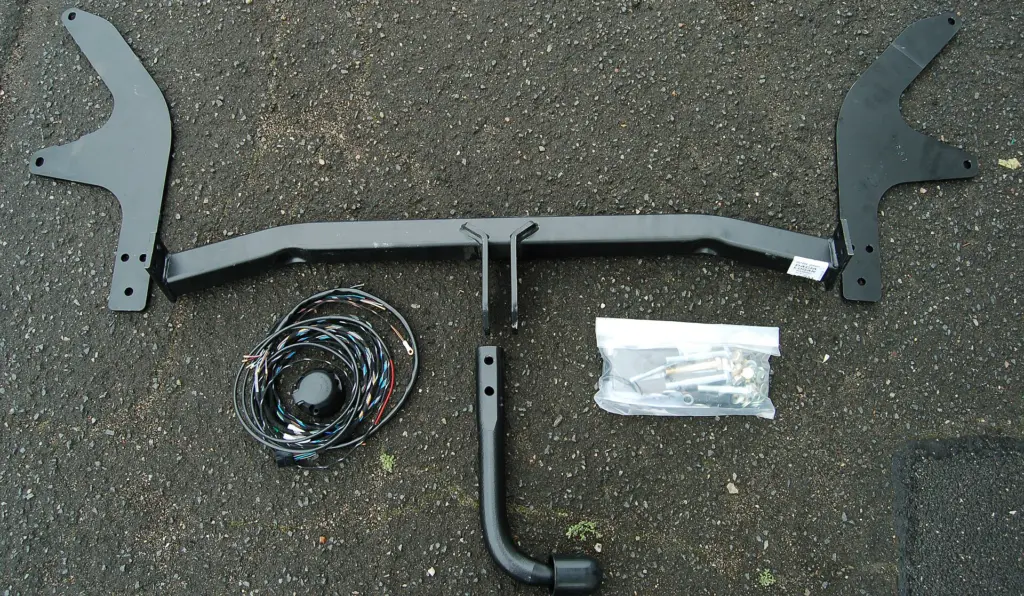
Detachable systems solve exactly this problem. After the trip, the ball bar goes into the trunk, and all that remains on the car is a small receiver behind or below the bumper. Vertical systems are inserted from below, horizontal ones from behind; Oris recommends the horizontal design for cars with little ground clearance. Invisible here means manual work. You kneel behind the car, and in winter that can mean in the slush.
Swivel hitches stay on the vehicle and fold away behind the bumper. On Westfalia models, a button releases the lock and the swiveling is done by hand. Not every car has enough space for this behind the bumper cover, Brink writes.
Does a detachable ball have to come off after every trip? According to the ADAC, there is only a legal obligation if the hitch covers the license plate. If removal is stated as a condition in the operating permit or type approval, you should comply with it. The ADAC recommends it anyway: after a rear-end collision, the insurer may assume partial liability because of the increased operating risk, and the ball can make the damage to the other car worse. Westfalia’s instructions require removing the ball head when not in use in any case.
Seven pins or thirteen?
The 7-pin socket is enough for bike racks, box trailers and boat trailers. Brink mentions one drawback: the system is open, so water can get in. According to Brink, the 13-pin socket to the German DIN standard is watertight and intended for caravans that need power for lights, a refrigerator and a water pump. Brink generally recommends the 13-pin system. We agree, because every adapter is one more plug connection.
More important than the number of pins is whether the kit is universal or vehicle-specific. Universal kits tap the analog signals of the taillights and, according to Brink, cannot be programmed. Vehicle-specific kits connect to the car’s data bus. According to Westfalia, only this connection makes features such as trailer stability control possible when towing. If the data sheet says „coding required,“ the car must then be coded so that the control units know a towing device is installed.
If you tow a caravan, look out for two items in the data sheet. Depending on the kit, permanent positive and the charging line are either included at Westfalia or only available as an add-on. Ask about them before you order.
Register it or not?
That depends on the approval mark on the type plate. Westfalia explains it like this: hitches with European approval, whose marking begins with an „e,“ do not need a German TÜV inspection; carrying the installation instructions in the car is sufficient. If the hitch bears a German approval mark (M or F) or an individual approval (TP), inspection and entry in the vehicle documents are required after installation.
And the installation? For the mechanical part, Westfalia gives non-binding guide times of 60 to 90 minutes for a detachable kit on a Seat or Cupra and 90 to 150 minutes for a fixed hitch on an Opel. Then comes the wiring kit: for the Golf VIII up to model year 08/2023, Westfalia expects 120 minutes without factory pre-wiring and 45 minutes with it. Workshops offer the coding, and Oris also names the specialist workshop as the usual route. Our position: you can do the bolting yourself, but the electrics on a modern car belong in a workshop that can also handle the coding.
Six product lines compared
All of these lines are only available vehicle-specifically. The values below come from manufacturers‘ examples; for your car, only the data sheet of the matching part number counts.
| Product line | Design | Electrics and special features | Best for |
|---|---|---|---|
| Westfalia A40V (kit) | vertically detachable, three-ball locking, lock | 13-pin, vehicle-specific, included in the set | Cars with parking sensors, occasional trailer |
| Westfalia F20 | fixed, bolted ball head | Wiring kit separate or as a kit | Continuous use, vans and work vehicles |
| Westfalia R10 | swivel, release by button, swiveled by hand | 13-pin, vehicle-specific, included | Frequent hitching without a loose ball bar |
| Brink detachable | vertically or diagonally detachable | Click when engaging or green/red color indicator | Anyone who wants clear feedback when inserting |
| Oris AK41 / AK4 | vertically or horizontally detachable | available as FIX4BIKE version with two retaining pins | Bike racks, low-slung cars (AK4) |
| Auto-Hak | fixed, ball plate, horizontally or vertically detachable | Wiring kit universal or vehicle-specific depending on the set | Anyone who wants to compare several designs for one model |
Westfalia A40V: detachable with kit
The ball head is inserted vertically, three balls hold it in the housing, and a lock protects against theft. As a kit, the 13-pin, vehicle-specific wiring kit comes with it. For the Seat and Cupra example, Westfalia states 109 kg tongue weight, a 9 kN D-value, 23 kg net weight and a concealed cutout in the bumper; coding is explicitly noted as required there.
Westfalia F20: fixed and bolted
Westfalia offers the fixed hitch with a welded (F10) or bolted ball head (F20). The Opel example reaches 150 kg tongue weight, 2,500 kg towing capacity and a 12.3 kN D-value, but only for vehicles without self-leveling suspension. It makes sense if the trailer is almost always attached and nothing covers the license plate.
Westfalia R10: swivel
A button releases the lock, the ball bar is swung out by hand and engages with a light and sound signal. According to Westfalia, the swivel module works independently, meaning without its own programming; the 13-pin wiring kit is included. For the Volvo example, the manufacturer states 110 kg tongue weight, a 10.7 kN D-value and a weight of 29 kg. Convenient. Whether it is available for your model is shown by the manufacturer’s product finder.
Brink: vertical or diagonal
Brink builds detachable hitches in two versions. The vertical one signals engagement with a distinct click, while the diagonal one shows green on the rotary knob for locked and red for another attempt. According to the manufacturer, you need neither tools nor grease. Brink does not do installations itself and gives a standard one-year warranty on the hitch and wiring kit.
Oris AK41 and AK4
Oris belongs to ACPS Automotive. The AK41 is inserted from below and engages automatically via three balls, while the AK4 is pushed in horizontally and is intended for cars with little ground clearance. For cyclists, the FIX4BIKE version is interesting: two pins on the ball neck additionally hold matching FIX4BIKE racks.
Auto-Hak
This independent Polish manufacturer from Słupsk has been building hitches for cars and vans since 1976. The range includes bolted ball heads, ball plates with two or four bolts, and horizontally and vertically detachable balls. With sets, check carefully which wiring kit is included. A universal 7-pin kit is the weaker choice on a car with a data bus.
How we would decide
- Car with parking sensors, a trailer or bikes a few times a year: a vertically detachable hitch with a 13-pin, vehicle-specific kit, such as the Westfalia A40V kit or a comparable Brink or Oris hitch.
- A trailer on the hitch almost every day: a fixed hitch, provided the license plate and rear fog light remain unobstructed and the sensors are not affected.
- Bike rack every week, no bending down: a swivel hitch, if the R10 is available for your model. Otherwise a FIX4BIKE hitch from Oris.
- Caravan: look out for permanent positive and the charging line, and check the tongue weight with a tongue weight scale, as Brink recommends.
- Electric car: first the manufacturer’s approval, then everything else.
Frequently asked questions
Can I retrofit a tow hitch to any car?
Only if a towing capacity is listed in the vehicle registration certificate (German Zulassungsbescheinigung Teil 1); otherwise the vehicle manufacturer has not approved the installation. For electric cars and plug-in hybrids, the German automobile club ADAC advises clarifying the type approval beforehand, because otherwise the warranty on electric components may be at risk.
What tongue weight applies with a bike rack?
The rack and bikes together must not exceed the tongue weight. A rack weighing 18 kg and two e-bikes at 25 kg each add up to 68 kg, which leaves little margin with 75 kg in the registration document. If the values for the car and the hitch differ, the lower one applies, according to the ADAC.
Which is better: 7-pin or 13-pin?
The 7-pin socket is enough for bike racks and box trailers, but according to Brink it is open to water. The 13-pin socket is watertight and intended for caravans. Brink generally recommends 13 pins, and this guide agrees, because every adapter is one more plug connection.
Does a tow hitch have to be registered?
That depends on the approval mark on the type plate. If the marking begins with an e, Westfalia says carrying the installation instructions in the car is sufficient. With a German approval mark M or F or an individual approval TP, inspection and entry in the vehicle documents are required.
Does the detachable ball have to come off after every trip?
According to the ADAC, there is only a legal obligation if the hitch covers the license plate or if it is stated as a condition in the operating permit. It is recommended anyway, because the insurer may assume partial liability after a rear-end collision. Westfalia requires removal when not in use in any case.
Can I install the tow hitch myself?
For the mechanical part, Westfalia gives guide times of 60 to 90 minutes for a detachable kit. The vehicle-specific wiring kit connects to the data bus and often has to be coded. This guide's position: you can do the bolting yourself, but the electrics belong in a workshop that can also handle the coding.
Sources
- Westfalia-Automotive: 2025 catalog (towing capacity, parking sensors, installation times, Golf VIII; in German)
- Westfalia-Automotive: questions and answers about tow hitches (in German)
- Westfalia-Automotive: detachable tow hitches (in German)
- Westfalia-Automotive: fixed tow hitches (in German)
- Westfalia-Automotive: swivel tow hitches (in German)
- Westfalia-Automotive: wiring kits (in German)
- Westfalia-Automotive: vehicle coding (in German)
- Westfalia-Automotive: A40V kit, data sheet (in German)
- Westfalia-Automotive: F20, data sheet (in German)
- Westfalia-Automotive: R10, data sheet (in German)
- Brink: detachable tow hitch (in German)
- Brink: fixed tow hitch (in German)
- Brink: swivel tow hitch (in German)
- Brink: wiring kit (in German)
- Brink: tongue weight (in German)
- Brink: frequently asked questions (in German)
- Oris: detachable tow hitches
- ACPS Automotive
- Auto-Hak (in Polish)
- ADAC: tongue weight (in German)
- ADAC: detachable tow hitch (in German)
- ADAC: not every tow hitch is suitable for bike racks (in German)
- ADAC: electric cars with tow hitches (in German)
Where to buy
- Westfalia A40V (Kit)Check price at Amazon.deAvailable in Germany: Amazon.de
- Westfalia starre Anhängerkupplung F20Check price at Amazon.deAvailable in Germany: Amazon.de
- Westfalia schwenkbare Anhängerkupplung R10Check price at Amazon.deAvailable in Germany: Amazon.de
- Brink abnehmbare AnhängerkupplungCheck price at Amazon.deAvailable in Germany: Amazon.de
- Oris abnehmbare Anhängerkupplung mit ElektrosatzCheck price at Amazon.deAvailable in Germany: Amazon.de
- Auto-HakCheck price at Amazon.deAvailable in Germany: Amazon.de