Contents13 sections
This guide was first published in German on handgetestet.de.
A roof load of 75 kilograms sounds like a lot. Subtract a box weighing 23.9 kilograms and a rack weighing 5.1 kilograms, and according to an ADAC example calculation only 46 kilograms remain for luggage. That is why a roof box has to suit the car first. The luggage comes after that.
Many families do well with 400 to 500 liters. We consider dual-side opening, quick mounting with a torque indicator and a lock that clicks audibly into place to be basic equipment. The six models below are classified according to the manufacturers‘ specifications.
How much can I actually load onto the roof?
Less than most people think. The permitted roof load is not stated in the vehicle registration document but in your car’s owner’s manual. According to the automobile club ADAC, it is usually between 50 and 100 kilograms, and the roof rack and box count toward it. The lowest value of the car’s roof load, the rack’s load capacity and the box’s payload always applies. Axle loads and the permitted gross vehicle weight must not be exceeded either.
Often forgotten: wet towels and ski clothing get heavier on the way home.
How fast can I drive with a roof box?
There is no statutory speed limit for roof boxes in Germany. The box counts as cargo, and you have to drive at an appropriate speed. The ADAC recommends no more than 130 km/h, and a lower value from the manufacturer takes precedence. At 130 km/h, the ADAC measured around 18 percent higher fuel consumption, about one liter per 100 kilometers.
Securely on the roof, and back down after the trip. And remember the extra height before driving into an underground garage.
What size do I need?
300 to 400 liters are enough for a couple or a small family; 450 to 600 liters are intended for families with lots of luggage or ski equipment. You shouldn’t blindly rely on the stated liters, though. The ADAC measured 10 to 20 percent less volume than stated for some boxes.
Whether your skis fit is decided by the interior length. Short, wide boxes are suitable for smaller cars, and the tailgate must still be able to open fully. Flat models („Low“) reduce the overall height. When it comes to empty weight, the math is simple. Every kilo of the box is missing from your luggage later. And the box itself has a limit too: many are rated for 75 kilograms, some only for 50 kilograms.
Which features make the difference on vacation?
Dual-side opening. It lets you reach your luggage from the sidewalk instead of from the road, and the ADAC explicitly names this as an advantage.
Quick-mount systems save time; at best, one person can mount the box alone. A torque indicator shows when the mount is tight enough. A central locking system that clicks into place automatically and audibly takes away the uncertainty when you set off. That leaves the question of the crossbars: does the mounting fit your profile, or do you need an adapter?
Six roof boxes and their key data
| Model | Volume / exterior dimensions | Empty weight / payload | Opening / mounting | For whom |
|---|---|---|---|---|
| Thule Motion 3 XL | 490 l / 215 × 89 × 43 cm | 23 kg / 75 kg | dual-side / PowerClick | Families, skis up to 200 cm |
| Thule Force 3 L | 450 l / 195 × 84.5 × 42.5 cm | 18.7 kg / 75 kg | dual-side / PowerClick | All-rounder, compact station wagons |
| Thule Vector M | 360 l / 212 × 88 × 33 cm | 29 kg / 75 kg | dual-side / PowerClick | Design and low profile |
| Kamei Husky 420 | 420 l / 165 × 88 × 44 cm | 15 kg / 75 kg | dual-side / tool-free | Smaller cars, short roofs |
| Atera Casar L | 420 l / 191 × 81 × 42 cm | 17.5 kg / 75 kg | dual-side / Premium Fit | Mid-range with comfort |
| Hapro Traxer 6.6 | 410 l / 191 × 81 × 42 cm | approx. 18 kg / 75 kg | dual-side / torque limiter | Budget-conscious families |
All specifications according to the manufacturers or the ÖAMTC (Hapro). Data for the exact variant sometimes differs, so a look at the data sheet before ordering doesn’t hurt.
Thule Motion 3 XL: lots of space, well-thought-out handling
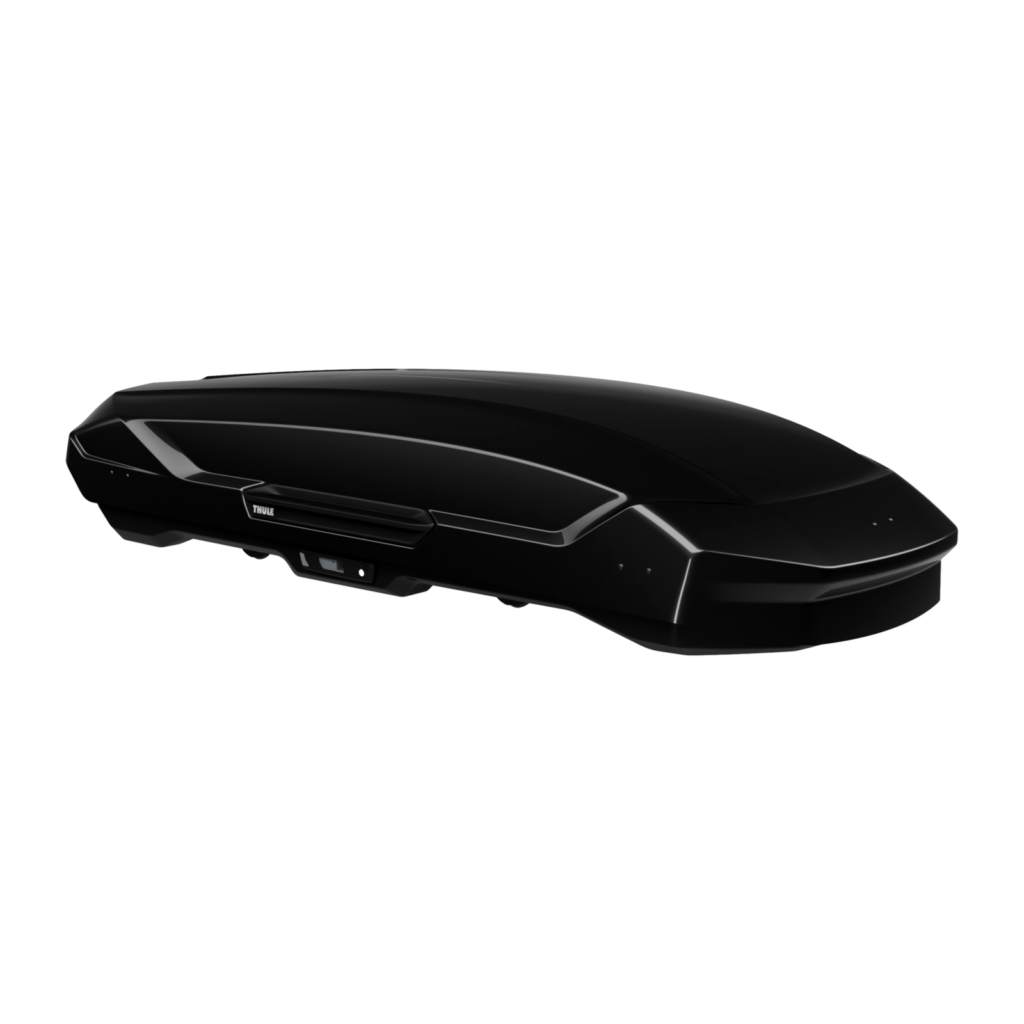
Within Thule’s lineup, the Motion 3 belongs to the upper price range. According to the manufacturer, the XL holds 490 liters and takes skis up to 200 centimeters. It opens on both sides and can be operated with one hand. The SlideLock system locks the lid automatically and indicates when the box is securely closed. The series ranges from 300 to 590 liters, also as flat „Low“ versions.
Thule Force 3 L: the smarter ratio of liters to kilos
According to the manufacturer, size L offers 450 liters at an empty weight of just 18.7 kilograms. If you work through the roof load, you can see the real advantage of this current Thule series here. Like the Motion 3, it has DualSide opening, PowerClick and SlideLock. For some racks, such as the Thule ProBar Evo, an adapter is required.
Thule Vector M: nicely flat, but heavy
In terms of price, the Vector sits at the top end of Thule’s range. At 33 centimeters it is very flat, lined with felt inside, and an LED light helps with loading in the dark.
Its weak point is the weight. 29 kilograms is a lot, and at 360 liters the volume is smaller. Here you need to recalculate the roof load especially carefully.
Kamei Husky 420: short and wide for small cars
At 165 centimeters long, the Husky 420 fits smaller cars and tailgates that swing up high. According to Kamei, it weighs 15 kilograms, carries 75 kilograms and opens on both sides via DuoLift. Mounting is tool-free, and central locking is included. Long skis stay outside, however. Inside, it measures 155 centimeters.
Atera Casar L: unfussy mid-range
According to the manufacturer, the Casar L holds 420 liters at an empty weight of 17.5 kilograms. It opens on both sides and has central locking. According to Atera, the variant in a lava finish comes with a lift and lowering aid for the lid. The ADAC tested the Casar L in its 2024 roof box test.
Hapro Traxer 6.6: stated and measured are two different things
In terms of price, the Traxer 6.6 sits in the middle of the field. The stated figures are 410 liters, a 75-kilogram payload and dual-side opening, and the mount has a torque limiter. In its 2024 test, however, the automobile club ÖAMTC measured only 380 liters. It described threading in the mounts as cumbersome.
So which box belongs on my roof?
If the big family vacation with lots of luggage is coming up and the roof is long enough, take the Thule Motion 3 XL. The Thule Force 3 L puts as much volume per kilo as possible on the roof. For a small car or a short roof, the Kamei Husky 420 is the fit.
The Atera Casar L and Hapro Traxer 6.6 deliver solid mid-range quality. The Thule Vector M remains an option for anyone to whom a flat, elegant shape matters more than weight.
The same applies to every box. Recalculate the roof load, put heavy items in the trunk, drive no faster than 130 km/h and check before every trip that the box is securely attached.
Frequently asked questions
How much can you load into a roof box?
The permitted roof load is stated in the car's owner's manual; according to the automobile club ADAC, it is usually between 50 and 100 kilograms, and the rack and box count toward it. In the ADAC example calculation, only 46 kilograms of a 75-kilogram roof load remain for luggage. The lowest value of roof load, rack capacity and box payload always applies.
How fast can you drive with a roof box?
There is no statutory speed limit in Germany; the box counts as cargo. The ADAC recommends no more than 130 km/h, and a lower value from the manufacturer takes precedence. At 130 km/h, the ADAC measured around 18 percent higher fuel consumption, about one liter per 100 kilometers.
What roof box size does a family need?
300 to 400 liters are enough for a couple or a small family; 450 to 600 liters are intended for families with lots of luggage or ski equipment. The ADAC measured 10 to 20 percent less volume than stated for some boxes. Whether skis fit is decided by the interior length.
Why is dual-side opening useful?
It lets you reach your luggage from the sidewalk instead of from the road; the ADAC explicitly names this as an advantage. According to the manufacturers, all six boxes in the comparison open on both sides. A torque indicator for mounting and a central locking system that clicks audibly into place also help.
Which roof box suits a small car?
Short, wide boxes are suitable for smaller cars, and the tailgate must still be able to open fully. The Kamei Husky 420 is 165 centimeters long and, according to the manufacturer, weighs 15 kilograms. Long skis do not fit; inside, it measures 155 centimeters.
Why does the empty weight of the roof box matter?
Every kilo of the box is missing from your luggage later. According to the manufacturer, the Thule Force 3 L offers 450 liters at 18.7 kilograms, whereas the flat Thule Vector M weighs 29 kilograms for 360 liters. With that one, you need to recalculate the roof load especially carefully.
Sources
- ADAC: driving with a roof box
- ADAC: roof load
- ADAC: roof boxes tested
- Thule: Motion 3 XL
- Thule: Force 3 L
- Thule: Vector M
- Kamei: Husky 420
- Atera: Casar L
- ÖAMTC: Hapro Traxer 6.6 in the 2024 roof box test
Where to buy
- Thule Motion 3 XLView at RamederAvailable in Germany: RamederCheck price at Amazon.deAvailable in Germany: Amazon.de
- Thule Force 3 LView at RamederAvailable in Germany: RamederCheck price at Amazon.deAvailable in Germany: Amazon.de
- Thule Vector MView at RamederAvailable in Germany: RamederCheck price at Amazon.deAvailable in Germany: Amazon.de
- Kamei Husky 420View at RamederAvailable in Germany: RamederCheck price at Amazon.deAvailable in Germany: Amazon.de
- Atera Casar LCheck price at Amazon.deAvailable in Germany: Amazon.de
- Hapro Traxer 6.6View at RamederAvailable in Germany: RamederCheck price at Amazon.deAvailable in Germany: Amazon.de