Contents14 sections
This guide was first published in German on handgetestet.de.
Patchy ankles, orange palms, a streak along the neck: that is rarely down to the brand and almost always down to the formula and how it goes on. If you are tanning for the first time, a tinted mousse such as the St. Tropez Classic Bronzing Mousse is the safest bet, because you can see where product has already been applied. On a small budget, the self-tanning mousse from Garnier is enough, and for the face, drops are the more relaxed solution.
Lotion, mousse or drops: which suits me?
Mousse dries quickly and spreads easily over large areas with a mitt. In return, it is not very forgiving. A missed spot stays pale, and an elbow you go over twice turns dark.
Lotions and milks work more slowly. Clarins, for example, recommends applying its self-tanning milk daily until the desired shade is reached and less often after that. That takes patience but gives you control. Drops, finally, are mixed into your own cream. The more drops, the darker. That works especially well for the face and for anyone who does not want to build a separate tanning routine.
Our rule of thumb: body and little time, go with mousse. Sensitive skin or worried about too much color, go with lotion or drops. If you use drops, stick with the basic skincare your skin already tolerates; suitable candidates are in our guide to moisturizers or, for the body, in our body lotion guide.
How do I avoid patches and streaks?
Tinted or transparent is the first fork in the road. According to St. Tropez, the Classic Mousse has a golden guide color so you do not miss any spots while applying it. The Garnier mousse, by contrast, is a transparent foam. That is easier on your bed sheets but calls for a systematic approach: leg by leg, arm by arm, always in the same order.
Preparation matters more than the product. In its instructions for the Liquid Gold Foam, Bondi Sands calls for cleansed, exfoliated skin with no cream residue. St. Tropez advises moisturizing dry areas such as knees, elbows and ankles beforehand so they do not soak up too much color. Add an application mitt, or your palms will stain. Wash your hands afterward; Garnier and Clarins both say so.
One last point that many people underestimate: do not shower too early. St. Tropez gives a development time of four to eight hours for the Classic Mousse and recommends waiting eight hours before showering. Applying it in the evening and letting it develop overnight is therefore the usual approach.
Doesn’t it always smell like biscuits?
Many buyers describe the typical self-tanner smell exactly that way. Manufacturers respond in different ways. St. Tropez advertises the Classic Mousse with its own fragrance that avoids the typical smell, while Bondi Sands uses coconut for Liquid Gold. Garnier describes its mousse as having a summery scent.
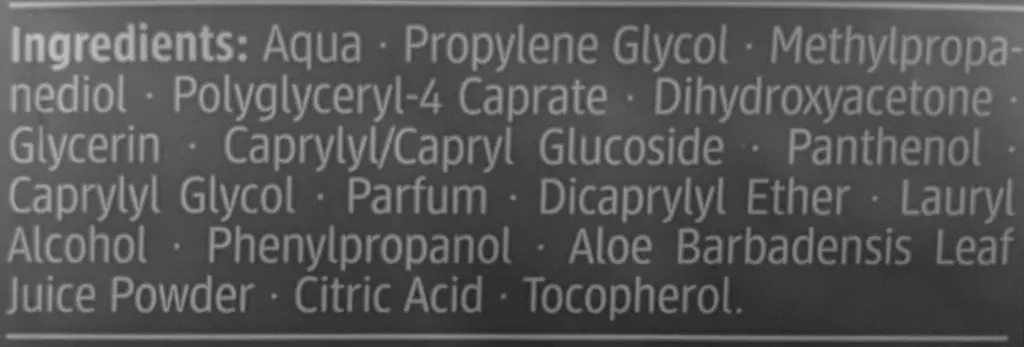
A look at the ingredient list is still worthwhile. If you react to fragrances, look for „parfum.“ It appears on almost every product here, including the Tanologist drops, which one retailer describes as odor-neutral. In the Garnier concentrate for the face, on the other hand, the manufacturer does not list any parfum.
How long does the color last, and how long does the bottle?
According to the manufacturers, the St. Tropez tan lasts up to ten days and the Garnier mousse up to one week. These are maximum values. If you bathe often, swim or exfoliate vigorously, the color fades faster.
The bottle itself ages, too. According to Stiftung Warentest, the German consumer testing organization, the tanning agent dihydroxyacetone (DHA) can release formaldehyde, and the amount rises with storage time and heat. The testers advise storing self-tanner somewhere cool and dark, closing it tightly after opening, using it up quickly and throwing out expired products. So the big supply bottle for the whole summer in the bathroom cabinet is not a good idea.
Does the tan protect me from sunburn?
No. As early as 2000, the cosmetics commission of what is now the German Federal Institute for Risk Assessment (BfR) stated that the brown pigments formed by DHA and erythrulose do not block UV light. If you go out in the sun, you still need clothing, a hat or sunscreen. Garnier, Clarins and Bondi Sands state this explicitly on their products. For the face, our guide to facial sunscreen (in German) can help.
And is DHA itself a concern? In 2010, the EU’s Scientific Committee on Consumer Safety (SCCS) concluded that DHA as a tanning agent poses no health risk to consumers at up to ten percent in cosmetics and up to 14 percent in spray-tanning booths. Bondi Sands recommends testing the product on a small area of the forearm 24 hours beforehand and not applying it to irritated or broken skin. If you are pregnant or have a skin condition, check with a doctor before use.
Six self-tanners compared
| Model | Format | Stated development time and how long it lasts | Best for |
|---|---|---|---|
| St. Tropez Classic Bronzing Mousse | tinted mousse, 240 ml | 4–8 hours, up to 10 days (manufacturer) | beginners, full body |
| Garnier Ambre Solaire Natural Bronzer Selbstbräunungs-Mousse | transparent mousse, 200 ml | up to one week (manufacturer) | small budget, body and face |
| Bondi Sands Liquid Gold Self Tanning Foam | mousse with argan oil, 200 ml | leave on 6–8 hours (retailer information) | deeper tan, coconut scent |
| Clarins Lait Fondant Auto-Bronzant | milk, 125 ml | daily until desired shade (manufacturer) | gradual tan, face and body |
| Isle of Paradise Self-Tanning Drops | drops, 30 ml | 1–12 drops into your skincare (retailer information) | face, color correction by skin tone |
| Tanologist Self Tan Drops | drops, 30 ml | dosed by number of drops (retailer information) | face and body, skincare routine |
St. Tropez Classic Bronzing Mousse
The classic among the mousses, and our favorite for beginners. The golden guide color shows you where there are still gaps as you apply it. According to the manufacturer, the mousse is vegan and contains vitamin E.
Garnier Ambre Solaire Natural Bronzer Selbstbräunungs-Mousse
A transparent mousse with coconut water, vegan according to Garnier and intended for body and face. There is no need to wash it off. Without a tint, it takes a little more care the first time, but your bed sheets are more likely to stay clean. If you just want to try self-tanning, this is the affordable way in.
Bondi Sands Liquid Gold Self Tanning Foam
According to retailer information, the foam combines DHA with erythrulose and argan oil and smells of coconut. Bondi Sands recommends a waiting time of six to eight hours and, for more color, a second layer after 30 minutes. It is more for experienced users looking for a deeper tan.
Clarins Lait Fondant Auto-Bronzant
This self-tanning milk builds up color day by day. Clarins relies on DHA and erythrulose, plus aloe vera and fig, and points out that the milk contains no UV filters. If you are worried about a harsh jump in color, this slow method serves you well.
Isle of Paradise Self-Tanning Drops
The drops come in three color-coded shades. Light is peach-colored, Medium is green to visually even out redness, and Dark is violet to counter yellowish tones. That is how the manufacturer’s text at the retailer describes it. One to twelve drops go into your cream, and more drops give more color. A revised version labeled „2.0“ is now turning up in stores.
Tanologist Self Tan Drops
Here, too, the drops go into your own moisturizer. The retailer describes the drops as vegan and cruelty-free. A small contradiction: although they are described as odor-neutral, the ingredient list still includes parfum.
Which self-tanner for whom?
- First time on the whole body: St. Tropez Classic Bronzing Mousse with a mitt, because the tint makes mistakes visible.
- Just trying it out: the Garnier mousse, transparent and uncomplicated.
- Slow and controlled: Clarins Lait Fondant, a little every day.
- Face only: mix Isle of Paradise or Tanologist into your usual cream; with no parfum on the list, the Garnier concentrate is an alternative.
- Deep tan for experienced users: Bondi Sands Liquid Gold.
And no matter how tanned the result turns out: sunscreen is still a must.
Frequently asked questions
What is the difference between self-tanning mousse, lotion and drops?
Mousse dries quickly and spreads easily over large areas with a mitt, but it is not very forgiving. Lotions and milks work more slowly and give you more control; Clarins recommends daily application until you reach the shade you want. Drops go into your own cream: the more drops, the darker. That works especially well for the face.
How do you avoid patches and streaks with self-tanner?
Preparation matters more than the product. Bondi Sands calls for cleansed, exfoliated skin with no cream residue. St. Tropez advises moisturizing knees, elbows and ankles beforehand. An application mitt protects your palms; wash your hands afterward. With a transparent mousse, a fixed order helps: leg by leg, arm by arm.
How long should you wait to shower after applying self-tanner?
St. Tropez gives a development time of four to eight hours for the Classic Mousse and recommends waiting eight hours before showering. Bondi Sands states six to eight hours for the Liquid Gold Foam. Applying it in the evening and letting it develop overnight is therefore the usual approach.
Does a tan from self-tanner protect against sunburn?
No. As early as 2000, the cosmetics commission of what is now the German Federal Institute for Risk Assessment (BfR) stated that the brown pigments formed by DHA and erythrulose do not block UV light. In the sun, you still need clothing, a hat or sunscreen. Garnier, Clarins and Bondi Sands state this explicitly on their products.
Is the DHA in self-tanner a health concern?
In 2010, the EU's Scientific Committee on Consumer Safety (SCCS) concluded that DHA in cosmetics at up to ten percent poses no health risk to consumers. Bondi Sands recommends a patch test on the forearm 24 hours beforehand. If you are pregnant or have a skin condition, check with a doctor before use.
How should you store self-tanner?
Cool and dark. According to Stiftung Warentest (the German consumer testing organization), DHA can release formaldehyde, and the amount rises with storage time and heat. The testers advise closing the bottle tightly after opening, using it up quickly and throwing out expired products. A large supply bottle in a warm bathroom cabinet is therefore not a good idea.
Sources
- St. Tropez: Classic Bronzing Mousse
- Garnier: Natural Bronzer self-tanning mousse
- Garnier: Natural Bronzer self-tanning concentrate
- Clarins: Lait Fondant Auto-Bronzant
- Müller (German retailer): Bondi Sands Liquid Gold Self Tanning Foam (retailer information)
- Cult Beauty: Isle of Paradise Self-Tanning Drops (retailer information)
- Lookfantastic: Tanologist Face and Body Drops (retailer information)
- BgVV/BfR (German federal authorities): Report on the 61st meeting of the Cosmetics Commission, 30.11.2000
- SCCS: Opinion on Dihydroxyacetone (SCCS/1347/10), 14.12.2010
- Stiftung Warentest: Self-tanners tested (test 04/2023)
Where to buy
- St. Tropez Classic Bronzing MousseCheck price at Amazon.deCheck price at Amazon.co.ukCheck price at Amazon.nlCheck price at Amazon.com.beCheck price at Amazon.frCheck price at Amazon.itCheck price at Amazon.esCheck price at Amazon.plCheck price at Amazon.seAvailable in Germany: Amazon.de
- Garnier Ambre Solaire Natural Bronzer Selbstbräunungs-MousseCheck price at Amazon.deCheck price at Amazon.co.ukCheck price at Amazon.nlCheck price at Amazon.com.beCheck price at Amazon.frCheck price at Amazon.itCheck price at Amazon.esCheck price at Amazon.plCheck price at Amazon.seAvailable in Germany: Amazon.de
- Bondi Sands Liquid Gold Self Tanning FoamCheck price at Amazon.deCheck price at Amazon.co.ukCheck price at Amazon.nlCheck price at Amazon.com.beCheck price at Amazon.frCheck price at Amazon.itCheck price at Amazon.esCheck price at Amazon.plCheck price at Amazon.seAvailable in Germany: Amazon.de
- Clarins Lait Fondant Auto-BronzantCheck price at Amazon.deCheck price at Amazon.co.ukCheck price at Amazon.nlCheck price at Amazon.com.beCheck price at Amazon.frCheck price at Amazon.itCheck price at Amazon.esCheck price at Amazon.plCheck price at Amazon.seAvailable in Germany: Amazon.de
- Isle of Paradise Self-Tanning DropsCheck price at Amazon.deCheck price at Amazon.co.ukCheck price at Amazon.nlCheck price at Amazon.com.beCheck price at Amazon.frCheck price at Amazon.itCheck price at Amazon.esCheck price at Amazon.plCheck price at Amazon.seAvailable in Germany: Amazon.de
- Tanologist Self Tan DropsCheck price at Amazon.deCheck price at Amazon.co.ukCheck price at Amazon.nlCheck price at Amazon.com.beCheck price at Amazon.frCheck price at Amazon.itCheck price at Amazon.esCheck price at Amazon.plCheck price at Amazon.seAvailable in Germany: Amazon.de