Contents13 sections
This guide was first published in German on handgetestet.de.
For a window cleaning robot, a conservatory is not simply a particularly large window. It consists of three tasks, and the device can really only take over one of them: the smooth side walls. For framed panes, we consider the Kärcher RCW 4 the most sensible purchase, because it needs no station and its manual clearly sets out the permitted tilt. If there is no power outlet within reach and the floor is seamless, the Ecovacs WINBOT W2S OMNI is the better fit. Panes divided by muntins are often done faster with a window vacuum. The glass roof stays a job for a pole, a hose or a professional cleaning company in any case.
The glass roof first, because this is where the technology ends
In its manual, Kärcher specifies the RCW 4 for vertical, framed glass surfaces with a maximum tilt of ±45 degrees. Ecovacs gives the same angle for the W2S series in its data sheet, without saying what it is measured from. We go by Kärcher’s reading: deviation from vertical. A glass roof with a 10-degree slope is then 80 degrees off. Far outside the range.
For the WINBOT W3 OMNI and the mini 2, the data sheet lists no tilt value at all. None of the manufacturers named here gives approval for glass lying flat.
Kärcher describes what works instead quite soberly: first remove leaves and loose dirt, clear the gutter, rinse from the highest point downward, then work with a telescopic pole and brush on the garden hose. As an alternative, the company recommends a pressure washer with a telescopic lance and glass attachment at low pressure, bearing in mind that the company also sells such devices. Twice a year is given there as a guideline, ideally on an overcast day. Even with the pole, you often still need a secure footing; what matters there is covered in our ladder guide. Do not step onto the roof itself unless the conservatory builder expressly permits it. For large or high roofs, we would hire a professional cleaning company.
Muntins: which ones get in the way and which do not
If the muntins sit between the panes of the glazing unit, the robot does not notice them at all. The surface stays smooth. Muntins mounted on the glass, by contrast, divide the pane into individual sections, and each section is a separate window for the device. So you move it by hand every time.
That is why the smallest section decides. According to Ecovacs, the W2S models require at least 30 × 40 cm, while the WINBOT mini 2 manages with 25 × 25 cm. Kärcher even sets 40 × 40 cm for the RCW 4. A door with eight sections of 35 × 35 cm therefore rules out the W2S and the RCW 4, and with the mini 2 it would take eight runs for a single side. In that case, we would rather reach for the window vacuum.
Frame edges, folding doors and other stumbling blocks
Ecovacs‘ safety instructions apply to many conservatory details. Frames less than 5 mm wide are off-limits. The manufacturer counts frames that stand less than 2 mm above the glass among the unfavorable cases, because the robot has trouble detecting them. You should therefore measure flat cover strips beforehand. Ecovacs also rules out handles above 70 to 105 mm in height.
All-glass sliding and folding systems are tricky. The device must not move across two frameless panes with a gap between them, because it can lose its grip there. On frameless glass, the starting point should be more than 10 cm from the edge, and glass doors are opened before the robot is put in place. Kärcher rules out damaged window seals.
Where the 5.5 meters of cable end
On the W2S OMNI, the W2S PRO OMNI and the W3 OMNI, a 5.5 m combined cable connects the robot and the station. Ecovacs gives 8 × 2.5 m as the largest single pane, on the W2S PRO OMNI and the W3 OMNI explicitly only in zone mode. Above 2.5 m in height, things get tight, and that is not unusual in tall conservatories.
On the outside, there is a second limit. The plug and power supply belong indoors, on the W3 OMNI explicitly the station as well, and a window must not be closed on the cable. You therefore cannot reach fixed glazing at the far end of a 7 m front from the open door.
Then there is the floor, and it carries a lot of weight. According to the manual, the Ecovacs station should only stand on a level, seamless surface; the manufacturer rules out carpets and tiles with joints. It must not be placed on raised surfaces either. In a tiled conservatory, the Omni concept therefore does not match the manufacturer’s own requirements, and Ecovacs offers no way around this. Devices without a station, such as the RCW 4 or the Hobot 2S, do not have this problem. The Winbots also only work between 0 and 40 °C and up to 85 percent humidity, the W2S PRO OMNI only from 4 °C. A heated-up glass extension in July or humid air above lots of plants quickly falls outside that range.
And the grip? Ecovacs advertises 8,000 Pa for the W2S OMNI. The data sheet lists 3,000 Pa for operation, and Kärcher also gives 3,000 Pa for the RCW 4. So the big number is of little use as a reason to buy. The insurance against suction loss mentioned by Ecovacs is best checked in the terms beforehand. None of these devices runs unattended, and nobody may stand below the work area.
Six devices for the side walls
| Model | Power and reach | Smallest section | Tilt according to manufacturer | Best for |
|---|---|---|---|---|
| Kärcher RCW 4 | Mains power, 5 m cable, 4 m rope | 40 × 40 cm | ±45° | Framed panes, also with tiled floors |
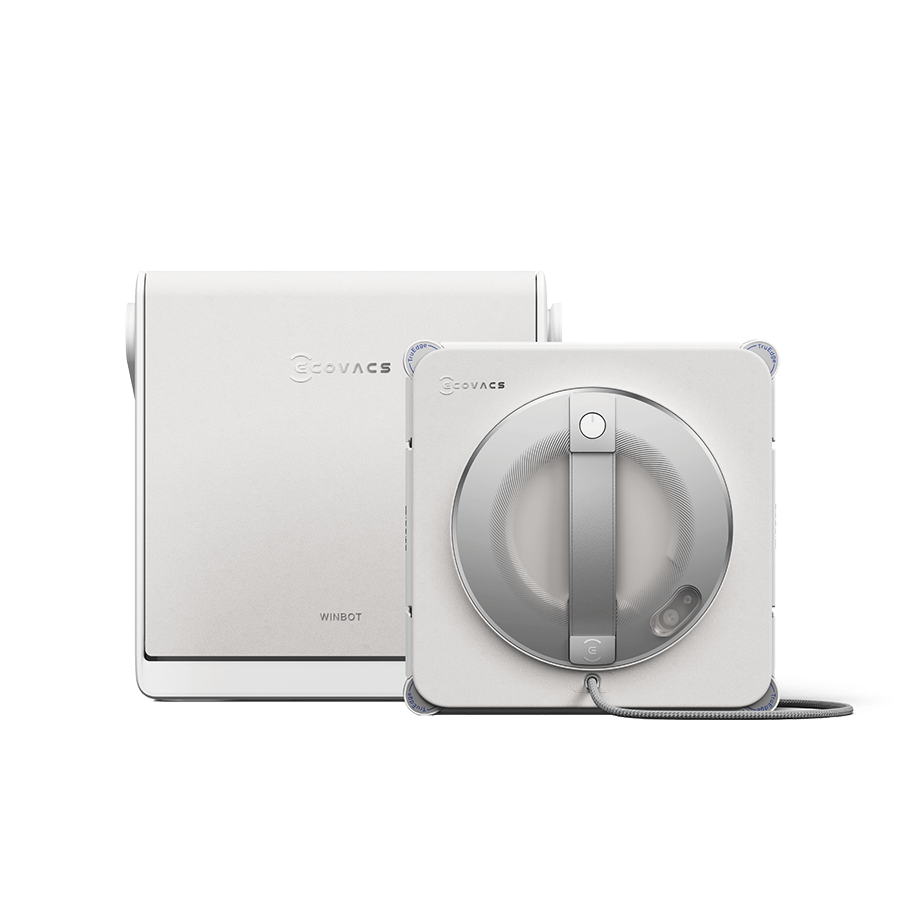
| Ecovacs WINBOT W2S OMNI | Battery in the station, up to 110 min, 5.5 m cable | 30 × 40 cm | 45° | Seamless floor, no power outlet nearby |
| Ecovacs WINBOT W2S PRO OMNI | Battery in the station, up to 110 min, 5.5 m cable | 30 × 40 cm | ±45° | Inclined panes, lots of glass |
| Ecovacs WINBOT mini 2 | Mains power, panes up to about 3 × 2.5 m | 25 × 25 cm | not stated | Smaller sections, skylights |
| Hobot 2S | Mains power, 5 m cable, 4.5 m rope | not stated | not stated | Fronts with a fixed anchor point inside |
| Kärcher WV 5 Ultra Care | Handheld device, 45 min battery, approx. 135 m² | Interchangeable small nozzle | Inclined, horizontal, overhead | Muntins and anything within reach |
Kärcher RCW 4
No station, and therefore no requirements for the floor. According to the manual, the 4 m rope can be looped around a handle, table leg or hook, or clamped in the window if necessary. Kärcher states 40 minutes of backup power and around 100 m² per tank fill. On the other hand, it always needs a power outlet, and 40 × 40 cm is the largest minimum section here. The product page advertises frameless glass, while the manual talks about framed surfaces; so you had better plan on frames. You have to wipe off bird droppings and pollen yourself beforehand.
Ecovacs WINBOT W2S OMNI
According to Ecovacs, the station weighs 5.2 kg and runs on a battery, so you do not need a power outlet at the pane. The cable is said to withstand up to 100 kg of pull. This is set against clear drawbacks: the floor has to be seamless, the station has to be carried along, and according to the data sheet the tank only covers about 50 m² in quick mode.
Ecovacs WINBOT W2S PRO OMNI
Here Ecovacs explicitly states ±45 degrees, that is, in both directions, and around 75 m² per tank fill. For conservatories with an inclined front, that is the reason for the extra cost. In cold weather, you have to stop sooner, because the manual sets 4 °C as the lower limit.
Ecovacs WINBOT mini 2
Small and, at 1.3 kg, light. According to the manual, panes over 3 m long or 2.5 m high are the limit, and the power supply has to lie on the floor rather than hang from the cable.
Hobot 2S
Hobot supplies a 4.5 m rope that, according to the manufacturer, holds 200 kg of tensile load, and keeps the device on the pane for 20 minutes during a power failure. That is shorter than with Ecovacs and Kärcher. Hobot gives no tilt approval; its advertising talks about vertical surfaces.
Kärcher WV 5 Ultra Care
Not a robot, and that is exactly why it is included here. With its interchangeable small nozzle, it reaches sections that every robot leaves out. In return, you do the work yourself.
What we would buy for which conservatory
- Framed panes from 40 × 40 cm, power outlet within reach, tiles with joints: Kärcher RCW 4.
- No power outlet close to the pane and a seamless floor: WINBOT W2S OMNI.
- Inclined front and lots of glass in one piece: W2S PRO OMNI, if the extra cost is acceptable to you.
- Muntins mounted on most of the panes: no robot, but the WV 5 Ultra Care.
- Glass roof: pole and hose, or a professional cleaning company if it is high or you are in doubt.
Frequently asked questions
Can a window cleaning robot clean the glass roof of a conservatory?
No. Kärcher approves the RCW 4 for a maximum tilt of ±45 degrees from vertical; a glass roof with a 10-degree slope is 80 degrees off. None of the manufacturers gives approval for glass lying flat. Kärcher recommends a telescopic pole with a brush on the garden hose; for large or high roofs, a professional cleaning company makes sense.
Can a window cleaning robot cope with muntins?
That depends on the design. Muntins between the panes of the glazing unit do not get in the way. Muntins mounted on the glass divide the pane into sections, and each section is a separate window for the robot. The W2S models require at least 30 × 40 cm, the WINBOT mini 2 manages with 25 × 25 cm. With many small sections, a window vacuum is faster.
What do I need to watch out for with folding doors and frameless glass?
According to Ecovacs, the robot must not move across two frameless panes with a gap between them, because it can lose its grip. On frameless glass, the starting point should be more than 10 cm from the edge. Frames less than 5 mm wide are off-limits, and the robot has trouble detecting frames less than 2 mm high.
Why does an Ecovacs station not fit into every conservatory?
According to the manual, the station should only stand on a level, seamless surface; Ecovacs rules out carpets and tiles with joints. The combined cable measures 5.5 m, so above a pane height of 2.5 m it gets tight. The Winbots also only work between 0 and 40 °C. Devices without a station, such as the RCW 4, do not have the floor problem.
Does suction power in pascals say anything about grip on the glass?
Not much. Ecovacs advertises 8,000 Pa for the W2S OMNI, while the data sheet lists 3,000 Pa for operation, the same as the Kärcher RCW 4. More important are the safety rope and supervision: none of these devices runs unattended, and nobody may stand below the work area.
Sources
- Ecovacs: WINBOT W2S OMNI, product page and data sheet
- Ecovacs: WINBOT W2S OMNI, user manual
- Ecovacs: WINBOT W2S PRO OMNI, product page and data sheet
- Ecovacs: WINBOT W2S PRO OMNI, user manual
- Ecovacs: WINBOT W3 OMNI, user manual
- Ecovacs: WINBOT mini 2, product page and data sheet
- Ecovacs: WINBOT mini 2, user manual
- Kärcher: Window cleaning robots
- Kärcher: RCW 4, product page
- Kärcher: RCW 4, operating instructions
- Kärcher: WV 5 Ultra Care
- Kärcher: Cleaning a conservatory
- Hobot: HOBOT-2S
Where to buy
- Ecovacs WINBOT W2S OMNIView at EcovacsAvailable in Germany: EcovacsCheck price at Amazon.deCheck price at Amazon.co.ukCheck price at Amazon.nlCheck price at Amazon.com.beCheck price at Amazon.frCheck price at Amazon.itCheck price at Amazon.esCheck price at Amazon.plCheck price at Amazon.seAvailable in Germany: Amazon.de
- Ecovacs WINBOT W2S PRO OMNIView at EcovacsAvailable in Germany: EcovacsCheck price at Amazon.deCheck price at Amazon.co.ukCheck price at Amazon.nlCheck price at Amazon.com.beCheck price at Amazon.frCheck price at Amazon.itCheck price at Amazon.esCheck price at Amazon.plCheck price at Amazon.seAvailable in Germany: Amazon.deView at CoolblueAvailable in Germany: Coolblue
- Ecovacs WINBOT mini 2View at EcovacsAvailable in Germany: EcovacsCheck price at Amazon.deCheck price at Amazon.co.ukCheck price at Amazon.nlCheck price at Amazon.com.beCheck price at Amazon.frCheck price at Amazon.itCheck price at Amazon.esCheck price at Amazon.plCheck price at Amazon.seAvailable in Germany: Amazon.deTry a sample at CoolblueTry a sample at Coolblue
- Kärcher RCW 4Check price at Amazon.deCheck price at Amazon.co.ukCheck price at Amazon.nlCheck price at Amazon.com.beCheck price at Amazon.frCheck price at Amazon.itCheck price at Amazon.esCheck price at Amazon.plCheck price at Amazon.seAvailable in Germany: Amazon.de
- Hobot 2SCheck price at Amazon.deCheck price at Amazon.co.ukCheck price at Amazon.nlCheck price at Amazon.com.beCheck price at Amazon.frCheck price at Amazon.itCheck price at Amazon.esCheck price at Amazon.plCheck price at Amazon.seAvailable in Germany: Amazon.de
- Kärcher WV 5 Ultra CareCheck price at Amazon.deCheck price at Amazon.co.ukCheck price at Amazon.nlCheck price at Amazon.com.beCheck price at Amazon.frCheck price at Amazon.itCheck price at Amazon.esCheck price at Amazon.plCheck price at Amazon.seAvailable in Germany: Amazon.de