Contents14 sections
This guide was first published in German on handgetestet.de.
For most roof windows, a window cleaning robot is the wrong purchase. Center-pivot windows can be rotated for cleaning, which brings the outer pane into the room to you, and for that a cordless window vacuum such as the Kärcher WV 2 Universal Care is enough. We would only consider a robot if the roof pitch is at least 45 degrees, the pane is large enough and there is an anchor point indoors. That applies to few windows.
Can a robot run on inclined glass at all?
Only within limits. The term roof window does not appear in any of the manuals we reviewed. Kärcher designates the RCW 4 for vertical, framed glass surfaces with an incline of no more than ±45 degrees. In the data sheet for the W2S series, Ecovacs lists a maximum angle for inclined windows: ±45 degrees for the W2S PRO OMNI. For the W3 OMNI, the W2 PRO and the mini models, no such value is given. Hobot describes the 2S for vertical surfaces.
Now for the calculation where many purchases fail. Kärcher measures from the vertical, whereas roof pitches are measured from the horizontal. VELUX specifies installation between 20 and 85 degrees for the VU center-pivot window, and 15 to 55 degrees for the GPL top-hung and pivot window, up to 75 in special cases. On a roof with a 35-degree pitch, the pane is therefore 55 degrees from vertical and thus outside the approved range. It only works from a 45-degree roof pitch, and at 45 degrees you are operating at the limit. Ecovacs does not say what the angle is measured from. We calculate as with Kärcher.
How large does the pane have to be?
On paper, almost any roof window is enough. According to Ecovacs, the W2S models and the W2 PRO require 30 × 40 cm; the RCW 4 needs 40 × 40 cm. The smallest VU window measures 550 × 838 mm on the outside and has a glazed area of 0.22 m².
In practice, things look different. At 272 × 272 mm, a W2S PRO OMNI covers around 0.07 m², almost a third of that area. That leaves little room to travel, and Ecovacs itself writes that the units work best on large windows. Only with formats such as the VU Y99 with 1.60 m² of glazed area does the robot have real work to do.
Does it detect the frame?
We cannot promise that across the board. For most models, Ecovacs specifies a frame height of 2 mm as the minimum and excludes frames less than 5 mm wide. How high the edge around your outer pane is cannot be found in any of the window manufacturers‘ data sheets we read. Measure it. If the glass sits almost flush, the window is one of the difficult cases for the robot.
The dirt also argues against it. VELUX warns against rubbing off dried-on dirt without first soaking it with water. Kärcher requires pre-cleaning for bird droppings and heavy pollen anyway, and Ecovacs wants the pane checked for small particles before starting so that nothing scratches. That is exactly the kind of soiling found on inclined glass that is rarely cleaned.
Where should the safety cord go?
This is where it gets serious. For exterior windows, Ecovacs requires a secure anchor point indoors, no wind and dry weather, and no one may stand below the work area. Kärcher allows the cord to be looped around a handle, table leg or hook, or clamped in the window. Ecovacs, on the other hand, prohibits closing a window on the power cable. With a Winbot that has a combined cable, that option is ruled out, and the window stays open while the robot runs.
That leaves the question of how the unit gets to the outside. With the sash rotated, you stand safely in the room, but the robot then hangs beneath a movable sash. VELUX says nothing about whether the cleaning bolts are designed for such a load, and Kärcher lists moving windows among the things that interfere with the travel path. With the window closed, you would have to lean out or climb onto the roof. We strongly advise against that. If a unit falls, it hangs on its cord outside on the roof tiles, and to retrieve it, you face the same problem again. For the inner glass, too: according to Aktion Das Sichere Haus (German home safety association), stools and drink crates are not safe climbing aids; you will find a suitable ladder in our ladder guide.
What works instead?
Rotating. For the VU, GPL and GPU, VELUX describes how the sash rotates 180 degrees and can be locked in place with cleaning bolts. On the GDL model, this gives access to the upper outer pane; you reach the lower one through the opened upper sash. You have both hands free. The type plate tells you which window you have; more on this in our article on smart roof windows.
According to VELUX, clean water is usually enough, along with a soft cloth or a squeegee with a rubber blade. Window vacuums work without drips, which matters under a sloped ceiling. Kärcher and Leifheit explicitly specify their units for inclined and overhead use. A note for VELUX owners: the GDL manual warns against contact with silicone without saying whether only sealants are meant, and the WV 5 Ultra Care has a silicone blade. If in doubt, ask the window manufacturer. The basics are in our window vacuum guide, and the comparison of designs for vertical glass is in our guide to window cleaning robots (in German).
Six devices compared on sloped glass
| Model | Type | Incline according to manufacturer | Smallest pane | Best for |
|---|---|---|---|---|
| Kärcher WV 2 Universal Care | Window vacuum, battery 35 min | Inclined, horizontal, overhead | no limit stated | rotating roof windows |
| Kärcher WV 5 Ultra Care | Window vacuum, battery 45 min | Inclined, horizontal, overhead | small nozzle interchangeable | narrow panes, dormers |
| Leifheit Dry & Clean | Window vacuum, battery up to 38 min | Inclined, horizontal, overhead | 17 cm nozzle available | if you also want an extension pole |
| Kärcher RCW 4 | Robot, mains-powered, 4 m cord | ±45° | 40 × 40 cm | large panes, roof pitch 45° and up |
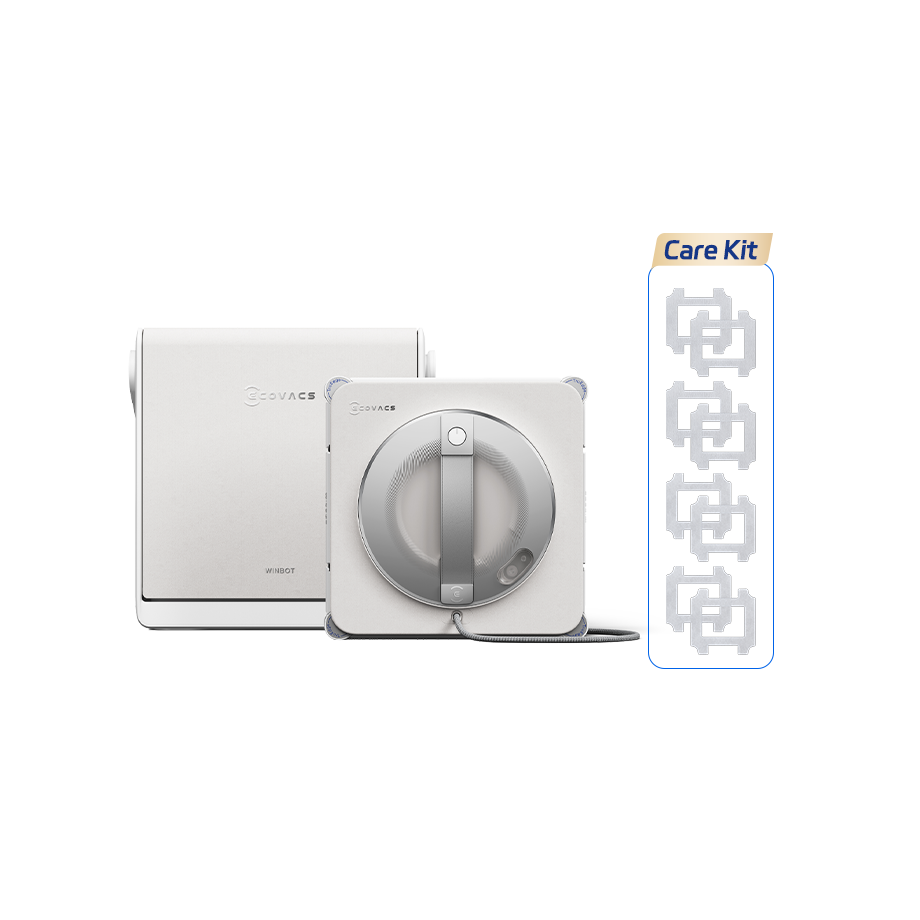
| Ecovacs WINBOT W2S PRO OMNI | Robot, station with battery | ±45° | 30 × 40 cm | large panes, roof pitch 45° and up, seamless floor |
| Ecovacs WINBOT W2 PRO | Robot, mains-powered | not specified | 30 × 40 cm | vertical windows, not for roofs |
Kärcher WV 2 Universal Care
At 0.6 kg, it stays easy to handle even overhead, and 35 minutes of runtime is enough for a few roof windows. For the scope of delivery, Kärcher lists only the large 280 mm nozzle.
Kärcher WV 5 Ultra Care
The second, small nozzle helps on narrow panes. According to Kärcher, however, the battery takes 345 minutes to charge, and the blade is made of silicone.
Leifheit Dry & Clean
Leifheit also sells it in a set with an extension pole and specifies up to 38 minutes of runtime. The pole does not replace a safe place to stand.
Kärcher RCW 4
The robot with the clearest rule: the incline is stated in the manual. It is still not intended for roofs with a pitch below 45 degrees, and it needs a power outlet. The cord is 4 m long, and backup power lasts 40 minutes.
Ecovacs WINBOT W2S PRO OMNI
The Ecovacs model with an explicit ±45 degrees. The station, which weighs around 5 kg, is supposed to stand on a level, seamless floor, though, not on tables and not on carpet. Under the slope of an attic room, that quickly becomes a problem. For one or two roof windows, the effort is too great for us.
Ecovacs WINBOT W2 PRO
It is listed here as a warning. Designed for vertical panes, with no incline specification in the data sheet. If you buy it for the roof, you do so at your own risk, because Ecovacs excludes liability in its manuals for damage caused by improper use.
When it won’t work
- Roof pitch below 45 degrees: no robot, regardless of brand.
- Fixed glazing or a skylight dome without access from inside: hire a professional.
- No anchor point for the cord, wind or rain: do not start.
- Pane only just above the minimum size: it is faster to clean by hand.
- Rotating center-pivot window: window vacuum or cloth; the WV 2 Universal Care is enough.
Frequently asked questions
Can a window cleaning robot be used on a roof window?
Only within limits. Kärcher approves the RCW 4 for glass inclined by no more than ±45 degrees, measured from the vertical. Roof pitches, by contrast, are measured from the horizontal. On a roof with a 35-degree pitch, the pane is therefore 55 degrees from vertical and outside the approved range. It only works from a 45-degree roof pitch.
How large does a roof window have to be for a window cleaning robot?
On paper, almost any will do: Ecovacs requires 30 × 40 cm, Kärcher 40 × 40 cm. In practice, though, a W2S PRO OMNI covers almost a third of the glazed area of a small VELUX window with 0.22 m². That leaves little room to travel. Only on large formats does the robot have real work to do.
Does the robot detect the frame of a roof window?
Not reliably. For most models, Ecovacs specifies a frame height of 2 mm as the minimum and excludes frames less than 5 mm wide. How high the edge around the outer pane is cannot be found in any window manufacturer's data sheet. Measure it: if the glass sits almost flush, the window is a difficult case.
Where do I attach the safety cord on a roof window?
Ecovacs requires a secure anchor point indoors, no wind and dry weather, and no one may stand below the work area. Ecovacs prohibits closing a window on the power cable. Leaning out or climbing onto the roof is not a solution. If a unit falls, it ends up hanging outside on the roof tiles.
How do I clean a roof window without a robot?
By rotating it. On VELUX center-pivot windows such as VU, GPL and GPU, the sash rotates 180 degrees and can be locked in place with cleaning bolts. According to VELUX, clean water is usually enough, along with a soft cloth or squeegee. Window vacuums from Kärcher and Leifheit are explicitly approved for inclined and overhead use.
What should I watch out for when using a window vacuum on VELUX windows?
The GDL manual warns against contact with silicone without saying whether only sealants are meant. The Kärcher WV 5 Ultra Care has a silicone blade, so if in doubt, ask the window manufacturer. According to VELUX, dried-on dirt should be soaked with water first rather than rubbed off.
Sources
- Kärcher: Window cleaning robots
- Kärcher: RCW 4, product page
- Kärcher: RCW 4, operating manual
- Kärcher: WV 2 Universal Care
- Kärcher: WV 5 Ultra Care
- Leifheit: Dry & Clean window vacuum
- Ecovacs: WINBOT W2S PRO OMNI, product page and data sheet
- Ecovacs: WINBOT W2S PRO OMNI, user manual
- Ecovacs: WINBOT W2 PRO, product page and data sheet
- Ecovacs: WINBOT W3 OMNI, user manual
- Hobot: HOBOT-2S
- VELUX: VU center-pivot window, product data sheet
- VELUX: GPL top-hung and pivot window, product data sheet
- VELUX: GPU top-hung and pivot window, product data sheet
- VELUX: GDL operating instructions
- Aktion Das Sichere Haus and GDV (German Insurance Association): Fall and tripping hazards during housework
Where to buy
- Kärcher WV 2 Universal CareCheck price at Amazon.deCheck price at Amazon.co.ukCheck price at Amazon.nlCheck price at Amazon.com.beCheck price at Amazon.frCheck price at Amazon.itCheck price at Amazon.esCheck price at Amazon.plCheck price at Amazon.seAvailable in Germany: Amazon.de
- Kärcher WV 5 Ultra CareCheck price at Amazon.deCheck price at Amazon.co.ukCheck price at Amazon.nlCheck price at Amazon.com.beCheck price at Amazon.frCheck price at Amazon.itCheck price at Amazon.esCheck price at Amazon.plCheck price at Amazon.seAvailable in Germany: Amazon.de
- Leifheit Dry & CleanCheck price at Amazon.deCheck price at Amazon.co.ukCheck price at Amazon.nlCheck price at Amazon.com.beCheck price at Amazon.frCheck price at Amazon.itCheck price at Amazon.esCheck price at Amazon.plCheck price at Amazon.seAvailable in Germany: Amazon.de
- Kärcher RCW 4Check price at Amazon.deCheck price at Amazon.co.ukCheck price at Amazon.nlCheck price at Amazon.com.beCheck price at Amazon.frCheck price at Amazon.itCheck price at Amazon.esCheck price at Amazon.plCheck price at Amazon.seAvailable in Germany: Amazon.de
- Ecovacs WINBOT W2S PRO OMNIView at EcovacsAvailable in Germany: EcovacsCheck price at Amazon.deCheck price at Amazon.co.ukCheck price at Amazon.nlCheck price at Amazon.com.beCheck price at Amazon.frCheck price at Amazon.itCheck price at Amazon.esCheck price at Amazon.plCheck price at Amazon.seAvailable in Germany: Amazon.deView at CoolblueAvailable in Germany: Coolblue
- Ecovacs WINBOT W2 PROView at EcovacsAvailable in Germany: EcovacsCheck price at Amazon.deCheck price at Amazon.co.ukCheck price at Amazon.nlCheck price at Amazon.com.beCheck price at Amazon.frCheck price at Amazon.itCheck price at Amazon.esCheck price at Amazon.plCheck price at Amazon.seAvailable in Germany: Amazon.de