Contents14 sections
This guide was first published in German on handgetestet.de.
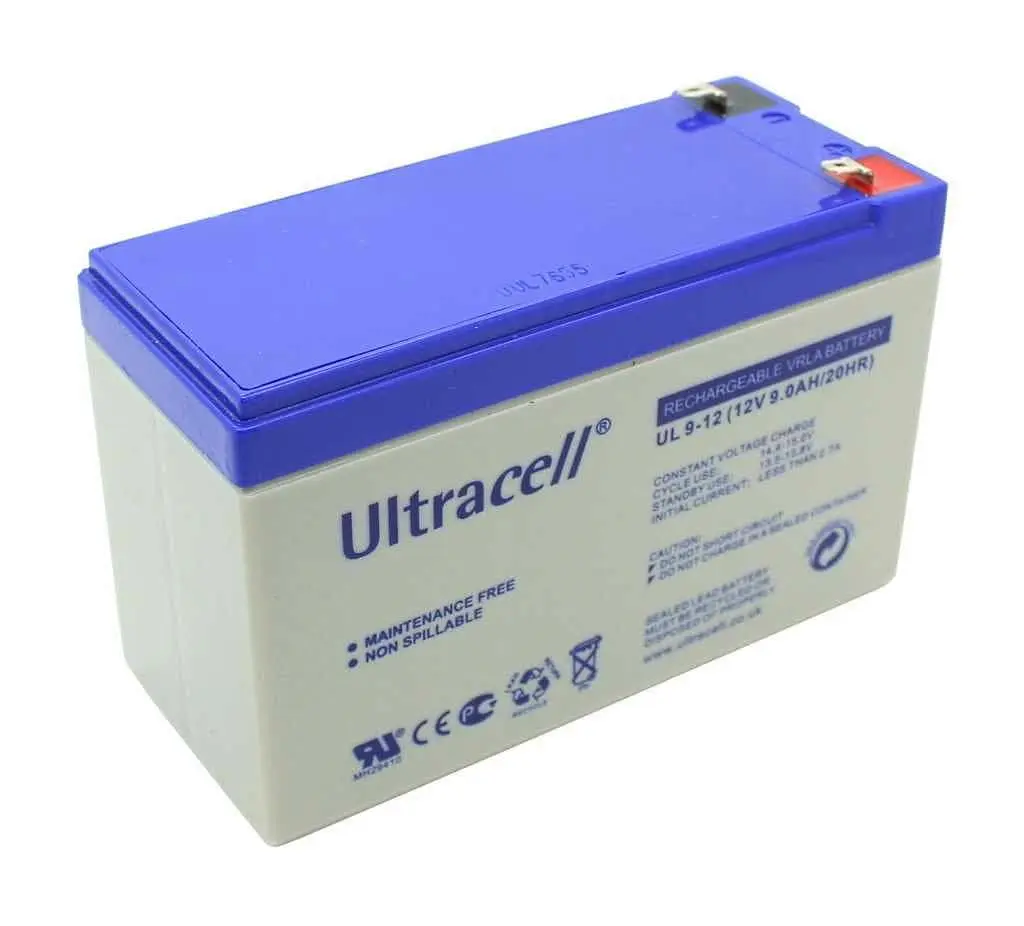
A new lead-acid battery for a lawn tractor, alarm system or kids‘ ride-on car only fits if four values match: voltage, capacity, case size and terminal type. The brand comes second. In the entry-level class we recommend the Long WPL7.2-12, because Long lists it as a long-life type designed for 10 to 12 years; in the mid-range class the Ultracell UL9-12 with 9 Ah in the standard 7 Ah case; and in the premium class the cycle-resistant Multipower MP12-12C. But first, get out the tape measure.
What are the dimensions of a 12 V lead-acid battery?
The most common battery around the house has a footprint of 151 × 65 mm and is 97.5 to 102 mm tall including terminals. Yuasa, Fiamm, Long, Multipower and CSB build their 12 V types with 7 to 7.2 Ah into this case, and Ultracell even fits 9 Ah. Measure the height: there are 4.5 mm between Yuasa (97.5 mm) and Long (102 mm), and some battery compartments are tight.
- 12 V, 7 to 9 Ah: 151 × 65 × 97.5 to 102 mm (alarm system, UPS, emergency lighting, gate opener)
- 12 V, 12 Ah: 151 × 98 × 98 mm for the Multipower MP12-12C
- 12 V, 18 Ah: 181 × 76 × 167 mm for the Multipower MP18-12 (typical for riding mowers)
- 6 V, 12 Ah: 151 × 50 × 99 mm for the Multipower MP12-6
- 6 V, 4.5 Ah: 70 × 47 × 106 mm for the Fiamm FG10451
The capacity on the label applies to a discharge over 20 hours. For the Multipower MP7.2-12B, that means 0.36 A until the voltage drops to 10.5 V. If a device draws 7.2 A, only 4.08 Ah remain according to the data sheet. A kids‘ ride-on car with a powerful motor therefore gets considerably less out of a 7 Ah battery than the number promises. Cold costs extra: Ultracell states that 86 percent of the capacity remains at 0 °C.
F1, F2 or screw: the terminal matters too
Small batteries have flat blade terminals according to the Faston standard. F1 stands for 4.75 mm wide tabs (Faston 187), F2 for 6.35 mm (Faston 250); in stores they are usually called 4.8 and 6.3 mm. The difference looks small. But a 4.8 mm cable connector will not slide onto a 6.3 mm tab, and a 6.3 mm connector sits too loosely on the narrow tab. That is why almost every model comes in both versions: Fiamm sells the FG20721 with 4.8 mm and the FG20722 with 6.3 mm, and at Multipower the B in MP7.2-12B stands for 6.3 mm.
Larger batteries have screw terminals. From 18 Ah, Fiamm uses tabs with a hole, the Multipower MP18-12 has M5 threads, and the data sheet for the MP18-12I variant lists 4 Nm as the recommended tightening torque, with a maximum of 6 Nm.
AGM, gel, glass mat: what is inside the battery
In stores, almost all of these batteries are sold as „lead gel.“ Technically, most of them are AGM batteries: the acid is held in a glass fiber mat (Absorbent Glass Mat), which is why they are also called glass mat batteries. Yuasa, Fiamm and CSB explicitly state AGM in their documentation, and Akkuwelt (German retailer) describes the Multipower batteries as „lead gel battery, AGM technology.“ All of them are valve-regulated (VRLA), sealed and maintenance-free. Fiamm allows installation upright or on the side, Yuasa up to a 90-degree tilt. None of them should be installed upside down.
Standby or cycling: why the same battery lasts for different lengths of time
A battery in an alarm system sits on float charge for years and is almost never used. A battery in a kids‘ ride-on car is run flat every weekend. Both are lead-acid batteries, but they lead two completely different lives. The service life in years stated on data sheets refers to the first case. Yuasa states up to 5 years at 20 °C for the NP series (Eurobat class „Standard Commercial,“ 3 to 5 years), Fiamm 5 years for the FG series, and Ultracell also 5 years for the UL9-12. Long, by contrast, classifies the WPL7.2-12 as a long-life type with 10 to 12 years according to Eurobat.
If you discharge cyclically, you need to look at different curves. For the MP12-12C, Multipower shows the number of cycles at 30, 50 and 100 percent depth of discharge. The rule behind it is simple: the deeper the discharge, the fewer the cycles. An electric fence energizer or a kids‘ vehicle that regularly runs until it stops therefore needs an explicitly cycle-resistant battery.
Charging without damage: voltage and current from the data sheet
For float charging, manufacturers state 13.5 to 13.8 V per 12 V battery, Yuasa 13.65 V at 20 °C. Cyclic charging allows more: Yuasa states 14.5 V, Ultracell and CSB 14.4 to 15.0 V, Multipower 14.7 to 14.8 V. For 6 V batteries, half of that applies, so 7.35 to 7.40 V for the MP12-6.
The current is at least as important. The Yuasa NP7-12 tolerates a maximum of 1.75 A during cyclic charging, the Multipower MP7.2-12B 2.16 A, and the Ultracell UL9-12 initially less than 2.55 A. A car battery charger that stubbornly delivers 6 or 10 A is far above that. The right choice is a charger with a dedicated program for small AGM batteries that limits the current; what else a good charger should be able to do is covered in our guide to battery chargers (in German).
Storing over the winter
Lawn tractors and kids‘ ride-on cars sit idle for months. Self-discharge is low with AGM, but not zero. Yuasa expects about 3 percent per month at 20 °C. Multipower states that 80 percent of the charge remains after six months, Long 85 percent for the WPL7.2-12. CSB and Ultracell recommend recharging after six months at the latest at 25 °C, and sooner at higher temperatures. So charge the battery fully before storing it, keep it in a cool, dry place (Multipower states −15 to 40 °C), and recharge it in spring before the first start.
Small, but not short-circuit proof
A 12 V battery with 9 Ah seems harmless. According to the CSB data sheet, however, the HR1234W delivers around 349 A in a short circuit, and the Yuasa NP7-12 210 A for one second. A wrench that touches both terminals can heat up severely within seconds. Yuasa also points out that VRLA batteries can release hydrogen, which forms an explosive mixture with air. A battery therefore does not belong in an airtight sealed box.
What to do with the old battery?
Not in household waste and not in the yellow recycling bin, as the German Environment Agency (Umweltbundesamt) explicitly points out. Since October 7, 2025, the German Battery Law Implementation Act (BattDG) has governed take-back, replacing the old Battery Act. End users must collect used batteries separately (Section 6). Retailers take back used batteries of the type they sell themselves free of charge, regardless of brand (Sections 14 and 18). This also applies to online retailers: they must offer return options within a reasonable distance. Some municipalities also accept old batteries at the recycling center or at the mobile hazardous waste collection. For starter batteries, Section 19 requires a deposit of €7.50 if no used battery is returned at the time of purchase.
Nine batteries from six brands compared
The classes are based on the price per battery as of November 2026: entry-level class up to around €30, mid-range class around €30 to €50, premium class from around €50. All figures come from the manufacturers‘ data sheets; the height is measured including terminals.
| Model | Class | Voltage, capacity | Dimensions L × W × H | Terminal | Service life according to manufacturer | Best for |
|---|---|---|---|---|---|---|
| Long WPL7.2-12 | Entry-level | 12 V, 7.2 Ah | 151 × 65 × 102 mm | F2, 6.3 mm | 10 to 12 years (Eurobat) | Alarm system, emergency lighting, gate opener |
| Multipower MP7.2-12B | Entry-level | 12 V, 7.2 Ah | 151 × 65 × 102 mm | F2, 6.3 mm | no figure in years | Standard replacement for 7 Ah batteries |
| Yuasa NP7-12 | Entry-level | 12 V, 7 Ah | 151 × 65 × 97.5 mm | F1, 4.8 mm | up to 5 years | Devices with 4.8 mm connectors, tight compartments |
| Multipower MP12-6 | Entry-level | 6 V, 12 Ah | 151 × 50 × 99 mm | F1, 4.8 mm | no figure in years | Kids‘ vehicles with a 6 V system |
| Ultracell UL9-12 | Mid-range | 12 V, 9 Ah | 151 × 65 × 99 mm | F2, 6.3 mm | 5 years | More runtime in a 7 Ah compartment |
| CSB HR1234W F2 | Mid-range | 12 V, 34 W per cell (15 min) | 151 × 65 × 99 mm | F2, 6.3 mm | up to 5 years | UPS with high short-term current |
| Fiamm FG20721 | Mid-range | 12 V, 7.2 Ah | 151 × 65 × 100 mm | F1, 4.8 mm | 5 years | Alarm system, VdS on request |
| Multipower MP12-12C | Premium | 12 V, 12 Ah, cycle-resistant | 151 × 98 × 98 mm | F2, 6.3 mm | Cycle curves up to 100% discharge | 12 V kids‘ ride-on car, electric fence, small solar system |
| Multipower MP18-12 | Premium | 12 V, 18 Ah | 181 × 76 × 167 mm | M5 screw | no figure in years | Lawn tractor, larger UPS |
Entry-level class: the standard battery for little money
Here you get the classic replacement battery for devices that rarely demand much from it. What you do not get: reserves for deep discharges. Our pick in the entry-level class is the Long WPL7.2-12. The reason is in the data sheet: Long designs it as a long-life type for 10 to 12 years, where other batteries in this price range state 3 to 5 years. In an alarm system or a garage door opener, that is exactly what counts. After six months of storage, Long states that 85 percent of the charge remains.
The Multipower MP7.2-12B is the unremarkable standard replacement with 6.3 mm tabs; Multipower does not state a service life in years. At 97.5 mm, the Yuasa NP7-12 is the lowest battery in the table and has the narrow 4.8 mm tabs. If you are powering a 6 V kids‘ vehicle, take the Multipower MP12-6 with 12 Ah; Akkuwelt explicitly lists it for kids‘ vehicles.
Mid-range class: more capacity in the same compartment
Between €30 and €50, it is less about durability than about performance. Our pick in the mid-range class is the Ultracell UL9-12. At 151 × 65 mm, it fits into any compartment for 7 Ah batteries, is only slightly taller at 99 mm and offers 9 instead of 7.2 Ah. For a one-hour discharge, Ultracell still states 5.34 Ah. For emergency lighting, a gate opener or a 12 V kids‘ ride-on car with a small compartment, that is a noticeable gain.
The CSB HR1234W F2 is built for UPS systems. CSB states its output in watts per cell, 34 W over 15 minutes, and allows 130 A discharge current. If you are equipping an uninterruptible power supply, first check which type the UPS manufacturer specifies. The Fiamm FG20721 remains the choice for alarm systems that require certification: Fiamm supplies it with VdS certification on request.
Premium class: for batteries that really work
From around €50, you buy either more capacity or a battery that is made to be run flat. Our pick in the premium class is the Multipower MP12-12C. The C stands for the cycle-resistant type; the data sheet shows cycle curves up to 100 percent depth of discharge and allows 3.6 A charging current. Electric fence energizer, small off-grid solar system, 12 V kids‘ ride-on car: in all of these, the battery actually gets discharged. At 4 kg and 98 mm wide, however, it needs more space than a 7 Ah battery.
The Multipower MP18-12 is the typical battery for riding mowers, and Akkuwelt explicitly lists it as a replacement for lawn tractors. Compare the dimensions of 181 × 76 × 167 mm and the position of the terminals with the old battery beforehand; what matters with the mower itself is covered in the lawn tractor guide (in German).
How we would decide
First read the old label: volts, Ah, terminal. Then measure the height. If the battery is permanently connected to the mains, for example in an alarm system, gate opener or emergency lighting, Long’s long-life type is worth it. If it simply has to fit into the existing compartment and should last longer, go for Ultracell’s 9 Ah battery. If it is regularly run flat, it needs a cycle-resistant type. And the old battery? It goes back to the retailer.
Frequently asked questions
What are the dimensions of a 12 V 7 Ah lead-acid battery?
The most common battery has a footprint of 151 × 65 mm and is 97.5 to 102 mm tall including terminals, for example the Yuasa NP7-12 at 97.5 mm and the Long WPL7.2-12 at 102 mm. Ultracell even fits 9 Ah into the same case. Measure the height, because some battery compartments are tight.
What do F1 and F2 mean on a lead-acid battery?
These are the flat blade terminals according to the Faston standard. F1 stands for 4.75 mm wide tabs, usually listed as 4.8 mm, F2 for 6.35 mm, usually listed as 6.3 mm. A 4.8 mm cable connector will not slide onto a 6.3 mm tab, and a 6.3 mm connector sits too loosely on the narrow tab. That is why almost every model comes in both versions.
Is a lead gel battery the same as an AGM battery?
In stores, almost all of these batteries are sold as "lead gel," but technically most of them are AGM batteries with the acid held in a glass fiber mat. All of them are valve-regulated (VRLA), sealed and maintenance-free. Fiamm allows installation upright or on the side, Yuasa up to a 90-degree tilt; none of them should be installed upside down.
How long does a lead-acid battery last?
The service life in years stated on data sheets applies to float charging in standby, for example in an alarm system. Yuasa states up to 5 years at 20 °C for the NP series, while Long designs the WPL7.2-12 for 10 to 12 years. If the battery is regularly deep-discharged, the number of cycles drops; that is what a cycle-resistant battery is built for.
What voltage and current should be used to charge a 12 V lead-acid battery?
For float charging, manufacturers state 13.5 to 13.8 V per 12 V battery, for cyclic charging around 14.4 to 15.0 V, and half of that for 6 V batteries. The current is limited, for the Yuasa NP7-12 to a maximum of 1.75 A. A car battery charger delivering 6 or 10 A is far above that; the right choice is a charger with a dedicated program for small AGM batteries.
How do you dispose of an old lead-acid battery?
Not in household waste and not in the yellow recycling bin. Under the German Battery Law Implementation Act (BattDG), retailers take back used batteries of the type they sell free of charge, regardless of brand, and this includes online retailers. Some municipalities also accept old batteries at the recycling center or at the mobile hazardous waste collection.
Sources
- Yuasa: NP7-12, product page
- Yuasa: Technical Data Sheet NP7-12L (PDF)
- FIAMM: FG series, product sheet (PDF, in German)
- Kung Long: WPL7.2-12 data sheet (PDF)
- CSB: HR1234W data sheet (PDF)
- Ultracell: UL9-12 data sheet (PDF)
- Multipower: MP7.2-12B data sheet (PDF)
- Multipower: MP12-12C data sheet (PDF)
- Multipower: MP18-12 data sheet (PDF)
- Multipower: MP18-12I data sheet (PDF)
- Multipower: MP12-6 data sheet (PDF)
- Akkuwelt: Ultracell UL9-12, retailer information
- Akkuwelt: Multipower MP18-12, retailer information
- BattDG Sections 14 and 18: retailers‘ take-back obligations (in German)
- BattDG Section 19: deposit requirement for starter batteries (in German)
- German Environment Agency: batteries and used batteries (in German)
- German Environment Agency: BattDG has entered into force (in German)
Where to buy
- Long WPL7.2-12Check price at Amazon.deAvailable in Germany: Amazon.de
- Multipower MP7.2-12BView at AkkuweltAvailable in Germany: Akkuwelt
- Yuasa NP7-12Check price at Amazon.deAvailable in Germany: Amazon.de
- Multipower MP12-6View at AkkuweltAvailable in Germany: Akkuwelt
- Ultracell UL9-12View at AkkuweltAvailable in Germany: Akkuwelt
- CSB HR1234W F2Check price at Amazon.deAvailable in Germany: Amazon.de
- Fiamm FG20721View at AkkuweltAvailable in Germany: Akkuwelt
- Multipower MP12-12CView at AkkuweltAvailable in Germany: Akkuwelt
- Multipower MP18-12View at AkkuweltAvailable in Germany: Akkuwelt