Contents13 sections
This guide was first published in German on handgetestet.de.
Three numbers decide a 24-volt garden lighting system: the total wattage of all the lights, the meters to the last light, and whether you want to dim. For a garden with six to ten lights, we consider the Die Bold Set 24V-Garten Mittel, Controller (Bold’s medium garden set with controller) the most sensible starting point, even though it does not contain a single light. It brings a transformer, cable and dimmer in a size that can handle later expansions.
Why 24 volts and not 12, 230 or solar?
At the same power, half as much current flows at 24 volts as at 12 volts. That determines the possible cable length. Then there is the installation: Paulmann writes about its 24-volt system that the cable does not have to be buried and may lie in shrubbery, under bark mulch or gravel, and that there is no minimum depth.
It is a completely different story with 230 volts. A new line through the lawn is an extension of the household installation, and under Section 13 of the German Low Voltage Connection Ordinance (Niederspannungsanschlussverordnung, NAV), only the grid operator or a registered electrical contractor may carry it out. That makes sense if you are digging anyway. The basic comparison of the voltages is in the guide to mains-powered garden lighting (in German).
Solar saves the cable and costs light. According to ELV (German retailer), the Bold SIMON solar set offers 70 lumens per light head and 6 to 9 hours of runtime on a full charge; the brand’s small 24-volt spotlight reaches 220 lumens according to its manual, and the same every evening. What is left of solar lights in winter is covered in the guide to the solar garden light (in German).
Step one: count the watts, plan in reserve
Let’s take a row-house garden as a calculation example. Six spotlights at 3 watts each stand in the flower bed, and two path lights at 5 watts each line the path to the patio. That makes 18 plus 10, so 28 watts.
Our assumption: a quarter should be left in reserve, because almost every garden gets one more light after the first summer. That makes 35 watts. Bold’s 36-watt plug-in transformer would already be fully used up. The 72-watt transformer would still have more than half free.
Consumption stays low. With the 86.5 percent efficiency that ELV quotes at full load, five hours each evening would come to about 60 kilowatt-hours a year.
Step two: measure the meters and calculate the voltage drop
Cables have resistance. Bold’s 30-meter distribution cable is labeled 16 AWG, which corresponds to around 1.3 mm². The outgoing and return conductors together make 60 meters of copper, so about 0.8 ohms. Let’s assume the worst case, with the entire load at the end:
- 28 watts at 24 volts: around 1.2 amps, just under 1 volt of loss, so 4 percent.
- 72 watts at 24 volts: 3 amps, 2.4 volts of loss, so 10 percent.
- 28 watts at 12 volts for comparison: 2.3 amps, almost 2 volts of loss, so 16 percent.
If the lights are spread along the run, things improve. Still, the calculation shows why the end of the cable cannot wander arbitrarily far. Paulmann sets a hard limit: no light may sit more than 50 meters from the transformer, and longer runs need a second feed point. The Paulmann cable is type H07RN-F with 2 × 1.5 mm². The Bold manuals for the transformer and cable contain no comparable limit. So it is better to plan two short runs there than one long one.
Measure with a tape measure from the outdoor outlet, not on the property plan. Going around flower beds quickly adds up. If the outlet is not in the right place, a garden outlet post (in German) is the clean solution.
Transformer, dimmer, sensor: what each one does
The transformers themselves cannot be dimmed; Bold states this explicitly in the technical data. Dimming, groups and timers are handled by a controller between the transformer and the cable. According to the manufacturer, Bold’s handles up to 240 watts, dims from 10 to 100 percent and offers timers for three or six hours that can repeat daily. The remote control also has two group buttons. The Paulmann controllers switch a maximum of 75 watts, and the wireless version operates at 433 MHz, where according to Paulmann, interference with other remote controls can occur.
Protection ratings deserve a second look. Bold’s 72-watt transformer is rated IP67, but according to ELV its power plug is only IP44. The small plug-in transformer is rated IP44 overall. So the plug belongs in a covered outdoor outlet, not in the dip next to the pond.
Paulmann says no electrical expertise is needed for Plug & Shine. Bold, on the other hand, writes in its manuals that installation and repair may only be carried out by qualified electricians, even though ELV describes the same system as plug-and-play. The manual is what counts. With Bold, you must not plug anything in while it is live, as this can damage the LED.
And the two classic bad buys? Transformers that are too small because the reserve was forgotten, and mixed systems. According to Paulmann, it uses a specific connector on the low-voltage side, so combining it with third-party lights is not possible. Bold works with M12 and M18 plugs. So you are committing to one family.
Six systems compared
| Model | Transformer and cable | Lights in the set | Control | Best for |
|---|---|---|---|---|
| Die Bold Set 24V-Garten Mittel, Controller | 72 W, IP67; 10 m | none | Remote control, dimmer, timer | Planning around your own beds |
| Die Bold Set 24V-Garten Akzentbeleuchtung, 8 Strahler | 36 W, IP44; 10 m | 8 × 3 W, 3000 K | Remote control, dimmer, timer | Complete set for flower beds |
| Die Bold Set 24V-Garten Akzentbeleuchtung, 2 Strahler | 36 W, IP44; 10 m | 2 × 3 W, 3000 K | none | Starter with expansion option |
| Die Bold Set 24V-Garten Groß, Controller, Kabel, Sensor | 150 W, IP67; 30 m | none | Remote control, dimmer, wireless sensor | large property |
| Paulmann Plug & Shine Plantini Basisset 3000 K | 21 VA, IP65 lights; 5 m | 3 × 2 W, 90 lm each | Controller as an accessory | small flower bed, low light output |
| Steinel Spot Garden C 24V | Power supply and cable sold separately | 1 spot, 7.84 W, 363 lm | Bluetooth app, dusk sensor | Colored light without a remote |
Die Bold Set 24V-Garten Mittel, Controller
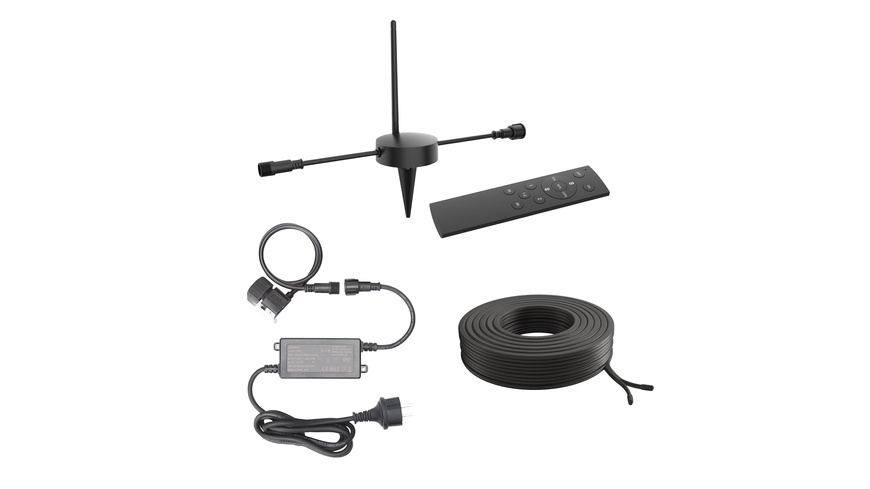
A 72-watt transformer, a controller with a 2.4 GHz remote control and 10 meters of distribution cable, all rated IP67 according to ELV. For our calculation example, there is plenty of headroom. However, you have to choose the lights separately and also plan for connection cables, because none are included in the set. If you would rather open a box and be done, this set will not make you happy.
Die Bold Set 24V-Garten Akzentbeleuchtung, 8 Strahler
Eight spotlights (the set name means „accent lighting, 8 spotlights“) at 3 watts each, 220 lumens and a 45-degree beam angle, plus a controller and connection cables. The lights are rated IP65 and dimmable via the controller. With a 24-watt load, however, they run on the 36-watt plug-in transformer, so only twelve more watts will fit later. If you plan to expand, that speaks for the medium set.
Die Bold Set 24V-Garten Akzentbeleuchtung, 2 Strahler
The smallest version: two spotlights, a 36-watt transformer, 10 meters of cable. There is no controller, so nothing gets dimmed. According to ELV, the set can be expanded later. For one tree and one shrub, that is enough.
Die Bold Set 24V-Garten Groß, Controller, Kabel, Sensor
The foundation for large properties (Groß means large): a 150-watt transformer, 30 meters of cable, a controller and a battery-powered wireless sensor for motion and brightness, rated IP44 according to ELV. Bold recommends mounting it at a height of 2 to 2.5 meters. Without a 30-meter run, you are paying for reserve you will hardly use.
Paulmann Plug & Shine Plantini Basisset 3000 K
Paulmann supplies three ground-spike lights, 5 meters of cable with four outputs and a 21 VA plug-in transformer. Its strength lies in the wide range of accessories and the IP68 cable. The rated luminous flux of only 90 lumens per light is sobering. Paulmann itself names small shrubs and flowers as the use case, and that is all it is.
Steinel Spot Garden C 24V
Steinel takes its own approach. According to the data sheet, the spot delivers 363 lumens at 7.84 watts, changes color, has a built-in brightness sensor and can be configured via Bluetooth Mesh, with a three-year manufacturer’s warranty included. The power supply and cable cost extra. Retailers list a 35-watt power supply for the set, which by calculation can handle four spots. More on connected lighting is in the guide to smart outdoor lighting.
Which system for which garden?
- Six to ten lights, expansion likely: Die Bold Set 24V-Garten Mittel, Controller plus lights as needed.
- Flower beds as a complete set, no expansion plans: accent lighting with 8 spotlights.
- One or two objects, expansion open: accent lighting with 2 spotlights.
- Runs over 30 meters or light on motion: the large set with sensor.
- Colored light and app control: Steinel Spot Garden C 24V.
Hole dimensions, load capacity and the question of the driveway are covered in the guide to in-ground garden lights (in German).
Frequently asked questions
Why 24 volts instead of 12 volts in the garden?
At the same power, half as much current flows at 24 volts, so the voltage drop along the cable stays smaller. In the calculation example, 28 watts at the end of 30 meters of cable lose about 4 percent at 24 volts and 16 percent at 12 volts.
Does the cable for 24-volt garden lighting have to be buried?
Paulmann writes about its 24-volt system that the cable may lie in shrubbery, under bark mulch or gravel, and that there is no minimum depth. It is different with 230 volts: under German low-voltage connection regulations (NAV), a new line through the lawn may only be laid by a registered electrical contractor or the grid operator.
How big does the transformer need to be?
Add up the watts of all the lights and leave a quarter in reserve, because almost every garden gets one more light later. That turns 28 watts into 35 watts, which would already fully use up Bold's 36-watt plug-in transformer, while the 72-watt transformer would still have more than half free.
How far can the last light be from the transformer?
Paulmann sets a hard limit of 50 meters; longer runs need a second feed point. The Bold manuals contain no comparable limit, so it is better to plan two short runs there than one long one. Measure with a tape measure from the outdoor outlet.
Can lights from different manufacturers be combined?
Usually not. According to Paulmann, it uses a specific connector, so combining it with third-party lights is not possible; Bold works with M12 and M18 plugs. So you are committing to one family. Mixed systems are among the classic bad buys, alongside transformers that are too small.
Sources
- ELV: Die Bold Set 24V-Garten Mittel (retailer information)
- ELV: accent lighting set, 8 spotlights (retailer information)
- ELV: accent lighting set, 2 spotlights (retailer information)
- ELV: large set with sensor (retailer information)
- ELV: Die Bold 72 W transformer
- ELV: Die Bold SIMON LED Solar (retailer information)
- Die Bold: 150 W transformer manual (PDF)
- Die Bold: 36 W plug-in transformer manual (PDF)
- Die Bold: controller and sensor manual (PDF)
- Die Bold: distribution cable manual (PDF)
- Die Bold: 3 W garden spotlight manual (PDF)
- Paulmann: Plug & Shine transformers and system FAQ
- Paulmann: Plantini basic set
- Steinel: Spot Garden C 24V data sheet (PDF)
- German Low Voltage Connection Ordinance (NAV), Section 13
Where to buy
- Die Bold Set 24V-Garten Mittel, ControllerView at ELVAvailable in Germany: ELV
- Die Bold Set 24V-Garten Akzentbeleuchtung, 8 StrahlerView at ELVAvailable in Germany: ELV
- Die Bold Set 24V-Garten Akzentbeleuchtung, 2 StrahlerView at ELVAvailable in Germany: ELV
- Die Bold Set 24V-Garten Groß, Controller, Kabel, SensorView at ELVAvailable in Germany: ELV
- Paulmann Plug & Shine Plantini Basisset 3000 KCheck price at Amazon.deAvailable in Germany: Amazon.de
- Steinel Spot Garden C 24VCheck price at Amazon.deAvailable in Germany: Amazon.de