Contents12 sections
This guide was first published in German on handgetestet.de.
By the third lesson at the latest, the teacher asks for a passage played first softly, then loudly, and the new keyboard cannot do it. What was bought was a complete set with bench, microphone and headphones whose keys do not respond to how hard they are struck. That is exactly what you should avoid. Our advice for almost all beginners is the Yamaha PSR-E383: 61 touch-sensitive keys, a learning function, battery operation. If it is going to be classical piano, on the other hand, a digital piano is the right instrument, not a keyboard.
Keyboard or digital piano?
This question comes before all others. A keyboard usually has 61 light, unweighted keys, hundreds of sounds and auto-accompaniment, and it weighs between three and eight kilos. It fits on a desk, runs on batteries and makes pop, German pop (Schlager) and film music instantly playable. A digital piano has 88 weighted keys and imitates the playing feel of an acoustic piano. If piano lessons with pieces from Bach to Burgmüller are on the agenda, there is no way around it. What matters there is explained in our article on digital pianos with hammer action (in German).
The keyboard is the right choice if a child first needs to find out whether music will stick. Or if chords and accompaniment count for more than finger technique. In keyboard lessons at music schools, it is the standard anyway.
Soft and loud: how beginner models differ
Touch sensitivity matters most. The key measures how fast it is pressed and plays correspondingly soft or loud. It is documented for the Yamaha, Casio, Roland and Korg models below. If the spec sheet does not mention it, the function is usually missing.
Then the key size. 61 keys are five octaves and are enough for the first few years, but you should look for „full size“: some sets use reduced-size keys that ingrain the wrong feel for distances.
Good learning systems break a piece down into right hand, left hand and both hands and wait until the correct key is played. That does not replace lessons. It does help with practice in between.
The power adapter: a small part, a frequent annoyance
Almost all beginner models run on six to eight AA batteries. In everyday use, though, the power adapter is what counts. It is not in every box. According to the spec sheet, Roland includes a power adapter with the E-X10, Korg with the EK-50, Alesis with the Melody 61. For the PSR-E473, Yamaha lists only the music rest as included and recommends the PA-150 power adapter as an accessory; for the PSR-E383, the PA-130 appears in the accessories list. On Amazon, however, the PSR-E383 is also explicitly offered as a bundle with a power adapter. With Casio, it also depends on the offer. So read the product description before ordering. Otherwise, there will be a keyboard under the Christmas tree that falls silent after three hours on batteries.
Six beginner keyboards on Amazon.de
| Model | Keys | Learning and sound | Power, weight | Best for |
|---|---|---|---|---|
| Yamaha PSR-E383 | 61, touch-sensitive | Keys to Success, 3-step lessons, 650 sounds | 6 × AA or power adapter (depending on the offer) | Beginners of all ages |
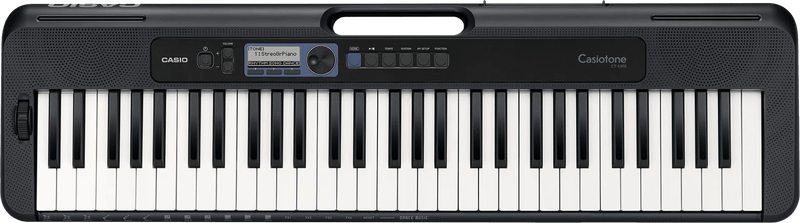
| Casio CT-S300 | 61, touch-sensitive | 400 sounds, 60 songs | 6 × AA or power adapter (depending on the offer), 3.3 kg | light, for the kids‘ room |
| Roland E-X10 | 61, touch-sensitive | 140 songs with three exercises each and scoring, 601 sounds | Power adapter included, 6 × AA, 3.9 kg | if you want a structured learning function |
| Yamaha PSR-E473 | 61, touch-sensitive | 820 sounds, sampling, microphone input | Power adapter sold separately, 6 × AA, 7.0 kg | Teenagers who make their own music |
| Korg EK-50 L | 61, touch-sensitive | 790 sounds, 2 × 10 W | Power adapter included, 8 × AA, 8 kg | Rehearsal room, parties, powerful sound |
| Alesis Melody 61 MK4 | 61, compact keys | 300 sounds, Skoove and Melodics to try out | Power adapter included, 6 × AA | Trying it out on a small budget |
Yamaha PSR-E383
Yamaha itself sees this as the standard model for anyone sitting at a keyboard instrument for the first time. The „Keys to Success“ learning function breaks the 125 built-in songs down into short phrases; you practice with the right, left or both hands, and at the end the keyboard scores the practice session. On top of that come 48-note polyphony, a duo mode for teacher and student on one keyboard, and USB for audio and MIDI. Enough to get started. Nobody will be overwhelmed.
Casio CT-S300
At 3.3 kilos according to retailer information, the lightest of the six instruments and flat enough for a desk. The keys respond to touch, and 400 sounds and 77 accompaniment rhythms are built in. The manufacturer’s specifications do not list a learning function as in-depth as Yamaha’s or Roland’s. If the keyboard is mainly used for free playing and lessons, you will hardly miss it.
Roland E-X10
Roland’s entry-level model focuses most clearly on learning. According to the manufacturer, each of the 140 built-in songs comes with three exercises, a score and a recorder for listening back. According to Roland, the piano sounds come from the company’s own digital and stage pianos. With 2 × 2.5 W, it remains an instrument for a bedroom, not for a living room full of guests. According to the spec sheet, batteries last about three hours; zinc-carbon cells are excluded.
Yamaha PSR-E473
One step up. Two knobs change the sound live, Quick Sampling records short snippets via the microphone or AUX input, and via USB the keyboard works as an audio interface on a computer. How to record songs with it is described in our guide to the audio interface for the home studio (in German). A child just looking for their first notes does not need that much instrument. Teenagers with their own ideas do.
Korg EK-50 L
This Korg houses two 10-watt amplifiers with 12-centimeter speakers in a bass reflex enclosure, according to the manufacturer twice as loud as the regular EK-50. The keyboard weighs 8 kilos and belongs to a higher price range. At family celebrations or in a youth club, that pays off. For practicing in the kids‘ room, you are mainly paying for volume that nobody needs there.
Alesis Melody 61 MK4
On Amazon, usually available as a set with stand, bench and headphones; according to Alesis, a microphone is included. On top of that come three months of Skoove Premium and a trial period with Melodics. Alesis, however, describes the 61 keys as compact, and there is no mention of touch sensitivity. For a few months of trying things out in the lowest price range, that can be enough. We would not buy it for lessons.
Which keyboard for which start?
If a child is starting keyboard lessons, get the Yamaha PSR-E383 and check for the power adapter when ordering. If you want to learn on your own with a practice program, the Roland E-X10 is a good choice, because the power adapter and learning system are already in the box.
- Little space, lots of transport: Casio CT-S300.
- Teenagers with recording plans: Yamaha PSR-E473.
- Music for parties and rehearsals: Korg EK-50 L.
- Piano lessons with classical repertoire: not a keyboard, but a digital piano with 88 weighted keys.
Headphones belong with it in any case. For the E-X10, Roland explicitly states that the speakers go silent as soon as headphones are plugged in, and that spares the nerves of everyone else in the household. A sturdy stand at the right height does more for daily practice than a hundred additional sounds.
If you would rather learn on a weighted keyboard right away instead of a keyboard, our review of the Kawai CN39 shares experience from several years of lessons.
Frequently asked questions
Keyboard or digital piano for beginners?
A keyboard usually has 61 light, unweighted keys, many sounds and auto-accompaniment, and it fits on a desk. A digital piano has 88 weighted keys and imitates the playing feel of an acoustic piano. For classical piano lessons, there is no way around it; for keyboard lessons or a first try, a keyboard is enough.
Why does touch sensitivity matter on a keyboard?
The key measures how fast it is pressed and plays correspondingly soft or loud. Without this function, you cannot play a passage first softly, then loudly in a lesson. If the spec sheet does not mention it, the function is usually missing; for the Alesis Melody 61 MK4, for example, there is no mention of it.
Does a keyboard come with a power adapter?
Not always. Roland includes a power adapter with the E-X10, Korg with the EK-50, Alesis with the Melody 61. Yamaha lists the power adapter as an accessory, but the PSR-E383 is also offered in bundles with a power adapter, and with Casio it also depends on the offer. Read the product description before ordering.
How many keys does a beginner keyboard need?
61 keys are five octaves and are enough for the first few years. Look for full-size keys, because reduced-size keys ingrain the wrong feel for distances. The manufacturer describes the keys of the Alesis Melody 61 MK4, for example, as compact.
Which keyboard suits teenagers who make their own music?
The Yamaha PSR-E473 offers two knobs for changing the sound, Quick Sampling via a microphone or AUX input, and works as an audio interface on a computer via USB. A child looking for their first notes does not need that much instrument. For parties and rehearsals, the louder Korg EK-50 L is the right fit.
Sources
- Yamaha: PSR-E383
- Yamaha: PSR-E473, specifications
- Roland: E-X10
- Roland: E-X10, specifications
- Korg: EK-50 L
- Korg: EK-50, specifications
- Alesis: Melody 61 MK4
- Musikhaus Müller (German retailer): Casio CT-S300, retailer spec sheet
Where to buy
- Yamaha PSR-E383Check price at Amazon.deAvailable in Germany: Amazon.de
- Roland E-X10Check price at Amazon.deAvailable in Germany: Amazon.de
- Casio CT-S300View at CoolblueAvailable in Germany: CoolblueCheck price at Amazon.deAvailable in Germany: Amazon.de
- Yamaha PSR-E473Check price at Amazon.deAvailable in Germany: Amazon.de
- Korg EK-50 LCheck price at Amazon.deAvailable in Germany: Amazon.de
- Alesis Melody 61 MK4Check price at Amazon.deAvailable in Germany: Amazon.de