Contents11 sections
This guide was first published in German on handgetestet.de.
Most bookshelf speakers end up exactly where they do not really belong: deep in a shelf compartment, ten centimeters from the wall, with booming bass. That is why we put a model first that its manufacturer explicitly designs for placement close to the wall. According to its data sheet, the Dali Sonik 1 may stand 1 to 50 centimeters from the back wall and works with amplifiers from 25 watts. If you want to spend less, look at the Wharfedale Diamond 12.1i. And if you have room for stands and a powerful amplifier, you will end up with the KEF LS50 Meta.
Does the speaker suit my amplifier?
All models here are passive. So they need an integrated amplifier, a receiver or a streaming amplifier with speaker terminals. Two specs in the data sheet determine whether the pair is a match.
The first is efficiency, usually given as sensitivity in dB at 2.83 volts and one meter. A three-dB difference sounds small. But it means the quieter speaker needs twice the amplifier power for the same volume. That is exactly the gap between the KEF LS50 Meta at 85 dB and the Wharfedale Diamond 12.1i at 88 dB.
The second is impedance. A nominal six or eight ohms is uncritical. More interesting is the minimum value, if the manufacturer states it. KEF specifies 3.5 ohms for the LS50 Meta. A small amplifier that, according to its manual, is only approved for 8-ohm speakers will reach its limit with that. We cover suitable devices in our guide to stereo amplifiers and streamers.
Shelf, stand or sideboard?
A shelf compartment acts like a small resonance chamber. If the bass reflex port is at the back, the back wall boosts the low end even more. In the manual for the Debut 3.0 series, Elac writes that proximity to a wall boosts the bass and too much proximity makes it sound unnatural, especially in corners. It recommends 30 to 60 centimeters of distance from walls. If it has to be the corner after all, the distances to the back wall and the side wall should differ.
Stands solve two problems at once. They take the speaker out of the compartment and bring the tweeter roughly to ear height at the sofa. That sounds trivial, but in a living room with a low sideboard it is often the biggest gain. Good stands are heavy, stable and can be filled with sand or granules. The KEF LS50 Meta has threaded inserts in the base for this, matching KEF’s S2 stand.
For the setup itself, the old rule applies. Both speakers and the listening position form an equilateral triangle, with the speakers angled slightly toward the listener. Elac says the same.
How large can the room be?
Hardly any manufacturer gives fixed square-meter figures, and they would be misleading anyway. An older building with a 3.20-meter ceiling, carpet and a wall of books behaves differently from a tiled living room. Our rule of thumb: a 13-centimeter woofer is enough for up to about 20 square meters. Beyond that, it is worth looking at 16.5 centimeters, as on the Elac Debut B6.3. If you want to fill an open-plan living area of 40 square meters with sound, you are usually better served by floorstanding speakers or a small subwoofer.
The lower cutoff frequency helps with comparisons, but only if it is measured the same way. Dali and KEF state the value at ±3 dB, other manufacturers prefer the more flattering value at −6 dB. For KEF, the two are far apart: 79 Hz versus 47 Hz.
Six bookshelf speakers at a glance
| Model | Woofer | Sensitivity / impedance | Amplifier according to manufacturer | Best for |
|---|---|---|---|---|
| Dali Sonik 1 | 5¼ inches | 86 dB / 6 ohms | 25 to 100 W | Shelves and spots close to the wall, small to medium rooms |
| Elac Debut B5.3 | 5¼ inches, aramid | 86.5 dB / 6 ohms | 20 to 120 W | Free-standing placement with some distance from the wall |
| Elac Debut B6.3 | 6½ inches, aramid | 87 dB / 6 ohms | 20 to 140 W | Larger rooms, deeper bass without a floorstander |
| Wharfedale Diamond 12.1i | 130 mm | 88 dB / 8 ohms | 20 to 100 W | Entry level, less powerful amplifiers |
| Q Acoustics 3020c | 120 mm | 87 dB / 6 ohms (retailer specs) | 25 to 90 W (retailer specs) | Narrow shelves, wall mounting |
| KEF LS50 Meta | 130 mm, Uni-Q | 85 dB / 8 ohms, min. 3.5 ohms | 40 to 100 W | Stands, powerful amplifier, plenty of distance from the wall |
Dali Sonik 1: built to sit close to the wall
At 27.4 centimeters tall, the Sonik 1 fits into almost any shelf compartment. Dali quotes 51 Hz to 26 kHz at ±3 dB, 86 dB and 6 ohms. The deciding line in the data sheet is a different one: recommended distance from the back wall 1 to 50 centimeters. A wall bracket is built into the cabinet. If you are looking for the Oberon 1, you should know that Dali now lists it among its discontinued models. On paper, the Sonik 1 has the same key specs.
Elac Debut B5.3 and B6.3: the choice when you have space
Elac sells the Debut 3.0 speakers internationally as the DB53 and DB63, and in Germany as the B5.3 and B6.3. Both have an aluminum tweeter and an aramid fiber woofer. According to the manual, the small one reaches down to 70 Hz at −3 dB, the large one to 50 Hz. In return, the B6.3 measures around 34 centimeters in height and weighs just under 7.9 kilograms. That makes it simply too tall for many shelf compartments.
Wharfedale Diamond 12.1i: easy on the amplifier
The new edition of the Diamond 12.1 is rated at 88 dB and 8 ohms, with a minimum of 4 ohms. That makes it the easiest load for a small amplifier. The bass reflex port is at the back. In the review by Hifi Pig, it still performed well a good 20 centimeters from the back and side walls. According to the specs, its frequency response ends at 65 Hz.
Q Acoustics 3020c: flat against the wall
At around 28 centimeters tall, the 3020c is about as compact as the Dali. Q Acoustics highlights the flat terminals that let it sit close to the wall, and offers its own wall bracket as well as matching stands. The technical data come from retailers, not from a manufacturer data sheet. If you need exact figures, double-check them with the seller before buying.
KEF LS50 Meta: demanding in both directions
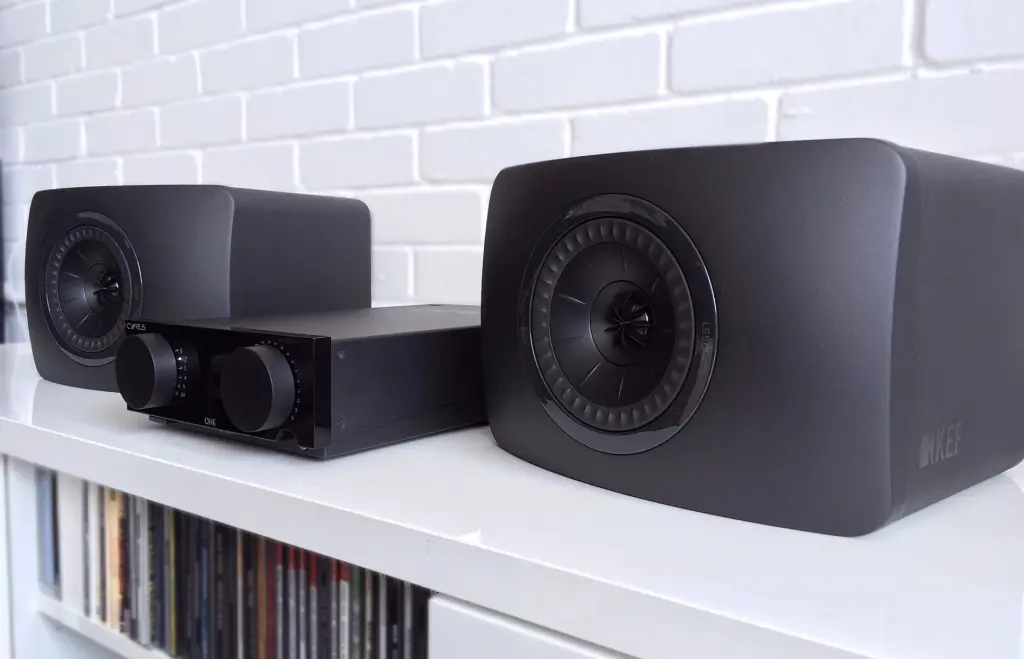
Coaxial Uni-Q driver, 7.8 kilograms per speaker, cabinet with a curved front. The LS50 Meta is the most elaborate speaker here. But it also demands the most. 85 dB and an impedance minimum of 3.5 ohms need an amplifier with reserves; KEF recommends 40 to 100 watts. The reflex port is at the back. On a cramped shelf, you give away what you are paying for with this one.
How we would decide
- The speakers need to go on a shelf or on the wall: Dali Sonik 1.
- Small or older amplifier, tight budget: Wharfedale Diamond 12.1i.
- Free-standing placement with stands, room up to about 20 square meters: Elac Debut B5.3.
- Larger room, but no floorstanding speakers: Elac Debut B6.3.
- Stands, distance from the wall and a powerful amplifier are available: KEF LS50 Meta.
One last tip from real-world setup. Before you put foam plugs in the reflex port or turn down the bass control, move the speakers ten centimeters forward. That is often enough.
Frequently asked questions
Which amplifier suits bookshelf speakers?
All models in the comparison are passive and need an integrated amplifier, receiver or streaming amplifier with speaker terminals. Efficiency and impedance are what matter: three dB less sensitivity requires twice the power for the same volume. According to KEF, the KEF LS50 Meta dips to 3.5 ohms, which pushes small 8-ohm amplifiers to their limit.
How much distance from the wall do bookshelf speakers need?
For the Debut 3.0 series, Elac recommends 30 to 60 centimeters, because proximity to a wall boosts the bass and too much proximity makes it sound unnatural, especially in corners. If it has to be the corner, the distances to the back wall and the side wall should differ. The Dali Sonik 1, by contrast, is designed for 1 to 50 centimeters according to its data sheet.
Are speaker stands worth it for bookshelf speakers?
Stands take the speaker out of the shelf compartment, which acts like a small resonance chamber, and bring the tweeter roughly to ear height at the sofa. Good stands are heavy, stable and can be filled with sand or granules. The KEF LS50 Meta has threaded inserts in the base for this, matching the S2 stand.
Are bookshelf speakers enough for a large room?
As a rule of thumb, a 13-centimeter woofer is enough for up to about 20 square meters. For larger rooms, a 16.5-centimeter woofer like the one in the Elac Debut B6.3 is an option, although it is too tall for many shelf compartments. For an open-plan living area of 40 square meters, floorstanding speakers or a small subwoofer are usually the better choice.
What helps if the bass booms on the shelf?
Often the cause is a rear-facing bass reflex port whose effect is amplified by the back wall. Before you put foam plugs in the port or turn down the bass control, move the speakers ten centimeters forward. That is often enough.
How do you set up bookshelf speakers correctly?
Both speakers and the listening position form an equilateral triangle, with the speakers angled slightly toward the listener. Elac recommends this too. Add enough distance from the wall and a height at which the tweeter sits roughly at ear level.
Sources
- Dali: Sonik 1, technical data
- Dali: Sonik manual, technical data with wall distance (PDF)
- Dali: Oberon 1 (discontinued)
- Elac: Debut 3.0 DB53
- Elac: Debut 3.0 DB63
- Elac: Debut 3.0 Owner’s Manual with placement advice (PDF)
- KEF: LS50 Meta, product data sheet (PDF)
- SoundStage! Hi-Fi: review of the KEF LS50 Meta
- Hifi Pig: review of the Wharfedale Diamond 12.1i
- Q Acoustics: press release on the 3000c series
- Sevenoaks: retailer specs for the Q Acoustics 3020c
Where to buy
- Dali Sonik 1 (Paar, Natureiche)Check price at Amazon.deCheck price at Amazon.co.ukCheck price at Amazon.nlCheck price at Amazon.com.beCheck price at Amazon.frCheck price at Amazon.itCheck price at Amazon.esCheck price at Amazon.plCheck price at Amazon.seAvailable in Germany: Amazon.de
- Wharfedale Diamond 12.1i (Paar, schwarz)Check price at Amazon.deCheck price at Amazon.co.ukCheck price at Amazon.nlCheck price at Amazon.com.beCheck price at Amazon.frCheck price at Amazon.itCheck price at Amazon.esCheck price at Amazon.plCheck price at Amazon.seAvailable in Germany: Amazon.de
- Elac Debut B5.3Check price at Amazon.deCheck price at Amazon.co.ukCheck price at Amazon.nlCheck price at Amazon.com.beCheck price at Amazon.frCheck price at Amazon.itCheck price at Amazon.esCheck price at Amazon.plCheck price at Amazon.seAvailable in Germany: Amazon.de
- Elac Debut B6.3Check price at Amazon.deCheck price at Amazon.co.ukCheck price at Amazon.nlCheck price at Amazon.com.beCheck price at Amazon.frCheck price at Amazon.itCheck price at Amazon.esCheck price at Amazon.plCheck price at Amazon.seAvailable in Germany: Amazon.de
- Q Acoustics 3020cCheck price at Amazon.deCheck price at Amazon.co.ukCheck price at Amazon.nlCheck price at Amazon.com.beCheck price at Amazon.frCheck price at Amazon.itCheck price at Amazon.esCheck price at Amazon.plCheck price at Amazon.seAvailable in Germany: Amazon.de
- KEF LS50 MetaCheck price at Amazon.deCheck price at Amazon.co.ukCheck price at Amazon.nlCheck price at Amazon.com.beCheck price at Amazon.frCheck price at Amazon.itCheck price at Amazon.esCheck price at Amazon.plCheck price at Amazon.seAvailable in Germany: Amazon.de