Contents12 sections
This guide was first published in German on handgetestet.de.
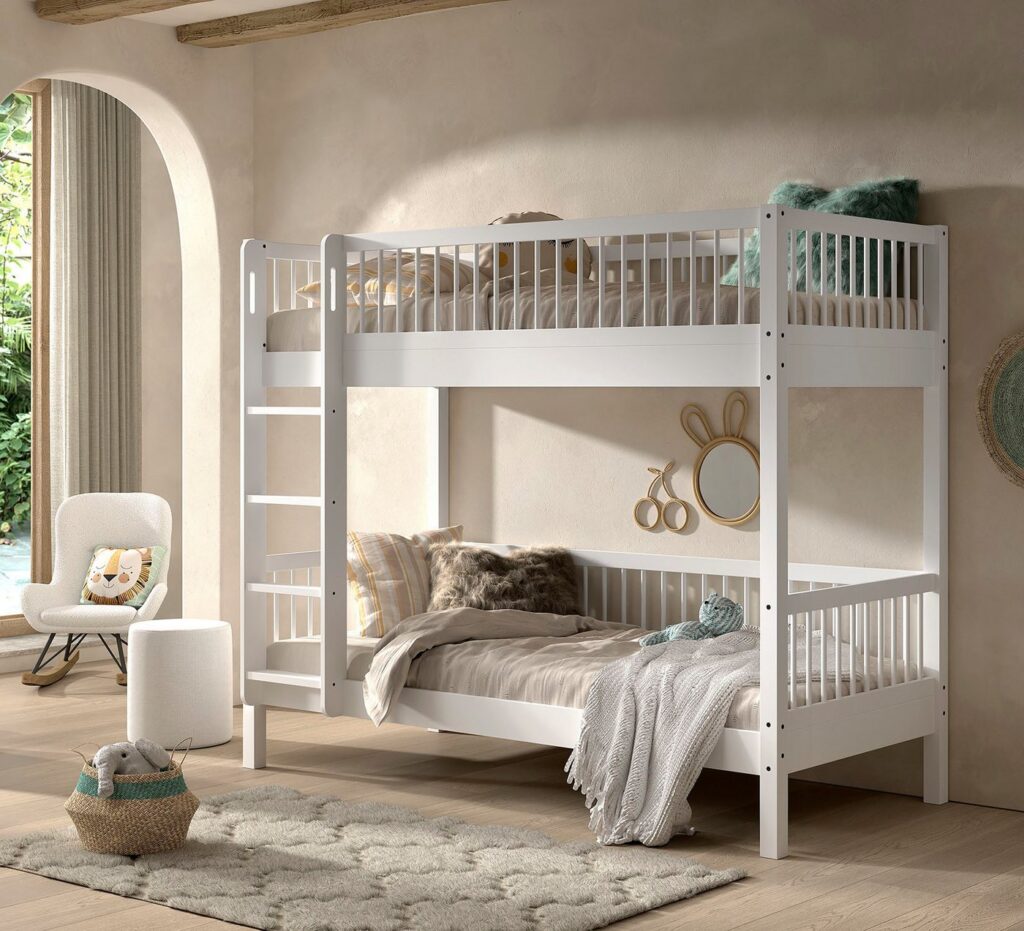
With a bunk bed, it is the mattress that determines safety, not the photo in the listing. The standard requires 16 cm of fall protection above the top of the mattress, and every additional centimeter of padding eats into that. As a starting point for two children aged six and up, we take the Vipack Forrest in beech: solid posts, an upper level protected all around, built to EN 747-1 according to the listing. That is not a recommendation for younger siblings. For them, there is no good compromise up top.
What DIN EN 747 regulates and what it does not do for you
Since July 2024, the standard has been in the version DIN EN 747-1:2024 (the German edition of the European standard), replacing the 2015 edition. It applies to bunk beds and high beds with an internal length of more than 140 cm, a bed base no wider than 120 cm and a sleeping surface at least 60 cm above the floor. For private as well as commercial use. The full text of the standard is not free, so we rely on the summaries from the DIN Consumer Council and the German Child Safety Association (BAG Mehr Sicherheit für Kinder).
The DIN Consumer Council names three dimensions for the ladder and one for fall protection: a clear distance between treads of at least 20 cm, a tread depth of at least 9 cm, a usable width of at least 30 cm, and fall protection of at least 16 cm above the mattress. The German Child Safety Association adds an upper limit of 30 cm for the step spacing and recommends 30 instead of 16 cm for the guardrail. That recommendation clearly goes beyond the standard, and we consider it sensible.
A case from Nuremberg shows how seriously courts take these dimensions. A 13-year-old fell out of the upper bed in a hotel at night; the guardrail only covered the middle of the bed. In 2019, the local court ruled that it must run the full length of the bed apart from an opening of 30 to 40 cm, and found that the boy was in principle entitled to damages. At the time of publication, the ruling was not yet final.
Age six: why this limit is not a formality
High beds are not suitable for children under six, the DIN Consumer Council writes in its safety tips on the standard. Stiftung Warentest, the German consumer testing organization, and the German Child Safety Association say the same, the latter on the grounds that younger children cannot assess the risk. Hard figures come from pediatric surgery at Leipzig University Medical Center: 162 young patients after accidents involving bunk beds, treated from 2014 to 2021, five years old on average. Among three- to five-year-olds, every second case ended in a fracture; among six- to nine-year-olds, it was 60 percent. Only from age ten did the share drop to 30 percent. 15 percent needed surgery.
Two things follow from this. The danger is not over on the sixth birthday; that is only when suitability begins. And the little brother who sleeps below will climb anyway. The German Child Safety Association therefore advises removing the ladder during the day in households with small children. That does not work with a ladder that is firmly screwed on, so ask about it. Study director Martin Lacher also urges caution with all children under ten.
Doing the math with the mattress
For the Vipack Sam, the listing gives both values: fall protection of around 43.2 cm and a top mattress of at most 20 cm. That leaves a good 23 cm above the mattress, a good 7 cm more than the standard requires. With a 12 cm mattress, it would be around 31 cm, putting the bed at the level the German Child Safety Association recommends. That is exactly how you should calculate for every model. The problem: most listings only give the maximum mattress height, not the height of the guardrail itself. The maximum mattress height ranges from 15 cm on the René to 26 cm on the Forrest. Stick to this limit, even if the old mattress is still good.
Innerspring is a poor fit here. The German Child Safety Association advises against it because it invites jumping. The DIN Consumer Council recommends using the mattress supplied with the bed, which does not help with our models: none of them comes with a mattress. Which type fits instead is explained in our mattress guide.
Wood, particleboard, wall: three points listings like to skip
The German Child Safety Association recommends frames made of wood or metal and advises against particleboard. The Relita Sely and the Vipack Sam are made of particleboard, which sets them apart from the Forrest and René. We include both anyway, because their listings state the safety data more completely than some solid wood beds. You will have to weigh that up yourself.
About the wall: for the Forrest in beech and the Sely, the listing states that wall mounting is required. That is not optional. Screw the bed to the wall as intended, in rented apartments with wall plugs suited to the particular wall. That rules out a freestanding bed in the room with these models, for example as a room divider. After assembly, shake the frame vigorously (the German Child Safety Association recommends doing this with the display model in the store) and retighten the screws. The slatted base and ladder must be firmly in place.
That leaves the location. Cables, power outlets, curtains, radiators and windows do not belong within reach of the top bunk. Cords, straps and ropes must never hang from the frame, as children can strangle themselves in them. According to the German Child Safety Association, a soft rug belongs in front of the bed, and the Leipzig physicians recommend this as well.
Five bunk beds compared
| Model | Sleeping surfaces | Top mattress max. | Frame | Best for |
|---|---|---|---|---|
| Vipack Forrest beech | 2 × 90 × 200 cm | 26 cm | Solid beech | Two children, long-term use |
| Vipack Forrest family bed | 90 and 140 × 200 cm | 26 cm | Solid oak | One adult or two children below |
| OTTO home René | 2 × 90 × 200 cm | 15 cm | Solid pine, FSC | Smaller budget, low-ceilinged room |
| Relita Sely | 2 × 90 × 200 cm | 15 cm | Particleboard | Shelves instead of a dresser |
| Vipack Sam | 2 × 90 × 200 cm, drawer | 20 cm | Particleboard, metal | Desk in the bed, little floor space |
Vipack Forrest beech
Continuous 5.5 × 5.5 cm posts and a rail guard running all the way around the top; according to the listing, the ladder is around 35 cm wide and has four steps. The entry height is about 138 cm at the top and 33 cm at the bottom. FSC certification and construction to EN 747-1 are noted, although elsewhere on the same page the 2012 version with the 2015 amendment is given. Check the information in the documentation. The listing states a load capacity of 75 kg without saying whether that is per sleeping surface. Ask if teenagers are going to sleep up top.
Vipack Forrest family bed
140 cm wide with a center bar below, 90 cm above, built from oak. The listing states a total load capacity of 220 kg and the warning for children under six. Worth considering for vacation homes or blended-family rooms. It costs considerably more than the beech version, and its width of 157.5 cm needs to fit somewhere first.
OTTO home René
At 140 cm in total height, it is significantly lower than the Forrest, protected all around and made of FSC pine with 45 mm posts; the ladder can be mounted on either side. The recommended minimum age is stated as six. The limits are tighter: 15 cm mattress height and 75 kg load capacity. That is enough for elementary school children, but it gets tight for teenagers.
Relita Sely
Nine shelf compartments on the back, one drawer, a tread width of 38.2 cm, fall protection all around. The listing openly states 80 kg per sleeping surface, the age limit and the requirement to fix it to the wall. Open compartments, however, act like rungs when children climb. Keep that in mind, too.
Vipack Sam
Mid-height, with an overall height of only around 117 cm and a pull-out desk under the upper level; the middle sleeping surface rolls out. Fully extended, it needs 288 cm of depth. The ladder rungs are around 29 cm apart. As a third sleeping surface, the rolling drawer carries no more than 50 kg. A piece of furniture for small rooms that only reveals what it can do when you rearrange it.
How we would decide
- Two siblings aged six and up, use over many years: Vipack Forrest in beech, with a thin mattress.
- Tight budget and a low-ceilinged room: OTTO home René, as long as a 15 cm mattress and 75 kg are enough.
- A bed whose lower level can also take adults: Forrest family bed, provided there is 158 cm of free width in the room.
- Only one child, but short on space: better a loft bed with a desk or play area than a second level nobody needs.
No school-age child in the house yet? Then wait. Two separate beds, or a guest bed for visitors, will do the job until the younger child turns six.
Frequently asked questions
From what age can a child sleep on the top bunk?
From six. According to the DIN Consumer Council, Stiftung Warentest (the German consumer testing organization) and the German Child Safety Association (BAG Mehr Sicherheit für Kinder), high beds are not suitable for younger children. That does not mean the danger is over: among six- to nine-year-olds, 60 percent of accidents ended in a fracture in an evaluation from Leipzig.
How high must the fall protection on a bunk bed be?
The standard requires at least 16 cm above the top of the mattress; the German Child Safety Association recommends 30 cm. Do the math with your mattress: on the Vipack Sam, that is around 43.2 cm of protection with a mattress of at most 20 cm. Stick to the maximum mattress height given in the listing.
Which mattress fits the top bunk?
A thin one, no higher than the listing allows at most, around 15 cm on the René, for example. The German Child Safety Association advises against innerspring mattresses because they invite jumping. None of the five beds in the comparison comes with a mattress.
Does a bunk bed have to be fixed to the wall?
For the Forrest in beech and the Relita Sely, the listing states that wall mounting is required. That rules out a freestanding bed in the middle of the room. After assembly, shake the frame vigorously, retighten the screws and keep cables, curtains and cords out of reach of the top bunk.
Bunk bed made of wood or particleboard?
The German Child Safety Association recommends frames made of wood or metal and advises against particleboard. The Forrest and René are made of solid wood, the Relita Sely and Vipack Sam of particleboard. Their listings, however, state the safety data more completely; you will have to weigh that up yourself.
Sources
- DIN Consumer Council: Safe children’s furniture (as of January 2015)
- DIN Media: DIN EN 747-1:2024-07
- German Child Safety Association (BAG Mehr Sicherheit für Kinder): bunk bed, high bed (as of 20.06.2024)
- Kinder- und Jugendärzte im Netz: Children under six should not sleep in a bunk bed
- aponet.de: High beds, high risk of injury for children under 6
- Stiftung Warentest: The bed as an underestimated hazard
- otto-schmidt.de: Nuremberg local court, 19 C 7391/18
- BAUR (German retailer): Vipack Forrest beech white
- BAUR: Vipack Forrest family bed
- BAUR: OTTO home René
- BAUR: Relita Sely
- BAUR: Vipack Sam
Where to buy
- Vipack Forrest BucheView at OTTOAvailable in Germany: OTTO
- OTTO home RenéView at OTTOAvailable in Germany: OTTO
- Vipack Forrest FamilienbettView at OTTOAvailable in Germany: OTTO
- Relita SelyView at OTTOAvailable in Germany: OTTO
- Vipack SamView at OTTOAvailable in Germany: OTTO