Contents13 sections
This guide was first published in German on handgetestet.de.
More amps sound like more charger. But for a car that sits through the winter, the programs count for more than the current. If you buy a charger without a lithium program, without an AGM mode and without genuine maintenance charging, you have saved money in the wrong place. For most cars and motorcycles, a fully automatic charger with around 5 amps that treats lead-acid, AGM and LiFePO4 batteries separately is enough: according to the manufacturer, the Bosch C40-Li does exactly that and also charges 6-volt batteries, which classic car owners will appreciate.
Which battery is actually in the car?
The battery label tells you. A lot depends on it. AGM batteries need a slightly higher charging voltage; Bosch states 14.7 volts in winter/AGM mode and 14.4 volts in the normal program.
Lithium only with a dedicated program. CTEK explicitly advises against charging LiFePO4 batteries with a lead-acid-only charger. NOCO only allows the lithium mode for batteries with a built-in battery management system (BMS). And if you have a classic car or an old motorcycle with a 6-volt system, you need a charger with a dedicated 6 V program. Not every 12 V charger has one.
How many amps do you need?
That depends on the battery. According to the German automobile club ADAC, 5, 7 or 10 amps are common; large batteries can take more. By the ADAC’s calculation, a 7-amp charger needs up to eleven hours to bring a flat 100 Ah battery to 80 percent. Maintenance charging and temperature compensation are just as important: the ADAC recommends fully automatic chargers with spark, short-circuit and reverse polarity protection and with temperature compensation for winter.
Can the battery stay in the car while charging?
With modern cars, disconnecting the battery is no longer a matter of course. Adaptive control units can cause problems afterward, the ADAC writes. Instead, it advises recharging the starter battery externally once or twice a quarter or leaving a charger with a maintenance function permanently connected.
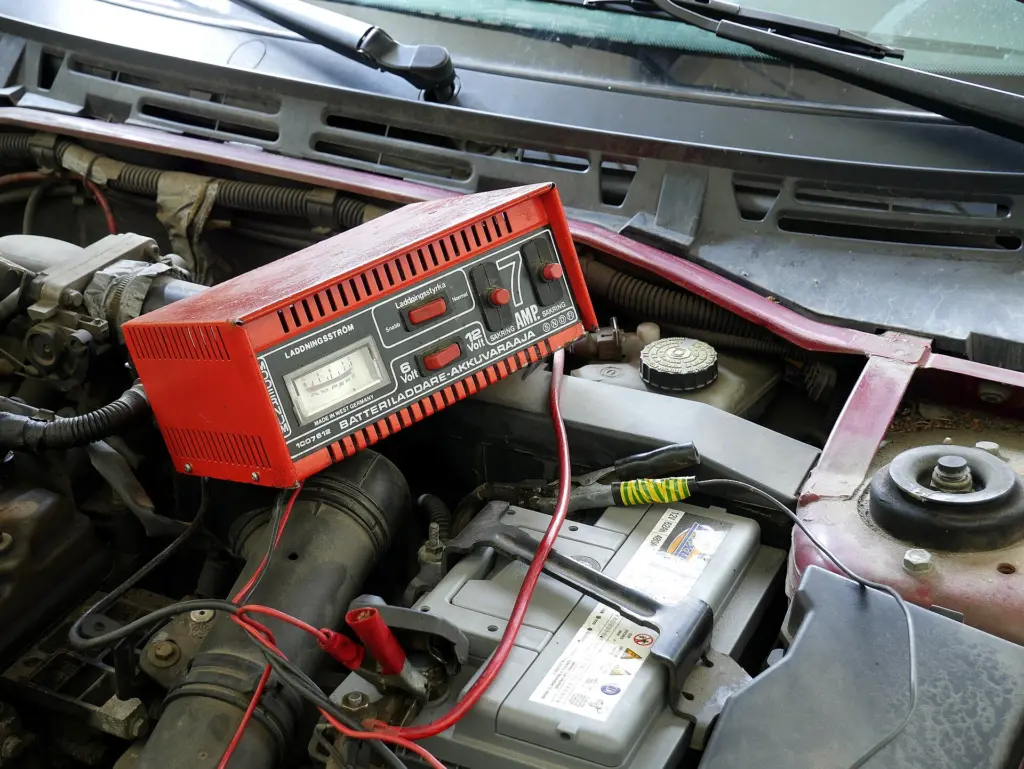
Where and how you connect the charger with the battery installed is specified by the vehicle manufacturer. So read the „Charging the battery“ section in the owner’s manual first. The ADAC describes the usual procedure as follows: red clamp to the positive terminal, black clamp to the designated ground point on the body and not to the negative terminal, because a battery sensor is often located there. Only then does the power plug go into the outlet. Disconnect in reverse order, black first. For motorcycles, the ADAC warns against switching on the ignition while charging.
If the battery is worn out despite care, the charger will not help. How to recognize a suitable new one is explained in our car battery guide.
Six chargers for cars, motorcycles and classic cars
| Model | Charging current (12 V) | Lithium (LiFePO4) | 6 V | Best for |
|---|---|---|---|---|
| Bosch C40-Li | 5 A (motorcycle 1 A) | yes | yes | Car, motorcycle, classic car |
| NOCO Genius5 | 5 A | yes, only with BMS | yes | Cars and motorcycles up to 120 Ah |
| CTEK CT5 Time to Go | 5 A | no | no | Lead-acid batteries from 20 to 160 Ah |
| Victron Blue Smart IP65 12/5 | 5 A | yes | no | If you want to configure via app |
| Bosch C80-Li | 15 A, briefly 20 A | yes | yes | Large batteries up to 400 Ah |
| Absaar Pro 4.0 Lithium | 4 A | yes | yes | Small budget, batteries up to 95 Ah |
Bosch C40-Li
According to Bosch, the C40-Li charges lead-acid and AGM batteries from 2 to 120 Ah at 5 amps. On top of that comes a dedicated LiFePO4 program at 14.2 volts. A mode with just 1 amp charges small motorcycle lithium batteries, as well as 6-volt systems. A push mode is supposed to revive heavily discharged batteries. What is missing? A power supply mode for battery replacement; only the larger C80-Li offers that.
NOCO Genius5
According to the manufacturer, the Genius5 comes with dedicated modes for 12 V, 12 V AGM, 12 V lithium and 6 V, and it is designed for batteries up to 120 Ah. It is known for its force mode, which is supposed to still charge batteries below 1 volt. NOCO itself points out that the protective functions are switched off in this mode. A tool for experienced users, not a convenience button.
CTEK CT5 Time to Go
The CT5’s distinguishing feature is the display of the remaining charging time in hours; CTEK also shows when a start attempt should be possible. It charges lead-acid batteries, including AGM and EFB, from 20 to 160 Ah. It cannot do lithium. Nor 6 volts. In a car with a classic starter battery, you will probably never miss either.
Victron Blue Smart IP65 12/5
Victron comes from the RV and boating world, and you can tell from the concept. Settings are made via Bluetooth in the VictronConnect app. According to the manufacturer, there are eight charging profiles including lithium and a storage mode that keeps the battery in gentler condition after a full charge than a fixed float voltage. The specified operating range is minus 20 to plus 50 degrees. If you do not want to pull out your smartphone for this, Bosch or NOCO will serve you more simply.
Bosch C80-Li
According to Bosch, the C80-Li delivers 15 amps for batteries up to 400 Ah, and briefly 20 amps in boost mode. This mode is limited to five minutes and then locked for half an hour. The interesting part is the supply mode at 13.6 volts, which is supposed to retain the vehicle settings during a battery replacement. For a small car that spends the winter in the garage, it is oversized.
Absaar Pro 4.0 Lithium
The Absaar is priced well below the others. According to retailer information, it charges lead-acid, gel, AGM and LiFePO4 batteries with 6 and 12 volts at 4 amps, fully charging batteries up to 95 Ah and providing maintenance charging up to 140 Ah. For a mid-size car with a large AGM battery, that gets tight.
What about motorcycles and classic cars in winter?
For motorcycles, the ADAC advises removing the battery, charging it fully and storing it somewhere cool at about 10 degrees. The charging current should be around a tenth of the capacity. So for a 10 Ah battery, a 5-amp car charger is too strong if it does not have a dedicated small-battery mode. According to the ADAC, lithium batteries need suitable chargers; even small permanent consumers such as an alarm system can drain them within a few weeks.
For classic cars, the system voltage decides. For 6 volts, the options here are the Bosch C40-Li, C80-Li, NOCO Genius5 and Absaar. If the car does end up with a weak battery in spring, a jump starter power bank gets you going faster than a charger. Afterward, charge the battery fully anyway.
So which charger suits me?
- One car, maybe a motorcycle, possibly lithium: Bosch C40-Li. It covers lead-acid, AGM, LiFePO4 and 6 volts, plus the small-battery mode.
- Similar scope, different manufacturer: NOCO Genius5. Use the force mode only with caution.
- Lead-acid batteries only, clear display wanted: CTEK CT5 Time to Go.
- RV, boat or love of tinkering: Victron Blue Smart IP65 with app and freely configurable profiles.
- SUV, van, large auxiliary battery: Bosch C80-Li. For normal passenger cars, it is oversized.
- Small budget, smaller batteries: Absaar Pro 4.0 Lithium, with compromises on large batteries.
If you are working through your winter checklist in the fall anyway, it is best to check the tire pressure at the same time. For that, there is our guide to cordless tire inflators (in German).
Small AGM blocks from alarm systems, kids‘ electric cars or ride-on mowers need a limited charging current. The values from the data sheets are in our guide to the 12 V lead-acid battery.
Frequently asked questions
How many amps does a car battery charger need?
According to the ADAC, 5, 7 or 10 amps are common, and large batteries can take more. By the ADAC's calculation, a 7-amp charger needs up to eleven hours to bring a flat 100 Ah battery to 80 percent. Maintenance charging, protective functions and temperature compensation for winter are just as important.
Can you charge a lithium battery with a normal charger?
CTEK explicitly advises against charging LiFePO4 batteries with a lead-acid-only charger. You need a dedicated lithium program, such as the ones offered by the Bosch C40-Li, NOCO Genius5 or Victron Blue Smart. NOCO only allows the lithium mode for batteries with a built-in battery management system.
Can the battery stay in the car while charging?
With modern cars, disconnecting the battery is no longer a matter of course; adaptive control units can cause problems afterward. Where to connect is specified in the owner's manual. According to the ADAC, the usual method is: red to positive, black to the designated ground point on the body, and only then the power plug.
What does an AGM battery need when charging?
AGM batteries need a slightly higher charging voltage. Bosch states 14.7 volts in winter/AGM mode and 14.4 volts in the normal program. The battery label tells you which battery is in the car, and that determines the right program.
Which charger is suitable for motorcycles and classic cars?
For motorcycles, the ADAC says the charging current should be around a tenth of the capacity; for a 10 Ah battery, 5 amps without a small-battery mode is too strong. For 6-volt classic cars, the Bosch C40-Li, C80-Li, NOCO Genius5 and Absaar are options. The CTEK CT5 handles neither lithium nor 6 volts.
What is force mode on the NOCO Genius5?
It is supposed to still charge batteries below 1 volt. NOCO itself points out that the protective functions are switched off in this mode. That makes it a tool for experienced users, not a convenience button to be used without a second thought.
Sources
- ADAC: Charging a car battery
- ADAC: Flat car battery
- ADAC: Storing a motorcycle battery over winter
- Bosch: C-Line battery chargers
- NOCO: Genius5
- NOCO: Force mode
- CTEK: CT5 Time to Go
- Victron Energy: Blue Smart IP65 Charger
Where to buy
- Bosch C40-LiCheck price at Amazon.deCheck price at Amazon.co.ukCheck price at Amazon.nlCheck price at Amazon.com.beCheck price at Amazon.frCheck price at Amazon.itCheck price at Amazon.esCheck price at Amazon.plCheck price at Amazon.seAvailable in Germany: Amazon.de
- NOCO Genius5Check price at Amazon.deCheck price at Amazon.co.ukCheck price at Amazon.nlCheck price at Amazon.com.beCheck price at Amazon.frCheck price at Amazon.itCheck price at Amazon.esCheck price at Amazon.plCheck price at Amazon.seAvailable in Germany: Amazon.de
- CTEK CT5 Time to GoCheck price at Amazon.deCheck price at Amazon.co.ukCheck price at Amazon.nlCheck price at Amazon.com.beCheck price at Amazon.frCheck price at Amazon.itCheck price at Amazon.esCheck price at Amazon.plCheck price at Amazon.seAvailable in Germany: Amazon.de
- Victron Blue Smart IP65 12/5Check price at Amazon.deCheck price at Amazon.co.ukCheck price at Amazon.nlCheck price at Amazon.com.beCheck price at Amazon.frCheck price at Amazon.itCheck price at Amazon.esCheck price at Amazon.plCheck price at Amazon.seAvailable in Germany: Amazon.de
- Bosch C80-LiCheck price at Amazon.deCheck price at Amazon.co.ukCheck price at Amazon.nlCheck price at Amazon.com.beCheck price at Amazon.frCheck price at Amazon.itCheck price at Amazon.esCheck price at Amazon.plCheck price at Amazon.seAvailable in Germany: Amazon.de
- Absaar Pro 4.0 LithiumCheck price at Amazon.deCheck price at Amazon.co.ukCheck price at Amazon.nlCheck price at Amazon.com.beCheck price at Amazon.frCheck price at Amazon.itCheck price at Amazon.esCheck price at Amazon.plCheck price at Amazon.seAvailable in Germany: Amazon.de