Contents13 sections
This guide was first published in German on handgetestet.de.
If you own only one cutting board, sooner or later you will cut raw chicken on it and the salad right afterward. Two boards are smarter: a heavy end-grain board for vegetables, herbs and bread, plus a light, dishwasher-safe one for raw meat and fish. This is exactly the separation the German Federal Institute for Risk Assessment (BfR) recommends.
The rest is quickly sorted. Material, size, weight and the juice groove are what count; the brand matters much less.
Wood or plastic: which is more hygienic?
Less clear-cut than some kitchen forums claim. In its answers on foodborne infections in private households (as of August 2024), the BfR writes that plastic boards can usually be cleaned in the dishwasher at over 60 °C. That is why it considers them better suited for raw foods than wooden boards. The German consumer advice center (Verbraucherzentrale) puts it the same way.
Many people skip the second part. Wood and plastic alike need a smooth surface. Once grooves and deep cuts have formed, bacteria can survive and multiply there, and the board should be replaced. That is what the BfR says, and the German Federal Centre for Nutrition (BZfE) says the same. So a scratched plastic board from the drawer is by no means cleaner than a smooth, well-kept wooden board.
In practice, that means meat and poultry on one board, fruit and vegetables on the other. Cooked food should not end up where raw food has just been until everything has been washed thoroughly.
Is end grain worth the extra cost?
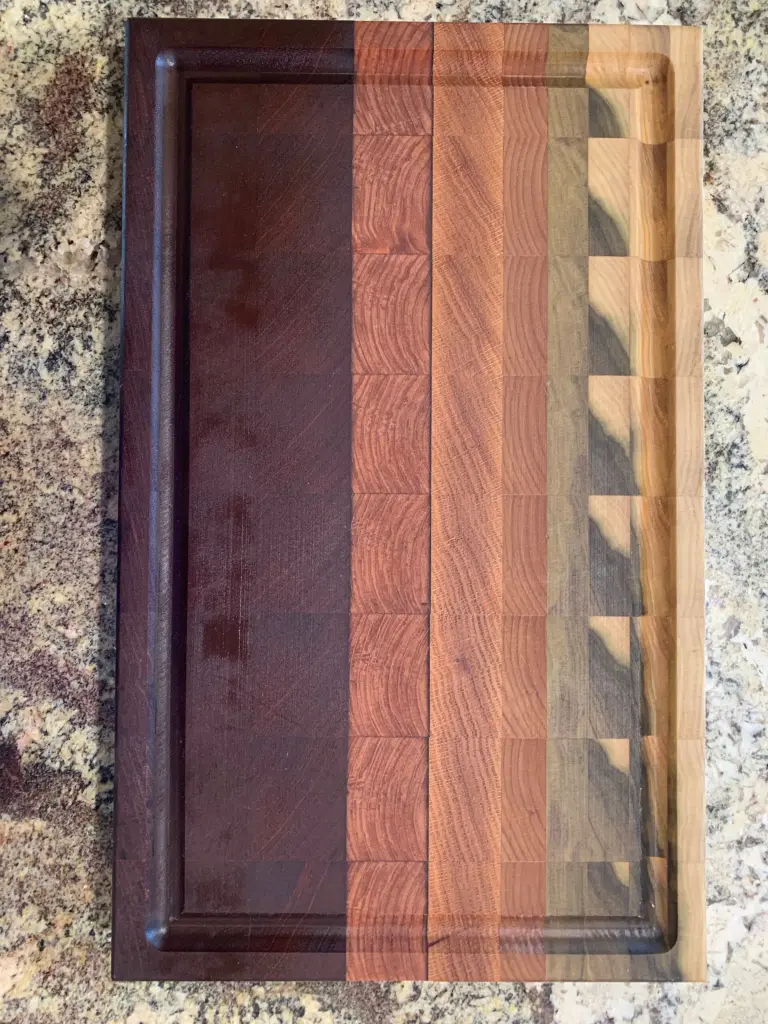
In end grain, the fibers stand perpendicular to the work surface. According to Zassenhaus, the blade slips in between the fibers instead of cutting across them, and the edge is subjected to less wear. For expensive chef’s knives, that is a serious argument. Edge-grain boards, in which the strips are glued lengthwise, usually cost less and weigh less.
In return, end grain demands space and muscle. According to the manufacturer, the Zassenhaus Hackblock weighs a good four kilos. It must not go in the dishwasher; it is washed by hand. Zassenhaus itself writes that wood can crack and warp.
So should you buy one? If you cut onions, carrots and herbs every day and own a good knife, you get real value for the money. As a breakfast board, a block like this is overkill.
How big does a cutting board need to be?
Bigger than you think in the store. A chef’s knife with a 20-centimeter blade should be able to lie across the board without sticking out over the edge. At 40 × 30 centimeters, there is still room next to the bell pepper for the pile you have already cut. Sizes around 30 × 20 centimeters are enough for a lemon, cheese and a clove of garlic, not for the Sunday roast.
Before you order, grab a folding ruler. Does the board fit in the sink? Does it sit securely without hanging over the edge of the countertop? In a narrow galley kitchen, a block 45 centimeters long quickly gets in the way, and nobody enjoys lifting a four-kilo board out of the cupboard every evening.
Do I need a juice groove?
A groove helps as soon as you often carve roasts, steaks or whole chickens. The groove then catches the meat juices before they run across the counter. With vegetables, it tends to get in the way, since it takes a few centimeters of surface away all around.
Reversible boards solve this. Epicurean builds its Gourmet Series with a groove on one side and a smooth back, and Boos offers a maple board on the same principle with its BBQ board. Joseph Joseph takes a different route and relies on small spikes that hold the meat in place. Which knife cuts the roast cleanly at the table is covered in our steak knife guide (in German).
Six boards for different kitchens
| Model | Material and construction | Dimensions and care | Best for | Offer (affiliate link) |
|---|---|---|---|---|
| Zassenhaus Hackblock Akazie Stirnholz | Acacia, end grain, non-slip feet | 45 × 30 × 4.5 cm, 4.02 kg; wash by hand | Main board for vegetables and herbs | Check price at Amazon.deCheck price at Amazon.co.ukCheck price at Amazon.nlCheck price at Amazon.com.beCheck price at Amazon.frCheck price at Amazon.itCheck price at Amazon.esCheck price at Amazon.plCheck price at Amazon.seAvailable in Germany: Amazon.de |
| Continenta cutting board with stainless steel drawer | End grain made of glued wooden cubes, hard oil | 39 × 27 × 6 cm or 48 × 32.5 × 6 cm; wood, by hand | Lots of prep, few bowls | |
| Boos Blocks R03 Pro Chef | North American hard maple, edge grain, reversible, NSF-certified | 51 × 38 × 3.8 cm; oiled, by hand | Large countertop where the board stays put | Check price at Amazon.deCheck price at Amazon.co.ukCheck price at Amazon.nlCheck price at Amazon.com.beCheck price at Amazon.frCheck price at Amazon.itCheck price at Amazon.esCheck price at Amazon.plCheck price at Amazon.seAvailable in Germany: Amazon.de |
| Epicurean Gourmet Series with juice groove | Paper composite, groove on one side | approx. 37 × 29 × 1 cm; dishwasher-safe | Raw meat and fish, small kitchens | |
| Joseph Joseph Cut&Carve Plus | Plastic, spikes on one side, non-slip feet | Size L 37.5 × 29.5 × 2.5 cm; dishwasher-safe | If you often carve roasts | Check price at Amazon.deCheck price at Amazon.co.ukCheck price at Amazon.nlCheck price at Amazon.com.beCheck price at Amazon.frCheck price at Amazon.itCheck price at Amazon.esCheck price at Amazon.plCheck price at Amazon.seAvailable in Germany: Amazon.de |
| Continenta Duracore cutting board | Recycled cellulose fiber, heat-resistant up to 180 °C | 23.5 × 16 to 34.5 × 24 cm, 0.7 cm thin; dishwasher-safe | Second board for raw food, small budget |
Zassenhaus Hackblock Akazie Stirnholz
A solid block of acacia end grain (the name means acacia end-grain chopping block), measuring 45 × 30 × 4.5 centimeters. Non-slip feet keep it in place, and the weight does the rest. Zassenhaus also makes the same block 8.5 centimeters high. Our pick as the main board, because size, weight and grain direction go together.
Continenta cutting board with stainless steel drawer
Continenta from Freiburg glues individual wooden cubes together into an end-grain board and finishes it with food-safe hard oil. The clever part sits underneath. You push what you have cut straight into a pull-out stainless steel drawer with the blade. The Amazon seller lists rubberwood as the type of wood.
Boos Blocks R03 Pro Chef
John Boos makes the R series from North American hard maple. The strips are glued lengthwise, the surface is oiled, and recessed handles on the sides make it easier to flip. According to the retailer, the R03 measures 51 × 38 centimeters. A beautiful piece of craftsmanship, but expensive and bulky. In a small kitchen, it would be out of place.
Epicurean Gourmet Series with juice groove
Not solid wood but a composite of paper fibers, made in the USA. Epicurean specifies the board as dishwasher-safe. One side has the juice groove, the other is smooth. At just under one centimeter thick, it disappears into any cupboard, and for raw meat a board that can be washed hot is the more sensible choice anyway, according to the BfR’s guidance.
Joseph Joseph Cut&Carve Plus
A plastic board with two faces. On top, small spikes hold the roast while you carve, and raised edges are meant to keep the juices on the board. The back is smooth. Joseph Joseph explicitly mentions non-slip feet and dishwasher suitability, and alongside size L the manufacturer also offers an XL version.
Continenta Duracore cutting board
Duracore is what Continenta calls its material made of recycled cellulose fiber. According to the manufacturer, it withstands heat up to 180 °C, and it is dishwasher-safe on top of that. At 0.7 centimeters, the board is thin. So it is no chopping board. As a second board for chicken breast, salmon and onions, it is entirely sufficient.
Which board suits your kitchen?
- Lots of vegetables, good knives: the Zassenhaus block as the main board, plus an Epicurean or a Duracore for everything raw.
- Little space: an Epicurean at around 37 × 29 centimeters is enough for almost everything and fits upright in the cupboard.
- Sunday roasts and barbecue evenings: the Cut&Carve Plus from Joseph Joseph, because the spikes and rim help when carving.
- Boos only if the countertop is long and the board can stay there permanently.
- The Continenta with drawer as soon as you regularly chop for several people.
A board is only as good as the blade on it. If you are just putting together your basic equipment, you will find chef’s knives and matching sets in our knife set guide. And if a board shows deep grooves after years of use, the answer is clear. Out with it.
Frequently asked questions
Is a wooden or a plastic cutting board more hygienic?
The German Federal Institute for Risk Assessment (BfR) considers plastic boards better suited for raw foods because they can usually be cleaned in the dishwasher at over 60 °C. What really matters, though, is a smooth surface: bacteria can survive in grooves and deep cuts. A scratched plastic board is no cleaner than a smooth, well-kept wooden board.
Is an end-grain cutting board worth it?
For anyone who cuts vegetables and herbs every day and owns a good knife. In end grain, the fibers stand vertically, and according to Zassenhaus the blade is subjected to less wear. On the other hand, a block like this is heavy, needs space and must not go in the dishwasher. As a breakfast board, it is overkill.
How big should a cutting board be?
A chef's knife with a 20-centimeter blade should be able to lie across the board without sticking out over the edge. At 40 × 30 centimeters, there is room left for what you have already cut. Measure beforehand whether the board fits in the sink and sits securely on the countertop.
Does a cutting board need a juice groove?
For roasts, steaks or whole chickens, yes: the groove catches the meat juices. With vegetables, it mostly takes away surface area. Reversible boards such as the Epicurean Gourmet Series have the groove on one side and a smooth back.
Which cutting board is suitable for raw meat?
A light board that can be washed hot, according to the BfR's guidance. According to the manufacturer, the Epicurean made of paper composite is dishwasher-safe, as is the thin Continenta Duracore made of recycled cellulose fiber. Do not put cooked food where raw food has just been until everything has been washed thoroughly.
Sources
- BfR (German Federal Institute for Risk Assessment): Questions and answers on foodborne infections in private households (22.08.2024)
- BZfE (German Federal Centre for Nutrition): Hygiene in the kitchen
- Verbraucherzentrale (German consumer advice center): Hygiene in the kitchen
- Zassenhaus: Hackblock Akazie Stirnholz 45 × 30 × 4.5 cm
- Continenta: end grain
- Continenta: Duracore
- John Boos: Maple R-Board Series
- John Boos: Maple BBQ Cutting Board
- Epicurean: Gourmet Series Cutting Board
- Joseph Joseph: Cut&Carve Plus
Where to buy
- Zassenhaus Hackblock Akazie StirnholzCheck price at Amazon.deCheck price at Amazon.co.ukCheck price at Amazon.nlCheck price at Amazon.com.beCheck price at Amazon.frCheck price at Amazon.itCheck price at Amazon.esCheck price at Amazon.plCheck price at Amazon.seAvailable in Germany: Amazon.de
- Continenta Schneidebrett mit Edelstahl-SchubladeCheck price at Amazon.deCheck price at Amazon.co.ukCheck price at Amazon.nlCheck price at Amazon.com.beCheck price at Amazon.frCheck price at Amazon.itCheck price at Amazon.esCheck price at Amazon.plCheck price at Amazon.seAvailable in Germany: Amazon.de
- Boos Blocks R03 Pro ChefCheck price at Amazon.deCheck price at Amazon.co.ukCheck price at Amazon.nlCheck price at Amazon.com.beCheck price at Amazon.frCheck price at Amazon.itCheck price at Amazon.esCheck price at Amazon.plCheck price at Amazon.seAvailable in Germany: Amazon.de
- Epicurean Gourmet Series mit SaftrilleCheck price at Amazon.deCheck price at Amazon.co.ukCheck price at Amazon.nlCheck price at Amazon.com.beCheck price at Amazon.frCheck price at Amazon.itCheck price at Amazon.esCheck price at Amazon.plCheck price at Amazon.seAvailable in Germany: Amazon.de
- Joseph Joseph Cut&Carve PlusCheck price at Amazon.deCheck price at Amazon.co.ukCheck price at Amazon.nlCheck price at Amazon.com.beCheck price at Amazon.frCheck price at Amazon.itCheck price at Amazon.esCheck price at Amazon.plCheck price at Amazon.seAvailable in Germany: Amazon.de
- Continenta Duracore SchneidebrettCheck price at Amazon.deCheck price at Amazon.co.ukCheck price at Amazon.nlCheck price at Amazon.com.beCheck price at Amazon.frCheck price at Amazon.itCheck price at Amazon.esCheck price at Amazon.plCheck price at Amazon.seAvailable in Germany: Amazon.de
Still undecided?
Keep comparing at your own pace – every article in this category is checked monthly for new and discontinued models.