Contents14 sections
This guide was first published in German on handgetestet.de.
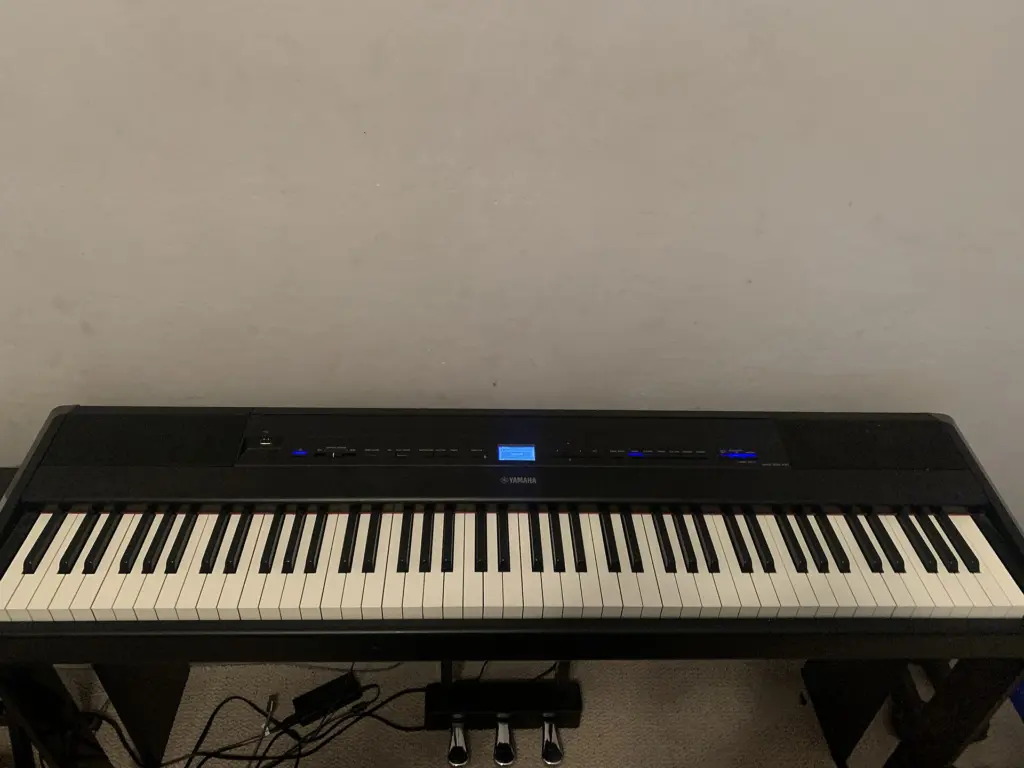
A digital piano is a keyboard first and only then a speaker with a sound library. If you seriously want to learn piano, you need 88 weighted keys with hammer action; otherwise your fingers will later lack the strength for a real piano. A keyboard with light keys, by contrast, often ends up in the basement after six months. In the vast majority of living rooms, the Roland FP-30X is a sound choice. On a tight budget, the Roland FP-10 is enough, and as a piece of living room furniture, the Yamaha Arius YDP-165 is worth considering.
Why the action matters more than any sound
Sounds, rhythms and displays can be added later via an app. The action cannot. That is why it pays to understand the manufacturers‘ terminology before comparing feature lists.
On an acoustic piano, the bass keys play heavier than the treble. Good digital pianos replicate this weighting by register. Yamaha calls it „Graded Hammer“ on the GH3 keyboard, Roland describes the same for the PHA-4, and Korg speaks of a natural weighted hammer action (NH). If there is no such reference, it is usually a keyboard.
Escapement goes one step further. Roland uses that name for replicating the slight resistance a grand piano hammer lets you feel as it releases. Advanced players notice the difference. Beginners rarely miss it.
Sampled concert grands are standard today. Polyphony is more noticeable. 192 notes, as on Yamaha, Casio and Kawai models in this class, is enough even with heavy pedaling; the Korg B2+ has 120.
That leaves the pedals. To get started, a loose footswitch in the box is enough. From the second year on, many players want half-pedaling and three pedals, which are built into console pianos and usually an accessory for portable models.
Practicing quietly: headphones and what the neighbors still hear
The headphone output is the real reason many people do not buy an acoustic piano. If a teacher or parent wants to listen in, you need two jacks. The FP-30X and the P-225 have two, the FP-10 and the Korg B2+ only one. On the YDP-165, Yamaha’s Stereophonic Optimizer adds a sense of space so the sound does not sit in the middle of your head.
And which headphones? Closed-back models block out the surroundings, while open-back models sound airier and press less during long practice sessions. Yamaha offers the closed HPH-100 and the open HPH-150 as accessories. It still is not completely silent, though, because the key action clacks audibly. In a rented apartment, a rug under the instrument helps more than any spec sheet.
Console or stage piano?
A console piano like the YDP-165 weighs 42 kg according to Yamaha, stands firmly and has three pedals and a key cover. It does not like being moved. A portable instrument like the Casio PX-S1100 weighs 11.2 kg and is only 23.2 cm deep. Something like that fits on a stand in a home office and can move to the rehearsal room when needed. In return, the speakers are smaller, and the stand plus pedal unit cost extra. Add both together and you quickly reach the price range of a basic console piano.
Six digital pianos you can find on Amazon.de
| Model | Keyboard and sound | Design, weight | Best for |
|---|---|---|---|
| Roland FP-30X | PHA-4 with escapement, SuperNATURAL Piano, 2 × 11 W | portable, 14.8 kg | Ambitious learners, flexible setup |
| Roland FP-10 | PHA-4 with escapement, SuperNATURAL Piano, 2 × 6 W | portable, 12.6 kg | Getting started on a small budget |
| Yamaha Arius YDP-165 | GH3, CFX sample, VRM Lite, 2 × 20 W | console piano, 42 kg | A fixed spot in the living area |
| Yamaha P-225 | GHC, CFX sample, 24 sounds, 2 × 7 W | portable, 11.5 kg | Stage, band, small rooms |
| Casio Privia PX-S1100 | Smart Scaled Hammer Action, 18 sounds, 2 × 8 W | portable, 11.2 kg, battery operation possible | Little space, on the move |
| Korg B2+ | NH keyboard, 12 sounds, 2 × 15 W | portable, 11.4 kg | Getting started with a learning app |
Roland FP-30X
Inside is the same PHA-4 keyboard as in the more expensive FP-60X. According to Roland, Bluetooth transmits both audio and MIDI, and via USB you can record audio and MIDI on a computer. Two headphone outputs, the Roland Piano App and an optional stand with a triple pedal turn it into an almost full-fledged home piano when needed. For a large living room, 2 × 11 W is on the thin side. That is where the outputs help, since you can connect active speakers to them.
Roland FP-10
The entry-level model of the series keeps the PHA-4 keyboard and the SuperNATURAL sound. Roland saved on the speakers, the number of sounds and the second headphone output. Bluetooth transmits MIDI only, so it works for apps but not for music from your phone. For early lessons, that is enough.
Yamaha Arius YDP-165
The classic living room piano of the Arius series. Yamaha combines the GH3 keyboard with synthetic ebony and ivory key surfaces, plus three pedals with half-pedaling and 303 practice pieces from Beyer, Burgmüller, Czerny and Hanon. The Smart Pianist app only works via cable, as there is no Bluetooth. Music from your tablet through the speakers? Not this way.
Yamaha P-225
The P-225 has become considerably shorter and slimmer than its predecessor. According to Yamaha, the new GHC keyboard is meant to feel just as weighted as the familiar GHS. Bluetooth audio is built in, and so are two headphone jacks. Compared with the FP-30X, for many people the only remaining question is which keyboard they prefer, and a visit to a store answers that faster than any table.
Casio Privia PX-S1100
At 23.2 cm deep, the Privia fits on any sideboard. Casio allows operation on six AA batteries, which is handy for rehearsals in the garden or at family celebrations. Bluetooth audio and MIDI run via the small WU-BT10 adapter. According to Casio, whether it is included depends on the market. Read the product description before you order.
Korg B2+
Korg offers no wireless here. Instead, USB-C carries MIDI and audio. According to the manufacturer, the instrument comes with three months of Skoove Premium, a piano learning app with lessons and songs. At 120 notes, its polyphony is the lowest in the field. As the B2+SP variant, the instrument is available with a wooden stand and three pedals.
Clavinova and Kawai: better bought from a specialist dealer
We did not find the Clavinova CLP-800 series or the new Kawai CX line as new goods on Amazon.de. Both are still interesting. According to Yamaha, the CLP-835 brings the GrandTouch-S keyboard, the CFX and the Bösendorfer Imperial sampled binaurally for headphones, and 2 × 30 W. The Kawai CX202 uses the RH Compact II action with three sensors, the SK-EX concert grand and 2 × 20 W. At 37 to 57 kg, trying one out in a store is the smarter move anyway than having it delivered on spec.
Learning apps: helpful, but no teacher
Every manufacturer has its own app: Smart Pianist from Yamaha, the Roland Piano App, and PianoRemote and PiaBookPlayer from Kawai. They control sounds, display sheet music and record. They do not replace lessons. Skoove or Tomplay run independently of the manufacturer on a tablet if the piano sends MIDI via USB or Bluetooth. Which tablet is suitable for this is covered in our tablet guide (in German). And if you want to record your playing via a microphone or line outputs, read on in our guide to audio interfaces for the home studio (in German).
Which piano for which player?
- Most learners: Roland FP-30X, because the keyboard, two headphone jacks and Bluetooth audio make a good package and it can later move onto a stand with three pedals.
- Small budget: Roland FP-10, the same keyboard with fewer features.
- A fixed spot in the living room: Yamaha Arius YDP-165, if three pedals and a calm piece of furniture matter more to you than wireless.
- Stage and rehearsal room: Yamaha P-225 or Casio PX-S1100, the latter if battery operation is also needed.
- Self-teaching with an app: Korg B2+, as long as 120 notes of polyphony are enough for you.
How a digital piano holds up over years of piano lessons is shown in our long-term review of the Kawai CN39.
Frequently asked questions
Why does the keyboard matter more than the sound on a digital piano?
Sounds, rhythms and displays can be added later via an app; the action cannot. Without 88 weighted keys with hammer action, your fingers will later lack the strength for a real piano. A keyboard with light keys often ends up in the basement after six months.
What do Graded Hammer and escapement mean?
On an acoustic piano, the bass keys play heavier than the treble, and good digital pianos replicate this. Yamaha calls it Graded Hammer, Korg calls it natural weighted hammer action. Escapement is Roland's term for replicating the slight notch felt when the hammer releases. Advanced players notice the difference; beginners rarely miss it.
How much polyphony does a digital piano need?
192 notes, as on Yamaha, Casio and Kawai models in this class, is enough even with heavy pedaling. The Korg B2+ has 120, the lowest polyphony in this comparison. Sampled concert grands, by contrast, are standard and hardly a distinguishing feature.
Can you practice silently on a digital piano?
With headphones the sound stays quiet, but it still is not completely silent, because the key action clacks audibly. In a rented apartment, a rug under the instrument helps more than any spec sheet. If a teacher or parent wants to listen in, you need two headphone jacks, as on the FP-30X and P-225.
Console piano or portable digital piano: which fits?
A console piano like the YDP-165 weighs 42 kg according to Yamaha, stands firmly and has three pedals. A portable instrument like the Casio PX-S1100 weighs 11.2 kg and can move to the rehearsal room when needed. The stand and pedal unit cost extra there, and together you quickly reach the price range of a basic console piano.
Do learning apps replace piano lessons?
No. The manufacturers' apps control sounds, display sheet music and record, but they do not replace lessons. Skoove or Tomplay run independently of the manufacturer on a tablet if the piano sends MIDI via USB or Bluetooth. According to the manufacturer, the Korg B2+ comes with three months of Skoove Premium.
Sources
- Roland FP-30X
- Roland FP-10
- Yamaha Arius YDP-165
- Yamaha YDP-165, specifications
- Yamaha P-225
- Yamaha Clavinova CLP-800, specifications
- Casio Privia PX-S1100
- Korg B2+
- Kawai CX202
Where to buy
- Roland FP-30XCheck price at Amazon.deAvailable in Germany: Amazon.de
- Roland FP-10Check price at Amazon.deAvailable in Germany: Amazon.de
- Yamaha Arius YDP-165Check price at Amazon.deAvailable in Germany: Amazon.de
- Yamaha P-225 (schwarz)Check price at Amazon.deAvailable in Germany: Amazon.de
- Casio Privia PX-S1100 (schwarz)Check price at Amazon.deAvailable in Germany: Amazon.de
- Korg B2+Check price at Amazon.deAvailable in Germany: Amazon.de