Contents13 sections
This guide was first published in German on handgetestet.de.
A display cabinet shows off what’s inside it, and that’s why it is unforgiving. Three questions decide the purchase: what glass is in the doors and shelves, what light hits the pieces, and how this tall, narrow piece of furniture is held to the wall. The most completely documented model is the Mäusbacher Faro, for which the retailer specifies tempered safety glass, warm white LEDs and load ratings per shelf. It is our starting point, provided you can clarify before buying how it is secured to the wall. Tight space and a tight budget point more toward the fif möbel OPTIMA.
Display cabinet, highboard or shelf with a door?
We haven’t found any standard that draws a firm line. In retail, almost anything with a pane of glass somewhere is called a display cabinet, even a cabinet with one glass door next to a wooden one. For buying, one simple question helps. Do you want to show things or just keep them dust-free? If you’re displaying collectibles, you need glass shelves and light from above. For glasses and tableware, wooden shelves behind a pane are enough, and they usually hold more. If it’s about closed storage with a bit of decor, a highboard (in German) is often the more honest choice, and for books a bookcase. If the display cabinet is to be part of a whole wall unit, read our guide to wall units.
What tempered safety glass really means
„Safety glass“ sounds unbreakable. The opposite gets closer to the truth. According to the German architecture portal Baunetz Wissen, tempered safety glass (ESG in German) is heated to over 600 °C and then rapidly cooled with air. This creates tension in the glass that makes it significantly more resistant to bending. It doesn’t get harder, even though retailers like to talk about hardened glass. If the pane breaks, it shatters into blunt-edged granules smaller than one square centimeter. That lowers the risk of serious cuts.
Two consequences for everyday life. After tempering, drilling or cutting is practically impossible, so a matching replacement shelf has to be ordered ready-made. And in rare cases, tempered glass breaks for no apparent reason, because tiny nickel sulfide inclusions can shatter the glass. In a living room, that’s no cause for concern, but it is a reason not to stack anything irreplaceable underneath the glass shelves.
If the listing doesn’t mention the type of glass, that doesn’t mean poor glass is used. It just means you don’t know. For the FORTE Como and the two WOOOD models, we found no information. With children in the household, we would ask before ordering.
How much can a glass shelf hold?
Less than most people think. According to the retailer, the Faro allows 4 kg per glass shelf and 7 kg per wooden shelf, the OPTIMA 5 kg per glass shelf. A stack of plates quickly reaches that. For the WOOOD metal cabinets, the listing states 20 kg per shelf, but those are metal shelves. More important than the individual figure is often the total: the OPTIMA is rated for a total load of 35 kg, the Faro for 67 kg. Heavy pieces belong at the bottom, and not just because of the shelf.
Light: lovely for glasses, tricky for paper
For crystal, ceramics and metal, a built-in LED is not a concern. Things are different for items that fade. Museums calculate in lux and hours here, because light damage adds up. The advisory network Museums Galleries Scotland gives a maximum of 50 lux and 100,000 lux hours a year for very sensitive items such as textiles, watercolors, stamps and color photos, and 200 lux for moderately sensitive ones such as wood or oil paintings. Those are museum values, not a requirement for the living room. But they show the direction. Four hours of light in the evening at 50 lux add up to around 73,000 lux hours a year, and a display cabinet next to a south-facing window can get far more during the day.
The Bavarian Palace Administration (Bayerische Schlösserverwaltung) endorses LEDs from a conservation point of view because they emit hardly any UV or infrared. Its 2012 caveats still apply when buying today. Warm color temperatures are preferred, at most 3,000 kelvin, better 2,700, because cool light has a high blue component. In closed display cases, the heat at the diode and transformer must also be considered. When buying, that means: choose warm white, and switch off the lighting when nobody is looking. The listings here don’t give kelvin figures. For the Faro, at least warm white with 506 lumens is stated.
Why a display cabinet belongs on the wall
Display cabinets are built tall and shallow. Divide the height by the depth and you see it immediately. The Exhibit comes to about 3.9, the Faro to 4.3, the narrow OPTIMA to 5.4. A highboard like the PAIDI MILA & BEN comes in at 3.2 by the same calculation. That isn’t a test value and says nothing about weight. For a comparison, it’s enough.
The German home safety initiative Aktion Das Sichere Haus recommends securing shelves and cabinets to the wall with metal brackets, and the German furniture quality association (Deutsche Gütegemeinschaft Möbel) generally considers additional wall anchoring advisable. For the models here, the picture varies. According to the retailer, WOOOD includes an anti-tip kit and recommends wall anchoring; for fif möbel, wall mounting is recommended as tip-over protection. The listings for the Faro and Como say nothing about it. That doesn’t mean nothing is included, but you’ll have to ask or wait for the assembly instructions.
The standard doesn’t help here. In its 2016 edition, DIN EN 14749 set safety requirements for storage furniture but excluded everything that depends on the building, and it is now listed as withdrawn. So the wall and anchors are up to you. In its 2026 guide, Ikea advises first determining the wall type, locating cables and pipes with a detector and hanging doors only after anchoring. That applies to its own furniture, but it also makes sense for glass doors. On a drywall partition, at least one fixing point should go into a stud. If in doubt, get expert advice.
Five display cabinets with their documented specs
| Model | W/H/D in cm | Glass according to listing | Lighting | Anti-tip according to listing |
|---|---|---|---|---|
| Mäusbacher Faro | 81/180/42 | Tempered safety glass, 2 glass shelves | LED warm white | not specified |
| fif möbel OPTIMA | 57.5/172/32 | Tempered safety glass on doors and sides, 4 glass shelves | none | Wall mounting recommended |
| FORTE Como | 90/168/41 | Glass door, type not stated | LED | not specified |
| WOOOD Ronja XL | 110/189/43 | Glass insert, type not stated | none | Anti-tip kit included |
| WOOOD Exhibit | 99/170 to 173/44 to 45 | Type not stated | none | Anti-tip kit included |
Mäusbacher Faro
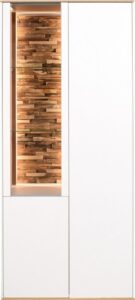
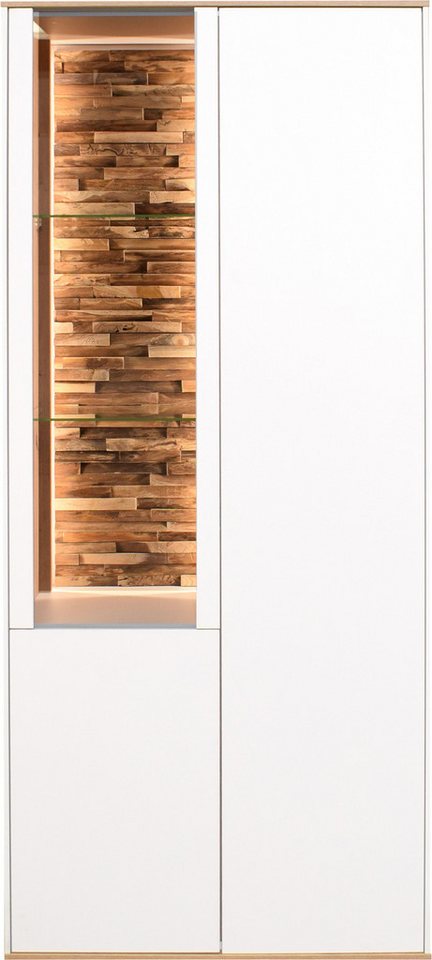
The most detailed listing of the five. One part sits behind glass, the other behind a wooden door, opened with push-to-open, no handle. Two LED strips shine with 9.56 watts, plus six adjustable shelves, two of them glass. At 86 kg the cabinet is heavy, and two-person assembly is advised. On its own website, the company from Upper Franconia advertises design and production in Germany, and the retailer cites a five-year manufacturer’s warranty. The manufacturer doesn’t publish anything online about the series itself, so all dimensions are retailer information. For a pure collector’s cabinet, though, the wooden door is wasted space.
fif möbel OPTIMA
The classic glass display cabinet for collectors: doors and sides of tempered safety glass, four adjustable glass shelves, 32 cm deep. That fits behind a door or in the hallway, which is why securing it to the wall is not optional here. The version we looked at has no lighting. Retailers offer a version with LEDs separately, so pay attention to which one you order. According to the retailer, it is made in Germany. The delivery time was six weeks.
FORTE Como
More furniture than showcase. At 90 cm wide, only part of it sits behind glass; according to the retailer, the doors close with soft-close dampers, and the particleboard shelves hold 5 kg each. That’s enough for glasses, hardly for coffee-table books. The wood-based material is listed as FSC-certified. That says something about where the wood comes from, nothing about off-gassing. The type of glass, the lighting’s wattage and the weight are missing from the listing.
WOOOD Ronja XL
Metal instead of particleboard. The manufacturer De Eekhoorn states 189 cm height, 110 cm width, powder-coated iron and China as the country of origin; the retailer states 65 kg and 20 kg per shelf. That makes the Ronja suitable for tableware and heavy books, too. According to the manufacturer, the doors only have a half glass insert, so it shows less than its name promises. You would have to add lighting.
WOOOD Exhibit
The slightly smaller sister at 53 kg. In the retailer information, the height varies between 170 and 173 cm and the shelf material between metal and wood. So don’t measure to the centimeter if the niche is tight, and ask. The price class is above the Ronja, without us being able to document a reason for it.
How we would choose
- Collection with lighting and storage space: Mäusbacher Faro, if the retailer confirms the wall anchoring beforehand.
- Figurines and models in a narrow niche: fif möbel OPTIMA, firmly anchored to the wall.
- Tableware and heavy pieces: WOOOD Ronja XL or Exhibit, both with 20 kg per shelf according to the listing.
- A bit of display cabinet in the living room unit: FORTE Como.
- Watercolors, stamps, old photos: better no permanent lighting and no spot by the window.
If new furniture smells strongly, the German consumer advice center Verbraucherzentrale recommends airing the room several times a day and not masking the smell with air fresheners. If a strong smell doesn’t go away even after a long time, that may be a defect.
Frequently asked questions
What does tempered safety glass (ESG) mean on a display cabinet?
Tempered safety glass is heated to over 600 °C and rapidly cooled. That makes it more resistant to bending, but not harder. If it breaks, it shatters into blunt-edged granules. Drilling or cutting it is practically impossible afterward, so you have to order a replacement shelf ready-made.
How much can a glass shelf in a display cabinet hold?
Less than you'd think. According to the retailer, the Faro allows 4 kg per glass shelf and 7 kg per wooden shelf, the OPTIMA 5 kg per glass shelf. A stack of plates quickly reaches that. According to the listing, the metal shelves of the WOOOD cabinets hold 20 kg; heavy pieces belong at the bottom anyway.
Does LED lighting damage the items in a display cabinet?
Crystal, ceramics and metal are not a concern. With watercolors, stamps or color photos, light damage adds up. The Bavarian Palace Administration prefers warm color temperatures up to 3,000 kelvin. Choose warm white, switch the light off when nobody is looking, and avoid a spot next to the window.
Does a display cabinet have to be anchored to the wall?
Yes, we recommend it. Display cabinets are tall and shallow; the narrow OPTIMA has a height-to-depth ratio of 5.4. The German safety initiative Aktion Das Sichere Haus recommends metal brackets. According to the retailer, WOOOD includes an anti-tip kit; the listings for the Faro and Como say nothing about it.
Which display cabinet is suitable for tableware?
For heavy tableware and coffee-table books, the WOOOD Ronja XL or Exhibit metal cabinets fit, both with 20 kg per shelf according to the listing. The Ronja, however, only has a half glass insert in the doors, and you would have to add lighting to both. For glasses, wooden shelves behind a pane are also enough.
Sources
- Baunetz Wissen: tempered safety glass
- Museums Galleries Scotland: Conservation and lighting
- Bavarian Palace Administration: use of LED technology (2012)
- Das Sichere Haus: anchoring furniture safely
- Deutsche Gütegemeinschaft Möbel: childproofing your home
- DIN: DIN EN 14749, 2016 edition
- Ikea: guide to wall anchoring
- Verbraucherzentrale: off-gassing from furniture
- De Eekhoorn: Ronja XL
- Mäusbacher furniture factory
- Retailer information from BAUR (German retailer): Faro, OPTIMA, Como, Ronja XL, Exhibit
Where to buy
- Mäusbacher FaroView at OTTOAvailable in Germany: OTTO
- fif möbel OPTIMAView at OTTOAvailable in Germany: OTTO
- FORTE ComoView at OTTOAvailable in Germany: OTTO
- WOOOD Ronja XLView at OTTOAvailable in Germany: OTTO
- WOOOD ExhibitView at OTTOAvailable in Germany: OTTO