Contents15 sections
This guide was first published in German on handgetestet.de.
Is an FFP2 mask enough for sanding, or does it have to be FFP3? For drywall compound, softwood and concrete, FFP2 is usually sufficient according to Moldex’s application table. If you work hardwood or produce a lot of dust at once, go for FFP3 with an exhalation valve, such as the Dräger X-plore 1930 V. And if you are in the workshop every weekend, you are better off planning on a half mask with P3 filters.
Which protection class do you need for sanding?
The classes differ in the permitted leakage. Under EN 149, no more than 8 percent unfiltered air may get inside with FFP2, and only 2 percent with FFP3. DGUV Rule 112-190 from the German Social Accident Insurance translates this into a protection level. There, FFP2 stands for ten times the limit value and FFP3 for thirty times.
What does that mean in the workshop? In its data sheet, Moldex assigns gypsum, cement, concrete dust and softwood to class FFP2, but hardwood dust to FFP3. That matches the German Technical Rule for Hazardous Substances TRGS 553: it classifies hardwood dust as carcinogenic, and against carcinogenic dusts the highest class should always be chosen. For dust containing quartz, for example when sanding concrete or tiles, TRGS 559 normally considers FFP2 sufficient. For very dust-intensive work, it calls for FFP3.
Our advice is simple. If you sand different materials, buy FFP3 straight away. Two kinds of masks on the shelf get mixed up faster than you would like.
What do NR, R and D on the mask mean?
The letters follow the protection class, for example „FFP3 NR D“. According to the DGUV, NR means the mask may only be put on repeatedly within a single work shift. R allows use beyond the shift. The D stands for passing the dolomite dust test: breathing resistance rises more slowly under heavy dust exposure. That matters at a belt sander, which throws a great deal of dust into the air in a short time.
With a valve or without?
For sanding, with a valve. The warm, moist exhaled air then escapes through the valve instead of through the filter fabric, and your glasses fog up less. As a guideline for employees, the DGUV rule gives a continuous wearing time of 150 minutes for filtering half masks with a valve and 75 minutes without. Each is followed by 30 minutes of recovery.
One drawback remains. The exhaled air leaves the mask unfiltered. Masks without a valve are intended for work in hospitals or near vulnerable people; in the workshop, this hardly matters.
Does the mask seal properly with a beard?
No. The DGUV rule explicitly lists stubble, beards and sideburns among the features that interfere with the seal. Uvex states that its folding mask is not suitable for beards, sideburns or deep scars in the sealing area, and Dräger warns beard wearers just as clearly about its half mask. The air then bypasses the filter. Around the edge. Beard wearers are better served by a powered air respirator with a hood or helmet; for these, the DGUV table does not list a beard as a restriction.
How long does a disposable mask last?
According to the DGUV, a filtering half mask should be replaced as soon as breathing resistance noticeably increases, at the latest after one shift. A half mask with replaceable filters is built differently: the body stays, and only the filters go in the trash. According to the manufacturer, Dräger’s P3 R filters have an expiry date of ten years after manufacture; here too, you change them when breathing becomes harder.
And what if the old filler could contain asbestos?
Then no mask from the hardware store will help. The Verbraucherzentrale, Germany’s consumer advice center, lists sanding walls with asbestos-containing filler and joint compound on lightweight partition walls among the jobs only specialist firms may carry out. Even for specialist firms, the German technical rule TRGS 519 prohibits high-speed machines such as sanders during maintenance work. For older houses with unknown layers of filler or adhesive, that means: first have someone determine what is in the wall, then plan.
Six masks worth considering for sanding
| Model | Design | Class and marking | Best for |
|---|---|---|---|
| Dräger X-plore 1930 V | Disposable mask with valve, sizes S and M/L | FFP3 NR D | Hardwood, mixed jobs, lots of dust |
| Dräger X-plore 1920+ V | Disposable mask with valve, sizes S and M/L | FFP2 NR D | Gypsum, softwood, occasional sanding |
| uvex silv-Air 5310+ premium | Folding mask, 360-degree valve, individually packaged | FFP3 NR D | Toolbox and jobs on the go |
| Moldex 2555 | Molded mask with climate valve, 17 g | FFP3 NR D | long sanding sessions in the workshop |
| 3M Aura 9332+ | Folding mask with valve | FFP3 NR D | Insulation materials and hardwood |
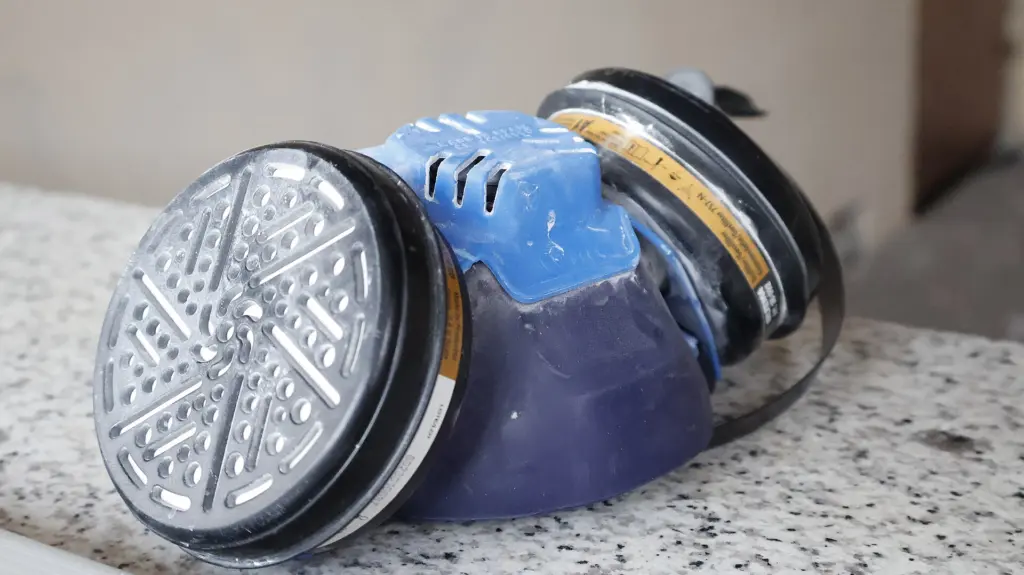
| Dräger X-plore 3300 Handwerkerset | Half mask with two P3 filters, sizes S, M, L | EN 140, filter P3 R | anyone who sands regularly |
Dräger X-plore 1930 V
This is the mask we recommend for the mixed-use home workshop. FFP3 with dolomite marking and an exhalation valve, plus two sizes, S and M/L, which suits narrow faces. Dräger itself now sells the updated 1930+ V with an adjustable head strap. In stores, the 1930 V is usually still available, with the same protection class, valve and sizes.
Dräger X-plore 1920+ V
The same design in FFP2. For drywall panels, wall filler and softwood, this class is sufficient according to the Moldex table. If you occasionally sand down a hardwood board, you need its FFP3 sibling.
uvex silv-Air 5310+ premium
A flat-folded FFP3 mask that, individually packaged, fits into any tool bag. Uvex mentions an EVA foam sealing lip at the nose and chin, an adjustable nose clip and a textile head strap with a stopper. On top of that comes an exhalation valve that is open on all sides.
Moldex 2555
Moldex builds the 2555 as a rigid molded mask with a climate valve that, according to the data sheet, adapts to different faces by itself without any adjustment. At 17 grams, it is light. Newer documents list it with the suffix IonicAir. Moldex describes it as keeping its shape throughout the whole shift.
3M Aura 9332+
3M explicitly promotes it for insulation materials and hardwood and mentions an embossed upper panel designed to reduce fogging of glasses. 3M now also offers a third generation with a revised valve. So when buying, look closely at which version is on offer.
Dräger X-plore 3300 Handwerkerset
A half mask to EN 140 with two bayonet filters of class P3 R. The size is determined by the distance between the bridge of the nose and the tip of the chin: S for 8.5 to 9.5 cm, M for 9.0 to 12.5 cm, L for 12.0 to 14.5 cm. According to Dräger, the straps contain latex. In the long run, it produces less waste than disposable masks. Sanding once a year? Then the set is overkill.
Which mask for which workshop?
- Mixed jobs with wood, filler and stone: Dräger X-plore 1930 V or Moldex 2555, both FFP3 with a valve.
- Only drywall and softwood, a few times a year: Dräger X-plore 1920+ V.
- On the move between job sites: uvex silv-Air 5310+, because the folded mask takes up hardly any space.
- Dust every weekend: Dräger X-plore 3300 Handwerkerset with P3 filters.
- Beard or suspected asbestos: none of these masks, but a powered air respirator or a specialist firm.
When sanding, dust does not only fly into your lungs. According to the DGUV, respiratory protection and eyewear must not get in each other’s way. Our article on safety glasses (in German) shows which styles are available. Suitable work gloves protect your hands, and if you take a cut-off grinder to stone, read our article on cordless angle grinders (in German) first.
Frequently asked questions
Is an FFP2 mask enough for sanding wood?
Moldex assigns softwood, gypsum, cement and concrete dust to class FFP2. Under the German technical rule TRGS 553, hardwood dust is classified as carcinogenic, and the highest class, FFP3, should be chosen against it. If you sand different materials, it is best to go straight for FFP3.
What do NR, R and D mean on a dust mask?
NR means the mask may only be put on repeatedly within a single work shift; R allows use beyond the shift. D stands for passing the dolomite dust test. Breathing resistance then rises more slowly under heavy dust, for example at a belt sander.
Dust mask with or without a valve?
For sanding, with a valve. The warm, moist exhaled air escapes through the valve, and your glasses fog up less. The German DGUV rule gives a continuous wearing time of 150 minutes for masks with a valve and 75 minutes without. The exhaled air, however, leaves the mask unfiltered.
Does an FFP mask seal properly with a beard?
No. According to the DGUV rule, beards, stubble and sideburns interfere with the seal, and air leaks in around the edge. Uvex and Dräger also warn beard wearers. A better fit is a powered air respirator with a hood or helmet; for those, the DGUV table does not list a beard as a restriction.
How long does a disposable dust mask last?
According to the DGUV, a filtering half mask should be replaced as soon as breathing resistance noticeably increases, at the latest after one shift. With a half mask with replaceable filters, the mask body stays and only the filters are thrown away. According to the manufacturer, Dräger's P3 R filters have an expiry date of ten years after manufacture.
Can I sand old filler that may contain asbestos myself?
No. The Verbraucherzentrale, Germany's consumer advice center, lists sanding asbestos-containing filler among the jobs only specialist firms may carry out. Even specialist firms are prohibited by the German technical rule TRGS 519 from using high-speed machines such as sanders for this. In older houses, have someone determine what is in the wall first.
Sources
- DGUV Rule 112-190 „Use of respiratory protective equipment“ (November 2021)
- BAuA (German Federal Institute for Occupational Safety and Health): TRGS 553 „Wood dust“ (version February 2025)
- BAuA: TRGS 519 „Asbestos“
- Verbraucherzentrale: Asbestos, dangerous and still relevant
- Moldex: data sheet for the classic series of FFP masks
- uvex: silv-Air 5310+ premium
- Dräger: X-plore 1930+ V FFP3 NR D
- Dräger: X-plore 1920+ V FFP2 NR D
- Dräger: X-plore 3300 Handwerkerset
- 3M: Aura 9332+ FFP3 with valve
Where to buy
- Dräger X-plore 1930 V FFP3Check price at Amazon.deAvailable in Germany: Amazon.de
- Dräger X-plore 1920+ V FFP2Check price at Amazon.deAvailable in Germany: Amazon.de
- uvex silv-Air 5310+ premium FFP3Check price at Amazon.deAvailable in Germany: Amazon.de
- Moldex 2555 FFP3Check price at Amazon.deAvailable in Germany: Amazon.de
- 3M Aura 9332+ FFP3Check price at Amazon.deAvailable in Germany: Amazon.de
- Dräger X-plore 3300 Handwerkerset P3Check price at Amazon.deAvailable in Germany: Amazon.de