Contents11 sections
This guide was first published in German on handgetestet.de.
A kids‘ toothbrush does not brush on its own. Not even one with Bluetooth. Parents should brush their children’s teeth after them until the end of second grade; that is what the parent guidance from the German Dental Association (Bundeszahnärztekammer) says, and no motor changes that. For children aged three and up, we consider the Philips Sonicare For Kids Smart the most thoughtfully designed choice, because the timer and quadrant signals are built into the handle and the app is just a bonus. If you do not want an app in the children’s room, go for the Oral-B Pro Kids 3+. For school-age children, the Oral-B iO Kids 6+ and the GUM Playbrush JUNIOR 6+ are worth considering.
What dentists recommend for children’s teeth
The guideline dates from 2021. That year, the German network „Gesund ins Leben“ („Healthy Start in Life“) published a recommendation on preventing tooth decay with fluoride for infants and toddlers, and the German Dental Association (BZÄK) lists the same amounts in its guidance for parents:
- From the first baby tooth, brush twice a day with a rice-grain-sized amount of toothpaste containing 1,000 ppm fluoride. Until the second birthday, parents measure the amount and do the brushing themselves. As an alternative in the first year of life, Gesund ins Leben allows a tablet with fluoride and vitamin D; clarify which approach is right with your pediatrician.
- From the second to the sixth birthday, a pea-sized amount of the same toothpaste, two to three times a day. The child learns to brush, and the parents brush again afterward.
- From age six, the BZÄK chart lists toothpaste with about 1,450 ppm, meaning junior or adult toothpaste, and a fully covered brush head.
- According to the BZÄK, follow-up brushing remains the parents‘ job until the end of second grade.
One detail that often gets overlooked: according to the BZÄK, after brushing in the evening the child should not eat anything else and should only drink still water. And a checkup at the dental practice twice a year is part of the routine.
Whether manual or electric makes no difference in either document. The manufacturers set the age limit. Oral-B advises against use under the age of three, GUM recommends the Playbrush from age three, and Philips states in the manual for the For Kids Smart that for children under eight, a parent should do the brushing or at least be present. So before the third birthday, stick with a soft manual toothbrush.
Small head, gentle start: how to recognize a good kids‘ toothbrush
A brush with a large head often ends up in a preschooler’s toothbrush cup because it „lasts longer.“ The head has to fit the mouth, not the child’s age three years from now. GUM solves this with two brush heads for the same handle: KIDS 3+ is extra small and has a color-marked bristle area that helps with the amount of toothpaste, while JUNIOR 6+ is somewhat larger.
The start is just as important. Vibration tickles, and a child who gets startled on the first evening will not want to brush on the second. Philips therefore slowly increases the intensity over the first 14 brushing sessions (EasyStart), and in the Extra Gentle program the timer starts at one minute and gradually extends to two. A timer that signals after each quarter helps with follow-up brushing just as much as when children brush on their own: upper left, upper right, lower left, lower right, 30 seconds each.
When it comes to the battery, it pays to read the fine print. Philips states 42 brushing sessions of two minutes each, which means 21 days when brushing twice a day, and includes a USB charger without a power adapter. GUM states up to eight weeks for the Playbrush. And then there are the running costs: Philips recommends a new brush head every three months, and GUM calculates six heads per child per year.
Five electric toothbrushes for kids side by side
| Model | Age according to manufacturer | Programs and timer | App | Best for |
|---|---|---|---|---|
| Philips Sonicare For Kids Smart (HX6600) | 3 years and up | Extra Gentle and Gentle, KidTimer ramping up from 1 minute, KidPacer every 30 seconds | Sonicare For Kids via Bluetooth, Philips account for parent overview | Preschoolers who first need to get used to vibration |
| Oral-B Pro Kids 3+ | 3 years and up | Daily Clean and Sensitive Plus, 2-minute timer | not required for use | Families without an app, small round head |
| Oral-B iO Kids 6+ | 6 years and up | Super Sensitive, Sensitive, Daily Clean, 2-minute music timer | Disney Magic Timer App | Elementary school children losing baby teeth |
| GUM Playbrush KIDS 3+ | 3 to 6 years | Power and Sensitive, measures pressure, position, duration | GUM Playbrush, 4 games free | Children who get into brushing through a game |
| GUM Playbrush JUNIOR 6+ | 6 years and up | same as KIDS 3+, larger brush head | GUM Playbrush, 4 games free | School-age children who want to see their own brushing times |
Philips Sonicare For Kids Smart
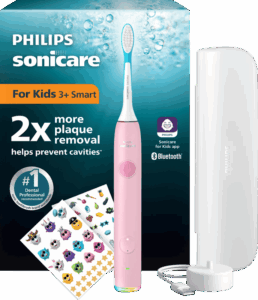
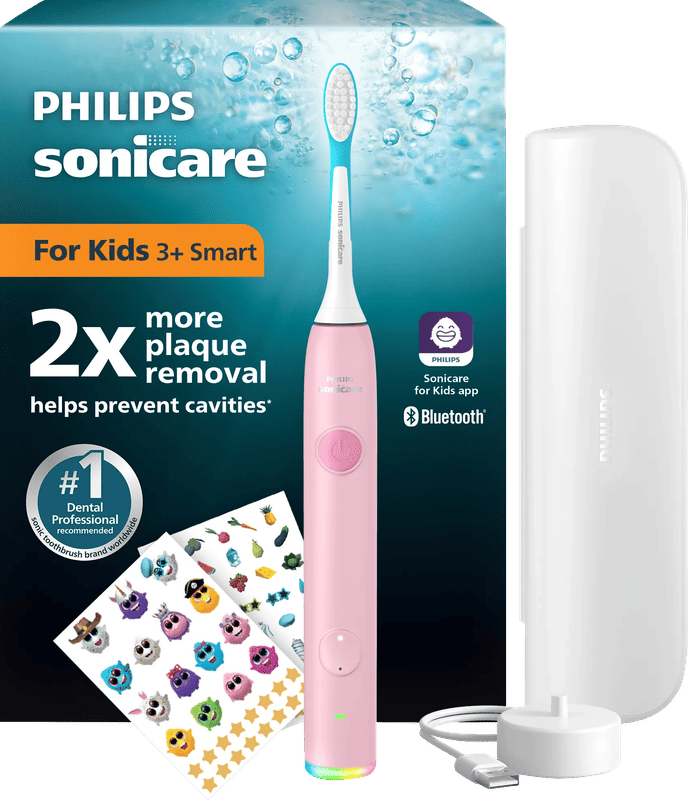
Our favorite for getting started. The manual describes two programs: Extra Gentle with reduced power for younger children and Gentle for older ones. The KidTimer switches the brush off by itself after the brushing cycle, and the KidPacer signals with a sound and light after each quarter. All of this works without a phone. The app adds an interactive brushing experience with the character Sparkly. For the parent overview, Philips requires a separate account.
Oral-B Pro Kids 3+
No app, no account, two modes. That is exactly what speaks for it. Oral-B cites a round brush head for small children’s mouths, extra-soft bristles and two modes, including Sensitive Plus. Four interchangeable stickers decorate the handle. According to Oral-B, it has no pressure control; when you do the follow-up brushing, the pressure is in your hands anyway.
Oral-B iO Kids 6+
Designed for the age when the first baby teeth start to wiggle. According to the manufacturer, it is gentle on wobbly teeth and gums, and it adds three modes including the Super Sensitive mode, a child-friendly speed reduction and a two-minute music timer. The Stitch edition comes with a charging station, a travel case and a case for the brush head. Oral-B explicitly specifies it for children aged six and up.
GUM Playbrush KIDS 3+
It used to be called the Playbrush Smart Sonic; since 2023, it has carried the name GUM Playbrush. According to GUM, the sonic toothbrush works with up to 17,000 movements per minute and measures pressure, position, duration and regularity. In the app, children fight monsters while they brush. Four games are free; nine more are only available with the premium upgrade in the app. If you are trying to get your child away from screens, think this through carefully.
GUM Playbrush JUNIOR 6+
Technically the same brush, just with a larger head. What makes it interesting for school-age children are the brushing statistics with duration, frequency and accuracy. If the child brushes without the app, according to GUM the brush stores the data for up to six months and syncs it later. If you already own the KIDS 3+, you do not need a new handle, only the larger heads.
App, account and brushing data
Brushing apps collect data about a child. How much is shown in a document that Philips published under the EU Data Act for its Bluetooth kids‘ toothbrush HX6322: brushing duration, mode and intensity are kept for 180 days in the app and 730 days on a server, and the data holder is Philips Oral Healthcare in the USA. For the For Kids Smart, the manual mentions registration as soon as you use the parent overview and data backup. Read the app’s privacy notice before pairing for the first time, and consider whether a nickname in the profile would not be enough. With GUM, several children can be managed in separate profiles. If you want to set rules for media use in general, you will find tips in our guide to tablets for kids (in German).
Independent measurements for individual models were published by Stiftung Warentest (the German consumer testing organization) in May 2026, covering nine electric toothbrushes for kids.
How we would decide
- Three to five years, child wary of vibration: Philips Sonicare For Kids Smart, because of the slow start and the growing timer.
- Three to five years, no app wanted: Oral-B Pro Kids 3+.
- Child only brushes with a game: GUM Playbrush KIDS 3+, knowing that nine of the 13 games require a premium upgrade.
- Age six and up, baby teeth starting to fall out: Oral-B iO Kids 6+.
- Age six and up, child wants to see their brushing stats: GUM Playbrush JUNIOR 6+.
- For your own brush, our guide to electric toothbrushes will help.
Whichever brush you choose: in the evening, you brush again afterward.
Frequently asked questions
From what age can a child use an electric toothbrush?
The manufacturers set the age limit. Oral-B advises against use under the age of three, and GUM recommends the Playbrush from age three. Philips states that for children under eight, a parent should do the brushing or at least be present. Before that, stick with a soft manual toothbrush.
How long do parents need to brush their children's teeth after them?
According to the German Dental Association (BZÄK), until the end of second grade, and an electric brush does not change that. After brushing in the evening, the child should not eat anything else and should only drink still water. A checkup at the dental practice twice a year is part of the routine.
How much toothpaste does a child need?
According to the German Dental Association, from the first baby tooth a rice-grain-sized amount of toothpaste with 1,000 ppm fluoride, and from the second to the sixth birthday a pea-sized amount. From age six, the chart lists toothpaste with about 1,450 ppm. Clarify questions about fluoride tablets with your pediatrician.
What should I look for in an electric toothbrush for kids?
The head has to fit the mouth, not the child's age three years from now. A gentle start is important: Philips slowly increases the intensity over the first 14 brushing sessions. A timer that signals after each quarter helps both with follow-up brushing and when children brush on their own.
Do kids' toothbrushes need an app?
No. On the Philips Sonicare For Kids Smart, the timer and signals work without a phone, and the Oral-B Pro Kids 3+ needs no app or account at all. With the GUM Playbrush, four games are free and nine more require a premium upgrade.
What data do brushing apps collect about children?
For a Philips Bluetooth kids' toothbrush, brushing duration, mode and intensity are kept for 180 days in the app and 730 days on a server, according to a published document. Read the privacy notice before pairing for the first time and consider whether a nickname in the profile is enough.
Sources
- Netzwerk Gesund ins Leben: Preventing tooth decay with fluoride in infancy and early childhood (2021)
- German Dental Association (Bundeszahnärztekammer): Guidance for parents (2021)
- Philips: Sonicare For Kids 3+ Smart user manual
- Philips: Information under the EU Data Act (Sonicare For Kids HX6322)
- Oral-B: Pro Kids 3+
- Oral-B: iO Kids 6+
- GUM: Playbrush for kids
- Stiftung Warentest: Electric toothbrushes for kids (28.05.2026)
Where to buy
- Philips Sonicare For Kids Smart HX6600View at CoolblueAvailable in Germany: CoolblueCheck price at Amazon.deAvailable in Germany: Amazon.de
- Oral-B Pro Kids 3+Check price at Amazon.deAvailable in Germany: Amazon.de
- Oral-B iO Kids 6+View at CoolblueAvailable in Germany: CoolblueCheck price at Amazon.deAvailable in Germany: Amazon.de
- GUM Playbrush KIDS 3+Check price at Amazon.deAvailable in Germany: Amazon.de
- GUM Playbrush JUNIOR 6+Check price at Amazon.deAvailable in Germany: Amazon.de