Contents13 sections
This guide was first published in German on handgetestet.de.
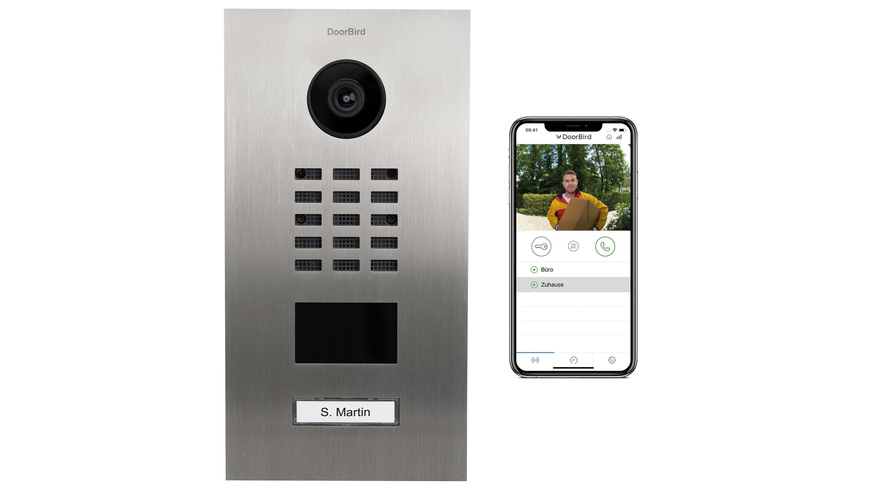
You can replace a door station in ten years. Not the conduit in the wall. That is why the most important decision in a new build comes long before the question of brand, namely when the electrician cuts the channels. We do not name a favorite here, because we do not have an independent test of these stations. All information comes from data sheets, manuals and retailer information. We therefore sort by installation situation: in a shell with a network cable, the DoorBird D2101V is the right fit; in a two-family house, the D2102V; on a finished facade, the D1101V surface-mount is the better fit.
This article covers the construction side: cabling, door opener, recess, renovation. The differences within the DoorBird range are covered in our comparison of DoorBird door stations, and the question of 2-wire or IP in our video door intercom guide.
What needs to go into the conduit before the plaster goes on?
At least two things: a network cable and a separate cable for the door opener. The network cable powers the station via PoE and carries the data at the same time. For the D2101V, DoorBird requires shielded cable of Cat.5 or higher and gives 80 meters as the maximum to the switch or injector. Metzler draws the line differently for its system: Cat5e up to 60 meters, Cat6 and higher up to 100 meters. Shielded Cat6 or better therefore meets both requirements.
Let’s run the numbers for a typical single-family house. Our assumption: the network cabinet is in the basement, and the front door is 4 meters up and 16 meters across. Add the 2-meter reserve at each end that Metzler recommends as a maximum. That makes 24 meters. So length rarely becomes a problem. Neighbors in the wall are more likely to cause trouble, because according to Metzler 230-volt lines should be kept more than half a meter away, since they can interfere with the signal. The cable therefore has no place in the same channel as the outdoor lighting.
Also check the switch. Not all PoE is the same: the D2101V only starts on 802.3af Mode A. A device that does not deliver this mode leaves it dark, according to the manual. You also must not connect the power supply and PoE at the same time.
Why the door opener needs its own cable
This is where the most consequential planning mistake happens, precisely because the phrase „door opener connection“ in the data sheet sounds harmless. The relays of the D2101V switch no more than 24 volts and 1 amp. They do not supply power. The electric door opener therefore needs its own power supply, and Metzler likewise requires a separate power supply and an additional cable for its station.
Even more important is where the relay sits. If it is in the station on the outside wall, someone could, according to DoorBird, break open the faceplate and short the wires, and the door would open. The manufacturer therefore recommends a separate security relay inside the house, such as the I/O Door Controller A1081. For your conduit planning, that means the door opener cable does not just run from the station to the door, but from the door to a point inside the building. Fix this point before plastering. We would only build with the relay inside.
If a motorized lock is used instead of a door opener, the cabling question changes. What to consider is explained in the guide Making a motorized lock smart (in German).
Recess, height, sun: three measurements for the wall
According to the data sheet, the current D2101V comes without a back housing and without a power supply. Flush-mount and surface-mount housings are accessories. If you are planning a recess in the shell, order the housing first and take the measurements from the housing on site, not from memory. The faceplate itself measures 253 by 131 millimeters, and the entire station is 48.75 millimeters deep.
For the height, what counts is the lens, not the center of the box. DoorBird specifies at least 145 centimeters, Metzler 1.4 to 1.6 meters. Because the lens sits at the top of the faceplate, the recess ends up noticeably lower than many people expect. The lens cannot be adjusted.
And then there is the orientation. Direct sunlight can permanently damage the image sensor, and according to DoorBird such damage is not covered by the warranty. A south-facing facade without a canopy is therefore a bad spot, no matter which faceplate hangs there. If you install the station in a post or a mailbox, you also need to provide ventilation and free water drainage, otherwise condensation is a risk, and here too the manufacturer declines warranty coverage.
Renovation: chisel in or mount on the surface?
In existing buildings, there is rarely a free conduit. If there is only doorbell wire, DoorBird’s A1072 converter transmits network and power over the two wires; that costs an extra device but saves running a new cable. On a finished facade, surface mounting is usually the more sensible solution: the D1101V surface-mount measures just 151.9 by 65 millimeters and comes with housing, power supply and Wi-Fi. Its back housing is made of polycarbonate, though, and there is only one relay. Chiseling into the wall only pays off if the facade is being replastered anyway. We think opening up an intact facade for a single station is the wrong call.
Six stations for the wall
| Model | Mounting and front | Network and power | Best for |
|---|---|---|---|
| DoorBird D2101V stainless steel V4A | Surface or flush mount, housing sold separately, stainless steel | LAN, PoE 802.3af Mode A or 15 V DC | New build with network cable, door and gate |
| DoorBird D2102V stainless steel V4A | Surface or flush mount, housing sold separately, stainless steel, two call buttons | LAN, PoE 802.3af Mode A or 15 V DC | Two-family house, new build with network cable |
| DoorBird D1101V flush-mount | Flush mount, compact | LAN, PoE, Wi-Fi 2.4 GHz | Narrow door reveal, Wi-Fi as a fallback |
| DoorBird D1101V surface-mount V4A | Surface mount, polycarbonate housing included | LAN, PoE, Wi-Fi 2.4 GHz, power supply included | Renovation without chiseling |
| Metzler VDM10 LAN/PoE | 5 mm stainless steel front according to the listing, three doorbell buttons | LAN, PoE 802.3af via switch | Three households, indoor stations instead of just an app |
| Hikvision DS-KV8213-WME1/Flush | Flush mount, aluminum instead of stainless steel, two buttons | Wi-Fi, PoE or 12 V DC according to the retailer | Two households, card reader wanted |
DoorBird D2101V stainless steel V4A
Two relays switch the door and gate separately, an input accepts the door release button from inside the house, and according to the data sheet RFID manages up to 500 transponders. The faceplate is 3 millimeters thick, and the station is rated IP65 and IK08. The image is weaker: 720p, and there is no Wi-Fi module. The housing comes separately, which mainly surprises buyers who expect a ready-made complete solution.
DoorBird D2102V stainless steel V4A
The sibling for two apartments: two call buttons, otherwise, according to the data sheet, the same technology with 720p, IP65 and IK08. Here, too, the back housing is not in the box. So plan the cabling the same way; only the recess turns out different, and you take the measurements from the housing as delivered.
DoorBird D1101V flush-mount
It is the slim solution for door reveals and pillars where a 13-centimeter-wide faceplate does not fit. The data sheet for the surface-mount version lists 1080p, 2.4 GHz Wi-Fi and one relay; DoorBird lists the flush-mount version there as available separately. So check its installation dimensions separately. If you want to switch both a gate and a door, one relay is the limit.
DoorBird D1101V surface-mount V4A
Technically the same family, but ready to mount right away, because the housing and power supply are in the box. That is exactly what makes it the renovation device. According to the data sheet, the motion sensor reaches up to 6 meters; on the D2101V, it is 10.
Metzler VDM10 LAN/PoE
A different concept: here the indoor station is part of the system, powered via a PoE switch. According to the listing, the front is made of 5-millimeter-thick V2A stainless steel, protected to IP65. Setup is done via the Hik-Connect app, and for advanced settings Metzler mentions Windows software. Metzler does not mention an open interface like DoorBird’s in these documents. In a small multi-unit building, where not everyone wants to pull out their phone, there is still a lot to be said for it.
Hikvision DS-KV8213-WME1/Flush
The exception in this list, because there is no stainless steel here. According to the retailer, it is an aluminum station with a 2-megapixel camera, two name buttons and a Mifare reader, rated IP65 and IK08. Because these figures come from the retailer, we only classify the station. It is of interest where two households share a flush-mount solution and the material is secondary.
Which station suits which installation situation
- Shell construction, cabling freely plannable, door and gate: DoorBird D2101V stainless steel V4A, with the door opener relay inside.
- Two apartments, cabling freely plannable: DoorBird D2102V stainless steel V4A.
- Narrow door reveal, recess possible: DoorBird D1101V flush-mount.
- Finished facade, doorbell wire in place: DoorBird D1101V surface-mount V4A.
- Three households with fixed indoor stations: Metzler VDM10 LAN/PoE.
- Two households, card reader wanted, aluminum is not a problem: Hikvision DS-KV8213-WME1/Flush.
One thing applies to all six. A camera at the front door is subject to data protection law, and the station is connected to your home network. How to secure accounts and access is described in the guide Setting up a security camera securely (in German); the rules of the German supervisory authority for doorbell cameras are listed in the sources.
Frequently asked questions
Which cables does a video door station need in a new build?
At least one network cable and a separate cable for the door opener. The network cable powers the station via PoE and carries the data. DoorBird requires shielded cable of Cat.5 or higher up to 80 meters; Metzler specifies Cat5e up to 60 meters or Cat6 and higher up to 100 meters. Shielded Cat6 fits both. Keep it more than half a meter away from 230-volt lines.
Why does the door opener need its own cable?
The relays of the D2101V switch no more than 24 volts and 1 amp; they do not supply power. In addition, according to DoorBird, with a relay in the outdoor station someone could break open the faceplate and short the wires. The manufacturer recommends a separate security relay inside the house, such as the A1081. So the cable runs from the door into the building.
At what height should a video door station be mounted?
What counts is the lens, not the center of the box. DoorBird specifies at least 145 centimeters, Metzler 1.4 to 1.6 meters. Because the lens sits at the top of the faceplate, the recess ends up lower than you might expect. Take the measurements from the flush-mount housing as delivered, which comes as an accessory for the D2101V.
Which PoE switch works with the DoorBird D2101V?
One that delivers 802.3af Mode A. Without this mode, the D2101V stays dark, according to the manual. You must not connect the power supply and PoE at the same time. So check the mode in the switch's data sheet before buying.
How do you retrofit a video door station in an older building?
If there is only doorbell wire, the DoorBird converter A1072 transmits network and power over two wires. On a finished facade, the D1101V surface-mount is usually more sensible: compact, with housing, power supply and Wi-Fi, though with a polycarbonate back housing and only one relay. Chiseling into the wall only pays off if the facade is being replastered anyway.
Does direct sunlight harm a door station?
Yes, direct sunlight can permanently damage the image sensor, and according to DoorBird such damage is not covered by the warranty. A south-facing facade without a canopy is a bad spot. In a post or mailbox, the station needs ventilation and free water drainage, otherwise condensation is a risk.
Sources
- DoorBird: D2101V data sheet, as of April 2024 (PDF)
- DoorBird: D21x installation manual (PDF)
- DoorBird: D2102V data sheet, as of April 2024 (PDF)
- DoorBird: D1101V surface-mount data sheet, as of April 2024 (PDF)
- Metzler: LAN/PoE connection requirements (PDF)
- Metzler: notes on component selection and installation (PDF)
- Bavarian State Office for Data Protection Supervision: video doorbell cameras (PDF)
- Retailer information on the Hikvision DS-KV8213-WME1/Flush
Where to buy
- DoorBird D2101V Edelstahl V4AView at ELVAvailable in Germany: ELVCheck price at Amazon.deAvailable in Germany: Amazon.de
- DoorBird D2102V Edelstahl V4AView at ELVAvailable in Germany: ELV
- DoorBird D1101V UnterputzView at ELVAvailable in Germany: ELVCheck price at Amazon.deAvailable in Germany: Amazon.de
- Metzler VDM10 LAN/PoECheck price at Amazon.deAvailable in Germany: Amazon.de
- Hikvision DS-KV8213-WME1/FlushCheck price at Amazon.deAvailable in Germany: Amazon.de