Contents14 sections
This guide was first published in German on handgetestet.de.
Dull kitchen knives rarely have a steel problem. Usually the right tool is missing, or the knife is being sharpened at the wrong angle. If you are willing to practice for half an hour, a 1000/3000 combination stone will take you furthest; if you would rather leave the angle to a guide, go for a rolling sharpener, and the honing steel remains what it is: a tool for in-between touch-ups.
This guide explains the technique behind it first. Grit, sharpening angle and steel hardness determine whether a sharpener suits your knives. The brand comes after that.
What the number on the stone means
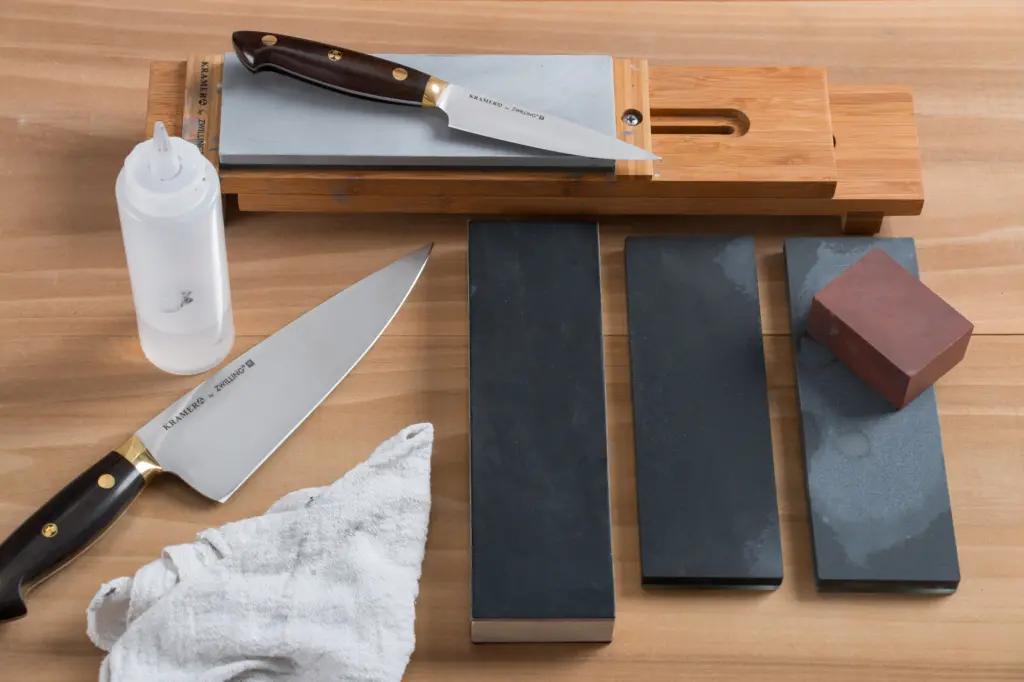
The higher the grit, the finer the abrasive and the less material the stone removes. In its sharpening guide, Zwilling classifies the levels like this: 250 for nicks and a new base edge, 1000 for normal sharpening, 3000 for fine honing, 5000 and 8000 for polishing. This breakdown explains almost every buying decision.
A household knife that is maintained regularly does not need a 250 stone. It eats steel. You take it out of the cupboard when the tip has broken off or someone has opened a tin can with the chef’s knife. In everyday cooking, the 1000 side is enough, and the 3000 side smooths the edge afterward. Whether you then need a 6000 stone is more a matter of taste: tomato skin and fish cut noticeably cleaner with a polished edge, while onions hardly show the difference.
Be careful with the numbers on pull-through sharpeners. Zwilling specifies the ceramic rods of the V-Edge in F grit, which follows a different standard than the numbers on Japanese water stones. An „F360“ therefore cannot be compared one-to-one with a 360 stone.
15 or 20 degrees: the angle matters more than the device
The angle is measured per side. According to Zwilling, it sharpens its knives to about 15 degrees per side, so around 30 degrees in total. The same company’s Japanese Miyabi knives are sharpened to 9.5 to 12 degrees per side. Wüsthof’s PEtec edge technology uses 14.5 degrees per side. Rugged outdoor and pocket knives tend to sit at around 20 degrees.
Why does that matter? A shallow angle cuts more easily but chips sooner. A steeper angle lasts longer but starts to feel dull earlier. If you resharpen a Japanese gyuto at 20 degrees, you give away exactly the sharpness you paid for. Conversely, a softer European knife does not take well to a very shallow angle.
On a stone, you hold the angle yourself. As an aid, Zwilling recommends placing two two-euro coins stacked on top of each other under the spine of the blade. Rolling sharpeners, electric devices and pull-through sharpeners, by contrast, set the angle for you. That is their real advantage, and at the same time their limitation: if the preset angle does not match the knife, the device grinds a new one.
Hard steel, different tools
The hardness of knife steel is given in HRC, the Rockwell scale. According to Zwilling, German kitchen knives are usually between 55 and 58 HRC, Japanese ones between 61 and 66. At Wüsthof, the company states 58 HRC for the Classic and Ikon series and 56 for the Gourmet series.
For the honing steel, this has a very practical consequence. It has to be harder than the blade, otherwise it does nothing. A chrome-plated steel removes hardly any material and is suitable for maintaining German knives. For blades from about 60 Rockwell, Zwilling recommends ceramic, which is considerably harder and removes more. So if you own a santoku with 62 HRC and run it over the old honing steel from your knife block, at best you are polishing the steel of the rod.
Very hard blades are also brittle. Coarse stages and a lot of pressure can cause small chips in the edge. Here, a lot speaks for stones or a rolling sharpener with a diamond disc, where you can control the pressure.
Stone, roller, electric or pull-through?
The water stone is the most versatile tool. Any angle works, and so does any hardness. It does, however, require practice, a non-slip base and patience. Zwilling describes the process like this: soak the stone until no more bubbles rise, then with light pressure sharpen first one side, then the other, until you can feel a fine burr across the edge. Soft stones gradually wear down in the middle and need to be flattened from time to time.
Rolling sharpeners hold the knife magnetically in a guide. A disc rolls along the edge. It is hard to get wrong. Electric sharpeners work even faster but remove more material than many people think. Simple pull-through sharpeners cost little and take seconds to use; their fixed angle and small abrasive surfaces make them the solution for knives you are not attached to.
Seven sharpeners compared
| Model | Type and abrasive | Angle | Best for |
|---|---|---|---|
| Naniwa combination stone 1000/3000 | Water stone, grit 1000 and 3000, 185 × 65 × 30 mm | freely selectable | Beginners on the stone, German and Japanese knives |
| King KDS 1000/6000 | Water stone with holder and flattening stone according to the retailer | freely selectable | anyone who wants a polished edge |
| HORL 3 Cruise | Rolling sharpener, diamond disc and stainless steel honing disc, permanently fitted | 15° / 20° | Getting started without freehand practice |
| HORL 3 | Rolling sharpener, diamond and ceramic disc, interchangeable | 15° / 20° | Knife collections, adding fine stones later |
| Chef’sChoice 1520 AngleSelect | electric, diamond discs | 15° / 20° | many knives, little time, serrated edges too |
| Zwilling V-Edge | V-shaped ceramic rod sharpener, F150 and F360 | approx. 15° / approx. 10° | Touching up straight-edged blades, Japanese ones too |
| Zwilling honing steel 23 cm | chrome-plated steel | freehand, 15–20° recommended | Maintaining German knives between sharpenings |
Naniwa combination stone 1000/3000
Naniwa from Osaka lists the stone as the Basic combination stone MV-510/530, measuring 185 × 65 × 30 mm. Two sides, two jobs: sharpening and smoothing. This is exactly the combination Zwilling also names as basic equipment. The stone costs little and is the most sensible way to get started, provided you want to hold the angle yourself.
King KDS 1000/6000
The classic from Japan. Instead of 3000, this one has a 6000 side that polishes more than it sharpens. Retailers describe the 1000 side as a stone to be soaked and the fine side as a stone that is only wetted. According to the retailer, a holder and a small flattening stone are included. If you jump straight from 1000 to 6000, you need a little more patience with the final honing.
HORL 3 Cruise
HORL itself calls it the entry-level model. According to HORL, it works with a diamond disc for sharpening and a stainless steel honing disc, both permanently fitted. The magnetic guide offers 15 degrees for thin blades made of carbon or Damascus steel and 20 degrees for chef’s and outdoor knives. The housing is made of plastic. In terms of price, the Cruise sits in the mid-range, so well above a stone.
HORL 3
The same angles, but with an oak or walnut housing and a ceramic instead of stainless steel honing disc. More important than the wood is the quick-change system: the discs can be swapped, and HORL offers two sharpening stones and a particularly fine disc for this. If you want to sharpen a Japanese knife below 15 degrees, you will only find the right angles on the HORL 3 Pro, with six settings from 10 to 25 degrees. In a normal household kitchen, we consider the Pro to be overkill.
Chef’sChoice 1520 AngleSelect
An electric sharpener with diamond discs that sharpens at either 15 or 20 degrees. According to the Amazon listing, it also handles serrated edges, which makes it interesting for households with many serrated steak knives (in German). According to the manufacturer, it is made in the USA. It is fast, loud and removes a noticeable amount of material; for an expensive Damascus steel knife, we would rather recommend the stone.
Zwilling V-Edge
Not a classic pull-through. The blade is drawn vertically downward between two angled ceramic rods. Two angle adapters are included, according to Zwilling for about 15 degrees on European blades and about 10 degrees on Japanese ones. The blue rods are coarse (F150), the green ones medium-fine (F360). The V-Edge cannot handle serrated edges.
Zwilling honing steel 23 cm
Chrome-plated, with a plastic handle. It realigns the edge between two sharpening sessions and removes little material in the process. Zwilling recommends five to ten strokes per side at 15 to 20 degrees. For knives beyond 60 HRC and for serrated edges, it is the wrong choice.
If you own Wüsthof knives, you can also take a look at the manufacturer’s two-stage hand sharpener, with a coarse stage made of carbide and a fine one made of ceramic. It is matched to Wüsthof’s shallow angle.
Which sharpener suits which kitchen
- Two or three good knives from a knife set and some enjoyment of the craft: Naniwa 1000/3000, plus the honing steel for the weeks in between.
- Japanese knives with 60 HRC and more: a stone. If you like a fine polish, take the King 1000/6000.
- No interest in practicing, but you want a fixed angle: HORL 3 Cruise, or the HORL 3 for many knives.
- Large household, serrated edges, little time: Chef’sChoice 1520.
- Only occasional touch-ups: Zwilling V-Edge.
One last piece of advice. Sharpen often and gently rather than rarely and roughly. Every coarse pass costs blade.
Frequently asked questions
What grit does a whetstone for kitchen knives need?
Zwilling breaks it down like this: 250 for nicks and a new base edge, 1000 for normal sharpening, 3000 for fine honing, 5000 and 8000 for polishing. A regularly maintained household knife does not need a 250 stone; the 1000 side followed by the 3000 side is enough.
At what angle do you sharpen kitchen knives?
The angle is measured per side. Zwilling sharpens its knives to about 15 degrees per side, its Japanese Miyabi knives to 9.5 to 12 degrees, and rugged outdoor knives tend to sit at around 20 degrees. A shallow angle cuts more easily but chips sooner; a steeper one lasts longer.
Is a honing steel suitable for Japanese knives?
A chrome-plated honing steel usually is not. It has to be harder than the blade, otherwise it does nothing. According to Zwilling, Japanese knives range from 61 to 66 HRC. For blades from about 60 Rockwell, Zwilling recommends ceramic, which is considerably harder.
Is a rolling sharpener worth it instead of a whetstone?
For anyone who does not want to practice. Rolling sharpeners hold the knife magnetically in a guide while a disc rolls along the edge, which is hard to get wrong. The limitation: the fixed angle of 15 or 20 degrees does not suit every knife, and if it does not match, the device grinds a new one.
How do you use a water stone?
According to Zwilling, soak the stone until no more bubbles rise, then sharpen with light pressure, first one side, then the other, until you can feel a fine burr across the edge. Soft stones wear down in the middle and need to be flattened from time to time.
Who is an electric knife sharpener for?
For large households with many knives and little time. The Chef’sChoice 1520 sharpens at either 15 or 20 degrees and, according to the listing, also handles serrated edges. It is fast, loud and removes a noticeable amount of material; for expensive Damascus steel knives, the stone is gentler.
Sources
- Zwilling: Sharpening knives with whetstones
- Zwilling: Knife sharpening angle
- Zwilling: Sharpening knives
- Zwilling: Japanese and German kitchen knives
- Zwilling: V-Edge
- HORL: Rolling sharpeners
- HORL: The principle
- Naniwa Abrasive: Sharpening Stones
- Wüsthof: Precision Edge Technology
- Chef’sChoice: Electric sharpeners
Where to buy
- Naniwa Kombistein 1000/3000Check price at Amazon.deCheck price at Amazon.co.ukCheck price at Amazon.nlCheck price at Amazon.com.beCheck price at Amazon.frCheck price at Amazon.itCheck price at Amazon.esCheck price at Amazon.plCheck price at Amazon.seAvailable in Germany: Amazon.de
- King KDS 1000/6000Check price at Amazon.deCheck price at Amazon.co.ukCheck price at Amazon.nlCheck price at Amazon.com.beCheck price at Amazon.frCheck price at Amazon.itCheck price at Amazon.esCheck price at Amazon.plCheck price at Amazon.seAvailable in Germany: Amazon.de
- HORL 3 CruiseCheck price at Amazon.deCheck price at Amazon.co.ukCheck price at Amazon.nlCheck price at Amazon.com.beCheck price at Amazon.frCheck price at Amazon.itCheck price at Amazon.esCheck price at Amazon.plCheck price at Amazon.seAvailable in Germany: Amazon.de
- HORL 3Check price at Amazon.deCheck price at Amazon.co.ukCheck price at Amazon.nlCheck price at Amazon.com.beCheck price at Amazon.frCheck price at Amazon.itCheck price at Amazon.esCheck price at Amazon.plCheck price at Amazon.seAvailable in Germany: Amazon.de
- Chef'sChoice 1520 AngleSelectCheck price at Amazon.deCheck price at Amazon.co.ukCheck price at Amazon.nlCheck price at Amazon.com.beCheck price at Amazon.frCheck price at Amazon.itCheck price at Amazon.esCheck price at Amazon.plCheck price at Amazon.seAvailable in Germany: Amazon.de
- Zwilling V-EdgeCheck price at Amazon.deCheck price at Amazon.co.ukCheck price at Amazon.nlCheck price at Amazon.com.beCheck price at Amazon.frCheck price at Amazon.itCheck price at Amazon.esCheck price at Amazon.plCheck price at Amazon.seAvailable in Germany: Amazon.de
- Zwilling Wetzstahl 23 cmCheck price at Amazon.deCheck price at Amazon.co.ukCheck price at Amazon.nlCheck price at Amazon.com.beCheck price at Amazon.frCheck price at Amazon.itCheck price at Amazon.esCheck price at Amazon.plCheck price at Amazon.seAvailable in Germany: Amazon.de