Contents10 sections
This guide was first published in German on handgetestet.de.
People rarely buy a motorcycle GPS for the map. What tips the balance are three questions that only come up once you are in the saddle: Does your gloved finger hit the right button? Does the mount hold on cobblestones? And what happens in steady rain? If you tour a lot, go for the Garmin zūmo XT3, because it plans twisty routes on its own and, according to the manufacturer, can be operated with gloves. For short after-work rides, much less device is often enough.
Before you buy: where the GPS will sit and where it gets power
Conditions on the handlebar are different from those in a car. Vibration, rain from the front, blazing sun on the display. A device that disappears into the tank bag is no help when you need to turn. So first sort out the space in the cockpit, then think about features.
- Mount: Garmin includes a handlebar mount with a U-bolt with the 6-inch model of the zūmo XT3, and a mount for smaller bikes with the 4.7-inch model. Power comes through the mount. According to the manual, the device must not be connected directly to the power cable from the bike’s electrical system.
- Weather protection: According to the Garmin manual, IPX7 means the device can withstand occasional immersion in up to 1 m of water for 30 minutes. For riding in the rain, that is enough. You should still keep your distance with a pressure washer.
- Operation: Large buttons on screen, adjustable touch sensitivity or physical buttons. If you ride in winter with thick gloves, look for physical buttons or a handlebar remote.
- Twisty routes: Garmin calls the feature „Adventurous Routing,“ TomTom lets you choose winding and hilly roads in three levels, and Beeline has a „Fun“ mode. What matters is that you can adjust the intensity. Otherwise your after-work ride turns into a detour over three mountain passes.
One detail from the Garmin manual: operation is possible between −15 and 55 °C, but charging only between 0 and 45 °C. If you set off on a frosty spring morning, take the device out of the garage fully charged.
What is allowed on the handlebar and what is not
A GPS on the handlebar is allowed. Operating it while riding is only allowed to a limited extent. Under Section 23 (1a) of the German Road Traffic Regulations (StVO), a navigation device may be used if it is neither picked up nor held and only requires a brief glance appropriate to the conditions. Entering a destination, reworking the route, browsing menus: that belongs at the side of the road, engine off.
Speed cameras are a stricter matter. Section 23 (1c) of the StVO prohibits devices that indicate traffic enforcement. On devices with several functions, exactly those functions must not be used. The ADAC, the German automobile club, makes clear that this also applies to speed camera warnings in a GPS and cites a fine and one point in the Flensburg register, Germany’s central driving offense register. According to the manufacturer, TomTom warns of speed cameras, Garmin offers camera data by subscription in some regions, and with Beeline it is part of the „Plus“ subscription. In Germany, this feature stays off. Other countries have their own rules; the ADAC’s country overview helps before you travel.
Five motorcycle GPS units compared
| Model | Display and operation | Weather and power | Best for |
|---|---|---|---|
| Garmin zūmo XT3 | 4.7 or 6 inches, touch, glove-friendly according to the manufacturer | IPX7, lithium-ion battery, power through the mount | Touring riders who plan routes on the device |
| TomTom Rider 550 | Touch with adjustable sensitivity, portrait and landscape | IPX7, built-in battery, motorcycle and RAM mount included | Riders looking for a standalone GPS with map updates over Wi-Fi |
| Beeline Moto II | 1.45 inches, round, 412 × 412 pixels, four buttons | weather-sealed, up to 14 hours of battery, USB-C | Commuters and after-work rides with the phone in your pocket |
| Chigee AIO-6 Max | 6 inches, 1280 × 720 pixels, touch plus four buttons | IP69K, connects to 12–18 V | Riders who want Apple CarPlay or Android Auto on the handlebar |
| BMW ConnectedRide Navigator | 5.5-inch touch, operated via the Multi-Controller | Power from the navigation preparation, charging via USB-C | BMW riders from model year 2014 with navigation preparation |
Garmin zūmo XT3: the device for long tours
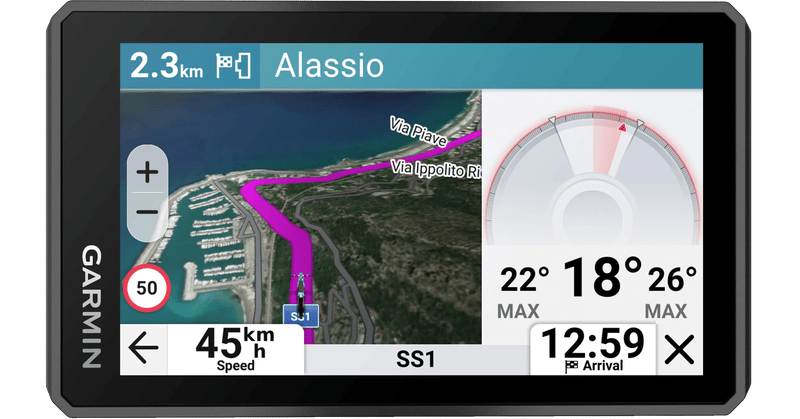
On sale since February 2026, in 4.7 and 6 inches. Garmin lists preinstalled road and topo maps, plus Michelin Scenic Roads and a map of routes that other motorcyclists ride frequently. A slider controls how twisty the routing gets. According to the manual, depending on the region, the device gives audible warnings of curves ahead and suggests a break after more than two hours without stopping. The lean angle display is more of a gimmick. If you do not want to tap with gloves on, you can add a handlebar remote.
TomTom Rider 550: solid and standalone
According to the manufacturer, the touch sensitivity can be adjusted for thin and thick gloves, and map updates run over Wi-Fi without a computer. You choose twisty roads in three levels. The box includes a motorcycle mount and a RAM mount, and the display rotates between portrait and landscape. Compared with the zūmo XT3, it feels plainer. For riders who simply want to get there, that is enough.
Beeline Moto II: an arrow instead of a map
Small, round, 42 grams. The Beeline Moto II does not show a large map but brief directions on 1.45 inches. Nothing works without a smartphone: Beeline requires an iPhone with iOS 16 or later or Android version 8.0 or later. According to the manufacturer, the „Fun“ mode looks for the twistiest roads to your destination, and Germany and Austria are covered by this route planning. For your regular evening ride, that is enough. On an Alpine tour over unfamiliar passes, you miss the overview.
Chigee AIO-6 Max: your phone mirrored onto the handlebar
Strictly speaking, the Chigee is not a GPS unit. It displays Apple CarPlay or Android Auto from your smartphone, so navigation comes from the app you already use. In the test by 1000PS, a German motorcycle magazine, the wireless connection was fast and stable, and the anti-glare 6-inch display was readable in blazing sun. There was criticism of small text in some apps and of cluttered views. Mounts are ordered separately, and power comes from a fixed connection to the bike’s electrical system.
BMW ConnectedRide Navigator: only for its own brand
If you ride a BMW with navigation preparation, you get factory-style integration here. The device clicks into the existing mount and is locked with the vehicle key. It is operated via the Multi-Controller on the handlebar, so your hand stays on the grip. According to BMW, it fetches updates and traffic data over Wi-Fi or with an inserted SIM card. Helmet and smartphone connect via Bluetooth. For other brands, it is not an option.
Which GPS suits which riding style?
- Multi-day tours, mountain passes, the occasional gravel road: Garmin zūmo XT3 in 6 inches. The smaller model fits better on naked bikes with little space.
- Standalone GPS that does not depend on a smartphone: TomTom Rider 550.
- Short rides, as little as possible on the handlebar: Beeline Moto II.
- If you want to see Google Maps, Apple Maps or music from your phone on the handlebar: Chigee AIO-6 Max.
- BMW with navigation preparation and Multi-Controller: ConnectedRide Navigator.
Voice directions are best delivered through a headset in the helmet, because you should only glance briefly at the screen while riding. Suitable devices are in our guide to motorcycle intercoms (in German). If you are also looking for a device for your car, you will find it in our car GPS guide (in German).
With the zūmo XT3, that leaves the question of size. According to Garmin, both versions have the same maps and features. Both are tested to MIL-STD-810 and waterproof to IPX7, and both record lean angle and g-force. The difference lies in the cockpit. The 4.7-inch version comes with a mount for smaller motorcycles, the 6-inch version with a handlebar mounting kit for larger bikes.
Our rule of thumb: before you buy, hold the device where it will later sit, using a cardboard template if necessary. If the large display covers the speedometer or warning lights, the small one is the better choice. On an adventure bike with wide handlebars, on the other hand, everything speaks for 6 inches, because you take in more map at a glance.
Manufacturer information as of November 2026. Bicycles and e-bikes call for different devices; they are covered in our guide to bike computers with navigation (in German).
We tested a hazard warning device with community reports in the car: OOONO Co-Driver NO2 review, with too many false alarms; speed camera warnings while driving are prohibited in Germany.
Frequently asked questions
Is a GPS on a motorcycle handlebar allowed?
The device on the handlebar is allowed; operating it while riding is only allowed to a limited extent. Under Section 23 (1a) of the German Road Traffic Regulations (StVO), it may neither be picked up nor held, and it may only require a brief glance. Entering a destination or reworking a route belongs at the side of the road.
Can a motorcycle GPS warn of speed cameras?
Not in Germany. Section 23 (1c) of the German StVO prohibits devices that indicate traffic enforcement; on devices with several functions, exactly that function must not be used. The ADAC (German automobile club) cites a fine and one point in the Flensburg register, Germany's central driving offense register. Other countries have their own rules.
Is IPX7 enough for riding in the rain?
For rain, it is enough. According to the Garmin manual, a device rated IPX7 can withstand occasional immersion in up to 1 m of water for 30 minutes. You should still keep your distance with a pressure washer. The Chigee AIO-6 Max is protected to IP69K.
What is the difference between the Beeline Moto II and a large GPS unit?
The Beeline Moto II weighs 42 grams and shows only brief directions on a 1.45-inch screen instead of a map. It does not work without a smartphone. That is enough for your regular local route; on an Alpine tour over unfamiliar passes, you miss the overview a zūmo XT3 offers.
How do I get Google Maps or Apple Maps onto the handlebar?
With the Chigee AIO-6 Max. Strictly speaking, it is not a GPS unit but mirrors Apple CarPlay or Android Auto from your smartphone onto a 6-inch display. Mounts are ordered separately, and power comes from a fixed connection to the motorcycle's electrical system.
What should you keep in mind with a GPS in freezing temperatures?
According to the Garmin manual, the zūmo XT3 operates between −15 and 55 °C, but it only charges between 0 and 45 °C. If you set off on a frosty spring morning, take the device out of the garage fully charged.
zūmo XT3 with 4.7 or 6 inches?
According to Garmin, both have the same maps and features. The small version comes with a mount for smaller motorcycles, the large one with a handlebar mounting kit for larger bikes. If the large display covers the speedometer or warning lights, take the small one.
Sources
- Garmin: zūmo XT3 owner’s manual
- Garmin: zūmo XT3 press release (German)
- Garmin Newsroom: zūmo XT3 (English)
- TomTom: Rider 550
- Beeline: Moto II technical specifications
- Beeline: Motorcycle routing options
- Beeline: Beeline Plus
- 1000PS: Chigee AIO-6 tested
- BMW Group: ConnectedRide Navigator
- German Road Traffic Regulations (StVO), Section 23
- ADAC: Radar detectors and speed camera apps
Where to buy
- Garmin zūmo XT3Check price at Amazon.deAvailable in Germany: Amazon.de
- TomTom Rider 550Check price at Amazon.deAvailable in Germany: Amazon.de
- Beeline Moto IICheck price at Amazon.deAvailable in Germany: Amazon.de
- Chigee AIO-6 MaxCheck price at Amazon.deAvailable in Germany: Amazon.de
- BMW ConnectedRide NavigatorCheck price at Amazon.deAvailable in Germany: Amazon.de
- Garmin Zumo XT 3 4,7 Zoll WeltView at CoolblueAvailable in Germany: Coolblue
- Garmin Zumo XT 3 6 Zoll WeltView at CoolblueAvailable in Germany: Coolblue