Contents12 sections
This guide was first published in German on handgetestet.de.
Most mice are saved not by the trap but by the wrong placement. If you know their runways, you can catch them with a simple snap trap costing a few euros. Indoors, a snap trap that triggers reliably, such as the Swissinno PRO SuperCat, is enough in most cases. Outdoors, it is a different story: there, the trap has to keep out birds, hedgehogs and cats, and it must not disappear.
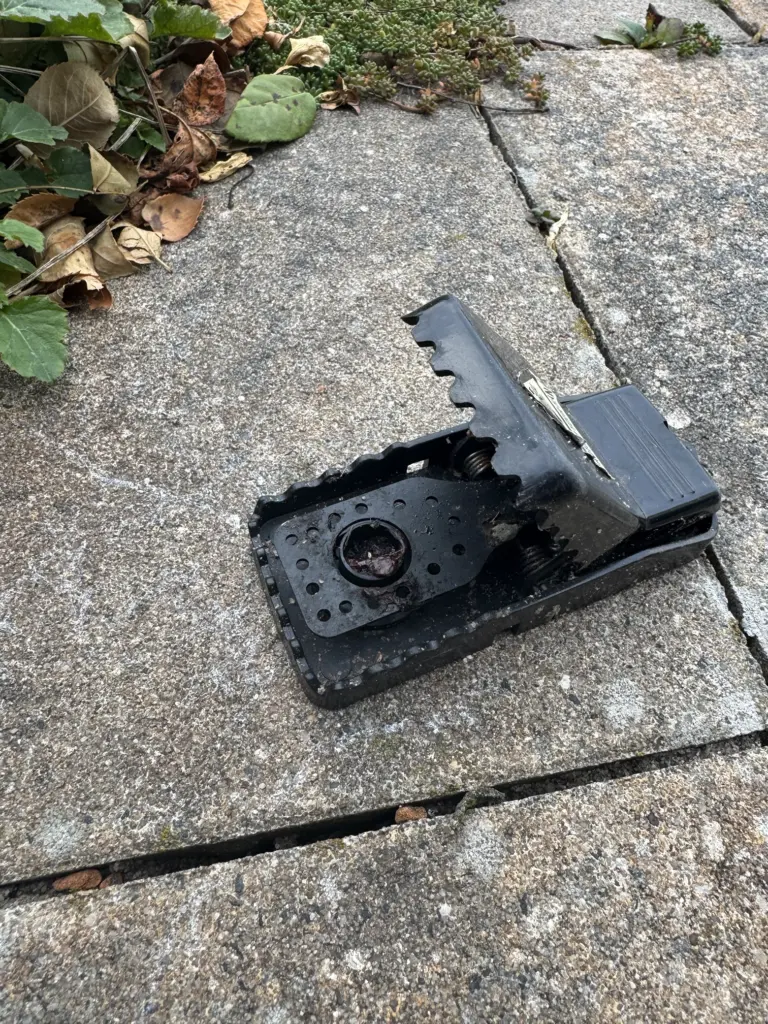
That is exactly where the black plastic trap we used in the garden for half a year failed. It caught mice. But songbirds got caught in it too, the catch wore out, and animals dragged the light trap away. The details are in our review of the plastic mouse trap. This guide sorts out which type of trap is suitable for which location.
What the law allows and what it doesn’t
Glue traps are out. Period. Selling them is allowed in Germany, but setting them up against mice is generally prohibited. The Research Services of the German Bundestag base this on Section 13(1) of the German Animal Welfare Act (Tierschutzgesetz): anyone who uses devices to catch vertebrates that cause avoidable pain or suffering commits an administrative offense under Section 18. That can get expensive.
In the garden, nature conservation law comes into play as well. European bird species are among the specially protected species (Section 7 of the German Federal Nature Conservation Act, Bundesnaturschutzgesetz), and Section 44 prohibits catching, injuring or killing them. An open snap trap laid out in a flower bed is therefore risky. Swissinno also points out that wood mice, yellow-necked mice, hazel dormice and shrews can end up in the trap and are protected. So if you trap outdoors, you should know whom you actually want to catch.
Seven mouse traps compared
| Model | Type | Location according to manufacturer | Best for |
|---|---|---|---|
| Swissinno Mausefalle PRO SuperCat | Snap trap, plastic, bait built in | indoors and outdoors | House, basement, garage |
| Swissinno Holz-Mausfalle classic | Snap trap, beech wood | mainly indoors, outdoors only in a tunnel | small budget, little plastic |
| Swissinno No See No Touch | enclosed snap trap | indoors and in weather-protected spots outdoors | anyone who doesn’t want to see the mouse |
| Swissinno Elektronische Maus- und Rattenfalle SuperCat | High voltage, 4 C batteries | along runways, near walls | recurring infestation, alerts on your phone |
| Goodnature A24 Starter Kit | CO2 trap, resets itself 24 times | indoors and outdoors, on a tree or wall | Garden, shed, rats and mice |
| Swissinno Lebendfalle MausHaus | Live trap | indoors and outdoors | anyone who doesn’t want to kill and can check often |
| Unbranded plastic snap trap (our review) | Snap trap, plastic, bait cup | not specified | indoors only, only with a cover |
Swissinno Mausefalle PRO SuperCat
For indoors, this is the trap we would recommend. According to the manufacturer, the trap only triggers once the mouse goes deep inside and lifts the trigger basket. This is meant to prevent the mouse from being caught by a leg or the tail, a weak point of many cheap traps. The peanut butter bait comes ready in the trap and, according to Swissinno, keeps for three years while sealed. The trap is registered as a biocidal product with the BAuA, the German Federal Institute for Occupational Safety and Health, and according to the manufacturer is certified for pest control under Section 18 of the German Infection Protection Act (Infektionsschutzgesetz). For outdoor use, Swissinno itself warns that ants and snails can empty the bait in a single night.
Swissinno Holz-Mausfalle classic
The familiar wooden board trap with a spring and bait holder, made here of FSC-certified beech wood. You set it by hand, and that takes a little practice. In return, it costs little and contains no plastic. Swissinno recommends it mainly for indoor use. Outdoors, it belongs in a tunnel or a box, to protect it from moisture and from animals it isn’t meant for.
Swissinno No See No Touch
An enclosed tunnel with a snap mechanism. The mouse stays out of sight; to empty it, you hold the trap over the trash can and press a lever. According to the manufacturer, it only catches mice, not birds or pets, and is also suitable for weather-protected spots outdoors. For people who are squeamish about the sight, it is the most pleasant solution.
Swissinno Elektronische Maus- und Rattenfalle SuperCat
This electronic mouse and rat trap has three plates inside. Only when the animal touches them does the trap deliver a high-voltage shock. A red light then comes on, and an alert goes to the free app via Bluetooth. It runs on four C batteries, which are not included. The considerably higher price is only worth it if mice keep coming back, for example in a pantry cellar or in a garden shed with animal feed.
Goodnature A24
The answer to two problems from our review. The A24 is fixed to a tree, a wall or a post with the included bracket, so it can’t be dragged away. And it resets itself: according to the supplier, one CO2 canister is good for 24 triggers, and a spare canister is included in the starter kit. With the starter kit, the lure has to be bought separately. It isn’t cheap. In this comparison, it is by far the most expensive trap and is intended more for properties with constant pest pressure than for the single mouse in the kitchen.
Swissinno Lebendfalle MausHaus
The flap closes as soon as the mouse is inside. Swissinno requires the trap to be checked at least every four hours and the mouse to be released at least one kilometer away. That is more effort than many people expect. If you can’t manage that, you are better off not using it. For individual field or wood mice in a garden shed, the live trap can still be the right way to go.
Unbranded plastic snap trap
These traps with a yellow warning sticker are sold in multipacks by many suppliers. Our unit caught mice and was easy to bait. After just a few uses, however, it barely latched anymore. In the garden, songbirds got caught in it, and cats, dogs or martens carried the trap away. We gave it three out of five stars. Indoors and under a cover, it can do its job; as a garden trap, we advise against it.
Which trap belongs where
- Kitchen, basement, garage: Swissinno PRO SuperCat, two or three along the wall. If you want to save money, go for the wooden classic trap.
- If you want neither to see nor to touch the mouse: No See No Touch.
- Garden shed or outbuilding with an infestation that keeps coming back: the electronic SuperCat or the screwed-down Goodnature A24.
- Garden, flower bed, compost heap: only traps that keep birds out and are fixed in place. Otherwise, better no trap at all.
- If you don’t want to kill: MausHaus, but only if someone checks every four hours.
How to make the trap actually catch
The German Environment Agency (Umweltbundesamt) advises placing traps on the runways, meaning along walls and under furniture or shelves. As bait, it names peanut butter, chocolate hazelnut spread, cheese or bacon. Check at least daily, better every twelve hours. So every day. A bait station that houses the trap protects children and pets. Swissinno recommends wearing gloves when emptying the trap, because mice transmit pathogens. According to the German Environment Agency, dead animals can go in the household trash. What else helps against burrowing animals and rodents in the garden is covered in our guide to keeping animals out of the garden; different rules apply to moles, see getting rid of moles (in German).
Frequently asked questions
Are glue traps for mice allowed?
No. Selling them is allowed in Germany, but setting them up is generally prohibited. The basis is Section 13(1) of the German Animal Welfare Act (Tierschutzgesetz); a violation is an administrative offense under Section 18.
Can I set an open snap trap in the garden?
That is risky. European bird species are specially protected, and Section 44 of the German Federal Nature Conservation Act (Bundesnaturschutzgesetz) prohibits catching or killing them. Outdoors, a trap belongs in a tunnel or a box that keeps birds out.
Which bait works for mouse traps?
The German Environment Agency (Umweltbundesamt) names peanut butter, chocolate hazelnut spread, cheese or bacon. Many Swissinno traps already come with a peanut butter bait inside the trap.
How often do I need to check a mouse trap?
According to the German Environment Agency, snap traps at least daily, better every twelve hours. For the MausHaus live trap, Swissinno requires a check at least every four hours.
Which mouse trap can be fixed in place in the garden?
The Goodnature A24 is mounted on a tree, wall or post with the included bracket and, according to the supplier, resets itself 24 times with a CO2 canister.
Sources
- German Animal Welfare Act (Tierschutzgesetz), Section 13
- German Federal Nature Conservation Act (Bundesnaturschutzgesetz), Section 44
- Research Services of the German Bundestag: On the ban on glue traps (WD 8 – 3000 – 041/24)
- German Environment Agency: What to consider when using traps
- Swissinno Mausefalle PRO SuperCat
- Swissinno Holz-Mausfalle classic
- Swissinno No See No Touch
- Swissinno Elektronische Maus- und Rattenfalle SuperCat
- Swissinno Lebendfalle MausHaus
- Gallagher: Goodnature A24 Starter Kit
Where to buy
- Swissinno Mausefalle PRO SuperCatCheck price at Amazon.deAvailable in Germany: Amazon.de
- Swissinno Holz-Mausfalle classicCheck price at Amazon.deAvailable in Germany: Amazon.de
- Swissinno No See No Touch (2er-Pack)Check price at Amazon.deAvailable in Germany: Amazon.de
- Swissinno Elektronische Maus- und Rattenfalle SuperCatCheck price at Amazon.deAvailable in Germany: Amazon.de
- Goodnature A24 Starter-KitCheck price at Amazon.deAvailable in Germany: Amazon.de
- Swissinno Lebendfalle MausHausCheck price at Amazon.deAvailable in Germany: Amazon.de
- Kunststoff-Schlagfalle ohne Marke (unser Test)Check price at Amazon.deAvailable in Germany: Amazon.de