Contents16 sections
This guide was first published in German on handgetestet.de.
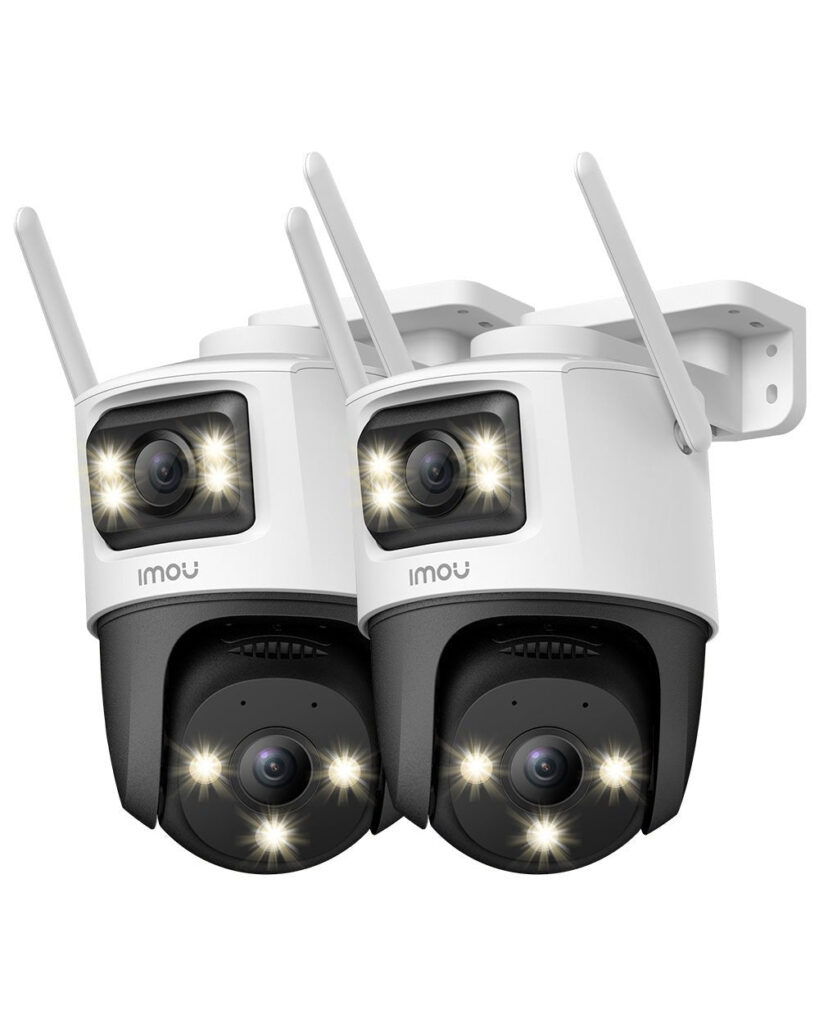
A pan-tilt camera sees a lot, but never everything at once. While it follows the delivery driver to the front door, nobody is watching the garden gate anymore. For most houses with a power outlet at the mounting spot, we therefore consider the Imou Cruiser Dual the most sensible choice: one fixed lens keeps the driveway in view, while a second one pans and follows. This guide explains how the pan-tilt head, zoom and tracking work and where their limits are.
We cover fixed battery cameras for house walls and driveways in our guide to outdoor security cameras. Here, the topic is cameras with a motor in the head.
What happens inside the head of a PTZ camera
PTZ stands for pan, tilt and zoom. Two small motors turn the lens horizontally and vertically. Typical figures are 340 to 355 degrees sideways and 90 degrees vertically. According to its data sheet, the Reolink TrackMix PoE pans at an adjustable 2.5 to 90 degrees per second. How well tracking works, however, depends above all on how early detection kicks in.
Mechanics wear out. A pan-tilt head that turns after a cat twenty times every night works harder than a fixed camera. Detection zones and person detection spare it. On battery cameras, they also spare the charge.
Optical, digital, hybrid: what zoom really means
Digital zoom merely crops a section of the image and enlarges it. No new detail is created in the process. Four Imou models in our table specify an eightfold digital zoom; at its core, that is a magnifying glass.
True optical zoom with moving lenses is rare in home cameras. A middle path with two fixed focal lengths is common. The Imou Cruiser Z has a 2.8 mm wide-angle lens and a 12 mm telephoto lens that covers only 24 degrees instead of 95. In between, the camera calculates digitally; Imou calls this 12x hybrid zoom. The TrackMix PoE works the same way with 2.8 and 8 mm and reaches sixfold. For a 40-meter driveway, a telephoto like that is worth a lot. For a row house garden eight meters deep, it is not.
Two lenses against the blind spot
Dual cameras come in two designs. The Cruiser Z and the TrackMix combine wide-angle and telephoto to bring in details from a distance. The Cruiser Dual splits the tasks: according to Imou, the upper lens can be aimed within a range of 260 degrees and then stays put, while the lower one pans 355 degrees. So you see the gate and the patio at the same time. That is the strongest argument against the classic single-lens PTZ.
Following people and planning patrols
Auto-tracking means the camera detects a person or a car and turns along with it. For the Cruiser 2 and Cruiser Dual, Imou specifies a detection range of 22 meters for people and 44 meters for vehicles. After the event, the camera should return to its home position. Depending on the brand, this preset is called a favorite point, focus point or guard point. On the TrackMix, Reolink allows one guard point and up to 64 patrol points that the camera moves through one after another.
Patrols sound good, but they come at a price. Whatever is not currently being covered, the camera does not see. And every position that reaches beyond your own fence is a legal problem.
Wi-Fi, network cable or PoE
The Imou Cruiser models have Wi-Fi and a network port, but still need a 12-volt power adapter. An Ethernet port simply is not PoE. Only with Power over Ethernet according to IEEE 802.3af, as on the Reolink TrackMix PoE, do power and data run through a single cable. That pays off in new builds and renovations. Several cameras on one recorder are covered in our guide to camera systems with a recorder; for the Cruiser SE+, Cruiser 2 and Cruiser Z, Imou specifies the ONVIF standard, which lets many recorders from other brands address them.
Without an outlet, only a battery remains. The Imou Cell PT pans on battery and solar panel, but it is a different type of device. It only wakes up on motion. Without Wi-Fi, the option is a security camera with a SIM card.
Seven pan-tilt outdoor cameras
| Model | Lens and zoom according to manufacturer | Power and network | For whom |
|---|---|---|---|
| Imou Cruiser Dual | fixed lens plus pan-tilt lens 355°/90°, 8x digital | 12 V power adapter, Wi-Fi 6, Ethernet | House with two viewing directions |
| Imou Cruiser Z | 2.8 mm and 12 mm, 12x hybrid, 355°/90° | 12 V power adapter, Wi-Fi 6, Ethernet | long driveway, large yard |
| Imou Cruiser 2 | one lens, 340°/90°, 8x digital | 12 V power adapter, Wi-Fi 6, Ethernet | one area with person and car detection |
| Imou Cruiser SE+ | 3.6 or 6 mm, 355°/90°, 8x digital | 12 V power adapter, 2.4 GHz Wi-Fi, Ethernet | Entry level |
| Imou Cell PT | 3 MP, 8x digital | 15,000 mAh battery, optional solar, Wi-Fi | Mounting spot without a power outlet |
| Reolink TrackMix PoE | 2.8 and 8 mm, 6x hybrid, 355°/90° | PoE or 12 V | New build with network cable |
| TP-Link Tapo C520WS | 2K, 360° horizontal field of view | Power plug, Wi-Fi or Ethernet | Tapo households |
Imou Cruiser Dual
Our recommendation for most properties. Two lenses, separate person and vehicle detection for each, Wi-Fi 6 or cable, microSD up to 512 GB, and usable from minus 30 to plus 60 degrees Celsius according to the data sheet. In power-saving mode, it records one frame per second when nothing is happening and switches to full video on motion. Weaknesses: digital zoom only, a maximum of 15 frames per second and a power adapter that requires an outdoor outlet. Imou offers variants with 3 and 5 megapixels on the pan-tilt lens.
Imou Cruiser Z
Two 5-megapixel lenses, one of them telephoto. According to Imou, infrared reaches more than 56 meters. This is the camera for farm driveways, barns and properties where the interesting things happen far away. In a small garden, its strength goes to waste.
Imou Cruiser 2
One lens, a 340-degree pan range, Wi-Fi 6 and up to 25 frames per second. It distinguishes people and vehicles and offers four night vision modes, from permanent color to pure infrared. Solid when a single area is enough.
Imou Cruiser SE+
The simplest Cruiser. You choose between 3.6 mm for a wider overview and 6 mm for a narrower, closer view. It only connects via 2.4 GHz Wi-Fi, and the microSD card can be at most 256 GB. For a carport or a backyard, that is enough.
Imou Cell PT
The battery version with 15,000 mAh. Imou specifies a runtime of up to 280 days, based on 20 videos of 15 seconds a day. A passive infrared motion sensor wakes the camera, after which it follows the object. The battery can only be charged between 0 and 45 degrees Celsius, so in winter the solar panel only helps once it is above freezing outside.
Reolink TrackMix PoE
4K with 8 megapixels, two focal lengths, sixfold hybrid zoom, PoE. Plus a guard point, patrol and RTSP for your own recorder. If you are running a network cable to the wall anyway, you get a technically very comprehensive camera here. The housing is rated IP65.
TP-Link Tapo C520WS
2K resolution, a Starlight sensor with an F1.6 aperture, Wi-Fi or Ethernet and microSD up to 512 GB. According to TP-Link, it does not support a solar panel. Privacy zones can be set in the app, which helps mask other people’s property. If you already use an indoor camera from Tapo, you keep everything in one app.
The neighbor is in the picture too: what Germany’s consumer advice centers recommend
With pan-tilt cameras in particular, the German Verbraucherzentrale (consumer advice center) is clear. Limiting coverage to your own property is most reliably achieved with fixed cameras. A rotating camera could be re-aimed at any time and capture other properties or paths, and that alone can, in individual cases, trigger injunction claims from neighbors. We read it this way: if you buy a PTZ camera, plan the pan range deliberately, set presets only on your own property, use privacy zones where the camera offers them, and put up a notice sign. If the property line runs right next to the house, a fixed camera is often the more honest solution. This is not legal advice.
How we would decide
- Driveway and garden in view at the same time, outlet available: Imou Cruiser Dual.
- Long driveway or large yard: Imou Cruiser Z; for a new build with cabling, the Reolink TrackMix PoE.
- Small area such as a carport or backyard: Imou Cruiser SE+.
- No power at the mounting spot: Imou Cell PT with a solar panel; without Wi-Fi, a camera with a SIM card.
And if the camera is mainly meant as a deterrent: a wireless alarm system (in German) reports open doors and windows before anyone is standing inside the house. The two can be combined.
How aperture, sensor and warm light determine night vision is explained in our guide to security cameras with color night vision.
What optical, hybrid and digital zoom really deliver is worked out in our guide to security cameras with zoom (in German).
Frequently asked questions
What does PTZ mean for a security camera?
PTZ stands for pan, tilt and zoom. Two small motors turn the lens horizontally and vertically, typically 340 to 355 degrees sideways and 90 degrees vertically. How well tracking works depends above all on how early detection kicks in.
What is the difference between digital and hybrid zoom?
Digital zoom merely crops a section of the image and enlarges it; no new detail is created. Hybrid zoom combines two fixed focal lengths, such as 2.8 mm and 12 mm on the Imou Cruiser Z, and fills the range in between digitally. For a long driveway, a telephoto like that is worth a lot.
How does auto-tracking work on a pan-tilt camera?
The camera detects a person or a car and turns along with it. For the Cruiser 2 and Cruiser Dual, Imou specifies a detection range of 22 meters for people and 44 meters for vehicles. Afterward, the camera should return to a defined home position, called a favorite point or guard point depending on the brand.
Does a PTZ camera with an Ethernet port not need a power adapter?
It does; an Ethernet port is not PoE. Despite their network port, the Imou Cruiser models need a 12-volt power adapter. Only with Power over Ethernet, as on the Reolink TrackMix PoE, do power and data run through a single cable. That pays off in new builds and renovations.
May a pan-tilt camera point at the neighbor's property?
No. Germany's consumer advice centers (Verbraucherzentrale) point out that a rotating camera can capture other properties or paths at any time, and that alone can trigger injunction claims. Plan the pan range deliberately, set presets only on your own property and use privacy zones. This is not legal advice.
Are there pan-tilt cameras that work without a power outlet?
Yes, for example the Imou Cell PT with a 15,000 mAh battery and an optional solar panel. It only wakes up on motion and then follows the object. The battery can only be charged between 0 and 45 degrees Celsius, so in winter the solar panel only helps above freezing.
Sources
- Verbraucherzentrale: Use security cameras to film only your own property
- Imou: Cruiser Dual, data sheet and product page
- Imou: Cruiser Z, data sheet and product page
- Imou: Cruiser 2, data sheet and product page
- Imou: Cruiser SE+, data sheet
- Imou: Cell PT and data sheet
- Reolink: TrackMix PoE
- TP-Link: Tapo C520WS
Where to buy
- Imou Cruiser DualView at ImouAvailable in Germany: ImouCheck price at Amazon.deAvailable in Germany: Amazon.de
- Imou Cruiser ZView at ImouAvailable in Germany: Imou
- Imou Cruiser 2View at ImouAvailable in Germany: Imou
- Imou Cruiser SE+View at ImouAvailable in Germany: Imou
- Imou Cell PTView at ImouAvailable in Germany: Imou
- Reolink TrackMix PoECheck price at Amazon.deAvailable in Germany: Amazon.de
- TP-Link Tapo C520WSView at CoolblueAvailable in Germany: CoolblueCheck price at Amazon.deAvailable in Germany: Amazon.de