Contents13 sections
This guide was first published in German on handgetestet.de.
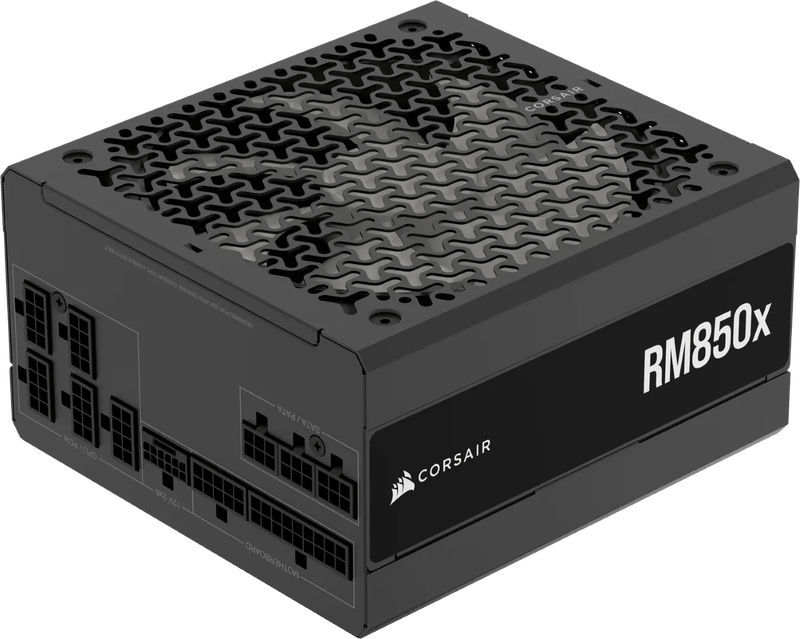
A power supply is something you rarely buy. That is exactly why it deserves more attention than most other components. If you are planning a gaming PC today with a current mid-range or high-end graphics card, you will have the most peace of mind with 850 watts, a 12V-2×6 cable out of the box and a fan that stops at low load. Our pick for that is the 2024 version of the Corsair RM850x.
More watts do not make the PC faster. Too few, however, can make it crash under load.
How many watts does my PC really need?
The most reliable answer comes from the graphics card manufacturer, because the card draws by far the most power while gaming. For its own RTX 50 series, Nvidia specifies a required system power ranging from 550 W (RTX 5060) through 650 W (RTX 5070) and 750 W (RTX 5070 Ti) to 850 W (RTX 5080). For the RTX 5090, it is 1,000 W. According to Nvidia, these figures apply to a PC with a Ryzen 9 9950X; with a more frugal processor there is some headroom, and with heavily overclocked components it shrinks.
Partner cards with higher clock speeds often require more than the reference design. So check the product page of your specific model, not just the chip. Which card suits which monitor is covered in our graphics card guide (in German).
Our rule of thumb: take the manufacturer’s figure and, if you want to install a more powerful card in two years, buy one step higher. An 850 W unit running at 400 W while gaming works close to half load, which is also where 80 PLUS sets the highest efficiency.
Gold, Platinum, Titanium: what the badges mean
The 80 PLUS certification program sets minimum efficiencies at 20, 50 and 100 percent load. For power supplies on the European 230 V grid, Gold means 90, 92 and 89 percent, Platinum 92, 94 and 90 percent. Titanium additionally requires 90 percent at just 10 percent load.
Cybenetics has also established itself as a second testing body. It measures across more than 1,450 load states, gives an average for efficiency and noise, and checks whether a unit handles the power excursions defined in ATX 3.1. You will find these average values in the table below.
How much do two percentage points matter? At a 300 W gaming load and three hours a day, a power supply with 92 instead of 90 percent efficiency saves around 8 kWh a year. You are more likely to notice the difference as heat in the case. Gold is entirely sufficient for a gaming PC.
ATX 3.1 and 12V-2×6: must-have or nice-to-have?
Nice-to-have, with a good argument in its favor. Corsair itself writes that an RTX 50 card also runs on an ATX 3.0 power supply. The core of ATX 3.1 is the revised 16-pin 12V-2×6 power connector. Its sense pins are shorter, so the card only draws full power when the plug is fully seated.
That brings us to safety. Corsair advises pushing the plug in firmly until the latch audibly clicks into place, then tugging firmly on the cable and repeating the same at the power supply. A half-seated plug is the source of error that is in your own hands.
Fully modular, quiet, passive: what matters day to day
All six units below are fully modular. So you only plug in the cables you actually need, and the case keeps room for airflow. The fan is more interesting. In semi-passive mode, it stays still while you browse or write and only spins up under load. A power supply without this feature, on the other hand, is something you hear constantly, even if quietly.
Also check the number of classic 8-pin connectors for graphics cards. Cards without a 16-pin socket need several of them depending on the model; the exact number is on the card’s product page.
Six current power supplies compared
Efficiency and noise as averages according to Cybenetics at 230 V; all other figures according to the manufacturer.
| Model | Efficiency and noise | Fan and connectors | Best for |
|---|---|---|---|
| be quiet! Pure Power 13 M 750W | 92.8 %, 6.2 dB(A) | 120 mm, semi-passive; 12V-2×6 (600 W), 4 × 6+2-pin | Quiet PCs up to RTX 5070 Ti |
| Corsair RM850x (2024) | Cybenetics Gold, noise class A | 140 mm, Zero RPM; 12V-2×6, 3 × 8-pin | Mid-range and high-end up to RTX 5080 |
| Seasonic Focus GX-850 (ATX 3.1) | 91.5 %, 21.1 dB(A) | 135 mm, switchable semi-passive; 12V-2×6 (600 W), 4 × 6+2-pin | Many connectors, 10-year warranty |
| MSI MAG A850GLS PCIE5 | 91.8 %, 18.1 dB(A) | 135 mm, always spinning; 12V-2×6 (600 W), 2 × 6+2-pin | Nvidia cards with a 16-pin socket |
| Cooler Master MWE Gold 850 V3 ATX 3.1 | 80 PLUS Gold | 120 mm, Zero RPM; angled 12V-2×6, 4 × 6+2-pin | Tight cases with little room at the connector |
| be quiet! Dark Power 14 1000W | 93.5 %, 10.4 dB(A) | 135 mm, switchable semi-passive; 12V-2×6, 8 × 6+2-pin | RTX 5090 and workstations |
be quiet! Pure Power 13 M 750W
In the Cybenetics test report, this power supply averages 6.2 dB(A) because the 120 mm fan stays still at low load. Average efficiency is 92.8 percent. At 750 W, it exactly meets Nvidia’s requirement for the RTX 5070 Ti. With an RTX 5070 there is headroom; for later upgrade plans it is tight.
Corsair RM850x (2024)
Corsair lists ATX 3.1, a 650 mm 12V-2×6 cable, three additional 8-pin cables for graphics cards and Japanese capacitors rated for 105 °C. The 140 mm fan stays off at low load, and according to Corsair, Cybenetics awards it noise class A. The manufacturer gives a ten-year warranty. The unit is 160 mm deep. In very compact cases, measure how much room remains behind the power supply for the cables; our PC case guide (in German) has tips on that.
Seasonic Focus GX-850 (ATX 3.1)
Look for the ATX 3.1 suffix in the name, because the Focus GX series previously existed in an ATX 3.0 version. Seasonic gives a ten-year warranty. A switch selects between an always-on and a semi-passive fan. On average, Cybenetics measures 21.1 dB(A), more than the be quiet! models. In return, the cables for graphics card and processor are 700 to 750 mm long. That helps in large cases with cable routing behind the motherboard.
MSI MAG A850GLS PCIE5
Watch for the S at the end of the model name; the A850GL without the S is a different unit. According to Cybenetics, the GLS meets the ATX 3.1 power excursion requirements and achieves 91.8 percent. Its fan, however, always runs, even at idle. And it offers only two classic 8-pin connectors for graphics cards. With an Nvidia card that has a 16-pin socket, that is no problem; with a Radeon that has three 8-pin sockets, it is.
Cooler Master MWE Gold 850 V3 ATX 3.1
The special feature is at the end of the cable. Cooler Master supplies the 12V-2×6 plug angled at 90 degrees, so the cable runs straight down or back instead of pressing against the side panel. The 120 mm fan with Zero RPM mode, 80 PLUS Gold and a ten-year warranty are listed in the data sheet. Check the part number: there is a non-modular version under the same name.
be quiet! Dark Power 14 1000W
For an RTX 5090, Nvidia requires 1,000 W, and that is exactly what this power supply is built for. Cybenetics measures 93.5 percent efficiency at an average of 10.4 dB(A). The 12 V side is split across four rails, plus there are eight 6+2-pin connectors. For a PC with an RTX 5070, this is too much power supply.
How we would decide
- Graphics card up to an RTX 5070 Ti or a comparable Radeon, with quiet operation as the priority: be quiet! Pure Power 13 M 750W.
- Mid-range to high-end with headroom up to the RTX 5080: Corsair RM850x (2024), our pick.
- Radeon card with several 8-pin sockets and a large case: Seasonic Focus GX-850 (ATX 3.1).
- Narrow case, little clearance to the side panel: Cooler Master MWE Gold 850 V3 with its angled plug.
- RTX 5090 or a workstation under sustained load: be quiet! Dark Power 14 1000W.
If the PC also runs overnight for photo editing or as a home server, an uninterruptible power supply belongs with it. What it needs to deliver is explained in our UPS guide.
Frequently asked questions
How many watts does my power supply need?
The most reliable answer comes from the graphics card manufacturer. Nvidia specifies 550 W for the RTX 5060, 650 W for the RTX 5070, 750 W for the RTX 5070 Ti, 850 W for the RTX 5080 and 1,000 W for the RTX 5090. If you plan to upgrade later, buy one step higher.
Is an 80 PLUS Gold power supply enough?
For a gaming PC, absolutely. On the 230 V grid, Gold means 90, 92 and 89 percent efficiency at 20, 50 and 100 percent load. At a 300 W gaming load and three hours a day, a unit with 92 instead of 90 percent saves around 8 kWh a year; you notice it more as heat in the case.
Do I need an ATX 3.1 power supply for an RTX 50 card?
It is not mandatory; Corsair itself writes that an RTX 50 card also runs on ATX 3.0. The core of ATX 3.1 is the revised 12V-2×6 connector with shorter sense pins, so the card only draws full power when the plug is fully seated. That is a good argument in its favor.
How do I plug in the 12V-2×6 connector correctly?
Corsair advises pushing the plug in firmly until the latch audibly clicks into place, then tugging firmly on the cable and repeating the same at the power supply. A half-seated plug is the source of error that is in your own hands.
Which power supply suits a Radeon with several 8-pin sockets?
One with enough classic connectors, such as the ATX 3.1 version of the Seasonic Focus GX-850 with four 6+2-pin plugs. The MSI MAG A850GLS offers only two, which is a problem with a Radeon that has three 8-pin sockets. The exact number is on the card's product page.
Which power supply is especially quiet?
One with a semi-passive fan that stops while you browse. According to Cybenetics, the be quiet! Pure Power 13 M 750W averages 6.2 dB(A), the Dark Power 14 1000W 10.4 dB(A). On the MSI MAG A850GLS, by contrast, the fan always runs, even at idle.
Sources
- Nvidia: GeForce graphics card comparison with required system power
- 80 PLUS (CLEAResult): Requirements of the efficiency levels
- Corsair: ATX 3.0 or ATX 3.1 for RTX 50 graphics cards
- Corsair: Plugging in the 12V-2×6 connector correctly
- Corsair: RM850x, specifications
- Cooler Master: MWE Gold 850 V3 ATX 3.1, specifications
- Cybenetics: Test report be quiet! Pure Power 13 M 750W
- Cybenetics: Test report Seasonic Focus GX-850 (ATX 3.1)
- Cybenetics: Test report MSI MAG A850GLS PCIE5
- Cybenetics: Test report be quiet! Dark Power 14 1000W
Where to buy
- Corsair RM850x (2024)Check price at Amazon.deCheck price at Amazon.co.ukCheck price at Amazon.nlCheck price at Amazon.com.beCheck price at Amazon.frCheck price at Amazon.itCheck price at Amazon.esCheck price at Amazon.plCheck price at Amazon.seAvailable in Germany: Amazon.deView at CoolblueAvailable in Germany: Coolblue
- be quiet! Pure Power 13 M 750WCheck price at Amazon.deCheck price at Amazon.co.ukCheck price at Amazon.nlCheck price at Amazon.com.beCheck price at Amazon.frCheck price at Amazon.itCheck price at Amazon.esCheck price at Amazon.plCheck price at Amazon.seAvailable in Germany: Amazon.de
- Seasonic Focus GX-850 ATX 3.1Check price at Amazon.deCheck price at Amazon.co.ukCheck price at Amazon.nlCheck price at Amazon.com.beCheck price at Amazon.frCheck price at Amazon.itCheck price at Amazon.esCheck price at Amazon.plCheck price at Amazon.seAvailable in Germany: Amazon.de
- MSI MAG A850GLS PCIE5Check price at Amazon.deCheck price at Amazon.co.ukCheck price at Amazon.nlCheck price at Amazon.com.beCheck price at Amazon.frCheck price at Amazon.itCheck price at Amazon.esCheck price at Amazon.plCheck price at Amazon.seAvailable in Germany: Amazon.de
- Cooler Master MWE Gold 850 V3 ATX 3.1Check price at Amazon.deCheck price at Amazon.co.ukCheck price at Amazon.nlCheck price at Amazon.com.beCheck price at Amazon.frCheck price at Amazon.itCheck price at Amazon.esCheck price at Amazon.plCheck price at Amazon.seAvailable in Germany: Amazon.de
- be quiet! Dark Power 14 1000WCheck price at Amazon.deCheck price at Amazon.co.ukCheck price at Amazon.nlCheck price at Amazon.com.beCheck price at Amazon.frCheck price at Amazon.itCheck price at Amazon.esCheck price at Amazon.plCheck price at Amazon.seAvailable in Germany: Amazon.de