Contents16 sections
This guide was first published in German on handgetestet.de.
People rarely buy a pool heater because of the heat pump itself, but because of a number on the box: „COP up to 16.“ That very number misleads many buyers. Our recommendation for most above-ground pools between 15 and 30 cubic meters is an inverter heat pump in the size of the Steinbach Silent 7, combined with a pool cover. Without a cover, any heater is fighting a losing battle.
This background piece explains why. If you are still deciding on the pool itself, you will find the basics in our guide to pools.
Cover first, then heat
At night, heat escapes through the open water surface. Steinbach writes that a pool without a cover can cool down by up to 4 degrees overnight. That is more than a small heat pump can bring back in a day.
Reliable figures on the savings come from the Canadian utility Hydro-Québec. It calculates up to 45 percent lower heating costs if a solar cover stays on the water 16 hours a day. This is based on a heat pump with a seasonal coefficient of performance of 4.5, a water temperature of 27 °C and the summer climate of Montréal. What the manufacturers themselves assume is also telling. In the manual for its heat pump, Bestway requires the cover to be kept on at all times while heating. Intex determined its heating table for the electric heater with a solar cover in place. Steinbach points out that losses from a missing cover are not taken into account in its own heating figures.
So the cover is not an accessory. It is part of the heating.
COP 16 or COP 4.8? It comes down to the air temperature
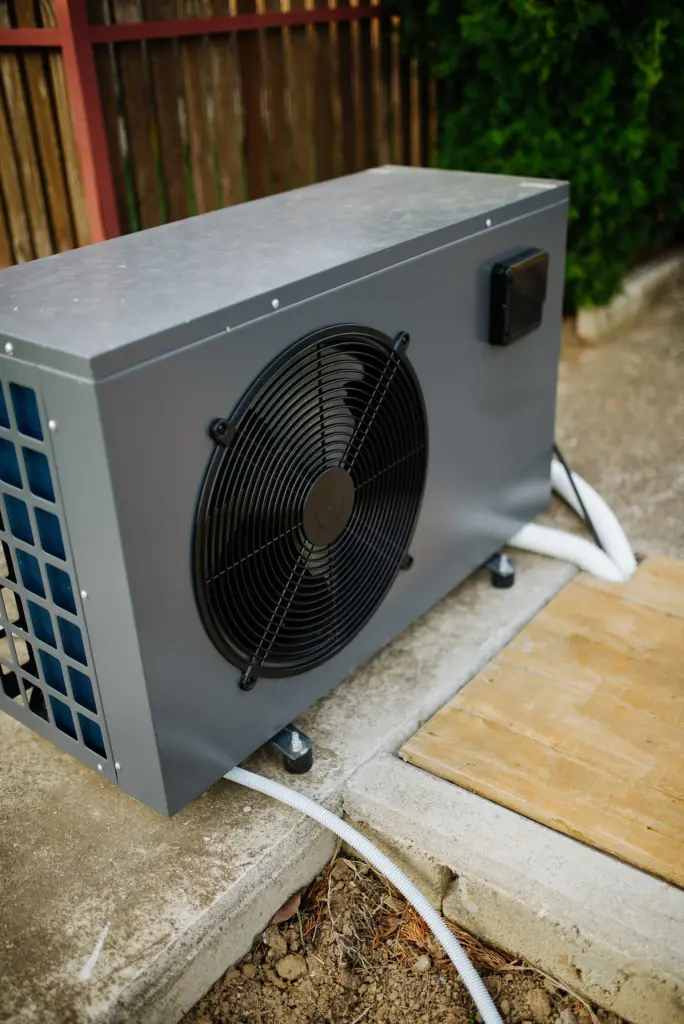
A heat pump draws heat from the outside air and transfers it to the pool water via a titanium heat exchanger. The coefficient of performance, or COP, tells you how many kilowatt hours of heat are produced from one kilowatt hour of electricity. Sounds simple. What matters, though, is the air and water temperature at which it was measured.
Two measuring points are common: 26 °C air with 26 °C water, in other words a warm July afternoon, and 15 °C air with 26 °C water, more like an evening in May. Poolex publishes both values for the Silverline Top 9. At 26 °C air, the COP ranges from 6.39 to 12.50 depending on the output setting; at 15 °C air, only from 4.89 to 6.23. The heating output also drops, from a maximum of 9.4 to 7.04 kilowatts. If you want to heat in spring, plan with the second value.
Steinbach states a COP of around 16 for the Silent series without giving the measurement conditions in the data table. If you divide the heating output of the Silent 7 by its input power in the same table, the result is 7. The two values obviously apply to different operating points. Bestway gives 4.8 for the Flowclear heat pump, cleanly measured at 26 °C air and water. These three numbers cannot be compared directly.
That leaves the design. A conventional heat pump switches on or off, always at full power. An inverter steplessly throttles back the compressor as soon as the target temperature is almost reached. Poolex puts the savings compared with on-off units at over 35 percent; that is a manufacturer claim. According to Steinbach, they are also quieter. With a unit two meters from your lounge chair, that is not a minor detail.
How many kilowatts does which pool need?
Manufacturers assign a maximum volume to each heat pump. Steinbach rates the Silent 5 for up to 25,000 liters and the Silent 7 for 30,000 liters. Bestway gives up to 30 cubic meters for 4.4 kilowatts. These values apply to the main season. Steinbach itself writes that for swimming weather in March or October, a heat pump needs to be two to four times as powerful as for the months of May through August.
The manuals show how sluggish the heating is. At 26 °C air, the Silent 7 manages about 0.4 degrees per hour in a pool with 20,000 liters. Bestway gives 1 to 3 degrees per day for its 4.4-kilowatt pump. And according to the Bestway table, a pool with 20 to 30 cubic meters reaches a maximum water temperature of 25 °C at 12 to 15 °C air. That is too little for an early first swim. Our advice: buy one size larger, and the inverter will get by on half its output in summer.
Solar mat and collector: free sunshine, but slow
A solar absorber is a black plastic body through which the filter pump sends the pool water. It does not need its own power connection. Intex states a gain of about 2.8 to 5 degrees for its 120 by 120 centimeter solar mat, depending on the weather.
Steinbach’s table for the Loop collector is more candid. A single collector needs 6.2 days to raise the water in a 14,000-liter pool by 3 degrees. Four collectors manage it in 1.6 days. This was measured with ten hours of direct sunshine, an outside temperature of 20 °C and a solar cover. A cloudy June looks different. So solar works as a supplement or for small pools. A medium-sized pool needs several elements.
Electric heater: quickly connected, expensive to run
An electric flow heater converts electricity into heat one to one. Let’s do the math with the table from the Intex manual. For an Easy Set pool measuring 457 by 107 centimeters with 12,431 liters, the 3-kilowatt heater needs around seven hours per degree, covered and on a sunny day. That is 21 kilowatt hours of electricity. At the average household electricity price in Germany of 37.3 cents per kilowatt hour, as reported by the German Association of Energy and Water Industries (BDEW) for October 2026, each degree costs just under eight euros. Five degrees: almost forty.
A heat pump with the COP of 4.8 that Bestway states for 26 °C air would produce the same amount of heat from roughly 4.4 kilowatt hours. That would be a little over one and a half euros. In cool air, the gap narrows, but it remains large. The electric heater still has its place: in small pools, for a few warm days, or where there is no room for an outdoor unit.
Socket, RCD, clearance: what the manuals require
Here the manufacturers agree. Steinbach and Bestway require a residual current device (RCD) with a tripping current of no more than 30 milliamperes and a distance of at least two meters between the heat pump and the pool. Bestway additionally requires one meter of clearance from other objects and rules out extension cords. For the electric heater, Intex requires a socket rated for at least 16 amperes and prohibits extension cords, timers and plug adapters. The unit must also stand lower than the hose connection on the pool.
For the large Silent models from 17.5 kilowatts, Steinbach requires connection by a qualified electrician. For the smaller ones, it depends on the existing outdoor socket. If it is old or not protected by an RCD, have it checked before buying. And the filter pump must deliver the minimum flow rate the heater requires. For the Silent 7, Steinbach specifies at least 4,000 liters per hour.
Seven pool heaters compared
| Model | Type | Output according to manufacturer | Pool according to manufacturer | Best for |
|---|---|---|---|---|
| Steinbach Silent 7 | Heat pump, inverter | 7 kW | up to 30,000 l | Above-ground pools 15 to 30 m³, long season |
| Steinbach Silent Mini | Heat pump, inverter | 4 kW | up to 20,000 l | small frame and Quick-Up pools |
| Poolex Silverline Top 9 | Heat pump, full inverter | up to 9.4 kW (26 °C air), up to 7.04 kW (15 °C air) | 50 m³ | larger pools, spring and fall |
| Bestway Flowclear 58748 | Heat pump | 4.4 kW (26 °C air) | up to 30 m³ | High summer, air from 12 °C |
| Intex solar mat 28685 | Solar absorber | about 2.8 to 5 °C gain | up to about 30,000 l | Getting started without a power connection |
| Steinbach Loop solar collector | Solar collector | 3 °C in 6.2 days (14,000 l, one element) | expandable | Supplement, sunny location |
| Intex pool heater 28684 | Electric flow heater | 3 kW | up to 17,033 l | small pools, short-term use |
Steinbach Silent 7
Seven kilowatts of heating output at one kilowatt of input power, R290 refrigerant, heating and cooling, control via app. Steinbach gives the sound pressure as 27 dB(A) at a distance of ten meters. For steel-wall and frame pools up to 30 cubic meters, this is the size that still has reserves in May.
Steinbach Silent Mini
The little sister with 4 kilowatts, also with an inverter. According to the manual, it raises 10,000 liters by about 0.3 degrees per hour at 26 °C air. It only needs a flow rate of 2,000 liters, so it suits smaller filter pumps.
Poolex Silverline Top 9
Poolex discloses output and COP for both measuring points. That makes planning honest. The fan blows upward, which according to Poolex saves floor space. For pools up to 50 cubic meters or for anyone who wants to swim early in the year.
Bestway Flowclear 58748
Compact and connectable directly to the hoses of above-ground pools, with a 32 or 38 millimeter connection. Bestway does not mention an inverter. According to the manual, the unit switches off below 12 °C outside air, which is why it is mainly suited to high summer.
Intex solar mat 28685
The simplest form of pool heating, suitable for filter pumps up to about 7,570 liters per hour. A bypass valve is included. A single mat does little for larger pools; several side by side achieve more.
Steinbach Loop solar collector
A dome-shaped collector measuring 58 by 58 centimeters with a capacity of five liters. Steinbach allows a maximum of 7,500 liters per hour and one bar of pressure. Several collectors can be connected in series. It must never be set up above the water level.
Intex pool heater 28684
Small, light and with a water level sensor. Intex limits the water temperature to 35 °C and the pool to just over 17,000 liters. Because of the electricity costs, it is better suited to the kids‘ paddling pool than to use all season.
How we would decide
- Above-ground pool up to 30 cubic meters, swimming from May: Steinbach Silent 7 plus a solar cover.
- Small frame pool up to 20 cubic meters: Steinbach Silent Mini.
- Large pool or long season: Poolex Silverline Top 9, planned with the value at 15 °C air.
- Only July and August: Bestway Flowclear or, with no power connection at all, several Intex solar mats.
- A few warm days in the paddling pool: Intex 28684, keeping an eye on the electricity bill.
If you are planning accessories anyway, our guide to pool robots covers the next building block for clean water.
How durable a frame pool with a steel frame is can be seen in our review of the Bestway Power Steel pool 56722.
Frequently asked questions
Does a pool heater need a cover?
Yes, the cover is part of the heating. According to Steinbach, a pool without a cover can cool down by up to 4 degrees overnight. Hydro-Québec calculates up to 45 percent lower heating costs if a solar cover stays on 16 hours a day. In its manual, Bestway requires the cover to be kept on at all times while heating.
What does the COP of a pool heat pump tell you?
It indicates how many kilowatt hours of heat are produced from one kilowatt hour of electricity, but it depends heavily on air and water temperature. For the Silverline Top 9, Poolex gives 6.39 to 12.50 at 26 °C air depending on the setting, but only 4.89 to 6.23 at 15 °C air. Without the measurement conditions, COP figures cannot be compared.
How powerful does a heat pump for my pool need to be?
Manufacturers state maximum volumes; Steinbach, for example, gives up to 30,000 liters for the Silent 7. These values apply to the main season. According to Steinbach, a heat pump for swimming weather in March or October needs to be two to four times as powerful as one for May through August. One size larger leaves the inverter reserve in summer.
Is a solar mat enough to heat a pool?
As a supplement or for small pools. Intex states a gain of about 2.8 to 5 degrees for its solar mat, depending on the weather. Steinbach needs 6.2 days with a single Loop collector to raise 14,000 liters by 3 degrees, and 1.6 days with four collectors, measured with ten hours of sunshine. A medium-sized pool needs several elements.
Is an electric pool heater worth it?
Only in small pools or for a few days. An electric flow heater converts electricity into heat one to one. For a pool with 12,431 liters, the 3-kilowatt Intex heater needs around seven hours per degree, meaning 21 kilowatt hours. A heat pump with a COP of 4.8 would need roughly 4.4 kilowatt hours for that.
What should you consider when connecting a pool heat pump?
Steinbach and Bestway require a residual current device (RCD) rated at no more than 30 milliamperes and a distance of at least two meters from the pool; Bestway rules out extension cords. If the outdoor socket is old or not protected by an RCD, have it checked before buying. The filter pump must also deliver the required minimum flow rate.
Sources
- Steinbach: Silent heat pump operating manual (2026)
- Steinbach: Silent Mini heat pump operating manual
- Steinbach: Which heat pump suits your pool?
- Steinbach: The 6 most common mistakes with pool heat pumps
- Steinbach: Loop solar collector user manual
- Intex: Electric pool heater 28684 user manual
- Intex: Solar Mat 28685
- Bestway: Flowclear heat pump 58748 with user manual
- Poolex: Silverline Top, technical data
- Hydro-Québec: Pool covers
- BDEW: Electricity price analysis October 2026
Where to buy
- Steinbach Silent 7Check price at Amazon.deAvailable in Germany: Amazon.de
- Steinbach Silent MiniCheck price at Amazon.deAvailable in Germany: Amazon.de
- Poolex Silverline Top 9Check price at Amazon.deAvailable in Germany: Amazon.de
- Bestway Flowclear 58748Check price at Amazon.deAvailable in Germany: Amazon.de
- Intex Solarmatte 28685Check price at Amazon.deAvailable in Germany: Amazon.de
- Steinbach Solarkollektor LoopCheck price at Amazon.deAvailable in Germany: Amazon.de
- Intex Poolheizung 28684Check price at Amazon.deAvailable in Germany: Amazon.de