Contents14 sections
This guide was first published in German on handgetestet.de.
Fifty-two minutes. That is as long as a 2,000-watt space heater lasts on a power station in the 2-kilowatt-hour class, and Jackery itself quotes around one hour for this size. Buying an expensive station just to keep the heater running is therefore the wrong approach in our view. Warm your body instead of the room: for a heated blanket, a heated mattress pad or the electrics of a parking heater, the Jackery Explorer 500 v2 with 512 watt-hours is enough.
The math every space heater fails
A space heater turns one kilowatt-hour of electricity into one kilowatt-hour of heat. No more is possible, as the German consumer advice center (Verbraucherzentrale) makes clear. And not even all of the battery’s energy reaches the outlet; the Jackery retailer GreenDrive calculates with a factor of 0.85. The method is explained in the guide calculating power station runtime (in German).
With the Explorer 2000 v2, around 1,740 of the 2,042 watt-hours remain. Divided by 2,000 watts, that gives the 52 minutes from the start. The Explorer 1000 v2 lasts 36 minutes at a full 1,500 watts, and the Explorer 500 v2 again 52 minutes at 500 watts. The pattern is no coincidence: the inverter grows along with the capacity. For every station, there is a heater that drains it in under an hour.
Just how small that is becomes clear when you look at demand. The Verbraucherzentrale cites 10,000 to 35,000 kilowatt-hours of heat per year for a household. Even the lower end averages around 27 kilowatt-hours a day over the year, and considerably more in January. You would have to drain an Explorer 2000 v2 almost sixteen times for that. And recharging with a solar panel? A study commissioned by the German Federal Office of Civil Protection and Disaster Assistance (BBK) calls heating an anticyclical load. It needs the most when the sun delivers the least.
What else gets in the way besides runtime
Many stations cannot even handle the device. A typical 2,000-watt heater overwhelms the Explorer 1000 v2 with its 1,500 watts; only the low setting runs. The Anker SOLIX C1000 Gen 2 delivers exactly 2,000 watts, so with no reserve. On the AC180, BLUETTI allows heaters up to 2,700 watts in Power Lifting mode, in which the device heats at reduced output, as our power station guide (in German) explains. That does not put more energy in the battery.
Then there are the weaknesses of the space heater itself. It is loud, and dust burns on the heating wires, which according to the Verbraucherzentrale pollutes the air. The German Fire Brigade Association (Deutscher Feuerwehrverband) warns about old space heaters that have sat in a damp basement for years, as they are more prone to cable fires and short circuits. Those are exactly the devices people pull out in an emergency. Where a space heater has its place in everyday life is covered in the guide infrared heaters and space heaters (in German).
Blanket and mattress pad: a twentieth of the power
Medisana states 100 watts for its XL heating pad. In its example table, Jackery calculates with 230 watts for a heated blanket. According to Stiftung Warentest, a German consumer testing organization, heated mattress pads need only a few watts because the mattress and duvet insulate well. Ideally, measure your own device.
Let’s run the numbers for an evening on the couch in a cold vacation home. Three hours at 100 watts is 300 watt-hours, around 350 including conversion losses. That fits in the Explorer 500 v2, which has about 435 watt-hours left at the outlet, and since blankets throttle down after warming up, actual consumption tends to be lower. For two blankets, you need the next size up.
One limit applies to every power source. According to the TÜV association (TÜV-Verband), heated blankets must never run unattended, and electric heating products should be off while you sleep. For the bed, the association recommends a heated mattress pad labeled „suitable for long-term use.“ According to Stiftung Warentest, heated blankets do not belong on a timer. So prewarm the bed, switch it off, sleep. Which models are available is shown in our guide to heated blankets (in German).
Parking heater: heat from the tank, electricity only for the fan
In a camper van, the ratio is reversed. According to its manual, the Planar 2D air heater, now sold as the Autoterm Air 2D, delivers 0.8 to 1.8 kilowatts of heat. To do so, it draws 10 to 29 watts of electricity and 0.1 to 0.24 liters of diesel per hour. So for every watt of electricity, you get around 60 watts of heat. The energy is in the tank. Eight hours at the highest setting cost only about 230 watt-hours of electricity.
Even so, a heater like this does not belong directly on the station’s 12-volt socket. The manual requires power from the battery, the wiring harness has 25-amp fuses, and the Jackery socket delivers 10 amps. The manual does not state how much the glow plug draws at startup. The heater therefore stays on the vehicle battery. The station can support this battery via a charger plugged into its 230-volt outlet. According to the manual, installation is done by a specialist workshop, and the heater must not run in garages because of the exhaust fumes. More on this in our guide to parking heaters (in German).
Power outage at home: power the heating system, not the space heater
The same principle applies in the basement. According to the BBK study, a gas or oil heating system needs an average of 159 watts for its pump and controls. On the Explorer 2000 v2, which powers the space heater for 52 minutes, it runs for around 18 hours by calculation, warming the whole house. Whether this works with your system depends on how it is connected; the details are in the guide heating during a power outage (in German). According to the BBK, gas-powered backup heaters should have an oxygen depletion sensor and flame failure protection. Open fire bowls and grills have no place in living spaces.
Six stations, honestly calculated
All runtimes are calculated values using a factor of 0.85 under continuous load. Thermostats and power settings extend them.
| Model | Capacity, continuous output | Weight | Space heater | Blanket at 100 W |
|---|---|---|---|---|
| Jackery Explorer 500 v2 | 512 Wh, 500 W | 5.7 kg | does not run | a good 4 hours |
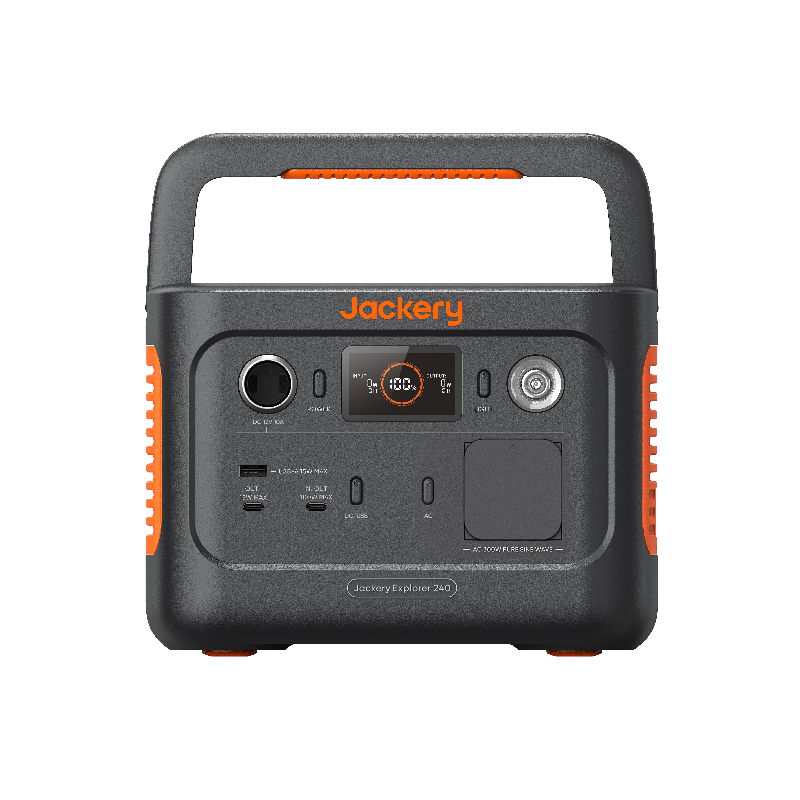
| Jackery Explorer 240 v2 | 256 Wh, 300 W | 3.6 kg (retailer information) | does not run | a good 2 hours |
| Jackery Explorer 1000 v2 | 1,070 Wh, 1,500 W | 10.8 kg | 1,000 W setting: 55 minutes | 9 hours |
| Jackery Explorer 2000 v2 | 2,042 Wh, 2,200 W | 17.5 kg | 2,000 W: 52 minutes | 17 hours |
| Anker SOLIX C1000 Gen 2 | 1,024 Wh, 2,000 W | 11.3 kg | 2,000 W: 26 minutes | just under 9 hours |
| BLUETTI AC180 | 1,152 Wh, 1,800 W | 16 kg | 2,000 W: under 30 minutes, longer when throttled | just under 10 hours |
Jackery Explorer 500 v2
The most fitting size for a blanket and mattress pad. That the inverter tops out at 500 watts is no drawback here, because it keeps the space heater out automatically. At 5.7 kilos, you can carry it to a vacation home or into a van. Jackery specifies minus 20 to plus 45 degrees Celsius for operation and charging, which counts in winter, and 6,000 cycles. It is too small for two blankets at the same time.
Jackery Explorer 240 v2
The affordable entry point, 3.6 kilos according to retailer information. It is enough for prewarming the bed or an hour on the couch. It cannot manage a long evening at 100 watts.
Jackery Explorer 1000 v2
The size for two people. Jackery quotes 4,000 cycles and an operating range of minus 10 to plus 40 degrees, so less leeway than the 500 v2. At 10.8 kilos, it weighs almost twice as much. In spring 2025, the ADAC (German automobile club) downgraded the Explorer 1000 v2 to „poor“ because its two DC inputs are not decoupled. So never charge it via solar and the car socket at the same time.
Jackery Explorer 2000 v2
Among the Jackery models on this list, the only one that can handle a 2,000-watt space heater at all. We would not buy it for that, though, but for the heating pump in the basement. 17.5 kilos is not a weight for day trips, and according to Jackery it can only be charged from 0 degrees upward.
Anker SOLIX C1000 Gen 2
On a space heater, it delivers full power from 1,024 watt-hours, and after 26 minutes it is over. It becomes interesting where an outlet is nearby: according to Anker, it charges at 1,600 watts in 49 minutes. According to the manufacturer, it can discharge down to minus 20 degrees but only charge from 0 degrees. It cannot be expanded.
BLUETTI AC180
Slightly more capacity than the 1-kilowatt-hour class and a mode for heaters. In return, it weighs 16 kilos, the most among the stations of this size here. BLUETTI quotes 3,500 cycles to 80 percent remaining capacity.
How we would decide
- One evening under the blanket, one person: Jackery Explorer 500 v2.
- Just prewarming the bed, small budget: Jackery Explorer 240 v2.
- Two blankets or several evenings without recharging: Jackery Explorer 1000 v2.
- Camper van: built-in diesel heater on the vehicle battery, with the station only as backup.
- Power outage at home: power the heating pump; then the Jackery Explorer 2000 v2 is the right fit.
- Really getting a room warm: no portable station can do that.
Frequently asked questions
How long does a space heater run on a power station?
Barely an hour. Using a factor of 0.85, the Explorer 2000 v2 has around 1,740 of its 2,042 watt-hours left, which is 52 minutes at 2,000 watts. The Explorer 1000 v2 lasts 36 minutes at a full 1,500 watts. For every station, there is a heater that drains it in under an hour.
Can a power station heat a room?
No, no portable station can do that. The German consumer advice center (Verbraucherzentrale) cites 10,000 to 35,000 kilowatt-hours of heat per year for a household; even the lower end averages around 27 kilowatt-hours a day. You would have to drain an Explorer 2000 v2 almost sixteen times for that. And the sun delivers the least exactly when you need it.
How long does a heated blanket run on a power station?
At 100 watts, a good 4 hours on the Explorer 500 v2 by calculation. Three hours on the couch cost around 350 watt-hours including conversion losses, and the station delivers about 435 at the outlet. Since blankets throttle down after warming up, actual consumption tends to be lower. For two blankets, you need the next size up.
Can a heated blanket run overnight on a power station?
No. According to the TÜV association (TÜV-Verband), heated blankets must never run unattended, and electric heating products should be off while you sleep, regardless of the power source. According to Stiftung Warentest, they do not belong on a timer. So prewarm the bed, switch it off, sleep. For the bed, the TÜV association recommends a heated mattress pad suitable for long-term use.
What can a power station do during a winter power outage?
Power the heating system, not the space heater. According to a BBK study, a gas or oil heating system needs an average of 159 watts for its pump and controls. On the Explorer 2000 v2, it runs for around 18 hours by calculation, warming the whole house. Whether this works with your system depends on how it is connected.
Can I connect a parking heater to the power station?
Not directly to the 12-volt socket. The Planar 2D manual requires power from the battery, the wiring harness has 25-amp fuses, and the Jackery socket only delivers 10 amps. The heater stays on the vehicle battery, and the station can support it via a charger.
Sources
- Verbraucherzentrale energy advice: direct electric heating
- BBK: Self-sufficient emergency power supply for the population (PDF)
- BBK: Power outage, preparedness and self-help (PDF)
- German Fire Brigade Association: increased fire risk from alternative heating methods
- TÜV association: using heated blankets safely
- Stiftung Warentest: heated blankets tested (free section)
- Medisana: HP 650 heating pad data sheet (PDF)
- Planar 2D operating manual (PDF)
- GreenDrive: Jackery Explorer 500 v2 (retailer information)
- GreenDrive: Jackery Explorer 1000 v2 (retailer information)
- GreenDrive: Jackery Explorer 2000 v2 (retailer information)
- Berger Camping: Jackery Explorer 240 v2 (retailer information)
- Product information from Jackery on the Explorer models
- Anker SOLIX: C1000 Gen 2
- BLUETTI: AC180
- ADAC: portable power stations tested (spring 2025)
Where to buy
- Jackery Explorer 500 v2View at JackeryAvailable in Germany: JackeryCheck price at Amazon.deAvailable in Germany: Amazon.de
- Jackery Explorer 240 v2View at JackeryAvailable in Germany: Jackery
- Jackery Explorer 1000 v2View at JackeryAvailable in Germany: JackeryCheck price at Amazon.deAvailable in Germany: Amazon.de
- Jackery Explorer 2000 v2View at JackeryAvailable in Germany: JackeryCheck price at Amazon.deAvailable in Germany: Amazon.de
- Anker SOLIX C1000 Gen 2Check price at Amazon.deAvailable in Germany: Amazon.de
- BLUETTI AC180Check price at Amazon.deAvailable in Germany: Amazon.de