Contents14 sections
This guide was first published in German on handgetestet.de.
A plug, a magnet on the window, done? That is how an extractor control looks on the store shelf. If you run an extractor hood and a wood-burning stove or a gas boiler in the same home, you should nevertheless clear the solution with your district chimney sweep first and only order afterward. For hoods with a plug, we consider the PROTECTOR AS-7020, approved by the German Institute for Construction Technology (Deutsches Institut für Bautechnik, DIBt), the obvious choice. The PROTECTOR AS-500 sold by ELV (German retailer) does not have this approval and is only an option if the chimney sweep explicitly accepts it.
Why is negative pressure in the home dangerous?
A stove or boiler that draws its combustion air from the room where it is installed is called room-air-dependent. If an extractor hood runs at the same time, indoor air is moved outside. If too little air flows back in, the pressure tips, and flue gases can come back into the room. The German consumer advice center (Verbraucherzentrale) calls this life-threatening, and the German chimney sweeps‘ association speaks of acute danger to life from carbon monoxide, which is invisible and has neither smell nor taste. A carbon monoxide detector is then a sensible second line of protection. It cannot prevent anything, though.
How little it takes is shown by a figure from the approval notices: negative pressure of more than 4 pascals relative to the outside must not occur in the home. Nor is the hood the only culprit. The Bavarian Firing Ordinance (Feuerungsverordnung) names vented tumble dryers and ventilation systems, and the association also warns about the portable air conditioner with an exhaust hose. According to the Verbraucherzentrale, pure recirculation is not an issue. Which hood suits your kitchen is covered in the range hood guide; here it is only about the safety measures.
Who decides what is sufficient in my case?
Your authorized district chimney sweep (Bezirksschornsteinfeger). In Bavaria, Section 4 (2) of the Firing Ordinance stipulates that systems extracting indoor air must not impair the operational safety of the fireplace. This is met, among other things, if safety devices prevent simultaneous operation or if it is technically ensured that no dangerous negative pressure develops. Other German states have their own ordinances. The Verbraucherzentrale puts it briefly: the extractor hood must be approved by the chimney sweep beforehand if room-air-dependent fireplaces are involved.
Ask two things on the phone. Is a window contact enough? And does it need DIBt approval? The answer decides your purchase, not our table.
What does a window contact do, and what does it not do?
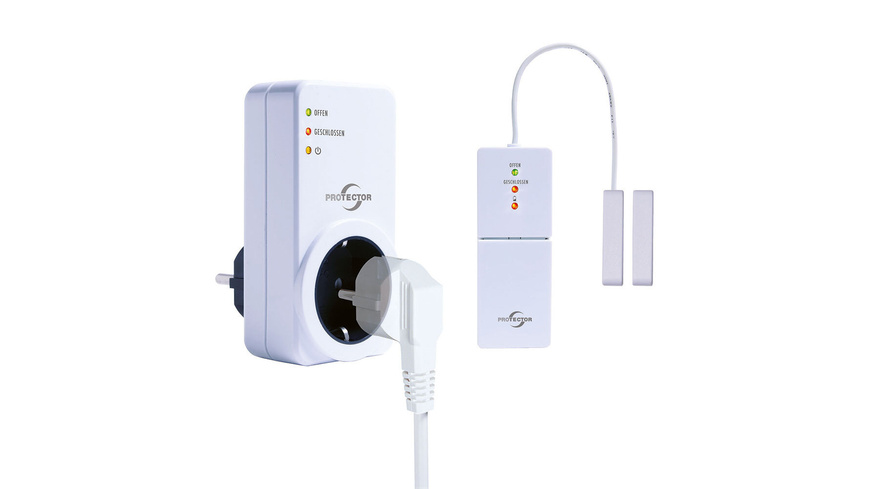
A magnet sits on the sash, a transmitter on the frame, and the receiver plugs in between the outlet and the hood’s plug. Window closed means the hood has no power. It does not measure pressure, only the position of the window. Protector states openly in the AS-500 manual that the device is an aid and does not replace your own checks; the roller shutter also has to be up. A smart home window contact (in German) is not designed for this job.
Plug-in adapters switch the entire power supply, so the hood’s light goes off as well. Hardwired hoods and downdraft cooktop extractors need a built-in version that disconnects only the fan. That is work on 230 volts and therefore a job for a qualified electrician.
How far does the window have to be open?
Further than many people think. The measurement depends on the extraction rate and the window area. According to the table in the AS-500 manual, a hood with 600 m³/h on a window of 0.8 m² needs a gap of at least 7 cm, measured at the top on the inside in the tilted position. The transmitter has to be positioned so that it only releases the hood from that gap onward. If the tilted position stays below that, the window has to be swung open, and in that case the approvals require it to be locked in place. You may only close it once the hood is off.
Is plugging it in all it takes?
Not with approved devices. The approval notice for the AS-7000 series requires installation by a specialist company; if you install it yourself, you need at least acceptance and initial commissioning by a contractor, with a written record. Magnets must be fastened so that they can only be removed with tools. The rule for the BROKO BL220F is built the same way. As the operator, you inform the district chimney sweep yourself and keep the record. During the fireplace inspection (Feuerstättenschau), the chimney sweep can also check extractor systems.
One thing no control replaces: according to the approval, the combustion air for the stove must be ensured independently of the window position.
Five extractor controls, specs side by side
| Model | DIBt approval | Switching capacity | Fits if … |
|---|---|---|---|
| PROTECTOR AS-7020 | Z-85.2-19 | 1,800 W | the hood has a plug, whether next to a stove or a gas boiler |
| PROTECTOR AS-7030 | Z-85.2-19 | 1,800 W | a wood-burning stove is in use and the window should stay closed while the stove is cold |
| PROTECTOR AS-5120 | Z-85.2-21 | 1,000 W | the hood draws little power |
| BROKO BL220F | Z-85.2-5 | 1,150 W | the receiver sits behind metal, for example with island hoods |
| PROTECTOR AS-500 | none | 1,800 W | the chimney sweep accepts it in advance |
PROTECTOR AS-7020: our pick for plug-in hoods
The approval covers room-air-dependent fireplaces in general, including on flue systems shared by several appliances in combination with an extractor hood. According to the manufacturer, the receiver handles 1,800 watts, the coin cell in the mini transmitter lasts up to two years, and up to 16 transmitters can be paired, including one for the roller shutter. The drawback is the same as with every window contact. When you cook in January, the window is open.
PROTECTOR AS-7030: for the wood-burning stove
This one adds a thermo transmitter on the stovepipe. Below a flue gas temperature of 40 °C, the hood runs even with the window closed. That sounds like the solution for everyone, but according to the approval it only applies to manually fed fireplaces and not to flue systems shared by several appliances. So this version is no use with a gas boiler. A specialist company fits the sensor, in coordination with the chimney sweep.
PROTECTOR AS-5120: smaller load
Its own approval, up to six window transmitters, but only 1,000 watts or 4.3 amps. That can be enough for a normal hood. Check the rating plate beforehand.
BROKO BL220F: with an external antenna
Its antenna hangs on a one-meter cable and can be routed out of the metal casing of an island hood. According to BROKO, the safety-relevant components are duplicated; when the window closes, the hood switches off after about 30 seconds. Be careful with the load: 1,150 watts is the limit, and BROKO warns of inrush currents that can reach 60 amps in special cases. In price, it sits well above the AS-500.
PROTECTOR AS-500: only with the chimney sweep’s yes
ELV and the manufacturer point out themselves that it has no DIBt approval and advise asking before you buy. Technically, it is simple: 1,800 watts, 433.92 MHz, up to 50 meters of wireless range in open space, one year of battery life according to the manual, for dry rooms only. The receiver must not sit behind metal. If your chimney sweep says yes, it is the simplest option. If they say no, it is of no use to you.
And if the window should stay closed?
Then a pressure monitor such as the BROKO BL220DDa measures the negative pressure itself, with 4 pascals as the limit for room-air-dependent fireplaces and 8 pascals for room-air-independent ones. It works together with a switching unit and costs several times as much as a window contact. Even the sealed stove from the wood-burning stove guide is not automatically in the clear: according to the association, such stoves are only tested for 8 pascals.
How we would decide
- Hood with a plug, gas boiler or stove in the house: AS-7020, signed off by a specialist contractor.
- Wood-burning stove that only burns in the evening: AS-7030, if the flue system is not shared by several appliances.
- Island hood with a metal casing: BROKO BL220F.
- Hardwired hood or downdraft cooktop extractor: built-in version, connected by a qualified electrician.
- Chimney sweep waives the approval in writing: AS-500 from ELV.
Frequently asked questions
Why is an extractor hood dangerous together with a wood-burning stove?
When the hood runs, indoor air is moved outside. If a stove or boiler draws its combustion air from the room and too little air flows back in, flue gases can come back into the room. The German chimney sweeps' association speaks of acute danger to life from carbon monoxide. According to the approval notices, negative pressure of more than 4 pascals must not occur.
Who decides which control is sufficient?
The authorized district chimney sweep (Bezirksschornsteinfeger). According to the German consumer advice center (Verbraucherzentrale), the extractor hood must be approved by them beforehand if room-air-dependent fireplaces are involved. Ask them whether a window contact is enough and whether it needs DIBt approval. The answer decides what you buy.
How does an extractor control with a window contact work?
A magnet sits on the sash, a transmitter on the frame, and the receiver plugs in between the outlet and the hood's plug. Window closed means the hood has no power. It does not measure pressure, only the window position. Plug-in adapters also switch off the hood's light; hardwired hoods need a built-in version installed by a qualified electrician.
How far does the window have to be open while the hood is running?
That depends on the extraction rate and the window area. According to the table in the AS-500 manual, a hood with 600 m³/h on a window of 0.8 m² needs a gap of at least 7 cm in the tilted position. The transmitter must only release the hood from that gap onward. If the tilted position is not enough, the window has to be swung open and locked in place.
Can I install an approved extractor control myself?
Only to a limited extent. The approval notice for the AS-7000 series requires installation by a specialist company; with self-installation, at the very least acceptance and initial commissioning by a contractor with a written record. Magnets may only be removable with tools. As the operator, you inform the chimney sweep yourself.
Is there a solution where the window can stay closed?
Yes, a pressure monitor such as the BROKO BL220DDa measures the negative pressure itself, with 4 pascals as the limit for room-air-dependent fireplaces. It costs several times as much as a window contact. For wood-burning stoves there is the AS-7030 with a thermo transmitter: below a flue gas temperature of 40 °C, the hood runs even with the window closed.
Sources
- Bavarian Firing Ordinance (Bayerische Feuerungsverordnung), Section 4
- Verbraucherzentrale: Range hoods
- German Federal Association of Chimney Sweeps: Planning a wood-burning stove
- German Federal Association of Chimney Sweeps: Caution with portable air conditioners (PDF)
- German Federal Association of Chimney Sweeps: Frequently asked questions
- ELV: PROTECTOR AS-500
- Protector: AS-500 manual (PDF)
- m-e: AS-7020
- DIBt approval notice Z-85.2-19 for the AS-7000 series (PDF)
- m-e: AS-5120
- DIBt approval notice Z-85.2-5 for the BL220 series (PDF)
- BROKO: BL220F
- BROKO: BL220DDa
Where to buy
- PROTECTOR AS-7020Check price at Amazon.deCheck price at Amazon.co.ukCheck price at Amazon.nlCheck price at Amazon.com.beCheck price at Amazon.frCheck price at Amazon.itCheck price at Amazon.esCheck price at Amazon.plCheck price at Amazon.seAvailable in Germany: Amazon.de
- PROTECTOR AS-7030Check price at Amazon.deCheck price at Amazon.co.ukCheck price at Amazon.nlCheck price at Amazon.com.beCheck price at Amazon.frCheck price at Amazon.itCheck price at Amazon.esCheck price at Amazon.plCheck price at Amazon.seAvailable in Germany: Amazon.de
- PROTECTOR AS-5120Check price at Amazon.deCheck price at Amazon.co.ukCheck price at Amazon.nlCheck price at Amazon.com.beCheck price at Amazon.frCheck price at Amazon.itCheck price at Amazon.esCheck price at Amazon.plCheck price at Amazon.seAvailable in Germany: Amazon.de
- BROKO BL220FCheck price at Amazon.deCheck price at Amazon.co.ukCheck price at Amazon.nlCheck price at Amazon.com.beCheck price at Amazon.frCheck price at Amazon.itCheck price at Amazon.esCheck price at Amazon.plCheck price at Amazon.seAvailable in Germany: Amazon.de
- PROTECTOR AS-500View at ELVAvailable in Germany: ELVCheck price at Amazon.deCheck price at Amazon.co.ukCheck price at Amazon.nlCheck price at Amazon.com.beCheck price at Amazon.frCheck price at Amazon.itCheck price at Amazon.esCheck price at Amazon.plCheck price at Amazon.seAvailable in Germany: Amazon.de