Contents10 sections
This guide was first published in German on handgetestet.de.
July, the third hot day in a row, and the home improvement store still has a cheap monoblock with an exhaust hose. That is how many bad purchases begin. Afterward, the unit drones in the bedroom, and part of the warm air comes right back in through the open window gap. If you can use a window or balcony door, a portable split unit such as the Midea PortaSplit is much better. It is quieter and more efficient, and it even heats in winter. The only thing against it is the price.
If all you need is to keep a home office cool on a few hot days, a simple monoblock such as the Comfee Breezy Cool Pro 2.6 is often enough. In between are units from De’Longhi and Trotec that compete on capacity and the refrigerant R290.
One housing or two?
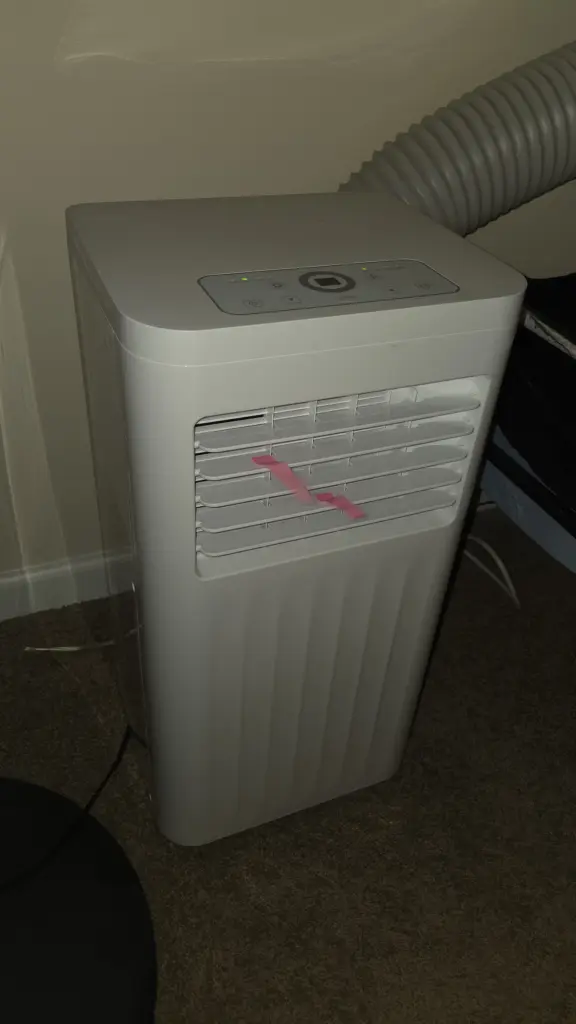
Almost everything hinges on this. In a monoblock, the compressor and evaporator sit together, and the waste heat has to go outside through a thick hose. In a portable split unit, the compressor is housed in an outdoor unit that hangs on the windowsill or balcony railing, and only a flat line then leads into the room.
You notice what that means first with the hose. With a single-hose unit, warm outside air flows in through gaps because the unit blows room air outside, as the German consumer advice center Verbraucherzentrale points out. Window seals help only to a limited extent. On top of that, an uninsulated hose gets hot and gives heat back into the room. So run it as short and straight as possible.
Then there is the noise. With a monoblock, the compressor sits next to your bed, and manufacturers usually state around 50 to 56 dB(A) on the high setting. With a split unit, it runs outside. For indoors, Midea states 39 dB(A) in silent mode.
As for room size, the manufacturers‘ cubic-meter figures assume rooms of normal height. An attic room under uninsulated sloped ceilings needs more reserve than a north-facing room in an old building. And the units are heavy, too; many weigh 30 to 37 kilograms. They all have casters. They still do not like stairs.
One plus to finish: according to the manufacturers, the monoblocks below run on propane (R290), a refrigerant with a very low greenhouse effect.
Letters you cannot compare
Room air conditioners carry a label from A+++ to D. However, split units are rated by the seasonal SEER value, monoblocks by the EER value under rated conditions. There is therefore more between an A on a monoblock and an A++ on a split unit than the letters suggest.
The Verbraucherzentrale also stresses that the class only describes efficiency, not absolute power consumption; a large A+ unit can therefore draw more electricity than a small A unit. It considers dual-hose units more efficient than single-hose units because they draw in outside air through a second hose.
If your main concern is humid air, check first whether a dehumidifier or air purifier would be enough. More on this under air purifiers.
Five portable air conditioners for 2026
| Model | Type | Cooling capacity according to the manufacturer | Energy class (cooling) | Best for |
|---|---|---|---|---|
| Midea PortaSplit | portable split unit, also heats | 3.5 kW (12,000 BTU/h) | A++ (SEER 6.1) | Bedrooms, year-round use |
| Midea PortaSplit Cool | portable split unit, cooling only | 8,000 BTU/h | A++ | smaller rooms, no heating needed |
| De’Longhi Pinguino GentleJet Inverter (PAC AP130i) | Monoblock with inverter | 3.3 kW (13,000 BTU/h) | A+ (EER 3.2) | large rooms without space for an outdoor unit |
| Trotec PAC 3500 E | Monoblock | 3.5 kW (12,000 BTU/h) | A | Rooms up to about 46 m², rarely used |
| Comfee Breezy Cool Pro 2.6 | Monoblock with app | 2.6 kW (9,000 BTU/h) | A | small budget, rooms up to about 33 m² |
Midea PortaSplit
The PortaSplit made the category of portable split units known among renters. According to the spec sheet, it cools at 3.5 kW, heats at 3.2 kW and achieves A++ for cooling (SEER 6.1) and A+ for heating (SCOP 4.0). For indoors, Midea states 39 to 49 dB(A). The connecting line is 2 meters long, 2.7 centimeters flat and cannot be disconnected. Price-wise, it plays in the premium class, and availability fluctuates heavily with the weather.
The outdoor unit weighs just under 10 kilograms. It must hang securely, and if you mount it on a railing, it is best to ask your landlord or homeowners‘ association first.
Midea PortaSplit Cool
Without the heating function and with less capacity: Midea states 8,000 BTU/h and SEER 6.1. According to the listing, that is enough for rooms up to about 28 square meters. It is not much cheaper than the large model. If you are looking for a heat pump for spring and fall anyway, go for the PortaSplit with heating instead.
De’Longhi Pinguino GentleJet Inverter
The current Pinguino is also a monoblock. Instead of constantly switching on and off, however, it throttles down via an inverter. De’Longhi states 3.3 kW of cooling capacity, EER 3.2 and class A+, a good figure for a single-hose monoblock. The spec sheet lists a sound pressure of 43 to 50 dB(A) and R290 as the refrigerant. Almost 37 kilograms is heavy, and it is hardly cheaper than a PortaSplit. Its place is where no outdoor unit is allowed.
Trotec PAC 3500 E
A classic monoblock with 3.5 kW for rooms up to 46 m² or 115 m³, energy class A, refrigerant R290. Trotec states a maximum sound pressure of 56 dB(A). For an office or living room that is cooled on a few days a year, that is a solid compromise. We would not let it run all night in the bedroom.
Comfee Breezy Cool Pro 2.6
Entry-level class. The Comfee costs only a small fraction of what a PortaSplit does and, according to the manufacturer, cools rooms up to about 33 m² with 2.6 kW. It uses R290 and can be controlled via an app. It has no inverter, so it is not quiet. For a small room and a small budget, it is still an honest solution. If you do without the app, you can limit its running time with a smart plug (in German).
So which one?
In a bedroom with a window or balcony door, it is the Midea PortaSplit. Expensive, yes. But if you use the unit for many weeks a year, the quiet indoor unit and the heating function give you enough for the extra cost.
- No outdoor unit possible, large room: De’Longhi Pinguino GentleJet Inverter, the most efficient monoblock here according to the label.
- Only on hot days, in the living room or office: Trotec PAC 3500 E.
- Small room, small budget: Comfee Breezy Cool Pro 2.6. With an exhaust hose and noise, but with a clear effect in a small space.
For all of them: a portable air conditioner fights the heat, not its cause. External sun shading and airing out at night often reduce demand more than half a kilowatt of extra cooling capacity. If your balcony gets a lot of sun, you can partly generate the electricity yourself during the day, for example with a balcony solar system with storage (in German).
Once you know your consumption, you should also check the price per kilowatt-hour. Notice periods, special termination rights and the typical bonus traps are explained in our guide to switching electricity providers (in German).
What the compressor start demands and how long the battery lasts is shown in the guide on running an air conditioner on a power station (in German).
Frequently asked questions
What is the difference between a monoblock and a portable split unit?
In a monoblock, the compressor and evaporator sit together, and the waste heat goes outside through a thick hose. In a portable split unit, the compressor is housed in an outdoor unit on the windowsill or balcony railing, and only a flat line leads into the room. That makes it much quieter indoors.
How loud is a portable air conditioner?
With a monoblock, the compressor sits right next to you, and manufacturers usually state around 50 to 56 dB(A) on the high setting. With a split unit, it runs outside; Midea states 39 dB(A) indoors in silent mode. In the bedroom, this difference matters a lot.
Why does a monoblock with an exhaust hose cool less effectively?
With a single-hose unit, warm outside air flows in through gaps because the unit blows room air outside, as the German consumer advice center Verbraucherzentrale points out. Window seals help only to a limited extent. An uninsulated hose also gets hot and gives heat back into the room, so it should run as short and straight as possible.
Can you compare the energy classes of air conditioners?
Only to a limited extent. Split units are rated by the seasonal SEER value, monoblocks by the EER value under rated conditions. There is therefore more between an A on a monoblock and an A++ on a split unit than the letters suggest. The class also only describes efficiency, not absolute power consumption.
What should you keep in mind about the PortaSplit's outdoor unit?
The outdoor unit weighs just under 10 kilograms and must hang securely. If you mount it on a railing, it is best to ask your landlord or homeowners' association first. The connecting line is 2 meters long, 2.7 centimeters flat and cannot be disconnected. Where no outdoor unit is allowed, the De'Longhi Pinguino GentleJet Inverter is the alternative.
How can you reduce cooling demand in summer?
A portable air conditioner fights the heat, not its cause. External sun shading and airing out at night often reduce demand more than half a kilowatt of extra cooling capacity. For attic rooms under uninsulated sloped ceilings, the cooling capacity should have more reserve than for a north-facing room.
Sources
- Midea: PortaSplit spec sheet
- Midea: PortaSplit product information
- Midea: PortaSplit Cool
- De’Longhi: Pinguino GentleJet Inverter
- Trotec: PAC 3500 E
- Verbraucherzentrale: Air conditioners, what to consider when buying and installing
Where to buy
- Midea PortaSplitCheck price at Amazon.deAvailable in Germany: Amazon.de
- Midea PortaSplit CoolCheck price at Amazon.deAvailable in Germany: Amazon.de
- De'Longhi Pinguino GentleJet InverterCheck price at Amazon.deAvailable in Germany: Amazon.de
- Trotec PAC 3500 ECheck price at Amazon.deAvailable in Germany: Amazon.de
- Comfee Breezy Cool Pro 2.6Check price at Amazon.deAvailable in Germany: Amazon.de