Contents14 sections
This guide was first published in German on handgetestet.de.
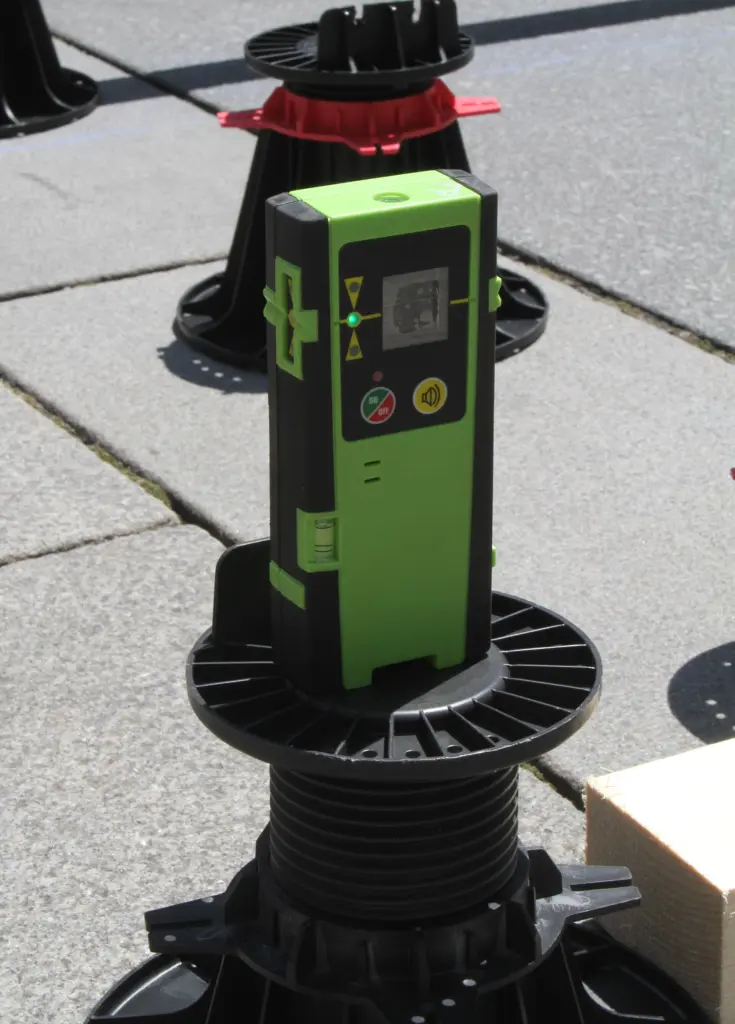
If you are setting a patio on adjustable pedestals, building formwork for a foundation or installing a suspended ceiling, you need a height that holds true over twenty meters. For most do-it-yourself builders, a self-leveling class 2 rotary laser with a receiver and grade rod is the right choice, such as the Stabila LAR 160. More elaborate units only pay off if the laser sits outdoors every day or slopes need to be set.
Many people buy the wrong thing. A rotary laser without a receiver becomes invisible in sunlight after a few meters. For interior finishing with short distances, on the other hand, a cross line laser (in German) that projects the line directly onto the wall is often enough.
What is behind the numbers on the data sheet
Accuracy is sometimes given in millimeters per meter, sometimes per 30 meters. Convert everything to one meter, and it becomes comparable. For the GRL 300 HV, Bosch states ±3 mm over 30 m, which is ±0.1 mm/m. Stabila specifies exactly this value for the LAR 160. On a 15 m patio, that means a deviation of at most 1.5 mm from the unit. Then there is the receiver: Leica states a detection width of ±1 mm in the fine setting for its Rod Eye receivers. In practice, the two values add up.
The working range is almost always given as a diameter. A 400 m diameter means 200 m distance from the unit. Without a receiver, it shrinks considerably, at Bosch to 20 to 60 m in diameter, and that applies mostly indoors.
Self-leveling only compensates for a crooked setup, usually by ±5°. If the tripod is more tilted than that, the unit shuts off or warns you. A slope, by contrast, deliberately tilts the laser plane. Manual slope means: automatic leveling off, tilt the plane by hand. Digital slope means you enter a percentage and the unit holds it. A 2% slope over a 4 m patio depth is 8 cm. You can also stake that out with a purely horizontal laser by reading the height at the grade rod and adding 2 cm per meter. Slower, but it works.
That leaves protection against water and dust. According to Bosch, IP54 means protection against dust and splashing water; according to Stabila, IP65 means protection against water jets and dust. The higher the second digit, the more water the housing can withstand. If you lay out a strip foundation in drizzle, do not go below IP54. A tripod and grade rod belong with it. Many sets include both, and a wobbly camera tripod renders any accuracy specification worthless.
Class 2 or 3R: what the accident insurers say
The laser class is on the rating plate, and it matters. According to DGUV Information 203-095 „Laser radiation on construction sites“ from the German Social Accident Insurance (DGUV), class 2 radiation is harmless to the eye with brief exposure of up to 0.25 s. From class 3R, eye damage is possible. Companies must then appoint a laser safety officer. The BG BAU, the German statutory accident insurer for the construction industry, writes in its module B 174 that 3R units can only be operated safely on construction sites if a direct look into the beam is unlikely for everyone involved.
Do not rely on the blink reflex. The DGUV explicitly states that it is not an effective protective measure: if the beam hits your eye, deliberately close your eyes and turn your head away. And the red glasses from the case? Stabila makes clear in the manual that laser viewing glasses are not safety glasses. They only make the beam easier to see. According to the DGUV, green class 2 lasers are generally no less visible than red class 3R lasers. Our position: for house and garden, class 2 is enough.
Six rotary lasers sorted by use
| Model | Accuracy | Range with receiver, protection, class | For whom |
|---|---|---|---|
| Stabila LAR 160 | ±0.1 mm/m | 600 m Ø (retailer information), IP65, class 2 | Patio, foundation, interior finishing |
| Makita SKR200Z | ±1 mm over 10 m | 200 m Ø, IP54, class 2 | Smaller properties, horizontal and vertical |
| Bosch GRL 300 HV | ±3 mm over 30 m | 300 m Ø, IP54, class 3R | Interior finishing with remote control |
| Bosch GRL 400 H | ±2.4 mm over 30 m | 400 m Ø, IP56, class 2 | Foundations and civil engineering, horizontal only |
| Bosch GRL 600 CHV | ±1.5 mm over 30 m (horizontal) | 600 m Ø, IP68, class 2 | Professionals with slope via app |
| Leica Rugby 620 | ±2.2 mm over 30 m | 500 to 1,100 m Ø depending on receiver, IP67, class 1 | Formwork, concrete, driveways |
Path 1: Patio, garden and slopes, do-it-yourself
What counts here is a receiver, a sensible set and a housing that can stand up to rain. If you lay decking boards (in German) on pedestals or a substructure, you measure dozens of points. Each of them has to be accurate to the millimeter.
Stabila LAR 160
According to the manual, it levels horizontally and vertically, plumbs, and works automatically within a range of ±5°. The housing is protected against water jets and dust to IP65, accuracy is ±0.1 mm/m, and the laser class is 2. For slopes, you switch to manual mode; a slope wedge from the accessory range makes that easier. According to Stabila, two D cells last about 40 hours, about 20 with the green LAR 160 G. Our favorite for home builders.
Makita SKR200Z
Makita states ±1 mm over 10 m, a measuring range of 200 m in diameter, IP54 and self-leveling up to ±6°. It runs on two 1.5 V batteries and works both horizontally and vertically. For single-family home properties, the range is sufficient. The geo-FENNEL FL 190A works more coarsely, with ±1.5 mm over 10 m and vertical adjustment via a leveling screw. That is enough for a paving bed and lawn edging.
Path 2: Interior finishing, drywall, screed
Indoors, the receiver is needed less often, but a remote control, wall mount and a cleanly vertical plane become important. Be honest with yourself about whether a line laser would do.
Bosch GRL 300 HV
According to Bosch, the 0 601 061 501 version includes the LR 1 receiver, RC 1 remote control and WM 4 wall mount, so everything for a suspended ceiling. Working range 300 m in diameter, IP54, ±3 mm over 30 m. Bosch rates it as class 3R. That is exactly why we advise private users to hold back, and according to the DGUV, companies need a laser safety officer.
Path 3: Professionals on the job site
On the job site, a tripod gets knocked over, it rains, and the unit runs all day. From here on, protection rating, run time and receiver matter more than any convenience detail.
Bosch GRL 400 H
Horizontal only, but simple: one button, IP56, class 2 and ±2.4 mm over 30 m. With the LR 1 receiver, it reaches 400 m in diameter according to Bosch. A warning function alerts you if the unit has been bumped.
Bosch GRL 600 CHV
The big Bosch: 600 m in diameter, IP68 and ±1.5 mm over 30 m horizontally. You set the slope in two axes via the Levelling Remote App. It runs on an 18 V battery pack or four D batteries. In the 0 615 994 0P5 version, Bosch supplies the BT 170 HD construction tripod and GR 240 measuring rod, though the unit weighs 4.3 kg with the battery.
Leica Rugby 620
Leica describes the 620 as a horizontal laser with manual slope in one axis, intended for formwork, concrete, foundations and driveways. The series data sheet states ±2.2 mm over 30 m, IP67, class 1 and up to 120 hours with the lithium battery. If you need digital slope in two axes, look at the Rugby 680 from the same series.
How we would decide
- Patio, garden wall, carport foundation: Stabila LAR 160 in a set with tripod and rod. If it is only about earthwork on a small property, the Makita SKR200Z is enough as well.
- Drywall and ceilings: first check whether a cross line laser is enough. Otherwise, a unit with a wall mount and remote control, paying attention to the laser class.
- Daily job site work with slopes: Bosch GRL 600 CHV or Leica Rugby 620. For pure height transfer without slope, the GRL 400 H is enough.
And after the purchase? Stabila advises checking accuracy before starting any work, especially after knocks. To do this, set the unit at least 10 m from a wall, mark the line and turn it three times by 90°. If the four marks are less than 2 mm apart, the ±0.1 mm/m tolerance is met. The effort is minimal.
Frequently asked questions
How do you compare the accuracy of rotary lasers?
Convert all figures to one meter. For the GRL 300 HV, Bosch states ±3 mm over 30 m, which is ±0.1 mm/m, exactly the same as the Stabila LAR 160. On a 15 m patio, that means a deviation of at most 1.5 mm. In practice, the detection width of the receiver comes on top.
Do I need a receiver for a rotary laser?
Outdoors, yes. Without a receiver, the beam becomes invisible in sunlight after a few meters. The working range on the data sheet is usually given as a diameter with a receiver: a 400 m diameter means 200 m distance from the unit. Without a receiver, it shrinks to 20 to 60 m in diameter at Bosch.
Can you set a slope with a rotary laser?
With manual slope, you switch off the automatic leveling and tilt the plane by hand; with digital slope, you enter a percentage. It also works with a purely horizontal laser: a 2% slope over a 4 m patio depth is 8 cm, so add 2 cm per meter at the grade rod. Slower, but it works.
What is the difference between laser class 2 and 3R?
According to the DGUV, the German Social Accident Insurance, class 2 radiation is harmless to the eye with brief exposure of up to 0.25 s; from class 3R, eye damage is possible. Companies then need a laser safety officer. According to the DGUV, green class 2 lasers are generally no less visible than red class 3R lasers. For house and garden, class 2 is enough.
What protection rating does a rotary laser need for outdoor use?
IP54 means protection against dust and splashing water, IP65 against water jets and dust. The higher the second digit, the more water the housing can withstand. If you lay out a strip foundation in drizzle, do not go below IP54. A sturdy tripod and a grade rod are just as important.
How do you check the accuracy of a rotary laser?
Stabila advises checking before starting any work, especially after knocks. Set the unit at least 10 m from a wall, mark the line and turn it three times by 90°. If the four marks are less than 2 mm apart, the ±0.1 mm/m tolerance is met.
Sources
- Stabila: LAR 160 / LAR 160 G user manual (PDF)
- geo-FENNEL: FL 190A and product data sheet (PDF)
- Makita: SKR200Z
- Bosch Professional: GRL 300 HV
- Bosch Professional: GRL 400 H
- Bosch Professional: GRL 600 CHV
- Leica Geosystems: Rugby 620 and Rugby 600 data sheet (PDF)
- DGUV Information 203-095: Laser radiation on construction sites (PDF, German Social Accident Insurance)
- BG BAU: Module B 174 construction lasers (PDF)
Where to buy
- Stabila LAR 160Check price at Amazon.deCheck price at Amazon.co.ukCheck price at Amazon.nlCheck price at Amazon.com.beCheck price at Amazon.frCheck price at Amazon.itCheck price at Amazon.esCheck price at Amazon.plCheck price at Amazon.seAvailable in Germany: Amazon.de
- Makita SKR200ZCheck price at Amazon.deCheck price at Amazon.co.ukCheck price at Amazon.nlCheck price at Amazon.com.beCheck price at Amazon.frCheck price at Amazon.itCheck price at Amazon.esCheck price at Amazon.plCheck price at Amazon.seAvailable in Germany: Amazon.de
- Bosch Professional GRL 300 HVCheck price at Amazon.deCheck price at Amazon.co.ukCheck price at Amazon.nlCheck price at Amazon.com.beCheck price at Amazon.frCheck price at Amazon.itCheck price at Amazon.esCheck price at Amazon.plCheck price at Amazon.seAvailable in Germany: Amazon.de
- Bosch Professional GRL 400 HCheck price at Amazon.deCheck price at Amazon.co.ukCheck price at Amazon.nlCheck price at Amazon.com.beCheck price at Amazon.frCheck price at Amazon.itCheck price at Amazon.esCheck price at Amazon.plCheck price at Amazon.seAvailable in Germany: Amazon.de
- Bosch Professional GRL 600 CHVCheck price at Amazon.deCheck price at Amazon.co.ukCheck price at Amazon.nlCheck price at Amazon.com.beCheck price at Amazon.frCheck price at Amazon.itCheck price at Amazon.esCheck price at Amazon.plCheck price at Amazon.seAvailable in Germany: Amazon.de
- Leica Rugby 620Check price at Amazon.deCheck price at Amazon.co.ukCheck price at Amazon.nlCheck price at Amazon.com.beCheck price at Amazon.frCheck price at Amazon.itCheck price at Amazon.esCheck price at Amazon.plCheck price at Amazon.seAvailable in Germany: Amazon.de