Contents14 sections
This guide was first published in German on handgetestet.de.
In online forums, the open comb is considered „closer,“ so it often ends up in the first shopping cart. For switching over, that is the wrong approach. If you have been using cartridge razors, you are better served by a closed comb, such as the Mühle R89, which the manufacturer itself recommends for beginners and sensitive skin. A fresh blade, light pressure and a proper lather take care of the rest.
A look under the blade
Under the blade sits a bar, the comb. With a closed comb, it is smooth or slightly wavy, and the blade protrudes only a little. With an open comb, the bar looks like a rake, and the blade is more exposed. Mühle describes the open comb as very effective on heavy beards but less gentle on the skin and with a higher risk of injury. If you shave every day, you do not need it. If you let your beard grow for three days and have dense stubble, you can switch later.
So for the first few weeks, a closed comb. Adjustable razors such as the Rockwell 6S allow both but cost more.
Next come weight and handle. A heavy razor sits steadily between your fingers and needs hardly any pressure; lightweight aluminum models are guided more with the fingertips. A short handle suits small hands, while large hands prefer a long version. To change the blade, you unscrew three-piece razors, while „twist“ models just need a turn at the end of the handle. Both become routine after a week.
And the running costs? Low. Almost all safety razors take the standard double-edge blade, a pack of ten sits in the low price range, and you are not tied to any brand.
Blade, brush, soap
The blade is the actual tool; the razor is merely its holder. There are dozens of kinds, and everyone perceives sharpness differently. A mixed sampler pack is therefore smarter than a hundred blades of one kind. The sources differ on how often to change: Mühle recommends about three to five shaves, Rockwell speaks of four to seven, and the American Academy of Dermatology (AAD) of five to seven. If the blade tugs or burns, change it sooner.
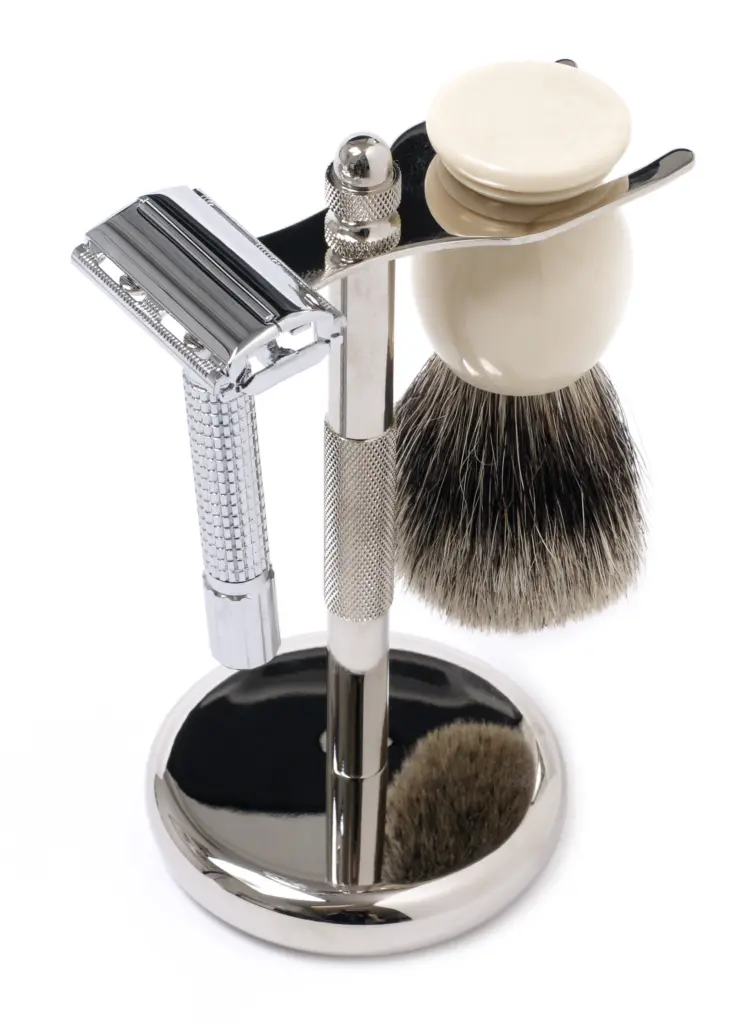
Brush and soap are not mere accessories. According to Mühle, thorough lathering softens the beard hairs so the razor glides better. A brush made of synthetic fiber dries quickly and contains no animal hair. Mühle calls its fiber „Silvertip Fibre.“ Shaving soap lasts a long time and takes some practice to lather. Shaving cream foams faster and is suitable for the first few weeks. If you want everything at once, take a set of razor, brush and stand. That saves you the search but is rarely cheaper than individual parts.
What your skin has to say
A safety razor is not a remedy for skin problems. It does, however, remove two things dermatologists view critically: many blades in a row and heavy pressure. The American Academy of Dermatology (AAD) writes that razors with one or two blades can be suitable for people who frequently get razor bumps. Its other tips apply to any device:
- Wet your skin and beard first, ideally right after showering, then apply a shaving cream. If you have sensitive skin, choose a product labeled accordingly.
- Shave in the direction of hair growth and rinse the blade after every stroke.
- Go over the same spot no more than twice, do not pull the skin taut, and use light pressure.
- Store the razor dry between shaves, not in the shower.
If redness or razor bumps persist for weeks, the AAD advises seeing a dermatologist. This also applies if you are prone to acne or have skin conditions. In that case, please consult a doctor beforehand to find out whether wet shaving is right for you at all.
Taking your safety razor on vacation
Razor blades are on the list of items prohibited in carry-on luggage that the German Federal Police (Bundespolizei) publishes under EU Implementing Regulation 2015/1998. This also applies to a new pack in its original packaging. Blades therefore belong in your checked suitcase. If you travel with carry-on only, buy them at your destination or take an electric shaver for the trip. Suitable models are presented in the electric shaver guide. A toiletry bag with its own compartment makes room for razor, brush and tube; see the toiletry bag guide (in German).
Seven safety razors side by side
| Model | Comb | Key data according to the seller | Best for |
|---|---|---|---|
| Mühle R89 | closed | chrome-plated metal, one blade included, also available as Twist | Beginners, sensitive skin |
| Mühle R41 | open | same design, exposed blade | Experienced shavers with heavy beards |
| Merkur 34C | closed | two-piece, short handle, around 78 g | small hands, those who like weight |
| Edwin Jagger DE89 | closed | chrome-plated brass, 68 g, 93 mm, Feather blade included | Beginners with an eye for looks |
| Henson AL13 | closed, mild | aluminum, around 37 g, blade tightly supported | light handling, people switching over |
| Rockwell 6S | interchangeable plates | stainless steel, six settings, five blades included | those who want room to grow |
| Fatip Testina Gentile | closed | brass, made in Italy | those who like it mild and simple |
Mühle R89
Mühle’s standard razor with a closed comb. Instead of teeth, the manufacturer places gentle waves under the blade and explicitly recommends the R89 for beginners and sensitive skin. It is available with many handles and as a Twist version that opens with a turn. The head can be purchased separately.
Mühle R41
The counterpart with an open comb. According to the manufacturer, it shaves very closely and is intended for men with dense beards. Mühle itself, however, calls it less gentle on the skin. As a first safety razor, it is the wrong choice.
Merkur 34C
A razor from Solingen, Germany, with a short, grippy shaft. The specialist retailer Dovo states around 78 grams, which is a lot for its size. It opens via a knob at the end of the handle. If you have large hands, consider the short design before buying.
Edwin Jagger DE89
According to the manufacturer, made of solid brass, triple-plated and hand-assembled in Sheffield. The standard handle measures 93 millimeters at 68 grams, the long version 101 millimeters. A Feather blade is included. The many handle patterns change nothing about the head.
Henson AL13
The lightweight of the field. Henson makes the razor from aircraft aluminum, and it weighs around 37 grams. The blade is supported to just short of the cutting edge and sits at a fixed angle of 30 degrees. The manufacturer advertises less razor burn; this has not been independently verified. If you like a closer shave, go for the Medium version AL13-M.
Rockwell 6S
Instead of a single head, Rockwell supplies interchangeable plates for six settings. The number is on the bottom of the razor, and setting one is the mildest. The manufacturer advises starting with settings one to three. A tip from Rockwell’s help pages: if a wet blade stays in the stainless steel for a long time, stains can form.
Fatip Testina Gentile
Fatip manufactures in Italy, and the „Testina Gentile“ head is the mild variant with a closed comb. Retailers and buyers do, however, report inconsistent build quality. If you order this one, check the head carefully when it arrives.
Our advice by beard and experience
- First safety razor, normal or sensitive skin: Mühle R89. If you also want a brush and stand, go for the matching Mühle set with a synthetic brush.
- Same purpose, different taste: Edwin Jagger DE89 or Merkur 34C. The difference lies more in handle and weight than in the shave.
- Light hand, little pressure: Henson AL13.
- Not sure how close the shave should be: Rockwell 6S. More expensive, but no second purchase.
- Dense beard, experience at hand: Mühle R41.
If you only want to keep your beard short rather than shave it clean, you do not need a safety razor. In that case, the beard trimmer guide (in German) is the better place to start.
We tested the electric alternative to the safety razor ourselves: the Braun Series 9 with cleaning station.
Frequently asked questions
What is the difference between an open and a closed comb?
With a closed comb, the bar under the blade is smooth or slightly wavy, and the blade protrudes only a little. With an open comb, it looks like a rake, and the blade is more exposed. Mühle describes the open comb as very effective on heavy beards but less gentle on the skin and with a higher risk of injury.
How often should you change the razor blade?
The sources give different figures: Mühle recommends about three to five shaves, Rockwell speaks of four to seven, and the American Academy of Dermatology (AAD) of five to seven. If the blade tugs or burns, change it sooner. Almost all safety razors take the standard double-edge blade, and a mixed sampler pack helps you choose a brand.
Does a safety razor help against razor bumps?
A safety razor is not a remedy for skin problems. It does, however, remove two things dermatologists view critically: many blades in a row and heavy pressure. The AAD writes that razors with one or two blades can be suitable for frequent razor bumps. If redness persists for weeks, it advises seeing a dermatologist.
Can I take razor blades in my carry-on luggage?
No. Razor blades are on the list of items prohibited in carry-on luggage that the German Federal Police publishes under EU Implementing Regulation 2015/1998. This also applies to a new pack in its original packaging. Blades belong in your checked suitcase; if you travel with carry-on only, buy them at your destination.
Do you need a brush and shaving soap?
Brush and soap are not mere accessories. According to Mühle, thorough lathering softens the beard hairs so the razor glides better. A synthetic brush dries quickly and contains no animal hair. Shaving soap lasts a long time but takes practice to lather; shaving cream foams faster and is suitable for the first few weeks.
Which safety razor lets you adjust how close it shaves?
Instead of a single head, the Rockwell 6S has interchangeable plates for six settings, with setting one being the mildest. The manufacturer advises starting with settings one to three. It is more expensive, but it saves you a second purchase if you are not yet sure how close a shave you want.
Sources
- Mühle: Closed or open comb
- Mühle: Safety razor FAQ
- Mühle: Traditional R89 with holder
- Edwin Jagger: DE89 Chrome
- Henson Shaving: AL13
- Henson Shaving: FAQ
- Rockwell Razors: Settings
- Rockwell Razors: Care
- Dovo: Blog on the Merkur 34C
- The Razor Company: Fatip Testina Gentile (retailer information)
- American Academy of Dermatology: How to shave
- American Academy of Dermatology: Razor bumps
- American Academy of Dermatology: Skin care for men
- German Federal Police: Prohibited items
- German Federal Aviation Office (Luftfahrt-Bundesamt): List of prohibited items
Where to buy
- Mühle R89 Rasierhobel (Traditional, mit Klingen)Check price at Amazon.deCheck price at Amazon.co.ukCheck price at Amazon.nlCheck price at Amazon.com.beCheck price at Amazon.frCheck price at Amazon.itCheck price at Amazon.esCheck price at Amazon.plCheck price at Amazon.seAvailable in Germany: Amazon.de
- Mühle Rasierset Silvertip Fibre mit R89Check price at Amazon.deCheck price at Amazon.co.ukCheck price at Amazon.nlCheck price at Amazon.com.beCheck price at Amazon.frCheck price at Amazon.itCheck price at Amazon.esCheck price at Amazon.plCheck price at Amazon.seAvailable in Germany: Amazon.de
- Edwin Jagger DE89Check price at Amazon.deCheck price at Amazon.co.ukCheck price at Amazon.nlCheck price at Amazon.com.beCheck price at Amazon.frCheck price at Amazon.itCheck price at Amazon.esCheck price at Amazon.plCheck price at Amazon.seAvailable in Germany: Amazon.de
- Merkur 34CCheck price at Amazon.deCheck price at Amazon.co.ukCheck price at Amazon.nlCheck price at Amazon.com.beCheck price at Amazon.frCheck price at Amazon.itCheck price at Amazon.esCheck price at Amazon.plCheck price at Amazon.seAvailable in Germany: Amazon.de
- Henson AL13Check price at Amazon.deCheck price at Amazon.co.ukCheck price at Amazon.nlCheck price at Amazon.com.beCheck price at Amazon.frCheck price at Amazon.itCheck price at Amazon.esCheck price at Amazon.plCheck price at Amazon.seAvailable in Germany: Amazon.de
- Rockwell 6SCheck price at Amazon.deCheck price at Amazon.co.ukCheck price at Amazon.nlCheck price at Amazon.com.beCheck price at Amazon.frCheck price at Amazon.itCheck price at Amazon.esCheck price at Amazon.plCheck price at Amazon.seAvailable in Germany: Amazon.de
- Mühle R41Check price at Amazon.deCheck price at Amazon.co.ukCheck price at Amazon.nlCheck price at Amazon.com.beCheck price at Amazon.frCheck price at Amazon.itCheck price at Amazon.esCheck price at Amazon.plCheck price at Amazon.seAvailable in Germany: Amazon.de