Contents13 sections
This guide was first published in German on handgetestet.de.
A solar light that shines until dawn in July is often dark in December before the late movie has even started. That does not mean it is broken. If you want reliable light on a garden path between November and February too, go for a light with a motion sensor and its own power-saving mode, such as the Esotec Ancona 71 DuoColor: it can be set to warm white light and, in winter mode, only turns bright when someone walks past. String lights and powerful floodlights have their place in the garden. You just need to know what they actually deliver over a long December night.
42 hours of sunshine for all of December
For December, the German Weather Service (DWD) gives an average of around 42 hours of sunshine over the years 1991 to 2020. For the entire month. Astronomically, about 248 hours would be possible, and in July as many as 498; clouds and fog swallow most of it. Even December 2025, according to the DWD one of the sunniest since records began in 1951, came to 68 hours on a provisional basis.
Let us work through an example. According to the data sheet, the Esotec Tini 85 has a 1.8 watt-peak solar panel and a 6.4 watt-hour battery that lasts up to nine hours at 75 lumens of continuous light. Watt-peak describes the output in full sun under standard test conditions. If every one of the barely 1.4 hours of sunshine on an average December day delivered this full output, the total would come to around 2.5 watt-hours at most. That is a good third of the battery. In reality it stays below that, because the winter sun comes in at a low angle and hardly any energy arrives on gray days.
This leads to a simple rule. Small panels cannot manage all-night continuous light in winter. Lights that stay dark or only glow faintly between two triggers get considerably further on the same charge. Esotec states openly in its user manuals that you should expect shorter runtimes in the winter months, and it considers locations on the north side unsuitable.
Lumens: from a faint glow to a yard floodlight
The lumen figure describes how much light a fixture emits in total. With solar lights, the range spans three orders of magnitude. Decorative light stakes such as the Esotec Trio Sticks reach 0.5 lumens according to the user manual; they mark a spot in the bed and illuminate nothing. The Ancona 71 glows at 2.2 lumens in winter mode and jumps to 100 lumens when it detects motion. That is enough to make out steps and edges on a garden path. The Tini 85 delivers up to 600 lumens when triggered, the Brilliant Luton wall floodlight 1,000 according to the manufacturer.
More light is not automatically better. For a path through the flower beds, we consider 1,000 lumens excessive; a floodlight like that belongs at the driveway or garage. Also pay attention to what the figure refers to. For the Aurinka string lights, Paulmann gives 6 lumens per LED, while Esotec does not state a luminous flux for its string lights at all. Figures per light point and figures per fixture cannot be compared directly.
Battery, panel, location: what the data sheets reveal
Two battery types are the ones you will come across most often. Nickel-metal hydride (NiMH) cells in AA format are used in the Ancona 71, for example, three of them at 1,300 mAh each. Esotec fits lithium iron phosphate (LiFePO4) cells in 18650 format in the Tini 85 and in its string lights with amber LEDs. For the Tini, the manufacturer gives a temperature range of minus 20 to plus 40 degrees Celsius. According to Esotec, NiMH cells self-discharge over time, so a light in storage should be recharged roughly every two months.
More important than the cell chemistry is whether you can replace it. Depending on the model, Esotec’s user manuals expect noticeably reduced capacity after one to three years, and the company sells matching replacement batteries. With the Ancona, the Tini and the amber string lights, replacement is intended. For the Eileen, Paulmann states that neither the light source nor the control gear can be replaced; the product page says nothing about the battery.
With the panel, the type of construction counts. For its long string lights, Esotec relies on amorphous panels with 2 watt-peak, explaining that they also harvest energy in diffuse light. The path lights, on the other hand, have monocrystalline cells.
Winter is decided by the location. Shade from the house, snow on the panel and light from other sources cost the most runtime. According to Esotec, a streetlight that shines on the panel at night simulates daylight, and the light never switches on at all. A detail hardly anyone thinks of: motion sensors respond to differences in heat. According to the Tini user manual, thick winter clothing can prevent a person from being detected against cold surroundings. Esotec therefore advises aligning the sensor so that you cross its detection zone from the side instead of walking straight toward it.
Warm light, dark corners: what the German Federal Agency for Nature Conservation advises
At night, a garden is a habitat for moths, beetles and bats. The German Federal Agency for Nature Conservation (BfN) counts reducing light pollution among the measures against insect decline and names color temperature, light intensity, direction of emission and duration of lighting as the factors. The BfN guidelines on outdoor lighting recommend largely avoiding cool white light with a high blue component in the evening and at night. In and near protected areas, it should be no more than 3,000 kelvin, preferably no more than 2,400 kelvin. According to the guidelines, the same recommendations apply to private outdoor lighting. The authors point out, however, that the light color is only an approximation of the actual spectrum.
For buying, that means: the Ancona 71 can be set to 2,800 kelvin, the insect-friendly version of the Paulmann Eileen shines at 2,200 kelvin, and Esotec’s amber string lights at 1,800 kelvin. At 4,000 and 4,100 kelvin, the Tini 85 and the Luton are well above that. Paulmann refers to studies according to which warm, long-wave light attracts fewer insects; that is a manufacturer claim. The biggest difference, in any case, comes from light that is not on at all. A motion sensor spares the battery and the moths alike. If you prefer mains power and fixed schedules, you will find alternatives in our guide to smart outdoor lighting.
Six solar lights and their key specs
| Model | Type and light | Battery and panel | Best for |
|---|---|---|---|
| Esotec Ancona 71 DuoColor | Post light, 71 cm; 2.2 lm orientation, 100 lm with motion; 2,800 or 6,500 K | 3 × NiMH 1,300 mAh, replaceable; 1.3 Wp | Garden paths that need light in winter too |
| Esotec Tini 85 | Bollard light, 85 cm; 75, 400 or 600 lm; 4,000 K | LiFePO4 6.4 Wh, replaceable; 1.8 Wp | Entrances that should turn bright with motion |
| Paulmann Eileen insect-friendly | Wall light with motion sensor; 300 lm; 2,200 K | no battery data; 8 to 10 h runtime | Patio and garden shed near a hedge or pond |
| Brilliant Luton (G40421/06) | Wall floodlight, pivots 90°; 1,000 lm; 4,100 K; IP65 | no battery data | Driveway, garage, yard |
| Esotec string lights 200 amber | 20 m, 200 LEDs; 1,800 K; seven light effects | LiFePO4 5.12 Wh, replaceable; 2 Wp amorphous | Ambient light in a tree or hedge, year-round |
| Paulmann Aurinka 200 | 21.9 m, 200 LEDs at 6 lm each; 3,000 K | 4 h runtime, 8 h charging time | Summer evenings on the patio |
Esotec Ancona 71 DuoColor
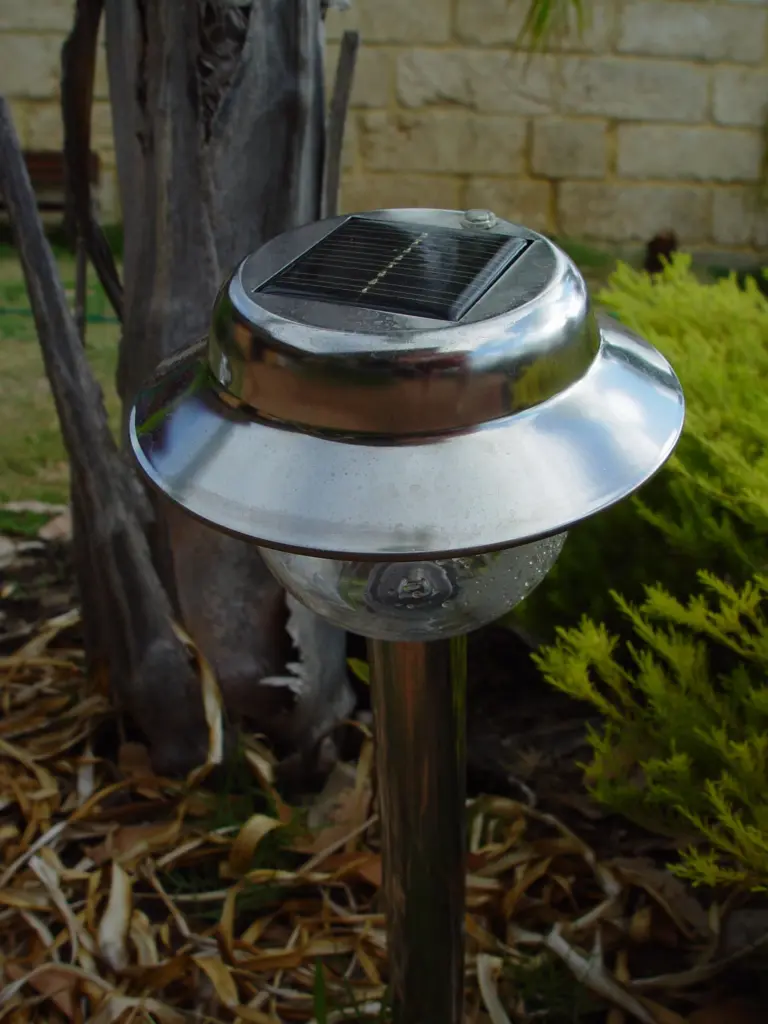
The heart of this stainless steel post light is a switch. In summer mode, it shines at full brightness after dark; in winter mode, it glows at 2.2 lumens and switches to 100 lumens for about 30 seconds when it detects motion. According to Esotec, the sensor covers 120 degrees and around six meters. The three AA batteries can be replaced, and the light color can be switched between 2,800 and 6,500 kelvin. A hundred lumens is no floodlight, but it is enough for the walk from the garden gate to the front door.
Esotec Tini 85
The 85-centimeter Tini, with its 6.4 Wh battery, offers more reserve. There are three modes to choose from: 75 lumens of continuous light, 75 lumens with 400 lumens on motion, or darkness with 600 lumens on motion. In winter, the third mode is the sensible one. At 4,000 kelvin, it is above the BfN recommendation, so it is less suited to a path by a wildlife garden.
Paulmann Eileen insect-friendly
This wall light emits 300 lumens in a golden light of 2,200 kelvin, and according to Paulmann the motion sensor covers 110 degrees and up to eight meters. The manufacturer gives the runtime as eight to ten hours, after six to eight hours of charging in good sun. A December day does not provide charging times like that. It cannot be dimmed.
Brilliant Luton (G40421/06)
The Luton is a flat wall floodlight that pivots by 90 degrees, with 1,000 lumens and an IP65 rating, meaning it is dust-tight and protected against water jets. Brilliant mentions three motion sensor settings but gives neither battery capacity nor runtime. At 4,100 kelvin, the light is neutral white. We see it at the driveway, angled downward and only with the motion sensor, not as garden lighting.
Esotec string lights with 200 amber LEDs
Twenty meters of string, two meters of lead cable, 200 LEDs at 1,800 kelvin: that is the warmest light color on our list. It is powered by a 2 Wp amorphous panel and a replaceable 1,600 mAh LiFePO4 battery, and Esotec gives up to ten hours of runtime on a full battery. The manufacturer does not state a luminous flux; this is ambient light, not path lighting. More on string lights with a power adapter can be found in our guide to outdoor string lights.
Paulmann Aurinka 200
Almost 22 meters long, 200 LEDs at 6 lumens each and 3,000 kelvin. Paulmann gives four hours of runtime and eight hours of charging time. Counting from nightfall, that means it goes out between 8 and 9 p.m. on a December evening, and only after a sunny day. It suits summer evenings on the patio, but not winter lighting.
How we would decide
- Garden path that needs light all year: Esotec Ancona 71 in winter mode, set to warm white.
- House entrance that should briefly turn really bright: Esotec Tini 85 in the mode with 600 lumens on motion only.
- Patio or garden shed near a hedge and pond: Paulmann Eileen in the 2,200 kelvin version.
- Driveway and garage: Brilliant Luton, aimed downward and never in continuous mode.
- Tree or hedge in winter: the amber string lights from Esotec; the Paulmann Aurinka only for the warmer months.
And to be completely honest: if a path needs to be lit until morning every winter night, solar is the wrong approach. A light with a mains connection and a timer will get you there faster.
If the light is not enough, a low-voltage system is the next step; see planning 24-volt garden lighting.
Frequently asked questions
Why do solar lights shine for such a short time in winter?
For December, the German Weather Service (DWD) gives an average of around 42 hours of sunshine for the entire month over the years 1991 to 2020. Even at full output, the Esotec Tini 85 would charge at most a good third of its battery on a December day. The low winter sun and gray days push the figure down further.
How many lumens does a solar light need for a garden path?
Fewer than many people think. The Ancona 71 jumps to 100 lumens when it detects motion, which is enough to make out steps and edges. Floodlights with 1,000 lumens such as the Brilliant Luton belong at the driveway or garage, not on a path through the flower beds. Figures per light point and per fixture cannot be compared directly.
Which light color is better for insects?
The guidelines of the German Federal Agency for Nature Conservation (BfN) recommend largely avoiding cool white light with a high blue component at night: no more than 3,000 kelvin, preferably no more than 2,400 kelvin. The insect-friendly Paulmann Eileen shines at 2,200 kelvin, the Esotec amber string lights at 1,800 kelvin. The biggest difference comes from light that only switches on with motion.
Can you replace the battery in a solar light?
With many models, yes. Depending on the model, Esotec expects noticeably reduced capacity after one to three years and sells replacement batteries; with the Ancona, the Tini and the amber string lights, replacement is intended. For the Eileen, Paulmann states that neither the light source nor the control gear can be replaced.
Where should a solar light be placed?
Away from shade, snow and other light sources, because these cost the most runtime. According to Esotec, a streetlight shining on the panel simulates daylight, and the light does not switch on. Esotec considers locations on the north side unsuitable. Align the motion sensor so that you cross its detection zone from the side.
Why does the motion sensor sometimes fail to react in winter?
Motion sensors respond to differences in heat. According to the Tini user manual, thick winter clothing can prevent a person from being detected against cold surroundings. Esotec therefore advises aligning the sensor so that you cross its detection zone from the side instead of walking straight toward it.
Sources
- esotec: Ancona 71 DuoColor solar post light (102534), product page
- esotec: Ancona user manual (PDF)
- esotec: Tini 85 solar bollard light (102597), product page
- esotec: Tini user manual (PDF)
- esotec: solar string lights with 200 amber LEDs (102569), product page
- esotec: solar string lights 200 user manual (PDF)
- esotec: Trio Sticks user manual (PDF)
- esotec: user manual for solar light 102066 with NiMH battery (PDF)
- Paulmann: Eileen insect-friendly solar LED outdoor wall light (94730)
- Paulmann: Aurinka 200 solar LED string lights (94875)
- Brilliant: Luton LED outdoor wall light with solar and motion sensor (G40421/06)
- German Weather Service (DWD): Germany’s weather in December 2025
- German Weather Service (DWD): The dark season (topic of the day)
- German Federal Agency for Nature Conservation (BfN): Guidelines for redesigning and retrofitting outdoor lighting systems (BfN-Skripten 543)
- German Federal Agency for Nature Conservation (BfN): Causes of threat and need for action in insect decline
Where to buy
- Esotec Ancona 71 DuoColorCheck price at Amazon.deAvailable in Germany: Amazon.de
- Esotec Tini 85Check price at Amazon.deAvailable in Germany: Amazon.de
- Paulmann Eileen insektenfreundlichCheck price at Amazon.deAvailable in Germany: Amazon.de
- Brilliant Luton G40421/06Check price at Amazon.deAvailable in Germany: Amazon.de
- Esotec Solar-Lichterkette 200 bernsteinCheck price at Amazon.deAvailable in Germany: Amazon.de
- Paulmann Aurinka 200Check price at Amazon.deAvailable in Germany: Amazon.de