Contents15 sections
This guide was first published in German on handgetestet.de.
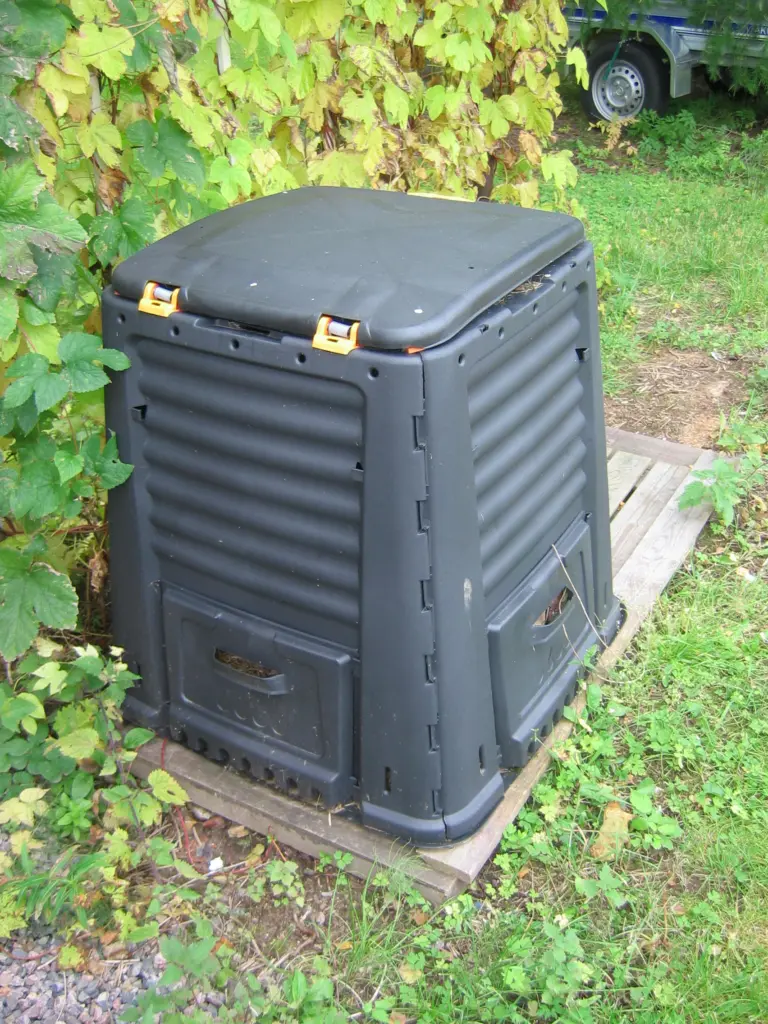
A lid on top, a hatch at the bottom for the finished soil, dark enough to disappear against the hedge, and please no bigger than a square meter. That is what the wish list looks like when someone buys a composter for the first time. The Garantia Thermo-King 400 comes closest: 74 × 74 centimeters of floor space, insulated walls, two access hatches, assembled without tools. If you would rather have it in black and without insulation, go for the Eco-King 400 from the same manufacturer.
One expectation you should drop right away, though. The lid alone does not keep odors at bay. Why that is and what helps instead is explained further down. You will find the basics on designs, filling and the rules between neighbors in our general composter guide; this one is only about this particular design for a small spot.
Why does a closed composter smell at all?
Because the decomposition goes wrong. Mature compost smells like damp forest soil, as the German Environment Agency (Umweltbundesamt, UBA) describes it in its compost guide. It only becomes unpleasant when air is lacking: with waterlogging or densely compacted layers, microorganisms that do without oxygen take over. The decomposition stalls, fermentation and putrefaction set in, and they smell of hydrogen sulfide and ammonia.
According to the UBA, it is precisely the closed design that encourages this kind of putrefaction. That is why the guide advises mixing in coarser material when filling, such as shredded shrub cuttings. Grass clippings go in only in thin, wilted layers. The contents should be moist, but no wetter than a wrung-out sponge. You still need the lid: it keeps out persistent rain, and that is exactly what the UBA recommends during days of rain. For the coarse, structural share, take a look at our guide to garden shredders (in German).
If meat, fish, bread, cheese and food leftovers stay out, as Graf lists in the instructions for the Thermo-King, there is also little in it for rats.
What comes out of the hatch at the bottom?
The oldest material. You top up from above, and whatever has been there longest settles at the bottom. Nothing falls out on its own; you take out the soil with a shovel or compost fork. The UBA gives these timeframes: fresh compost for mulching after about three to four months, mature compost after four to six months in the summer half of the year, otherwise after six to twelve. It should not be stored for longer than a year.
One more thing. A hatch is only useful if you can kneel in front of it. If the bin stands close to the hedge, the hatch side should face the path. Models with hatches on two sides are more forgiving here; with the Thermo-Star, according to Graf, you can even remove compost from every side.
Partial shade by the hedge: the right spot?
Yes, according to pretty much every set of instructions. The UBA recommends a shady, wind-sheltered location so the compost does not dry out, and explicitly suggests hedges as a windbreak. On its Eco-King page, Graf mentions a partially shaded spot, for example under trees or hedges. Juwel also calls for partial shade in its instructions. For the Thermo-King, Graf specifies a sunny to partially shaded spot, sheltered from the wind but not completely still.
It always goes on open soil, never on paving slabs, concrete or asphalt. Earthworms need to get in, and water needs to drain away. Graf recommends loosening the soil beforehand and keeping at least 0.5 meters from the neighboring property. According to the UBA, a wire mesh at the base helps against voles and rats. For the Garantia models, it is an accessory and has to be ordered separately; only the Thermo-Wood is also available as a bundle with the grid. For the Thermo-Star, the manufacturer does not list one in its catalog.
Is 60 × 60 centimeters enough?
For a small garden, yes. The Eco-Master fits 300 liters into 60 × 60 centimeters. For a household with a lawn, flower beds and kitchen scraps, we consider 400 liters the sensible minimum, and at Garantia that takes 70 to 74 centimeters square. That still leaves room to work, even by a narrow hedge. For reference: according to the UBA, a bed with heavy feeders can take about three liters of compost per square meter and crop.
The Thermo-King 900 already measures a full meter square. That does not break the brief, but it leaves hardly any room for the shovel in front of the hedge.
Thermo composter, wooden box or tumbler?
The wooden slatted composter is open. Here, the UBA advises two or three boxes side by side, with 1 to 3 centimeters of gap between the boards, so you can turn the compost from one to the next. That is inexpensive and works well with lots of leaves, but it takes up space and has neither a lid nor a hatch. A tumbler is rotated instead of turned and, in return, sits on a frame, meaning it has no contact with the ground. Yet the UBA names exactly that contact as the access route for earthworms and tiny soil organisms.
That leaves the closed plastic bin. Thermo composters also have insulated walls. Whether that makes them compost measurably faster, however, has not been proven according to the UBA. The insulation mainly keeps decomposition going in winter. Do not expect miracles.
Seven composters for the spot by the hedge
| Model | Footprint, height, capacity | Walls and hatches | Color | Who it suits |
|---|---|---|---|---|
| Garantia Thermo-King 400 | 74 × 74 cm, 84 cm high, 400 l | insulated (Thermolen), 2 filling hatches, 2 access hatches | green | Home garden with kitchen and garden waste |
| Garantia Eco-King 400 | 70 × 70 cm, 83 cm high, 400 l | uninsulated, 2 filling hatches, 2 access hatches | green or black | Those who want it black and cheaper |
| Garantia Eco-Master 300 | 60 × 60 cm, 90 cm high, 300 l | uninsulated, 1 large filling opening, access hatch with handle | black | Small garden, exactly 60 × 60 cm of space |
| Garantia Thermo-Wood 400 | 72 × 72 cm, 90 cm high, 400 l | insulated (Thermolen), 2 filling hatches, 2 access hatches | anthracite-brown wood finish | A spot in view near the patio |
| Juwel Aeroquick 290 | approx. 72 × 72 cm, approx. 80 cm high, 290 l | weather-resistant plastic, lid, removal at the bottom | depending on version, according to the retailer | Small household, low hedge |
| Thermo composter 450 l „Made in Austria“ | approx. 80 × 80 cm, approx. 105 cm high, 450 l | thick-walled plastic, lid, removal at the bottom side, snap-together system | green | Those who want quick assembly and side removal at the bottom, tested by us |
| Garantia Thermo-Star 400 | 80 × 80 cm, 102 cm high, 400 l | insulated (Thermolen), removal on every side | green | Those who want to remove compost from several sides |
Garantia Thermo-King 400
The little brother of the Thermo-King 600, which we recommend for larger gardens in the general guide. Graf foams the walls from recycled polypropylene, calls the material Thermolen and describes it as UV- and weather-resistant. According to the instructions, the side panels snap together without tools. The lid can be locked into a summer or winter position, which also secures it against wind. For this particular wish list, it has one flaw. Graf offers it in green, not black, and the base grid (74 × 74 cm) costs extra.
Garantia Eco-King 400
Same idea, but without insulation and, in return, also available in black. At 8 kilograms, it is considerably lighter, and the footprint shrinks to 70 × 70 centimeters. Two filling hatches, removal at the bottom, tool-free snap-together system, windproof lid. If you compost little in winter, you will hardly miss the insulation.
Garantia Eco-Master 300
The only one that truly fits into 60 × 60 centimeters. In return, at 90 centimeters it is comparatively tall and has only a one-piece opening on top. At the bottom there is a large access hatch with a handle. According to the manufacturer, it is UV-stable and can be assembled without tools. If you need more volume, it is also available with 450 liters on 70 × 70 centimeters.
Garantia Thermo-Wood 400
Technically a thermo composter made of the same Thermolen as the Thermo-King, with an anthracite-brown wood finish on the outside. According to Graf, the ventilation openings are concealed under the wood cladding on all four sides. By a hedge, the dark brown hardly stands out. Next to the patio, it looks calmer than smooth green.
Juwel Aeroquick 290
The Tyrolean manufacturer from Austria states around 72 × 72 centimeters and a height of 80 centimeters in the instructions. That makes it the lowest bin on this list, which helps behind a closely trimmed hedge. Juwel calls for level garden soil in partial shade and warns against hot ashes and embers. According to the instructions, it is cleaned with a garden hose. At 290 liters, it suits two people better than a family.
Thermo composter 450 l „Made in Austria“
A green thermo composter made of thick-walled plastic, which the seller describes as manufactured in Austria. With a footprint of around 80 × 80 centimeters and about 450 liters, it sits between the Thermo-King 400 and the large models and still fits well by a hedge. According to the seller, the plastic is weather- and UV-resistant, the parts snap together, and the finished soil can be removed from the side at the bottom. A base grid against rodents is not included, so you should order one at the same time. Buyers like it above all for its easy assembly. We could not trace the „environmental protection award“ in the listing title to any source, so we leave it out.
We assembled this composter ourselves and set it up in the garden by a thuja hedge. Assembling it alone without tools took 12 minutes; with two people it is even easier. The instructions are easy to follow, the delivery arrived undamaged, and once assembled it feels sturdy. According to the enclosed leaflet, it is made of recycled PE plastic and is still a little wobbly when empty; only once filled does it stand really firm. For assembly and first impressions, we gave it five out of five stars; the long-term test is ongoing. All photos and details are in our review of the 450 l thermo composter. It is available on Amazon.
Garantia Thermo-Star 400
Insulated like the Thermo-King, but built differently. The side panels hang on a hinge system, the lid contains a smaller lid for quick filling, and according to Graf you can remove compost from every side. At 80 × 80 centimeters and a good meter in height, it is the largest in this field. The manufacturer does not offer a base grid, which is a clear drawback wherever voles are around.
How we would decide by the hedge
- Family, lawn, kitchen scraps and around 75 centimeters of space: Thermo-King 400 with base grid.
- It has to be black, insulation is not a must: Eco-King 400.
- Only 60 × 60 centimeters free: Eco-Master 300.
- The bin is in view of the patio: Thermo-Wood 400, with the grid included.
- Small household, low hedge: Juwel Aeroquick 290.
We would only choose the Thermo-Star if there are no rodents in the garden. And for every model: mix in coarse material, do not drown it, close the lid during persistent rain. That way, the neighbors‘ noses are spared.
Torn between the two 400-liter models from Garantia? Read the head-to-head comparison at Thermo-King 400 or Eco-King 400 (in German).
Frequently asked questions
Why does a closed composter smell?
Because the decomposition goes wrong when air is lacking. With waterlogging or densely compacted layers, according to the German Environment Agency, fermentation and putrefaction set in, producing hydrogen sulfide and ammonia. The fix: mix in coarser material such as shredded shrub cuttings, add grass clippings only in thin, wilted layers, and keep the contents no wetter than a wrung-out sponge.
When can you take compost out of the access hatch?
According to the UBA, fresh compost for mulching after about three to four months, mature compost after four to six months in the summer half of the year, otherwise after six to twelve. The oldest material is at the bottom, and you take it out with a shovel or compost fork. Compost should not be stored for longer than a year.
Which thermo composter fits into 60 × 60 centimeters?
The Garantia Eco-Master 300 fits 300 liters into 60 × 60 centimeters. For a household with a lawn, flower beds and kitchen scraps, 400 liters is the sensible minimum, and at Garantia that takes 70 to 74 centimeters square.
Where should a composter stand?
In a partially shaded, wind-sheltered spot, for example by a hedge, and always on open soil, never on paving slabs or concrete. Graf recommends loosening the soil and keeping at least 0.5 meters from the neighboring property. A wire mesh at the base helps against voles and rats.
Does a thermo composter compost faster?
According to the UBA, it has not been proven that insulated walls compost measurably faster. The insulation mainly keeps decomposition going in winter.
What must not go into a thermo composter?
Meat, fish, bread, cheese and food leftovers, as Graf lists in the instructions for the Thermo-King. If they stay out, there is also little in it for rats.
Sources
- German Environment Agency (Umweltbundesamt): Kompostfibel, composting correctly
- Garantia: Thermo-King composter
- Garantia: Thermo-King assembly instructions (PDF)
- Garantia: ECO-King
- Garantia: ECO-Master
- Garantia: Thermo-Wood
- Garantia: Thermo-Star
- Garantia: Garden catalog with composter overview (PDF)
- Juwel: Instructions Aeroquick 290 / 420 (PDF)
Where to buy
- Garantia Thermo-King 400Check price at Amazon.deAvailable in Germany: Amazon.de
- Garantia Eco-King 400Check price at Amazon.deAvailable in Germany: Amazon.de
- Garantia Eco-Master 300Check price at Amazon.deAvailable in Germany: Amazon.de
- Garantia Thermo-Wood 400Check price at Amazon.deAvailable in Germany: Amazon.de
- Juwel Aeroquick 290Check price at Amazon.deAvailable in Germany: Amazon.de
- Garantia Thermo-Star 400Check price at Amazon.deAvailable in Germany: Amazon.de
- Thermokomposter 450 l „Made in Austria“Check price at Amazon.deAvailable in Germany: Amazon.de