Contents10 sections
This guide was first published in German on handgetestet.de.
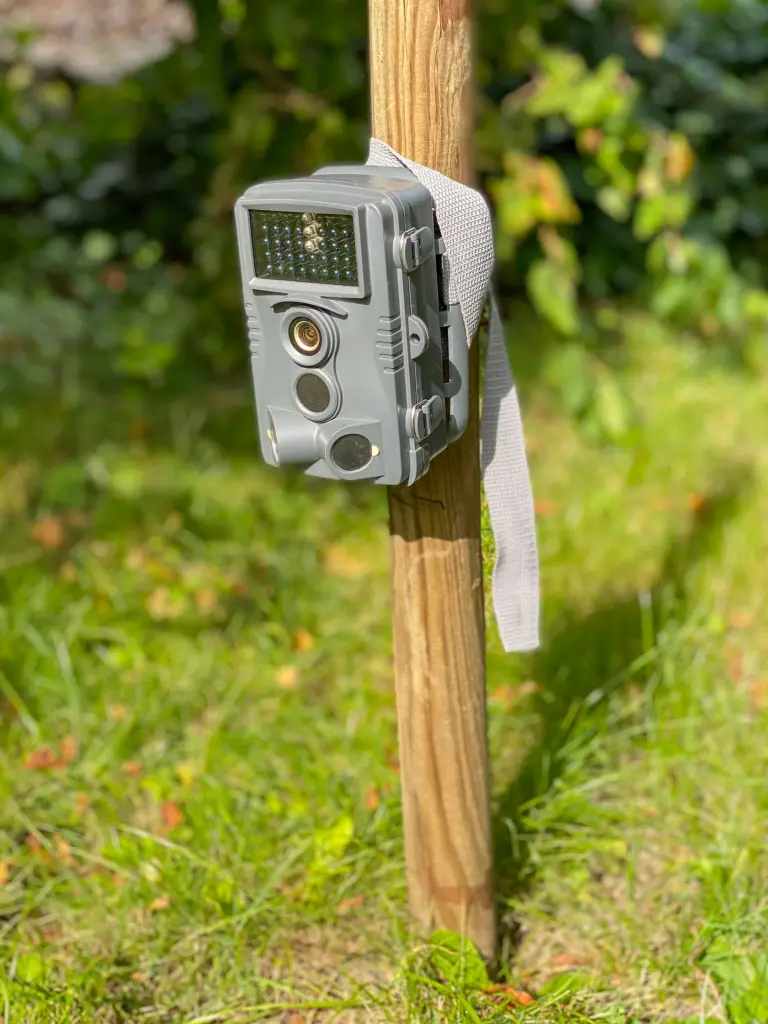
Which hedgehog, fox or marten roams through your garden at night? To answer exactly that question, you need neither cellular service nor a subscription. We consider the Bushnell Core DS-4K No Glow the most sensible solution here. If you want the pictures sent to your phone from a distance, the Spypoint Flex-Dark is worth a look.
Trail cameras rarely disappoint because of poor pictures. Usually they are hanging in the wrong place: too close to the path, pointed at the neighbor’s fence, or in a dead zone, even though the app was supposed to send photos.
Light, network, power
The megapixel count is almost always printed at the top of the box. It does not tell you much. What matters more is how the camera illuminates at night, how the pictures get to you and how long the power lasts.
First, the light. Low-glow LEDs give off a faint red glow when triggered and usually light up a greater distance. No-glow LEDs work in longer-wave infrared around 940 nanometers and are barely visible to the naked eye. That protects against prying eyes and theft but often costs some range.
Then the network. Cameras with a SIM card send every picture to your phone, but usually require a data plan from the manufacturer. Check the reception at the planned location first, because without a network the expensive camera remains an ordinary camera trap. Inexpensive models with an app usually transmit via Wi-Fi and Bluetooth over just a few meters. They save you from pulling out the memory card but are no substitute for a cellular camera.
And the power. Classic models need six to eight AA cells. Solar panels, built in or as an accessory, extend the run time considerably, as long as the camera is not hanging in deep shade.
That leaves the trigger speed. Values between 0.15 and 0.4 seconds are common. At a feeding spot it hardly matters; on a game trail it decides whether the deer is in the picture or only its rear end.
If your garden is mainly about birds, a well-placed nest box often captures more than any camera. And for animals at the edge of the forest in daylight, a good pair of binoculars remains the more discreet tool.
Where the camera may hang and where it may not
Legally, a trail camera counts as video surveillance, even if it is only aimed at animals. The Verbraucherzentrale (German consumer advice center) sums it up clearly for private individuals: cameras belong on your own property and, as a rule, may capture neither neighbors nor passersby on public paths. According to the Verbraucherzentrale, even if only part of the neighboring property is in the frame, the neighbors‘ interests regularly prevail. Violations can result in fines and claims for injunctive relief or damages. The Verbraucherzentrale recommends a sign even if only your own garden is being filmed. So aim the camera so that the fence, sidewalk and neighbors‘ windows stay out of the frame. How to aim permanently mounted cameras is described in our guide to the outdoor security camera.
In the forest and in open countryside, it gets stricter. The Unabhängiges Landeszentrum für Datenschutz Schleswig-Holstein (ULD, the data protection authority of the German state of Schleswig-Holstein) considers the use of trail cameras in areas regularly accessible to walkers to be fundamentally inadmissible. According to the ULD, the General Data Protection Regulation (GDPR) applies even if only wildlife is to be photographed; the Higher Administrative Court in Saarlouis (Germany) confirmed this in 2017. The authority sees exceptions at most for those entitled to hunt: the camera captures only a small, enclosed area such as a bait site, people cannot be identified, and signs in accordance with Article 13 GDPR are posted at the access points. In the ULD’s view, sending pictures to a phone even intensifies the intrusion. This guidance applies to Schleswig-Holstein; if you want to take pictures in the forest elsewhere, it is best to check with your own state data protection authority beforehand.
Five models side by side
| Model | Night illumination | Transmission and power | Photo and video | Best for |
|---|---|---|---|---|
| Bushnell Core DS-4K No Glow | No-glow, up to about 36 m | Memory card; 6 AA, solar as an accessory | 32 MP, 4K | Garden and hunting ground without a subscription |
| Spypoint Flex-Dark | No-glow and low-glow, about 30 m | Cellular with app; solar with built-in battery | 40 MP, 1080p with sound | Remote monitoring of distant spots |
| Spypoint Flex-M | Infrared, detection about 27 m | Cellular with app, Spypoint SIM only | 28 MP, 720p with sound | Getting started with cellular cameras |
| Browning Dark Ops Pro X 1080 | Invisible, about 27 m | Memory card, AA batteries | 24 MP, 1080p with sound | Game trails with a fast trigger |
| Victure HC200 | 940 nm LEDs, short range | Memory card, 8 AA | 16 MP, 1080p | First attempts in the garden |
Bushnell Core DS-4K No Glow: two sensors, no subscription
Bushnell relies on two image sensors here, one for day and one for night. According to the manufacturer, the invisible infrared reaches around 36 meters, the camera triggers in 0.15 seconds and lasts up to twelve months on six AA cells. A solar panel can be added later. Some buyers, however, report a faintly visible red shimmer; if you need absolute invisibility, keep that in mind.
Spypoint Flex-Dark: pictures to your phone, power from the sun
The Flex-Dark is the camera for spots you do not visit every week. According to Spypoint, it uses dual SIM to select the strongest available network, charges its built-in battery via a solar panel and can switch between no-glow and low-glow LEDs. The free plan covers 100 photos a month at reduced resolution; if you want more, you pay monthly. For a home garden, that is usually more technology than you need.
Spypoint Flex-M: the cheaper route to the app
The Flex-M transmits via LTE and comes with a preinstalled SIM. According to the listing, it only works with the Spypoint card. It records video in just 720p. Spypoint now offers the Flex-M2 with 32 megapixels and 1080p video; the older Flex-M, however, is still offered new on Amazon.
Browning Dark Ops Pro X 1080: invisible and quick
For this model, Browning specifies a trigger speed of 0.22 seconds, invisible infrared illumination with a range of just over 27 meters and a detection range of around 30 meters. There is no cellular connection; the pictures go to the memory card. That is exactly why it suits places where someone checks in regularly anyway.
Victure HC200: for getting started in the garden
Victure sells its trail cameras well below the price of the brand-name models. According to the manufacturer, the HC200 takes 16-megapixel photos and 1080p video, is protected against dust and water jets to IP66 and runs on eight AA cells. Its night vision has only a short range; buyers complain that animals at greater distances are barely recognizable in the dark. For the feeding spot in front of the patio that can be enough, for the edge of the forest probably not.
Which camera for which spot?
- Your own garden, animals at night: Bushnell Core DS-4K No Glow. No running costs, good range, long battery life.
- Remote property or hunting ground, see pictures right away: Spypoint Flex-Dark, provided there is cellular coverage.
- Try out the app without spending much: Spypoint Flex-M, with compromises on video and SIM freedom.
- Game trails with fast animals: Browning Dark Ops Pro X 1080.
- Just curious who visits the bird feeder at night: the Victure HC200 is enough if the animals come close to the camera.
Whichever you choose: check the frame first, then arm the camera. A test shot in daylight quickly shows whether the neighbor’s fence is in the picture.
If the camera is meant to guard a cabin or property rather than watch animals, a security camera with a SIM card with live view and a solar panel is a better fit.
If a barn or farmyard has power but no internet, a closed system from our guide to the wireless security camera with monitor is the right choice.
Frequently asked questions
What is the difference between low-glow and no-glow?
Low-glow LEDs give off a faint red glow when triggered and usually light up a greater distance. No-glow LEDs work in longer-wave infrared around 940 nanometers and are barely visible to the naked eye. That protects against prying eyes and theft but often costs some range.
Is a trail camera with a SIM card worth it?
For remote spots you do not visit every week, yes. Cameras with a SIM send every picture to your phone, but usually require a data plan from the manufacturer. Check the reception at the planned location first, because without a network the camera remains an ordinary camera trap. For a home garden, that is usually more technology than you need.
Am I allowed to put up a trail camera in my garden?
On your own property, generally yes, but neighbors and passersby on public paths must not be captured. According to the Verbraucherzentrale (German consumer advice center), as soon as even part of the neighboring property is in the frame, the neighbors' interests regularly prevail. It also recommends a sign. A test shot in daylight shows whether the neighbor's fence is in the frame.
Am I allowed to set up a trail camera in the forest?
That is where it gets stricter. The ULD Schleswig-Holstein (a German state data protection authority) considers trail cameras in areas regularly accessible to walkers to be fundamentally inadmissible, even if only wildlife is to be photographed. The authority sees exceptions at most for those entitled to hunt. Outside Schleswig-Holstein, check with your own state data protection authority beforehand.
How important is the trigger speed?
Values between 0.15 and 0.4 seconds are common. At a feeding spot it hardly matters; on a game trail it decides whether the animal is in the picture. Browning specifies 0.22 seconds for the Dark Ops Pro X 1080, Bushnell 0.15 seconds for the Core DS-4K No Glow.
Is an inexpensive trail camera good enough for the garden?
For the feeding spot in front of the patio, the Victure HC200 can be enough if the animals come close to the camera. Its night vision has only a short range; buyers complain that animals at greater distances are barely recognizable in the dark. For the edge of the forest, probably not.
Sources
- Bushnell: Core DS-4K No Glow Trail Camera
- Spypoint: Flex-Dark
- Spypoint: Flex-M2 (successor to the Flex-M)
- Browning Trail Cameras: Dark Ops Pro X 1080
- Victure: HC200 Trail Camera
- Verbraucherzentrale (German consumer advice center): Only film your own property with security cameras
- ULD Schleswig-Holstein: Guidance on the legal situation for the use of trail cameras (as of May 2021, PDF, in German)
Where to buy
- Bushnell Core DS-4K No GlowCheck price at Amazon.deCheck price at Amazon.co.ukCheck price at Amazon.nlCheck price at Amazon.com.beCheck price at Amazon.frCheck price at Amazon.itCheck price at Amazon.esCheck price at Amazon.plCheck price at Amazon.seAvailable in Germany: Amazon.de
- Spypoint Flex-DarkCheck price at Amazon.deCheck price at Amazon.co.ukCheck price at Amazon.nlCheck price at Amazon.com.beCheck price at Amazon.frCheck price at Amazon.itCheck price at Amazon.esCheck price at Amazon.plCheck price at Amazon.seAvailable in Germany: Amazon.de
- Spypoint Flex-MCheck price at Amazon.deCheck price at Amazon.co.ukCheck price at Amazon.nlCheck price at Amazon.com.beCheck price at Amazon.frCheck price at Amazon.itCheck price at Amazon.esCheck price at Amazon.plCheck price at Amazon.seAvailable in Germany: Amazon.de
- Browning Dark Ops Pro X 1080Check price at Amazon.deCheck price at Amazon.co.ukCheck price at Amazon.nlCheck price at Amazon.com.beCheck price at Amazon.frCheck price at Amazon.itCheck price at Amazon.esCheck price at Amazon.plCheck price at Amazon.seAvailable in Germany: Amazon.de
- Victure HC200Check price at Amazon.deCheck price at Amazon.co.ukCheck price at Amazon.nlCheck price at Amazon.com.beCheck price at Amazon.frCheck price at Amazon.itCheck price at Amazon.esCheck price at Amazon.plCheck price at Amazon.seAvailable in Germany: Amazon.de