Contents14 sections
This guide was first published in German on handgetestet.de.
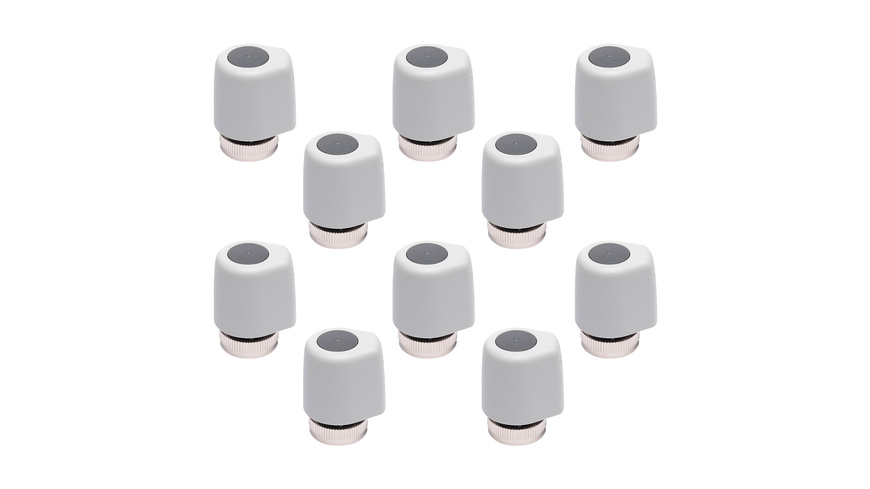
One room stays cold while all the others are warm. Often the culprit is an actuator on the heating manifold that has given up. The swap itself takes minutes; choosing the right part takes longer. For the most common case, a 230-volt wiring center with normally closed actuators on M30 valves, we consider the EZ 10-piece value set Drive Series 1.1 the sensible choice, because a whole manifold is usually the same age anyway. If you’re only replacing one circuit, take the single actuator from the same series.
Before you order, go through three questions in turn. If you’d like to make your underfloor heating smart as a whole, you’ll find an overview in the guide Smart control for underfloor heating (in German). Here, it’s all about the small component on the valve.
First question: what does the old actuator say?
Two specifications decide everything. The voltage, usually 230 V or 24 V. And the operating mode: NC means normally closed, NO means normally open. An NC actuator only opens the valve while current is flowing. An NO actuator does the reverse. Mixing them doesn’t work, because then the room heats exactly when the thermostat wants it to stay off.
The voltage comes from the wiring center in the manifold cabinet, not from the actuator. A 24-volt actuator connected to 230 volts will be destroyed; a 230-volt actuator on 24 volts won’t move. If nothing on the old housing is legible anymore, the rating plate on the wiring center helps. Some wall thermostats can be set to either operating mode, the Homematic IP wall thermostat with switching output, for example, via the menu item “nc” or “no”.
Second question: does the valve fit?
Common manifold valves have an M30 x 1.5 thread. That is what the EZ actuators are designed for, as is the motorized Homematic actuator; ELV (German retailer) lists Heimeier, MNG, Junkers, Honeywell-Braukmann, Oventrop, Comap and Schlösser. Everything else needs a valve adapter. Möhlenhoff’s adapter list shows how fragmented the market is: VA 59 for Danfoss RAV/L, VA 16 for Buderus, VA 39 for Oventrop valves from before 1997.
Many people overlook one detail. Some valves need more stroke. For quite a few types, the Möhlenhoff list notes “actuator with at least 5 mm stroke required”, for some even 6.5 mm. According to its data sheet, the EZ Drive 1.1 manages 5 mm, the Alpha 5 from Theben 4 mm. Choose the shorter actuator for such a valve and you’ll end up with a circuit that never opens fully.
How fine the tolerances are is shown in an eQ-3 information sheet: if you press the valve pin down to the closing point, a gap of 0.5 to 1 mm should remain to the adapter. Without a gap, the valve doesn’t close completely; with significantly more, the motor blocks. The same logic applies to radiators; see our guide to valve adapters (in German).
Third question: stay thermal or switch to motorized?
Thermal actuators work with an expansion element. They are quiet, slow and only know open or closed. The EZ Drive needs around 240 seconds for 4 mm of travel and about 1 watt when open. Theben states a running time of about three minutes for the Alpha 5.
Motorized actuators such as the HmIP-VDMOT adjust the valve continuously and, according to ELV, only draw power while they are moving. The catch: they run on 3.3 volts and only connect to a Homematic controller with motor outputs. They won’t work with your old wiring center. Switching therefore means replacing the wiring center and the actuators together. That makes sense if individual rooms never get properly warm even with the valves fully open, because according to the manufacturer the controller takes over hydronic balancing. For a single faulty actuator, it’s overkill.
What about First-Open?
Theben briefly describes the function as an aid for installing and commissioning the heating system: a new NC actuator keeps the valve open until it has been powered for the first time. That is relevant in new builds, when the screed is already being heated before the electrical work is finished. When replacing an actuator in a running system, it hardly matters. The EZ documentation doesn’t mention the function.
The room stays cold: what else could be the cause
Before an actuator is replaced, troubleshooting comes first. If all rooms are cold, it’s rarely an actuator; more likely the boiler, the pump or the fuse of the wiring center. If only one room stays cold, try patience first: a thermal actuator needs a few minutes until the valve is open. Then check the seating on the adapter, the stroke and the operating mode. Only then the actuator.
If a room only gets lukewarm even though the actuator opens, hydronic balancing is often missing. A new actuator won’t fix that.
When a professional has to step in
Pulling the actuator off the valve and fitting a new one is mechanical work. The connecting cable, however, ends in the wiring center, and in 230-volt systems that carries mains voltage. 24-volt wiring centers are also connected to the mains via a power supply. eQ-3 states clearly in its instructions that work on the 230-volt mains may only be carried out by a qualified electrician in accordance with the German standard VDE 0100. Under Section 13 of the German Low Voltage Connection Ordinance (Niederspannungsanschlussverordnung), the same applies to changes to the installation. If a valve drips or is stuck, call a heating engineer. If you only want to replace the wall thermostat, our guide to the smart room thermostat will help.
Six actuators and components compared
| Model | Type and voltage | Stroke, valve (according to manufacturer) | Best for |
|---|---|---|---|
| EZ 10-piece value set actuator Drive Series 1.1, NC, 230 V | thermal, NC, 230 V | 5 mm, M30 x 1.5 | a whole manifold on a 230 V wiring center |
| EZ 20-piece value set actuator Drive Series 1.1, NC, 24 V | thermal, NC, 24 V | 5 mm, M30 x 1.5 | large systems with a 24 V wiring center |
| EZ actuator Drive Series 1.1, NC, 230 V | thermal, NC, 230 V | 5 mm, M30 x 1.5 | replacing one faulty circuit |
| Möhlenhoff Alpha 5 230 V NC | thermal, NC, 230 V, First-Open | 4 mm (Theben data sheet), adapter sold separately | valves that need a VA adapter |
| Homematic IP motorized actuator HmIP-VDMOT, set of 8 | motorized, 3.3 V | M30 x 1.5 with VA 80 adapter | switching to wireless control |
| Homematic IP motorized underfloor heating controller HmIP-FALMOT-C8 | controller, 230 V power cable | up to 8 motorized actuators | required for the VDMOT |
EZ Drive Series 1.1 in a set of ten
Ten normally closed 230-volt actuators, each with a 0.8 m cable. EAZY Systems specifies 100 N actuating force, IP 54 in any mounting position and 300 mA inrush current. ELV mentions operation with 230 V Homematic controllers and with conventional wall thermostats. Drawbacks: no NO model, no First-Open specification, and the documentation doesn’t make clear which adaptations fit other threads.
EZ Drive Series 1.1 with 24 V
The same actuator for extra-low voltage, in a set of twenty. According to the data sheet, it draws 470 mA when switching on and 85 mA in operation. That matters when sizing the power supply.
EZ Drive Series 1.1 single unit
The cheapest route if exactly one circuit has failed and the remaining actuators are young. Technically identical to the set.
Möhlenhoff Alpha 5
An expansion-element actuator, according to Theben with function and fit monitoring and protection against actuator damage caused by leaking valves. It is mounted on a valve adapter that is not included; on Amazon there are offers that come with a matching VA adapter. Möhlenhoff also makes its Antrieb 5 actuator as an NO version. Check the stroke if your valve requires 5 mm.
Homematic IP HmIP-VDMOT and FALMOT-C8
Only makes sense as a pair. The FALMOT-C8 controller drives up to eight motorized actuators and is powered via a mains cable; wall thermostats report the room temperature to it wirelessly. Every VDMOT comes with the VA 80 adapter. This is a system change, not a spare part.
How we would decide
- One actuator faulty, the rest fine: a single EZ Drive with the matching voltage.
- All actuators from the original installation, 230 V wiring center, M30 valves: EZ set of ten.
- Valves with a special thread or more stroke: Alpha 5 with the adapter from the Möhlenhoff list.
- NO system: don’t look at EZ; get the NO version from the manufacturer.
- Rooms unevenly warm, app control wanted: VDMOT with FALMOT-C8, installed by a professional.
Frequently asked questions
What do NC and NO mean on an actuator?
NC means normally closed: the valve only opens while current is flowing. NO works the other way around and is normally open. Mixing them doesn't work; otherwise the room heats exactly when the thermostat wants it to stay off.
Can I connect a 24-volt actuator to 230 volts?
No. A 24-volt actuator connected to 230 volts will be destroyed, and a 230-volt actuator on 24 volts won't move. The voltage comes from the wiring center in the manifold cabinet. If the old housing is illegible, its rating plate helps.
Which actuator fits my valve?
Common manifold valves have an M30 x 1.5 thread, and the EZ actuators fit them directly. Other valves need an adapter, for example from the Möhlenhoff list. Also check the stroke: some valves require 5 mm or more, while the Alpha 5 manages 4 mm.
Why does one room stay cold despite underfloor heating?
If all rooms are cold, the cause is more likely the boiler, the pump or the fuse of the wiring center. If only one room stays cold, give the thermal actuator a few minutes and then check its seating, stroke and operating mode. Only after that should you replace the actuator.
Is switching to motorized actuators worth it?
The HmIP-VDMOT runs on 3.3 volts and only works with the FALMOT-C8 controller, so the old wiring center goes. That makes sense if rooms heat unevenly even though the valves are open. For a single faulty actuator, it's overkill.
Am I allowed to replace the actuator myself?
Pulling the actuator off and fitting a new one is purely mechanical work. The cable, however, ends in the wiring center, which carries mains voltage in 230-volt systems. According to eQ-3 and Section 13 of the German Low Voltage Connection Ordinance (NAV), work on the mains belongs in the hands of a qualified electrician.
Sources
- ELV: EZ 10-piece value set Drive 1.1, 230 V
- ELV: EZ 20-piece value set Drive 1.1, 24 V
- EAZY Systems: data sheet actuator Series 1.1
- eQ-3: data sheet HmIP-VDMOT
- eQ-3: note on the valve adapter ring
- eQ-3: data sheet HmIP-FALMOT-C8
- eQ-3: manual HmIP-BWTH
- Theben: data sheet Alpha 5 230 V
- Möhlenhoff: Antrieb 5
- Möhlenhoff: valve adapter list
- German Low Voltage Connection Ordinance (NAV), Section 13
Where to buy
- EZ 10er-Spar-Set Stellantrieb Drive Serie 1.1, NC, 230 VView at ELVAvailable in Germany: ELV
- EZ 20er-Spar-Set Stellantrieb Drive Serie 1.1, NC, 24 VView at ELVAvailable in Germany: ELV
- EZ Stellantrieb Drive Serie 1.1, NC, 230 VView at ELVAvailable in Germany: ELV
- Möhlenhoff Alpha 5 230 V NCCheck price at Amazon.deAvailable in Germany: Amazon.de
- Homematic IP Stellantrieb motorisch HmIP-VDMOT, 8er-SetView at ELVAvailable in Germany: ELV
- Homematic IP Fußbodenheizungscontroller motorisch HmIP-FALMOT-C8View at ELVAvailable in Germany: ELVCheck price at Amazon.deAvailable in Germany: Amazon.de
- Homematic IP Stellantrieb motorisch HmIP-VDMOTCheck price at Amazon.deAvailable in Germany: Amazon.de