Contents12 sections
This guide was first published in German on handgetestet.de.
A slow pan across the lake, the camera sits on a solid tripod, and yet the image judders at the start and stops at the end with a small twitch. The legs are almost never to blame. Smooth video footage depends on the head.
For travel with a lightweight mirrorless camera, the Manfrotto Befree Live or the Ulanzi JJ06 GlideGo will do; according to the manufacturers, both weigh less than 1.8 kg. Smooth pans with heavy gear, on the other hand, call for a 75 mm half bowl and real counterbalance, as on the Sachtler Ace M or the Leofoto LVC-193C with BV-15. In between are the SmallRig AD-01 and the Benro KH26PC. Both are affordable and tall. They belong in the studio or at an interview rather than in a backpack.
Two payload figures, only one counts
Many manufacturers state separate figures for legs and head, and the legs often carry much more. What counts is the lower figure. That is almost always the head. Add up camera, lens, monitor, microphone and cage and leave some reserve, because a rig gets heavy faster than you think.
What actually happens inside the head
Back to the lake. A fluid head slows movements through damping, so that a pan starts and ends smoothly instead of jerking into motion. Simple heads have fixed damping; better ones can be adjusted in steps: little resistance for fast tracking shots, a lot for slow landscape pans.
The counterbalance is a spring. It holds the camera in position when tilting. Without it, a heavy camera tips forward as soon as you let go, and if its range doesn’t match your gear, the spring is of little use.
That leaves the half bowl (60, 75 or 100 mm). With it, the head is level in seconds, and for clean pans that is almost a must, because otherwise the horizon drifts during the movement. Travel tripods partly solve this with a leveling center column.
Height, packed size, plate
Height is measured to the camera plate, not to the center column. An extended center column makes the image shakier. For standing interviews, a good 160 cm makes sense. On the ground, the minimum height is what counts.
Carbon saves weight, aluminum saves money. If the tripod needs to go in your carry-on or strap to a backpack, the packed size matters more than any other spec. And then there’s the quick-release plate: Manfrotto 501, Arca-Swiss or a proprietary system? If you already own a gimbal or a second plate, the matching system spares you constant swapping.
Don’t have a suitable camera yet? Our guide to buying a mirrorless camera helps you choose. If you prefer to film on the move, the gimbal guide for smartphones and mirrorless cameras (in German) is the alternative to a tripod.
Six video tripods from travel to studio
| Model | Head payload | Height | Weight | Best for |
|---|---|---|---|---|
| Manfrotto Befree Live (Alu, Hebel) | 4 kg | 40–151 cm | approx. 1.75 kg | Travelers with a lightweight camera |
| Ulanzi JJ06 GlideGo | 5 kg | 44–187 cm | approx. 1.76 kg | Travelers who want plenty of height |
| Leofoto LVC-193C + BV-15 | 10 kg | 35.5–163 cm | approx. 3.95 kg | Enthusiasts with a larger rig |
| Sachtler System Ace M MS Mk II | up to 4 kg | 78–169 cm | approx. 4.4 kg | Entry into professional gear, finest pans |
| SmallRig AD-01 | 6 kg | 85–186 cm | approx. 4 kg | Budget-conscious buyers, interviews |
| Benro KH26PC | 6.8 kg | 87.5–184.5 cm | approx. 4 kg | Beginners for the studio |
All figures according to the manufacturers. On some models, the height applies with the center column extended.
Manfrotto Befree Live (aluminum, lever locks)
Around 1.75 kg, about 40 cm folded, up to 4 kg payload: that is how Manfrotto describes its compact travel video tripod. The head dampens panning and tilting and uses the widespread 501PL plate. Without the center column, it reaches 130 cm; with it, 151 cm. For tall people filming standing up, that is tight. For travel, it is an honest compromise.
Ulanzi JJ06 GlideGo
Carbon legs with an integrated head, 1.76 kg, 51.5 cm packed size and up to 187 cm height according to Ulanzi. You will hardly get more height in this weight class. According to the manufacturer, the head carries 5 kg, the legs considerably more. However, the damping is fixed, which suits calm shots and slow pans and is less suited to fast tracking shots. Plates in the Uka and F38 systems mount directly.
Leofoto LVC-193C with BV-15
Twin-tube carbon legs and the BV-15 fluid head make up a classic video tripod. Leofoto states a payload of 10 kg, a 75 mm leveling base and a spreader that can sit mid-level or at ground level. Panning and tilting are damped, and the counterbalance covers 0 to 3 kg. Just under 4 kg and 85 cm packed size? That belongs in the car trunk rather than on a plane.
Sachtler System Ace M MS Mk II
When it comes to fluid heads, Sachtler is considered the benchmark, and the Ace M system is the entry point into that world. According to the manufacturer, it carries 0 to 4 kg and offers five counterbalance steps and three damping levels plus zero. It comes with a 75 mm half bowl, two-stage aluminum legs with a mid-level spreader and a height of 78 to 169 cm. At 4.4 kg, it is not light. The money is well spent if you need fine, repeatable pans; if the camera mostly stays fixed, it is wasted.
SmallRig AD-01
A twin-tube aluminum tripod with a working height of 85 to 186 cm. SmallRig specifies 8 kg for the tripod and 6 kg for the head. The quick-release plate is handy: according to the manufacturer, it also fits the plates of the DJI RS 2, RS 3 and RS 3 Pro gimbals. That saves setup time when switching between tripod and gimbal. Its minimum height is too high for ground-level shots.
Benro KH26PC
It succeeds the popular KH26P. Benro states a payload of 6.8 kg, a height of up to 184.5 cm and a 60 mm half bowl for leveling; the plate is compatible with the Manfrotto 501 system. A weight of around 4 kg and a packed size of 91 cm argue against travel. In the studio, at the club house or for an interview, it is a solid, affordable tripod.
Which tripod for which shooting situation?
Air travel or hiking with a lightweight camera: if packed size is what counts, take the Manfrotto Befree Live; if you need more height, the Ulanzi JJ06 GlideGo. Smooth pans with camera and accessories up to about 3 kg succeed with the Leofoto LVC-193C with BV-15, because counterbalance and leveling base are right.
If you work professionally with a lightweight camera and want to fine-tune damping and counterbalance, you will end up with the Sachtler System Ace M MS Mk II. For interviews and studio work at a lower price, there are the SmallRig AD-01 and the Benro KH26PC. With a DJI gimbal, the AD-01 comes out ahead.
If you rarely pan and mostly film static shots, a lightweight travel tripod will do. If, on the other hand, there is regularly movement in the shot, don’t skimp on the head. It matters more than the legs.
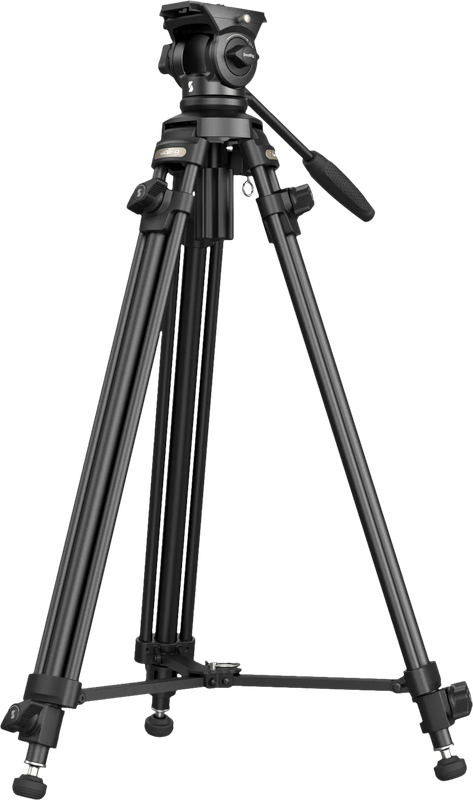
According to SmallRig, the AD-50 is a carbon tripod with a detachable fluid head for up to 6 kg, a working height of 73 to 163 cm, a mid-level spreader and a weight of 2.8 kg.
Frequently asked questions
What payload does a video tripod need?
Many manufacturers state separate figures for legs and head; what counts is the lower one, almost always that of the head. Add up camera, lens, monitor, microphone and cage and plan in some reserve, because a rig gets heavy faster than you think.
What does a fluid head do?
It slows movements through damping, so that a pan starts and ends smoothly instead of jerking into motion. Simple heads have fixed damping; better ones can be adjusted in steps: little resistance for fast tracking shots, a lot for slow landscape pans.
Why does a video head need counterbalance?
The counterbalance is a spring that holds the camera in position when tilting. Without it, a heavy camera tips forward as soon as you let go. If its range doesn't match your gear, the spring is of little use. On the Leofoto BV-15, it covers 0 to 3 kg according to the manufacturer.
What is a half bowl on a tripod good for?
With a half bowl of 60, 75 or 100 mm, the head is level in seconds. For clean pans, that is almost a must, because otherwise the horizon drifts during the movement. Travel tripods partly solve this with a leveling center column.
How tall should a video tripod be?
Height is measured to the camera plate. For standing interviews, a good 160 cm makes sense; an extended center column makes the image shakier. The Manfrotto Befree Live reaches 130 cm without the center column, the Ulanzi JJ06 GlideGo up to 187 cm according to the manufacturer. For ground-level shots, the minimum height is what counts.
Which tripod works with a DJI gimbal?
According to the manufacturer, the quick-release plate of the SmallRig AD-01 also fits the plates of the DJI RS 2, RS 3 and RS 3 Pro gimbals. That saves setup time when switching between tripod and gimbal. Its minimum height is too high for ground-level shots, though.
Sources
- Manfrotto: Befree Live Aluminium, lever locks
- Manfrotto: Befree Live fluid video head
- Ulanzi: JJ06 GlideGo
- Leofoto: LVC-193C + BV-15
- Leofoto: BV-15 fluid head
- Sachtler: System Ace M MS Mk II
- SmallRig: AD-01 Fluid Head Tripod
- Benro: KH26PC
- SmallRig AD-50 Video Tripod Set: product specs
Where to buy
- Manfrotto Befree LiveCheck price at Amazon.deAvailable in Germany: Amazon.de
- Ulanzi JJ06 GlideGoCheck price at Amazon.deAvailable in Germany: Amazon.de
- Leofoto LVC-193C + BV-15Check price at Amazon.deAvailable in Germany: Amazon.de
- Sachtler System Ace M MS Mk IICheck price at Amazon.deAvailable in Germany: Amazon.de
- SmallRig AD-01Check price at Amazon.deAvailable in Germany: Amazon.de
- Benro KH26PCCheck price at Amazon.deAvailable in Germany: Amazon.de
- SmallRig AD-50 Video Tripod SetView at CoolblueAvailable in Germany: Coolblue