Contents15 sections
This guide was first published in German on handgetestet.de.
The tether catches the unit. It does not prevent damage in every case. If you use a window cleaning robot on the outside, you therefore secure the area below the pane first and the technology second. Among the units compared here, we consider the Ecovacs WINBOT W2S OMNI the most sensible choice for exterior panes, because power and safety tether run in one cable and a power outage in the house does not affect it. If the floor there has tiles or boards with joints, the Kärcher RCW 4 is a better fit. And if the pane is above a sidewalk you cannot cordon off? Then the robot stays off there.
The choice between a robot and a handheld unit is covered in our guide to window cleaning robots (in German).
Where does the tether go, and how much can it hold?
Always to something solid indoors, even when cleaning outside. Ecovacs lists furniture legs, curtain rods and stair railings and, for the mains-powered models, recommends a sturdy metal railing. Kärcher names similar points and allows, if necessary, clamping the tether in the closed window. Despite the list, we would not use a chair. It slides.
The tensile load sounds reassuring: 100 kg for the W2S OMNI, 1,900 N for the WINBOT mini 2, 200 kg for the Hobot 2S, all according to the manufacturer. Kärcher does not give a figure in its documentation. Such numbers describe the tether, not the curtain rod it hangs from. Check the tether, carabiner and anchor point before every use. Kärcher also requires keeping the tether out of the robot’s path, because if the robot runs over it, it can come loose from the pane. Enough length for the whole window must remain. We would not give it more than that, because every loop lengthens the fall.
The Omni models work differently. On them, the tether is part of the power cable and ends in a station that, on the W2S OMNI, weighs 5.2 kg, according to the data sheet attaches itself to the floor with at least 800 N of suction and additionally carries a 1 m tether with a carabiner. Ecovacs rules out carpet and floors with joints.
What happens during a power outage?
No power, no suction. That is why every unit contains a backup battery that only keeps the fan running. Kärcher states at least 40 minutes on a full charge for the RCW 2 and RCW 4, Ecovacs 30 minutes, Hobot 20 minutes with a warning tone. That is time to take it down, not to keep cleaning.
That figure applies to a fully charged backup battery, and according to the manual, charging takes around three hours on the W2S PRO. On top of that come two inconspicuous sources of error. On the RCW 4, the plug connection must be screwed together, otherwise the power supply can be cut off mid-run. On the mini 2 and W2S PRO, the power adapter should lie on the floor and not hang freely from the cable, because otherwise the robot can fall.
Omni units run on the station’s battery, around 110 minutes according to the data sheet. If a circuit breaker trips at home, they don’t notice. One drawback of the Winbots remains: only the manufacturer or its customer service can replace the safety battery, while Kärcher leaves the replacement to the owner. No manufacturer states how much holding time is left after a few years.
How much wind is too much?
Ecovacs contradicts itself here. The same manual permits exterior windows only when it is not windy, and a few lines later only prohibits use in storm gusts at force 10 on the Beaufort scale. The product page for the W2S PRO OMNI even promises safety in unexpected gusts of wind. We stick to the strictest statement: no wind, no rain, no snow. Kärcher requires removing the robot in strong wind or precipitation.
In spring, temperature also matters. The W2S OMNI, W3 OMNI and mini 2 are approved from 0 °C, the W2S PRO series only from 4 °C. Switch off automatic roller shutters beforehand; Kärcher names them as a hazard in the cleaning area.
Balcony or open facade: who is standing below?
Above your own balcony, a unit will at worst fall onto your own tiles. Without a balcony, according to the Hobot manual, a safety zone must be set up below the pane that nobody enters, and other people must be warned. Kärcher requires something similar; Ecovacs also mentions valuable and fragile objects. So the parked car counts too.
In a townhouse garden, two chairs can take care of that. On the third floor above a sidewalk, they can’t. No manual names a maximum number of floors, and Ecovacs even advertises use on higher floors. There, we would trust neither battery nor tether and would call in a professional service.
Your own fall weighs more heavily than the unit’s. The robot is placed on the outside and taken down again. If your arm only reaches by leaning your upper body over the railing, don’t do it. According to the German home safety initiative Aktion Das Sichere Haus, stools and chairs are not safe climbing aids; what does work is in our ladder guide. If you can reach the outside from inside, a window vacuum is often the calmer solution.
Frameless panes: what changes?
There is no edge stop. The unit has to detect the edge before it loses suction. Ecovacs advises starting more than 10 cm from the edge and prohibits two frameless panes with a gap between them, which affects sliding systems and glass railings with joints. Frames narrower than 5 mm are also off-limits, as are cracks and stickers. Kärcher advertises the RCW 4 for frameless surfaces, but the manual speaks of framed glass. We go with the less favorable statement.
Six units, ranked by their safety system
| Model | During a power outage | Tether according to manufacturer | Frameless | Best for |
|---|---|---|---|---|
| Ecovacs WINBOT W2S OMNI | Battery in the station, around 110 min of operation | 5.5 m combined cable, 100 kg; 1 m on the station | possible according to the manual | Exterior panes, jointless floor |
| Kärcher RCW 4 | Backup battery at least 40 min | 4 m | framed only according to the manual | Floors with joints, user-replaceable battery |
| Ecovacs WINBOT W3 OMNI | Battery in the station, up to 130 min | 5.5 m combined cable, 100 kg; 1 m on the station | yes | Lots of glass on one floor |
| Ecovacs WINBOT mini 2 | Backup battery 30 min | 3.3 m, 1,900 N | yes | Small panes, balcony doors |
| Kärcher RCW 2 | Backup battery at least 40 min | 4 m | not specified | Framed panes, tight budget |
| Hobot 2S | Backup battery 20 min, warning tone | 4.5 m, 200 kg | Edge sensor according to the manufacturer | Fixed anchor point indoors, short distance to the pane |
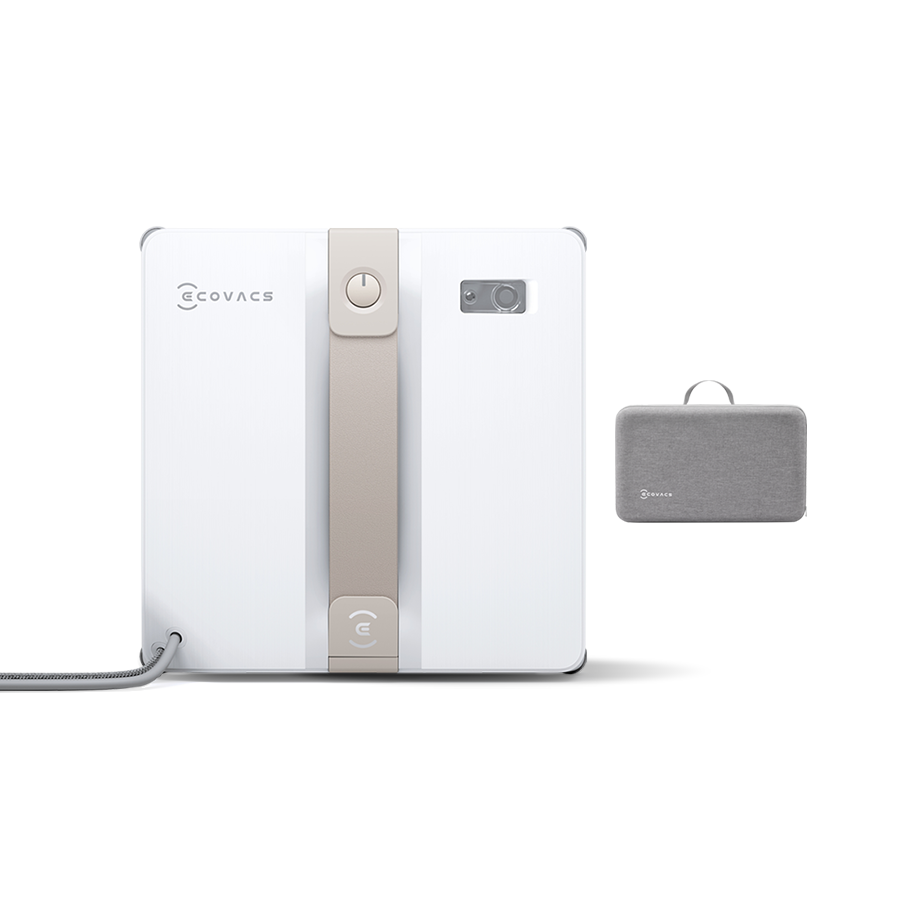
Ecovacs WINBOT W2S OMNI
No outlet needed at the window, no second line that someone forgets. On the other hand, the cable ends after 5.5 m, according to the manual the station must stand indoors, and the window must not close on the cable. Ecovacs mainly promotes the newer W2S PRO OMNI for its edge cleaning. We see no safety gain in its specifications, and the PRO series is also only approved from 4 °C.
Kärcher RCW 4
Long holding time, a user-replaceable battery, no floor requirement. On the other hand, it is always connected to the mains, and tether and cable are two separate lines. We advise against using it on frameless glass.
Ecovacs WINBOT W3 OMNI
The safety system matches the W2S OMNI, but the station weighs 10 kg. The documentation does not show any safety gain.
Ecovacs WINBOT mini 2
Small and, at 1.3 kg, light in the hand when placing it on the pane. According to the manual, panes longer than 3 m are its limit.
Kärcher RCW 2
The same 40 minutes as the RCW 4, but only two side sensors instead of four and no frameless detection in the specifications. For framed windows, that is enough.
Hobot 2S
High tether rating, shortest holding time. Without a balcony, the manual from the German distributor explicitly requires the safety zone mentioned above.
And who pays if something happens?
If the unit hits someone or someone else’s property, whoever acted negligently is liable under Section 823 of the German Civil Code (BGB). Using it contrary to the manual will then hardly work in your favor. According to the German consumer advice center (Verbraucherzentrale), personal liability insurance also covers gross negligence, just not intent. Damage to rented premises should be explicitly included in the policy. Report the incident immediately and do not pay or sign anything without the insurer’s consent. We are not aware of any court ruling on window robots.
If the unit was defective, the manufacturer comes into play. Under the German Product Liability Act, it is liable for injuries and for damage to other items in private use. However, you bear the burden of proof for the defect and the cause. For property damage, you currently bear a statutory deductible. It will be abolished under the new product liability law from December 9, 2026, but according to the IHK Frankfurt, the Frankfurt Chamber of Industry and Commerce, only for products placed on the market from then on. A robot you buy today will usually still fall under the old rule. This law does not replace the fallen robot itself. The Ecovacs warranty excludes fall damage if the suction cup and safety tether were not used. Ecovacs also mentions insurance against loss of suction, but does not state any conditions on its product or warranty pages. Don’t count on it.
How we would decide
- Balcony or terrace below, floor without joints: W2S OMNI.
- Floor with joints or a preference for a user-replaceable battery: Kärcher RCW 4, provided the panes are framed.
- Small balcony door or narrow pane: WINBOT mini 2.
- Frameless railings with gaps: no robot.
- Facade above someone else’s or public property: professional service.
Frequently asked questions
Where do I attach the window robot's safety tether?
Always to something solid indoors, even when cleaning outside. Ecovacs names furniture legs, curtain rods and stair railings; Kärcher allows, if necessary, clamping the tether in the closed window. We would not use a chair, because it slides. Check the tether, carabiner and anchor point before every use.
What happens to a window cleaning robot during a power outage?
A backup battery keeps the fan running: Kärcher states at least 40 minutes, Ecovacs 30, Hobot 20 with a warning tone. That is time to take it down, not to keep cleaning. Omni units run on the station's battery and do not notice if a circuit breaker trips at home.
Can a window cleaning robot clean outside in wind?
We follow the strictest statement in the manuals: no wind, no rain, no snow. Ecovacs contradicts itself in its own manual; Kärcher requires removing the robot in strong wind or precipitation. The W2S OMNI and mini 2 are approved from 0 °C, the W2S PRO series only from 4 °C.
Can I use a window robot above a sidewalk?
Without a balcony, the Hobot manual requires a safety zone below the pane that nobody enters. Above a sidewalk you cannot cordon off, the robot stays off. No manual names a maximum number of floors; on a facade above someone else's property, we would call in a professional service.
Does a window cleaning robot work on frameless panes?
Only to a limited extent, because there is no edge stop. Ecovacs advises starting more than 10 cm from the edge and prohibits two frameless panes with a gap between them. Frames narrower than 5 mm are also off-limits. In the RCW 4 manual, Kärcher speaks of framed glass. For glass railings with gaps: no robot.
Who is liable if the window robot falls?
If it hits someone, whoever acted negligently is liable under Section 823 of the German Civil Code (BGB). According to the German consumer advice center (Verbraucherzentrale), personal liability insurance also covers gross negligence, just not intent. If the unit was defective, the German Product Liability Act comes into play. The Ecovacs warranty excludes fall damage if the suction cup and tether were not used.
Sources
- Ecovacs W2S OMNI, data sheet
- Ecovacs W2S OMNI, manual
- Ecovacs W2S PRO OMNI, product page
- Ecovacs W2S PRO, manual
- Ecovacs W3 OMNI, product page
- Ecovacs W3 OMNI, manual
- Ecovacs mini 2, product page
- Ecovacs mini 2, manual
- Ecovacs: Warranty
- Kärcher RCW 4, product page
- Kärcher RCW 4, manual
- Kärcher RCW 2, product page
- Hobot: HOBOT-2S
- Verbraucherzentrale, personal liability insurance
- Verbraucherzentrale, manufacturer liability
- Section 823 BGB
- Section 1 ProdHaftG
- Section 11 ProdHaftG
- IHK Frankfurt: New product liability rules 2026
- Das Sichere Haus: Household cleaning
Where to buy
- Ecovacs WINBOT W2S OMNIView at EcovacsAvailable in Germany: EcovacsCheck price at Amazon.deCheck price at Amazon.co.ukCheck price at Amazon.nlCheck price at Amazon.com.beCheck price at Amazon.frCheck price at Amazon.itCheck price at Amazon.esCheck price at Amazon.plCheck price at Amazon.seAvailable in Germany: Amazon.de
- Kärcher RCW 4Check price at Amazon.deCheck price at Amazon.co.ukCheck price at Amazon.nlCheck price at Amazon.com.beCheck price at Amazon.frCheck price at Amazon.itCheck price at Amazon.esCheck price at Amazon.plCheck price at Amazon.seAvailable in Germany: Amazon.de
- Ecovacs WINBOT W3 OMNIView at EcovacsAvailable in Germany: EcovacsCheck price at Amazon.deCheck price at Amazon.co.ukCheck price at Amazon.nlCheck price at Amazon.com.beCheck price at Amazon.frCheck price at Amazon.itCheck price at Amazon.esCheck price at Amazon.plCheck price at Amazon.seAvailable in Germany: Amazon.deView at CoolblueAvailable in Germany: Coolblue
- Ecovacs WINBOT mini 2View at EcovacsAvailable in Germany: EcovacsCheck price at Amazon.deCheck price at Amazon.co.ukCheck price at Amazon.nlCheck price at Amazon.com.beCheck price at Amazon.frCheck price at Amazon.itCheck price at Amazon.esCheck price at Amazon.plCheck price at Amazon.seAvailable in Germany: Amazon.deTry a sample at CoolblueTry a sample at Coolblue
- Kärcher RCW 2Check price at Amazon.deCheck price at Amazon.co.ukCheck price at Amazon.nlCheck price at Amazon.com.beCheck price at Amazon.frCheck price at Amazon.itCheck price at Amazon.esCheck price at Amazon.plCheck price at Amazon.seAvailable in Germany: Amazon.de
- Hobot 2SCheck price at Amazon.deCheck price at Amazon.co.ukCheck price at Amazon.nlCheck price at Amazon.com.beCheck price at Amazon.frCheck price at Amazon.itCheck price at Amazon.esCheck price at Amazon.plCheck price at Amazon.seAvailable in Germany: Amazon.de