Contents12 sections
This guide was first published in German on handgetestet.de.
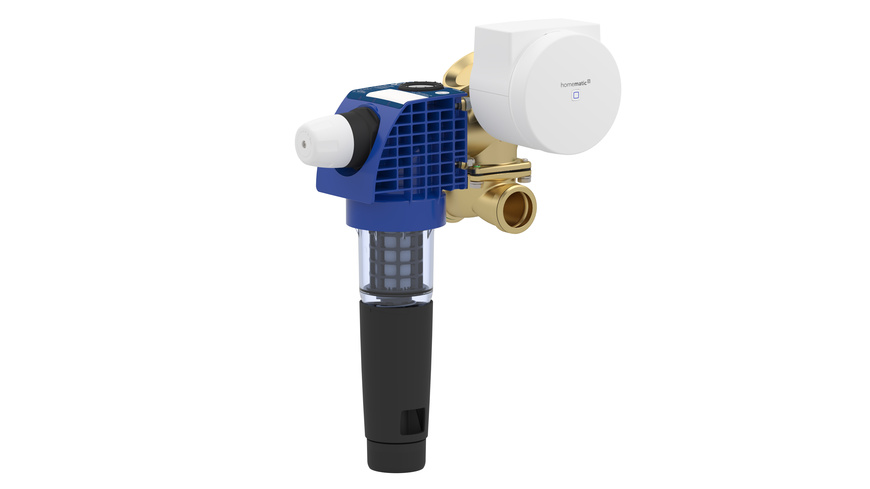
A water alarm beeps. That helps as long as someone is at home. If the family goes away for two weeks and the washing machine hose in the basement bursts, the water keeps running until someone turns it off. That is exactly what an automatic water shutoff on the main line is for: a motorized valve behind the water meter that closes on a signal. For a house that already uses Homematic IP or plans to start with it, we consider the Homematic IP HmIP-WSS water shutoff and supply unit the most coherent solution. It is, however, a job for a plumber, not a Saturday afternoon project.
This guide covers technology, installation rules and limitations. If you only want an alarm on the floor, you are better served by the guide to the water alarm with leak sensor.
Two ways to detect a leak
The valve on its own knows nothing. When it closes is decided by one of two mechanisms, and they differ more than the advertising suggests.
The first is the floor sensor. It sits where water shows up first: under the dishwasher, next to the hot water tank, at the lowest point in the boiler room. According to its instructions, the Homematic IP HmIP-SWD-2 water sensor detects moisture and standing water from a depth of 1.5 millimeters. When it reports, the valve closes via radio. This way, there are no false alarms because someone takes a long shower. The flip side: no sensor on the tiles will notice a pipe dripping behind the bathtub or leaking into the screed.
The second principle measures in the pipe itself. A flow meter counts how much water flows and for how long, and compares that with limit values. According to the manufacturer, the SYR SafeTech Connect measures flow, pressure and temperature, learns the household’s habits during a learning phase and shuts off in the event of unusually high consumption. At regular intervals, it also checks for micro-leaks, meaning tiny, continuous losses. The JUDO ZEWA i-SAFE works in a similar way, with a turbine meter and adjustable limits for draw duration, draw volume and flow rate. Devices like these also find the leak in the wall. In return, you have to set their limits so that filling a pool or watering the garden does not count as a burst pipe.
Our assessment: measuring in the pipe is the more comprehensive principle, the floor sensor the calmer one. The two can be combined. SYR and JUDO offer their own floor sensors that can also trigger the valve.
Ball valve or solenoid valve
On the main line, there is almost always a motor-driven ball valve. It only needs power to switch and holds its position on its own afterward. In the HmIP-WSS, this job is done by a ball valve with an actuator that can also be operated by hand in an emergency: under the cover there is a socket key (Torx 49) for opening or closing the valve.
Solenoid valves are more commonly found on individual appliances. The H-Tronic WSS1 water protection switch screws a valve of this type with a G3/4 thread between the faucet and the inlet hose of a washing machine. That is a different league: it protects one connection, not the house.
What the law says about installation
This is where it gets serious. Section 12 of the German Ordinance on General Conditions for the Supply of Water (AVBWasserV) stipulates that the installation behind the house connection and substantial changes to it may only be carried out by the water utility or by an installation company listed in its register of installers. A shutoff valve with filter and pressure reducer directly behind the meter is exactly that kind of intervention. eQ-3 says the same in the instructions for the HmIP-WSS: installation is a substantial intervention in the drinking water system and only permitted for a qualified professional.
According to the same regulation, the property owner connected to the supply is responsible for the installation behind the house connection, and in rented premises alongside the tenant. So if you rent, talk to the owner first. What you can retrofit without touching the pipes is covered in the guide Smart home for renters (in German).
The instructions also specify the location: in the cold water line after the water meter and before the distribution lines, in accordance with DIN EN 806-2 and DIN EN 1717. Whether a backflow preventer is already in place there or needs to be added is something the plumber assesses on site. The same applies to an existing water softener, which needs its place in the sequence of fittings; more on that in the guide to the water softening system (in German).
Five solutions side by side
| Model | Detects leaks via | Key data according to manufacturer | Who it suits |
|---|---|---|---|
| Homematic IP HmIP-WSS water shutoff and supply unit | Wireless water sensors | DN 25, 3.6 m³/h, 100 µm filter, pressure reducer 1 to 6 bar, rechargeable batteries for power outages | Homes with Homematic IP, installation by a plumber |
| Homematic IP water sensor set with Access Point 2 | Floor: moisture or water from 1.5 mm | Access Point 2 and two sensors, siren approx. 77 dB, IP44 | Getting started, add the water shutoff later |
| Homematic IP HmIP-SWD-2 water sensor | Floor | 2 × AAA, typically 5 years, radio range up to 230 m in open field | Additional measuring points in the house |
| H-Tronic WSS1 water protection switch | Wired floor sensor | Solenoid valve G3/4, also cuts power up to 3680 W, no radio | A single appliance such as a washing machine |
| SYR SafeTech Connect | Flow, pressure, micro-leak test | Wi-Fi and app, self-learning phase, optional floor sensors | Those who also want to detect concealed leaks |
Homematic IP HmIP-WSS water shutoff and supply unit
The device combines three fittings: a shutoff valve, a backwash filter with 100 µm fineness and a pressure reducer according to DIN EN 1567, adjustable from 1 to 6 bar and set to 4 bar at the factory. According to the manufacturer, it can therefore replace an existing filter or pressure reducer in the same position. It is designed for DN 25 and up to 3.6 m³/h, for water from 5 to 30 °C, and for indoor use only (IP20). A power outlet must be nearby; the power supply draws up to 26 W. If the power fails, three rechargeable batteries keep it running; when they are almost empty, the valve closes on its own.
It is triggered by a Homematic IP water sensor, which can be paired directly via Push-to-Pair; for the app, you need an access point or a hub. The manufacturer does not mention any built-in flow measurement, so a leak inside a wall goes undetected. Drawbacks worth knowing: according to ELV (German electronics retailer), the device is not compatible with the older CCU3 hub. And the filter needs looking after. The instructions call for backwashing at least every six months (with a 10-liter bucket underneath if there is no drain connection) and annual maintenance including a battery check, because a dirty filter can become contaminated with germs.
A detail from the instructions that rarely gets mentioned: if the water shutoff closes while someone is in the shower, the cold water in the mixer tap is suddenly gone. eQ-3 explicitly warns of scalding. If there are children or elderly people in the household, keep that in mind with the bathroom thermostats.
Homematic IP water sensor set with Access Point 2
The set of Access Point 2 and two sensors is the way in if there is no Homematic IP hub in the house yet. According to ELV, you can choose in the app whether moisture already triggers an alarm or only standing water. The sensors beep on site at about 77 dB and send a notification to your phone. A tilt sensor reports if someone moves them. The water shutoff can be paired later. Which other hubs are an option is described in our guide to the smart home hub.
Homematic IP HmIP-SWD-2 water sensor
The individual sensor covers additional spots. A house with a boiler room, kitchen, utility room and two bathrooms quickly adds up to five or six measuring points, because each sensor only covers its own patch of floor. It typically runs for five years on two AAA batteries and is rated IP44.
H-Tronic WSS1 water protection switch
The affordable solution for a single appliance. The WSS1 plugs into the outlet, the appliance plugs into it, and the solenoid valve sits on the faucet. If the wired sensor reports water, it cuts power and water to the machine and sounds an alarm at about 80 dB. If the sensor or valve is missing, it also closes. There is no app, and H-Tronic calls for a monthly check of valve and sensor. For the washing machine in the basement, that is sensible. It is no substitute for a water shutoff on the main line.
SYR SafeTech Connect
The alternative from specialist plumbing suppliers, listed on Amazon in several nominal sizes. According to SYR, the device measures flow, pressure and temperature, learns the household’s consumption, regularly tests for micro-leaks and sends alerts via app and email. While you are on vacation, the app lets you release a set amount of water, for instance for the neighbor who waters the plants. It remains a separate system with its own app. If you are worried about concealed leaks, for example in an older building with old pipes, this is the more suitable principle.
Vacation, power outage, insurance
For trips away, the flow-based devices have their own programs. According to the manufacturer, the JUDO ZEWA i-SAFE switches on its own to an away mode with stricter limits after 72 hours without any water being drawn. For the HmIP-WSS, eQ-3 does not mention a dedicated vacation mode. The valve can, however, be controlled via the app, so you can close it before leaving and open it again before you return.
During a power outage, the devices behave differently. The HmIP-WSS keeps running on battery and closes as a precaution before the batteries run out. After that, the socket key helps. For the WSS1, which is plugged into the outlet, H-Tronic does not state how it behaves during a power outage; if you are going away, you are better off turning off the faucet there anyway.
Whether home contents or homeowners insurance takes a water shutoff into account depends solely on your own policy. Ask your insurer before buying, and keep the plumber’s installation record.
Which solution suits which home
- Owner-occupied home with Homematic IP or plans for it: Homematic IP HmIP-WSS water shutoff and supply unit plus at least three water sensors, installed by a registered plumber.
- No hub yet: start with the set of Access Point 2 and two sensors, and have the water shutoff retrofitted at the plumber’s next visit.
- Older building with concealed pipes: a device with flow measurement such as the SYR SafeTech Connect, supplemented with floor sensors.
- Rental apartment or just the washing machine: H-Tronic WSS1 on the appliance connection, without touching the house plumbing.
A water shutoff also fits behind the base station of a robot vacuum with a permanent water supply; what matters there is covered in the guide Robot vacuum with fixed water connection.
Frequently asked questions
Can I install a water shutoff on the main line myself?
No. Under Section 12 of the German water supply regulation AVBWasserV, substantial changes behind the house connection may only be carried out by the water utility or a plumber registered with it. eQ-3 says the same in the instructions for the HmIP-WSS. If you rent, talk to the owner first.
Floor sensor or flow measurement: which detects leaks more reliably?
The floor sensor reports water from 1.5 millimeters and does not trigger false alarms during long showers, but it cannot see a leak inside a wall. Measuring in the pipe also finds concealed leaks, but it needs well-chosen limit values. The two can be combined.
What happens to the water shutoff during a power outage?
The HmIP-WSS keeps running on three rechargeable batteries and closes as a precaution before they run out. After that, you open the valve by hand with the socket key under the cover. For the outlet-powered H-Tronic WSS1, the manufacturer does not state how it behaves during a power outage.
What maintenance does the Homematic IP water shutoff need?
The instructions call for backwashing the filter at least every six months, with a 10-liter bucket underneath if there is no drain connection, and annual maintenance including a battery check. A dirty filter can become contaminated with germs. According to ELV, the device is not compatible with the older CCU3 hub.
Is water protection for just the washing machine enough?
For a rental apartment or a machine in the basement, the H-Tronic WSS1 is a sensible choice. It sits between the faucet and the inlet hose, cuts power and water to the machine when it detects water, and sounds an alarm at about 80 dB. It does not protect the house, and there is no app.
How many water sensors does a single-family home need?
Each sensor only covers its own patch of floor. A house with a boiler room, kitchen, utility room and two bathrooms quickly adds up to five or six measuring points. The HmIP-SWD-2 typically runs for five years on two AAA batteries and is rated IP44.
Sources
- AVBWasserV Section 12, customer installation (gesetze-im-internet.de)
- Homematic IP: Water shutoff and supply unit
- eQ-3: Installation and operating instructions HmIP-WSS (PDF)
- eQ-3: Data sheet HmIP-WSS (PDF)
- ELV: Homematic IP water shutoff and supply unit
- ELV: Water sensor set with Access Point 2
- eQ-3: Operating instructions HmIP-SWD-2 water sensor (PDF)
- H-Tronic: Operating instructions WSS1 water protection switch (PDF)
- SYR: Brochure SafeTech Connect and SafeFloor Connect (PDF)
- JUDO: ZEWA i-SAFE micro-leak protection system
Where to buy
- Homematic IP Wasserstopp und Versorgungseinheit HmIP-WSSView at ELVAvailable in Germany: ELV
- Homematic IP Set Wassersensor mit Access Point 2View at ELVAvailable in Germany: ELV
- Homematic IP Wassersensor HmIP-SWD-2View at ELVAvailable in Germany: ELVCheck price at Amazon.deAvailable in Germany: Amazon.de
- H-Tronic Wasserschutzschalter WSS1View at ELVAvailable in Germany: ELV
- SYR SafeTech ConnectCheck price at Amazon.deAvailable in Germany: Amazon.de