Contents13 sections
This guide was first published in German on handgetestet.de.
Imou quotes 120 days on a single charge for the Cell 3C. The footnote reveals the basis: 20 videos of 15 seconds each per day. At a driveway with parcel deliveries, a cat and the neighbor’s car, that is exceeded quickly. If you do not want to keep fetching the ladder, plan the spot for the solar panel first and choose the camera after that. For most outdoor locations, we consider the Imou AOV Air with the 8-watt panel the most coherent solution. According to the data sheet, it still charges at minus 10 degrees Celsius, although it cannot pan.
Why does the battery run flat faster than promised?
Because the advertised figure describes a very quiet location. Imou assumes 0.19 watt-hours for these 300 seconds of event video per day. If the camera triggers three times as often, the math alone leaves roughly 40 days. Live view, spotlight and siren are not even included in that.
In the AOV Air data sheet, Imou lists four factors that affect runtime: settings, activity, network conditions and temperature. Reolink additionally warns about frequent detection and long live view sessions. If the camera sits at the edge of the wireless range, better reception alone often helps. How to measure it is explained in our guide to Wi-Fi for security cameras.
What happens to the battery and panel in winter?
Two things come together, and the second is often overlooked. First, there is a lack of sun. We ran the numbers for Kassel, Germany, using PVGIS, the EU’s solar calculator (14 percent losses, no shading, irradiation data 2005 to 2023). A 3-watt panel facing south at a 60-degree tilt produces roughly 10.6 watt-hours per day in June and 2.9 in December. With 8 watts, it is about 7.8 in December. Turned east or west, the December value shrinks to 1.1 and 3.0 watt-hours respectively.
These are monthly averages. A gray week falls well below them, and the charging electronics of small panels are not included in the calculation. For comparison: at the usual 3.6 volts, 5,000 milliamp-hours equal about 18 watt-hours.
Then comes the frost. The Imou cameras can operate down to minus 20 degrees Celsius, but charging is another matter. According to the data sheets, the AOV Air and Cell PT 3C accept power from minus 10 degrees Celsius, the Cell Go only from 0 degrees. Reolink also states 0 degrees for its 3-, 6- and 12-watt panels and writes that charging pauses below that to protect the lithium battery. A clear frosty day then does nothing for the battery, even though the sun is shining.
How do I align the solar panel?
Facing south, free of shade and not under the roof overhang. Reolink recommends a tilt of 40 to 45 degrees for year-round use and advises against horizontal mounting, because leaves and dirt collect there. If winter is the bottleneck, it can be steeper: in our calculation, 60 degrees yields almost 17 percent more in December than 35 degrees, and even vertically on a south-facing wall you still get 0.94 instead of 0.98 watt-hours per watt per day. Summer loses a lot in the process, but there is surplus power then anyway.
If the camera faces north, the panel still belongs on the sunny side. For the Cell PT 3C, Imou explicitly provides for separate mounting. Measure the cable length beforehand.
What is AOV, and does it really save power?
AOV stands for Always-on Video. Without an event, the Cell PT 3C saves a still image every 2 seconds; during an event, it switches to video at the full frame rate. The AOV Air works similarly, with selectable intervals. Compared with true continuous recording, that is economical. Compared with event-only recording, it is not. Imou explicitly recommends AOV when running with a solar panel and offers to switch to „Event“ or „Power saving“ depending on the battery level. Our reading: AOV without a panel is not a good idea. The manufacturer does not state how much power the mode uses per day. The still images also take up space; more on that in our guide to storage for security cameras (in German).
Which settings make the biggest difference?
- Draw the detection zone tightly so the street and sidewalk do not trigger it.
- Lower the sensitivity if branches or cats keep setting off alarms.
- Set night vision to „Smart“: color with spotlight only during an event, infrared otherwise.
- Only activate the siren and spotlight where they are needed.
- Assign a more economical mode for low battery levels.
- Keep live view short. It is the power drain you control yourself.
Which cameras are worth considering?
| Model | Power | Charging in the cold | Protection rating, wireless | Best for |
|---|---|---|---|---|
| Imou AOV Air with 8 W panel | 5,000 mAh, AOV, event, power saving | from −10 °C | IP67, 2.4 and 5 GHz | fixed viewing direction, winter operation |
| Imou Cell PT 3C with solar panel | 5,000 mAh, 5 W panel, AOV | from −10 °C | IP65, 2.4 and 5 GHz | large areas, panning |
| Imou Cell 3C with solar panel | 5,000 mAh, event mode via PIR | not specified | IP66, 2.4 GHz | quiet spots, small budget |
| Imou Cell Go with 8 W panel | 5,000 mAh, six modes | from 0 °C | IP65, 2.4 GHz | light, relocatable solution |
| Reolink Argus 4 Pro | 5,000 mAh, 6 W panel optional | panel from 0 °C | IP66, 2.4 and 5 GHz | 180-degree view, purchase via Amazon |
Why the AOV Air with the 8-watt panel?
It combines the lower charging limit with the larger panel Imou offers for this model. On top of that come 3K resolution, Wi-Fi 6 and an IP67 protection rating. The lens is fixed, and the field of view is 94 degrees. So it covers one corner of the property well, but not the whole property. Imou lists the 8-watt panel as a bundle in its shop.
When is the Cell PT 3C the better choice?
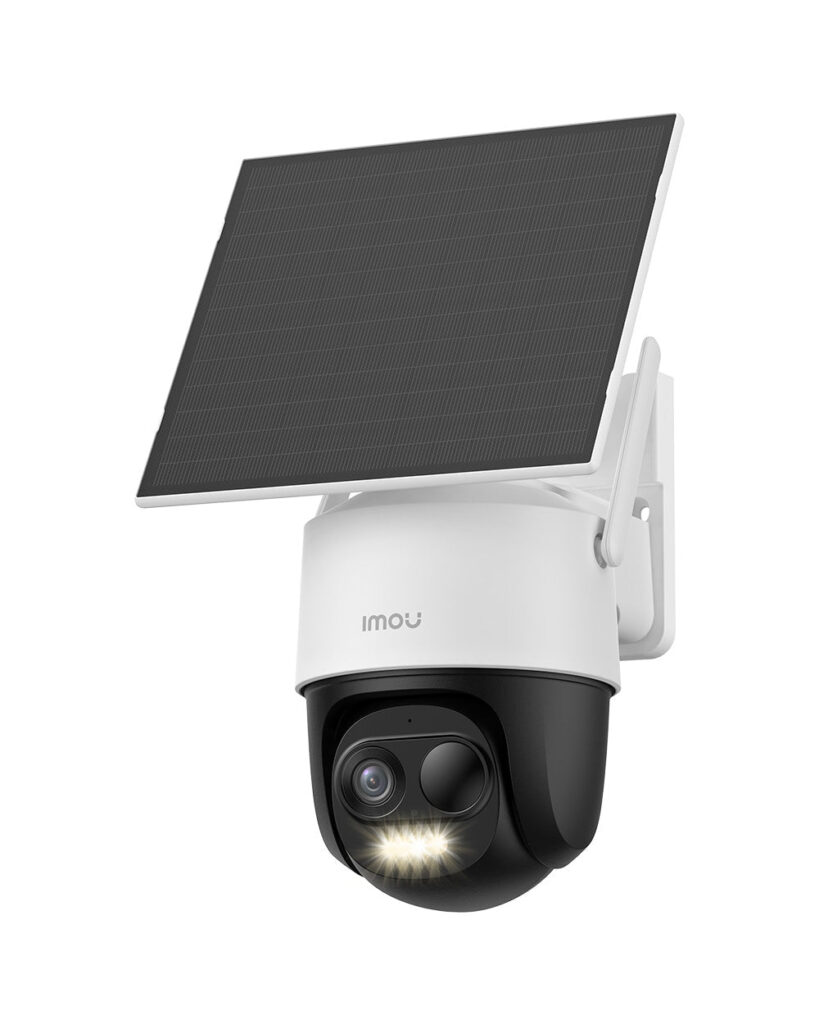
When one camera needs to cover more than one viewing direction. It pans 350 degrees, tilts 90 degrees and comes with a 5-watt panel. At 575 grams, it weighs a good deal more than twice as much as the AOV Air, and its field of view is narrower at 78 degrees. What panning means for your planning is explained in our guide to the pan-tilt security camera.
Is a Cell 3C enough?
At a quiet back entrance, yes. It detects motion with a PIR sensor and can only record then, which is exactly what Imou’s 120 days are based on. No charging temperature is listed in the technical specifications, so its winter behavior remains an open question. Our budget pick.
And the Cell Go?
At 210 grams, it can be moved quickly. Without a solar panel, the shop does not currently list it as available. The storage is built in and, at 4 GB, on the small side, and the 0-degree charging limit argues against drafty north-facing locations.
Are there alternatives on Amazon?
According to the manufacturer, the Reolink Argus 4 Pro delivers 4K via two lenses and a 180-degree view, also with 5,000 milliamp-hours. Its operating range ends at minus 10 degrees Celsius, however, and charging via the Reolink panels only starts at 0 degrees. You will find Imou models there too. Check before buying whether the panel is included.
Which camera suits which spot?
- South side or open area, year-round operation: Imou AOV Air with 8 W panel.
- Large yard, several viewing directions: Cell PT 3C.
- Little activity and a small budget: Cell 3C with solar panel.
- Permanently dark north-facing yard with no room for a panel: a wired camera is the better choice. The selection for that is in our guide to the outdoor security camera, and multiple cameras are covered in our guide to the camera kit.
What a small panel still delivers in December is calculated in our guide to the security camera with solar panel.
Frequently asked questions
Why does the camera battery run flat faster than advertised?
Because the advertised figure describes a very quiet location. The 120 days for the Imou Cell 3C are based on 20 videos of 15 seconds each per day. If the camera triggers three times as often, the math leaves roughly 40 days, not counting live view, spotlight and siren.
Does a battery camera charge in freezing temperatures?
The Imou cameras can operate down to minus 20 degrees Celsius, but charging is another matter. According to the data sheets, the AOV Air and Cell PT 3C accept power from minus 10 degrees Celsius, the Cell Go only from 0 degrees. Reolink pauses charging below 0 degrees to protect the battery.
How do I align the solar panel of a security camera?
Facing south, free of shade and not under the roof overhang. Reolink recommends a tilt of 40 to 45 degrees for year-round use and advises against horizontal mounting. If winter is the bottleneck, it can be steeper: in December, 60 degrees yields almost 17 percent more than 35 degrees.
What is AOV on security cameras?
AOV stands for Always-on Video. Without an event, the Cell PT 3C, for example, saves a still image every 2 seconds, and during an event it records video at the full frame rate. Compared with continuous recording, that is economical; compared with event-only recording, it is not. Imou explicitly recommends AOV with a solar panel.
Which settings extend battery life?
Draw the detection zone tightly so the street and sidewalk do not trigger it, and lower the sensitivity if branches or cats set it off. Set night vision to Smart and only activate the siren and spotlight where needed. Live view is the power drain you control yourself.
When is the inexpensive Imou Cell 3C enough?
At a quiet back entrance. It detects motion with a PIR sensor and only records then, which is exactly what Imou's 120 days are based on. No charging temperature is listed in the technical specifications, so how it behaves in winter remains an open question.
Sources
- Imou: Cell 3C, product page with runtime footnotes
- Imou: Cell 3C, technical specifications
- Imou: AOV Air, product page
- Imou: AOV Air, technical specifications
- Imou: AOV Air, data sheet (PDF)
- Imou: Cell PT 3C, product page
- Imou: Cell PT 3C, technical specifications
- Imou: Cell Go, technical specifications
- Reolink: Solar panel efficiency
- Reolink: Solar panel not charging
- Reolink: Argus 4 Pro
- European Commission, Joint Research Centre: PVGIS 5.3 (our own calculation for Kassel, SARAH3 irradiation data, 2005 to 2023, as of 04.11.2026)
Where to buy
- Imou AOV Air mit 8-W-PanelView at ImouAvailable in Germany: ImouCheck price at Amazon.deCheck price at Amazon.co.ukCheck price at Amazon.nlCheck price at Amazon.com.beCheck price at Amazon.frCheck price at Amazon.itCheck price at Amazon.esCheck price at Amazon.plCheck price at Amazon.seAvailable in Germany: Amazon.de
- Imou Cell PT 3C mit SolarpanelView at ImouAvailable in Germany: ImouCheck price at Amazon.deCheck price at Amazon.co.ukCheck price at Amazon.nlCheck price at Amazon.com.beCheck price at Amazon.frCheck price at Amazon.itCheck price at Amazon.esCheck price at Amazon.plCheck price at Amazon.seAvailable in Germany: Amazon.de
- Imou Cell 3C mit SolarpanelView at ImouAvailable in Germany: ImouCheck price at Amazon.deCheck price at Amazon.co.ukCheck price at Amazon.nlCheck price at Amazon.com.beCheck price at Amazon.frCheck price at Amazon.itCheck price at Amazon.esCheck price at Amazon.plCheck price at Amazon.seAvailable in Germany: Amazon.de
- Imou Cell Go mit 8-W-PanelView at ImouAvailable in Germany: Imou
- Reolink Argus 4 ProCheck price at Amazon.deCheck price at Amazon.co.ukCheck price at Amazon.nlCheck price at Amazon.com.beCheck price at Amazon.frCheck price at Amazon.itCheck price at Amazon.esCheck price at Amazon.plCheck price at Amazon.seAvailable in Germany: Amazon.de