Contents14 sections
This guide was first published in German on handgetestet.de.
The label on a third-party battery says 3,000 mAh, the original says considerably less. The math seems simple. It rarely works out. For your first spare, we recommend the camera maker’s original, because Sony, Canon and Fujifilm explicitly approve only their own batteries in their manuals. A third-party battery with a built-in USB-C port can make sense as a third battery if you want to recharge on the go without a charger. Which camera suits you in the first place is covered in our guide to buying a mirrorless camera (in German).
Original or third-party: what do the camera makers say?
The manuals are clear. In the help guide for the Alpha 7 IV, Sony says to use only Sony-brand batteries and warns that charging batteries not designed for the camera can cause leakage, overheating or explosion. In the X-T5 manual, Fujifilm requires genuine Fujifilm batteries, otherwise the camera may malfunction.
Canon goes the furthest. The EOS R6 Mark II manual states that Canon is not liable for damage caused by third-party accessories, citing battery leakage or explosion as an example. According to Canon, repairs after such a defect are not covered by the repair warranty, not even for a fee. That is no proof that third-party batteries are bad. It does mean, however, that if something goes wrong, you carry the risk.
Does a higher mAh rating on the label really mean longer runtime?
Not necessarily. In March 2024, the tech site techtest.org discharged and measured eight batteries for Canon’s LP-E6NH slot. The original Canon battery reached 2,051 mAh at 0.2 A. Some third-party batteries came in above that, while one labeled 2,600 mAh reached only 1,659 mAh. The tester called the 3,000 mAh rating of another third-party battery wildly exaggerated.
You can check any rating with a quick calculation: voltage times capacity gives you watt-hours. Sony’s NP-FZ100, with 7.2 V and 2,280 mAh, comes to 16.4 Wh, and that is exactly the figure Sony states. If a label lacks the watt-hour figure, or it does not match the calculation, that would be a reason for us to keep looking.
Charging via USB-C: in the camera, on the battery or in a dual charger?
All three cameras in our selection charge the battery through their USB-C port. That sounds convenient but has one drawback. While the battery is charging in the camera, you are not taking pictures. For the Alpha 7 IV on the supplied power adapter, Sony states about 255 minutes and recommends a USB PD power adapter with 9 V and 2 A or more for faster charging. Fujifilm gives about 180 minutes for the X-T5.
Two batteries overnight? That is what a dual charger is for. It does, however, need a powerful power adapter: for its BC-W235 charger, Fujifilm recommends a USB PD power adapter with at least 27 W. Which power adapters deliver that is covered in our guide to USB-C chargers (in German). Batteries with their own USB-C port charge directly from a power bank, with no camera or charging cradle at all.
Can the spare battery go on a plane?
Yes, but only in your carry-on. The German Federal Aviation Office (Luftfahrt-Bundesamt, LBA) prohibits loose spare lithium batteries in checked baggage. Each lithium-ion battery may have no more than 100 Wh, and the LBA requires every battery to have passed the tests under the UN Manual of Tests and Criteria, Part III, subsection 38.3. According to the authority’s dangerous goods leaflet, spare batteries must be individually protected against short circuits, for example with their protective cap. Camera batteries at around 16 to 19 Wh are well below the limit. Airlines may have stricter rules, and a look at their conditions before you travel saves trouble at the check-in counter.
Seven batteries and chargers at a glance
| Model | Key specs | Charging | Best for |
|---|---|---|---|
| Sony NP-FZ100 | 7.2 V, 2,280 mAh, 16.4 Wh, approx. 83 g (Sony) | in the camera via USB-C or in the Sony BC-QZ1 charger | Alpha owners who want a safe second battery |
| Canon LP-E6NH | measured 2,051 mAh at 0.2 A (techtest.org) | LC-E6/LC-E6E charger or via USB in compatible EOS models | EOS R and EOS DSLR users |
| Fujifilm NP-W235 | 7.2 V, 2,200 mAh rated capacity, approx. 79 g (Fujifilm) | in the camera via USB-C or in the BC-W235 | X-T5, X-H2, X-S20 and GFX |
| SmallRig NP-FZ100 USB-C (4265) | 7.2 V, 2,400 mAh, 17.28 Wh (SmallRig) | USB-C directly on the battery, 5 V/2.2 A, approx. 2.5 h | Sony users who charge from a power bank on the go |
| Patona Protect NP-FZ100 | 7.2 V, 2,600 mAh, 18.72 Wh (Patona) | Sony charger or Patona charger | Videographers with a third and fourth battery |
| Fujifilm BC-W235 | two NP-W235 at once, approx. 200 min, approx. 150 min from 30 W | USB-C, PD power adapter from 27 W recommended | Fujifilm users with two or more batteries |
| Patona Premium Twin Performance PD | two NP-FZ100, LCD display, 60 g (Patona) | USB-C, full speed from 20 W PD | Sony users on the road |
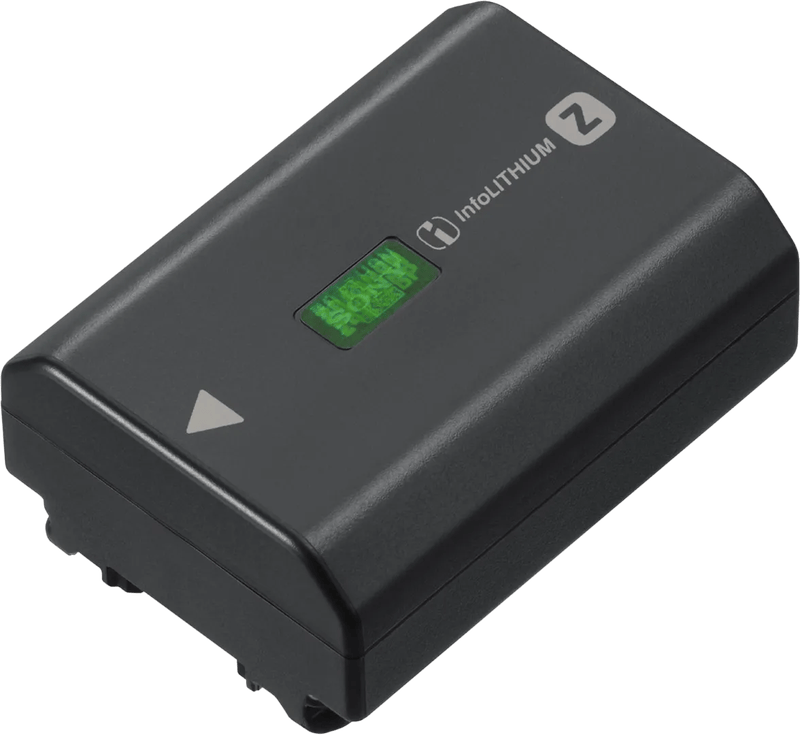
Sony NP-FZ100
The Z-series battery powers the Alpha 7 III and IV, the Alpha 6700, the FX3 and other Sony models. Sony specifies 7.2 V, 2,280 mAh and 16.4 Wh. Thanks to InfoLITHIUM, the camera shows the remaining charge as a percentage. According to Sony, one charge in the Alpha 7 IV lasts for about 580 photos using the monitor or about 110 minutes of actual video recording.
Canon LP-E6NH
In the EOS R6 Mark II manual, Canon lists the LP-E6NH alongside the newer LP-E6P. The camera charges both with the PD-E1 USB power adapter, but not the older LP-E6. With a full LP-E6NH, Canon states about 580 shots using the monitor for the R6 Mark II. In the techtest.org test series, the original battery was not the strongest. The manual, however, approves only Canon batteries.
Fujifilm NP-W235
Fujifilm specifies a nominal capacity of 2,350 mAh and a rated capacity of 2,200 mAh at 7.2 V. The battery is designed for 0 to 40 °C. On a mountain in winter, that matters. According to Fujifilm, one charge in the X-T5 lasts for about 580 shots in normal mode using the monitor.
SmallRig NP-FZ100 USB-C (4265)
This third-party battery has its own USB-C port and an indicator light that glows red while charging and green when the battery is full. SmallRig specifies 2,400 mAh and 17.28 Wh and states about 2.5 hours of charging time at 5 V and 2.2 A. According to the manufacturer, it also fits Sony’s original charger. It makes a good third battery. Because of the camera makers‘ stance, we would not buy it as our only spare.
Patona Protect NP-FZ100
For the Protect battery, Patona advertises a housing made of flame-retardant V1 material that, according to the manufacturer, keeps its shape up to 90 °C. The rating of 2,600 mAh and 18.72 Wh adds up mathematically. If you shoot long videos and swap between several batteries, this is a useful addition to the original.
Fujifilm BC-W235
The dual charger charges two NP-W235 at the same time. At 25 °C, that takes about 200 minutes according to Fujifilm; with a power adapter of 30 W or more, the time drops to around 150 minutes. So you should budget for the matching PD power adapter right away.
Patona Premium Twin Performance PD
This compact charger takes two NP-FZ100, charges them independently and shows the status on an LCD. Patona states a weight of 60 g. According to the manufacturer, it only reaches full charging speed on a PD power adapter of 20 W or more. It is not intended for Sony’s FX2.
Which battery for which camera bag?
- You have a Sony Alpha and only one battery so far: first a second Sony NP-FZ100.
- You shoot with a Canon EOS R or an EOS DSLR: an original LP-E6NH; with newer models, check the manual first to see whether the LP-E6P is intended.
- You use a Fujifilm X-T5, X-H2 or X-S20: NP-W235 plus the BC-W235 dual charger as soon as you have two batteries.
- You charge from a power bank on the go: SmallRig with USB-C as a third battery, not as your only one.
- You shoot long videos with Sony: the original as your base, plus Patona Protect and the Twin PD dual charger.
Frequently asked questions
Original or third-party battery for the camera?
The original for your first spare. Sony warns that batteries not designed for the camera may leak, overheat or explode. According to the EOS R6 Mark II manual, Canon accepts no liability for damage caused by third-party accessories. That does not prove third-party batteries are bad, but you carry the risk yourself.
Does a higher mAh rating on the label mean longer runtime?
Not necessarily. In measurements by techtest.org, the original Canon battery delivered 2,051 mAh, while a third-party battery labeled 2,600 mAh managed only 1,659 mAh. You can check any rating by multiplying voltage by capacity, which gives you watt-hours.
Can a spare camera battery go on a plane?
Yes, but only in your carry-on. The German Federal Aviation Office (LBA) prohibits loose spare lithium batteries in checked baggage and limits each battery to 100 Wh. Spare batteries must be individually protected against short circuits, for example with their protective cap. Airlines may have stricter rules.
Charge in the camera or in a dual charger?
While the battery charges in the camera via USB-C, you cannot shoot. For the Alpha 7 IV on the supplied power adapter, Sony states about 255 minutes. A dual charger is meant for two batteries overnight; for the BC-W235, Fujifilm recommends a USB PD power adapter with at least 27 W.
How many photos does a camera battery last?
The manufacturers give similar figures for all three cameras. Sony rates the Alpha 7 IV at about 580 photos using the monitor, and Canon also gives about 580 shots for the R6 Mark II. Fujifilm states about 580 shots in normal mode for the X-T5.
Which spare battery charges directly from a power bank?
Batteries with their own USB-C port, such as the SmallRig NP-FZ100 USB-C (4265). SmallRig specifies 2,400 mAh, 17.28 Wh and about 2.5 hours of charging time, and an indicator light shows the charge status. Because of the camera makers' stance, the guide advises against it as your only spare.
Sources
- Sony: NP-FZ100, specifications
- Sony: BC-QZ1 charger
- Sony: Alpha 7 IV help guide (battery, charging, runtime)
- Canon: EOS R6 Mark II advanced user guide
- Fujifilm: X-T5 specifications with NP-W235
- Fujifilm: X-T5 accessories (BC-W235)
- Fujifilm: charging the X-T5 battery
- SmallRig: NP-FZ100 USB-C battery 4265
- Patona: Protect NP-FZ100
- Patona: Premium Twin Performance PD
- techtest.org: eight LP-E6NH batteries measured (March 2024)
- German Federal Aviation Office: electronic devices with lithium batteries
- German Federal Aviation Office: dangerous goods tips for passengers
Where to buy
- Sony NP-FZ100View at CoolblueAvailable in Germany: CoolblueCheck price at Amazon.deCheck price at Amazon.co.ukCheck price at Amazon.nlCheck price at Amazon.com.beCheck price at Amazon.frCheck price at Amazon.itCheck price at Amazon.esCheck price at Amazon.plCheck price at Amazon.seAvailable in Germany: Amazon.de
- Canon LP-E6NHCheck price at Amazon.deCheck price at Amazon.co.ukCheck price at Amazon.nlCheck price at Amazon.com.beCheck price at Amazon.frCheck price at Amazon.itCheck price at Amazon.esCheck price at Amazon.plCheck price at Amazon.seAvailable in Germany: Amazon.de
- Fujifilm NP-W235Check price at Amazon.deCheck price at Amazon.co.ukCheck price at Amazon.nlCheck price at Amazon.com.beCheck price at Amazon.frCheck price at Amazon.itCheck price at Amazon.esCheck price at Amazon.plCheck price at Amazon.seAvailable in Germany: Amazon.de
- SmallRig NP-FZ100 USB-C 4265Check price at Amazon.deCheck price at Amazon.co.ukCheck price at Amazon.nlCheck price at Amazon.com.beCheck price at Amazon.frCheck price at Amazon.itCheck price at Amazon.esCheck price at Amazon.plCheck price at Amazon.seAvailable in Germany: Amazon.de
- Patona Protect NP-FZ100Check price at Amazon.deCheck price at Amazon.co.ukCheck price at Amazon.nlCheck price at Amazon.com.beCheck price at Amazon.frCheck price at Amazon.itCheck price at Amazon.esCheck price at Amazon.plCheck price at Amazon.seAvailable in Germany: Amazon.de
- Fujifilm BC-W235Check price at Amazon.deCheck price at Amazon.co.ukCheck price at Amazon.nlCheck price at Amazon.com.beCheck price at Amazon.frCheck price at Amazon.itCheck price at Amazon.esCheck price at Amazon.plCheck price at Amazon.seAvailable in Germany: Amazon.de
- Patona Premium Twin Performance PD NP-FZ100Check price at Amazon.deCheck price at Amazon.co.ukCheck price at Amazon.nlCheck price at Amazon.com.beCheck price at Amazon.frCheck price at Amazon.itCheck price at Amazon.esCheck price at Amazon.plCheck price at Amazon.seAvailable in Germany: Amazon.de