Contents13 sections
This guide was first published in German on handgetestet.de.
Briquettes or lump charcoal? The question comes down to the clock, not to taste. If you are grilling two steaks in half an hour, you need fast lump charcoal; if you are cooking a roast indirectly for three hours, you need briquettes. For a typical evening on the kettle grill, Weber Briketts in the 8 kg bag are the solid choice, because Weber openly states the wood species, origin and certification on the product page. Short grilling sessions with lump charcoal from German beech work well with proFagus DER SOMMER HIT.
Lump charcoal or briquettes: what do you need on a normal barbecue evening?
Lump charcoal lights faster and gets hot quickly. After that, the heat tapers off relatively soon. For its Premium Holzkohle, Weber states around 15 minutes until it is ready for grilling and about 1.5 hours of burn time at 180 °C. Briquettes take longer but keep going: for its own briquettes, Weber states up to three hours, and in its older lighting information sheet, depending on the grilling method, even up to four.
That leads to a simple rule. Sausages, vegetables, steaks: lump charcoal. Pulled pork, whole chicken, Dutch oven: briquettes. For the pot over the embers, there is our Dutch oven guide (in German), and for choosing the grill itself, the guide to kettle grills and kamados.
Coconut briquettes are a third group. They are made from carbonized coconut shells instead of wood. Weber and McBrikett state up to three hours for their coconut briquettes, similar to charcoal briquettes.
What is really behind FSC, Naturland and DIN EN 1860?
This is the heart of the matter. In 2020, the WWF, together with the German Thünen Institute of Wood Research, examined 150 charcoal products from several EU countries, with at least 30 pieces of wood per package. Of the 23 products bought in Germany, more than half lacked information on wood species or origin. Even with FSC-certified products, the testers found wood species that did not match. At the time, charcoal was not covered by the EU Timber Regulation.
The German Environment Agency (Umweltbundesamt, UBA) therefore recommends labels such as FSC, Naturland or organic labels. According to the UBA, the DIN test mark under DIN EN 1860-2 only proves that no foreign substances such as pitch, petroleum, coke or plastics are present. It says nothing about where the wood comes from.
Our advice: only buy bags that state the wood species and country of origin, plus a forest certification label. A DIN mark alone is not enough.
Seven products for embers and lighting
| Model | Type and raw material | Manufacturer specifications | Who it’s for |
|---|---|---|---|
| Weber Briketts 8 kg (17591) | Charcoal briquettes, FSC Mix; wood from Poland, Ukraine, Namibia | up to 3 hrs., ready to grill after about 20 min. | Long evenings on the kettle grill |
| Weber Premium Holzkohle 3 kg (17828) | Lump charcoal, FSC Mix; beech, hornbeam, oak, birch and others | about 1.5 hrs. at 180 °C, ready to grill after about 15 min. | Short, hot grilling |
| Weber Grillbriketts aus Kokosnussschalen 4 kg (18401) | Coconut shells, tapioca starch; from Indonesia | up to 3 hrs., ready to grill after about 20 min. | Anyone who doesn’t want to burn wood |
| proFagus DER SOMMER HIT | Beech lump charcoal from Germany, retort process | large pieces, 2.5 to 15 kg, also in organic quality | Steaks and sausages |
| proFagus GRiLLiS | Beech charcoal briquettes from Germany | 3, 7 and 10 kg, even burn over hours | Dutch oven, smoker, roasts |
| McBrikett KOKOKO CUBES | Coconut briquettes in cube form | up to 3 hrs. | Dutch oven, ceramic grill |
| Weber Anzündwürfel 22 pieces (17945) | Solid firelighter | according to Weber, easy to light even when damp | Anyone starting without liquid lighter fluid |
Weber Briketts 8 kg
Pressed from carbonized wood, starch and water. Weber lists the wood species individually and names Poland, Ukraine and FSC-certified areas in Namibia as the origin, manufactured in the EU. On top of that comes certification by the German certification body DIN CERTCO. This openness is worth more than any advertising line on the bag.
Weber Premium Holzkohle
According to Weber, this lump charcoal comes from the same regions as the briquettes, also FSC Mix. It is ready after about 15 minutes and lasts around an hour and a half. It can handle an hour of steaks and vegetables. A pork neck cooked low and slow, no.
Weber Grillbriketts aus Kokosnussschalen
Instead of wood, Weber uses carbonized coconut shells, candlenut shells and tapioca starch for these coconut-shell briquettes, all from Indonesia. The manufacturer states the same burn time and lighting time as for the wood briquettes. If you want to avoid charcoal made from forest wood altogether, this is an alternative with a clearly stated origin.
proFagus DER SOMMER HIT
In Bodenfelde in Germany’s Weser Uplands, proFagus carbonizes beech wood from thinning in German forests as well as untreated wood residues. According to the manufacturer, the charcoal comes in large pieces, without dust or hard-to-ignite small bits, and glows through quickly. On its certificates page, proFagus lists PEFC, FSC and DINplus for the grill charcoal, as well as Naturland, which the beech charcoal has carried again since 2023. It is intended for short grilling times.
proFagus GRiLLiS
For its briquettes, proFagus presses beech charcoal pieces smaller than 2 cm with food-grade starch and cures them for three hours at 80 °C. The manufacturer promises very hot embers and an even burn over hours, but does not give a number of hours. If charcoal from Germany matters to you and you want to cook for a long time, this is where you end up.
McBrikett KOKOKO CUBES
Cubes made from coconut shells, for which, according to McBrikett, no tree is cut down. The manufacturer states up to three hours of constant heat and little ash, and aims the cubes at Dutch oven and ceramic grill users.
Weber Anzündwürfel
Solid firelighter cubes in a pack of 22. In its lighting information sheet, Weber always recommends three cubes under the chimney starter for briquettes.
How do you light it without flare-ups and clouds of smoke?
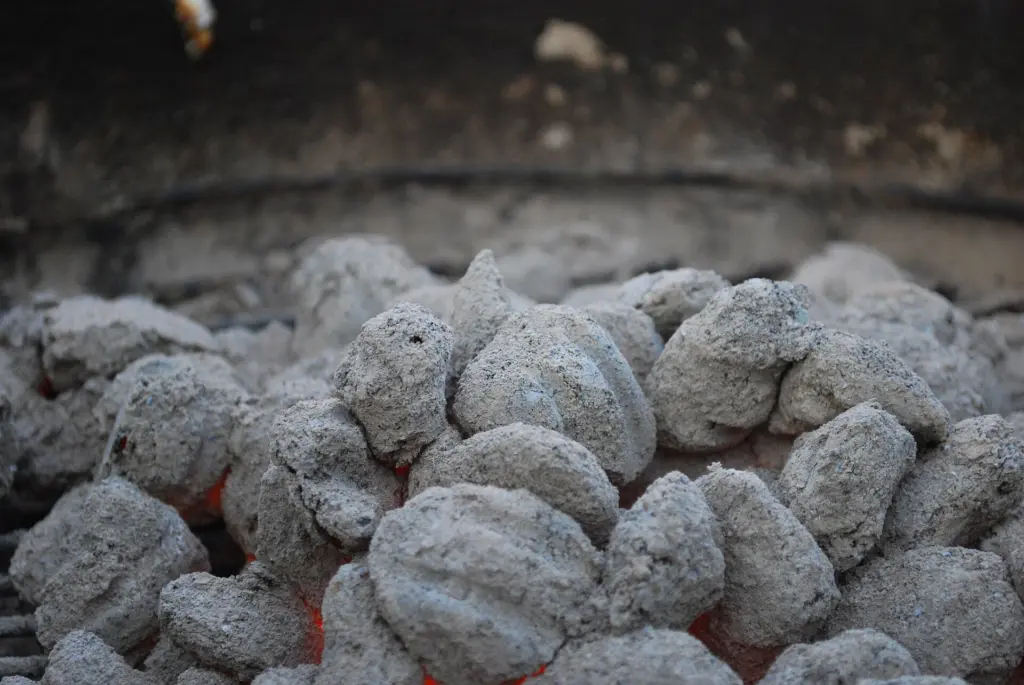
With a chimney starter. Two to three cubes on the charcoal grate, the chimney filled with charcoal on top, then wait. According to Weber’s information sheet, this takes 15 to 20 minutes with lump charcoal and about 30 with briquettes. proFagus reckons with 30 to 40 minutes until the charcoal is completely covered in gray-white ash. Only then does the food go on the grate. By then the heavy smoke has died down, and according to the German Federal Institute for Risk Assessment (BfR), fewer polycyclic aromatic hydrocarbons (PAHs) are then deposited on the food. A grill tray prevents fat from dripping into the embers, because according to the BfR dripping fat produces additional PAHs.
Methylated spirits and gasoline are off-limits. Weber states this on every charcoal product page: no highly flammable liquids for lighting or relighting. The BfR considers solid firelighters the safer choice, partly because liquid grill lighters are dangerous for small children.
And the grill stays outdoors. Always. In an experiment by the German Federal Institute for Materials Research and Testing (BAM) and the BfR, 800 g of glowing charcoal in a 19-cubic-meter room produced more than 3,000 ppm of carbon monoxide after two hours. According to the BfR, at such levels you lose consciousness within a few minutes. No smoke detector went off, whereas a CO detector did within seconds. The BfR explicitly warns against charcoal in indoor spaces and garages, even with windows and doors open. Tents, awnings and caravans are no exception. The leftover embers for warmth have no place there either. Devices that detect the gas can be found in the CO detector guide.
Finally, the ash. The UBA advises putting it in the general waste once it has cooled, not on the compost, because heavy metals and PAHs accumulate in it.
Which bag for which barbecue evening?
- Kettle grill evening with direct and indirect grilling: Weber Briketts 8 kg, thanks to the openly stated origin and up to three hours of embers.
- A quick round of steaks: proFagus DER SOMMER HIT or Weber Premium Holzkohle.
- Dutch oven and long cooking times with German beech: proFagus GRiLLiS.
- Without wood from the forest: Weber coconut briquettes or McBrikett KOKOKO CUBES.
- For lighting: chimney starter plus solid cubes, never methylated spirits.
Frequently asked questions
Lump charcoal or briquettes: what is the difference?
Lump charcoal lights faster and gets hot quickly, but then soon tapers off. Weber states around 15 minutes until its Premium Holzkohle is ready for grilling and a burn time of about 1.5 hours. Briquettes take longer but, according to Weber, last up to three hours. Steaks and sausages work well with lump charcoal; pulled pork and Dutch oven cooking with briquettes.
What do FSC, Naturland and DIN EN 1860 mean for charcoal?
According to the German Environment Agency (UBA), the DIN test mark under DIN EN 1860-2 only proves that no foreign substances such as pitch, petroleum, coke or plastics are present; it says nothing about where the wood comes from. The UBA recommends labels such as FSC, Naturland or organic labels. Buy bags that state the wood species, country of origin and a forest certification label.
Where does the wood in charcoal come from?
Often that remains unclear. In a 2020 study by WWF and the Thünen Institute, more than half of the 23 products bought in Germany lacked information on wood species or origin. Even with FSC-certified products, the testers found wood species that did not match. For its briquettes, Weber names Poland, Ukraine and Namibia.
Are coconut briquettes an alternative?
Yes, for anyone who does not want to burn wood. Coconut briquettes are made from carbonized coconut shells. Weber and McBrikett state up to three hours for their coconut briquettes, similar to charcoal briquettes. Weber names Indonesia as the origin of its coconut briquettes.
How do you light charcoal properly?
With a chimney starter and solid firelighter cubes, never with methylated spirits or gasoline. According to Weber's information sheet, this takes 15 to 20 minutes with lump charcoal and about 30 with briquettes. The food only goes on the grate once the coals are covered in gray-white ash. According to the German Federal Institute for Risk Assessment (BfR), fewer PAHs are then deposited on the food.
Can you grill with charcoal in a garage or tent?
No, the grill always stays outdoors. In an experiment by BAM and BfR, 800 g of glowing charcoal in a 19-cubic-meter room produced more than 3,000 ppm of carbon monoxide after two hours, and a smoke detector did not go off. The BfR warns against it even with windows and doors open, tents and caravans included.
Sources
- Weber: Briketts 8 kg
- Weber: Premium Holzkohle
- Weber: Grillbriketts aus Kokosnussschalen
- Weber: Anzündwürfel, 22 pieces
- Weber: information sheet on lighting and temperature control (PDF)
- proFagus: beech grill charcoal and GRiLLiS
- proFagus: certificates
- proFagus: grilling tips
- McBrikett: KOKOKO coconut briquettes
- Umweltbundesamt (German Environment Agency): grilling
- WWF/Thünen Institute: EU market analysis of charcoal 2020 (PDF)
- BfR: questions and answers on grilling
- BfR/BAM: grilling with charcoal does not belong indoors
Where to buy
- Weber Briketts 8 kg (17591)Check price at Amazon.deCheck price at Amazon.co.ukCheck price at Amazon.nlCheck price at Amazon.com.beCheck price at Amazon.frCheck price at Amazon.itCheck price at Amazon.esCheck price at Amazon.plCheck price at Amazon.seAvailable in Germany: Amazon.de
- Weber Premium Holzkohle 3 kgCheck price at Amazon.deCheck price at Amazon.co.ukCheck price at Amazon.nlCheck price at Amazon.com.beCheck price at Amazon.frCheck price at Amazon.itCheck price at Amazon.esCheck price at Amazon.plCheck price at Amazon.seAvailable in Germany: Amazon.de
- Weber Grillbriketts aus Kokosnussschalen 4 kgCheck price at Amazon.deCheck price at Amazon.co.ukCheck price at Amazon.nlCheck price at Amazon.com.beCheck price at Amazon.frCheck price at Amazon.itCheck price at Amazon.esCheck price at Amazon.plCheck price at Amazon.seAvailable in Germany: Amazon.de
- proFagus DER SOMMER HIT Buchen-HolzkohleCheck price at Amazon.deCheck price at Amazon.co.ukCheck price at Amazon.nlCheck price at Amazon.com.beCheck price at Amazon.frCheck price at Amazon.itCheck price at Amazon.esCheck price at Amazon.plCheck price at Amazon.seAvailable in Germany: Amazon.de
- proFagus GRiLLiS Buchen-BrikettsCheck price at Amazon.deCheck price at Amazon.co.ukCheck price at Amazon.nlCheck price at Amazon.com.beCheck price at Amazon.frCheck price at Amazon.itCheck price at Amazon.esCheck price at Amazon.plCheck price at Amazon.seAvailable in Germany: Amazon.de
- McBrikett KOKOKO CUBESCheck price at Amazon.deCheck price at Amazon.co.ukCheck price at Amazon.nlCheck price at Amazon.com.beCheck price at Amazon.frCheck price at Amazon.itCheck price at Amazon.esCheck price at Amazon.plCheck price at Amazon.seAvailable in Germany: Amazon.de
- Weber Anzündwürfel 22 StückCheck price at Amazon.deCheck price at Amazon.co.ukCheck price at Amazon.nlCheck price at Amazon.com.beCheck price at Amazon.frCheck price at Amazon.itCheck price at Amazon.esCheck price at Amazon.plCheck price at Amazon.seAvailable in Germany: Amazon.de