Contents13 sections
This guide was first published in German on handgetestet.de.
A red entry-level device in a room with large windows: the line is there, but nobody can see it. That is how many disappointments with cross-line lasers begin. For most DIYers, we therefore recommend a green, self-leveling laser with ±0.3 mm/m, such as the Stabila LAX 60 G. If you only occasionally line up pictures, shelves or a row of tiles, the smaller Bosch Quigo Green is enough. And if what you are really after is measuring rooms, a laser distance meter is the right tool, not a line laser.
Why green looks brighter than red
According to Bosch and Stabila, green laser diodes operate at around 500 to 540 nanometers, red ones usually at 635. The human eye is particularly sensitive to this green range. At the same laser class, a green line therefore appears brighter.
That comes at a noticeable surcharge. In the basement or a windowless hallway, red is often enough. In a living room with a south-facing window, rarely.
The range figure is similarly deceptive. The printed value is a laboratory figure for the visible line indoors. Outside in the sun, even a green line disappears after a few meters. The only thing that helps then is a receiver that detects the pulsed line and beeps as soon as it is level with it.
Not every device has this pulse mode, and not every manufacturer states a value for it.
Pendulum, tolerance, power: the technology behind it
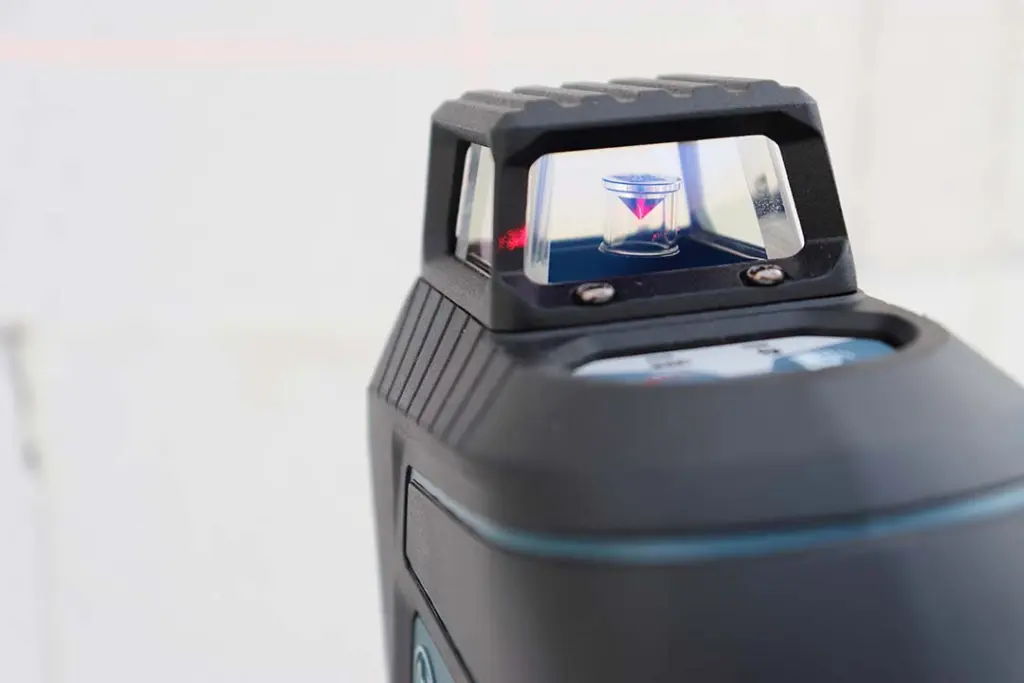
Inside hangs a pendulum. It aligns the lines as long as the device is not tilted more than about 4 degrees; beyond that, most devices flash as a warning. For stair railings and sloped ceilings, a lock mode for angled lines helps.
Accuracy appears in the data sheet sometimes in mm per meter, sometimes in mm at 10 m. ±0.3 mm/m and ±3 mm at 10 m mean the same thing. At ±0.6 mm/m, deviations of up to 3 mm can add up over a 5 m wall. Enough for a row of pictures. Hardly for a suspended ceiling.
A receiver is only worth it if the laser can pulse, and then the one the manufacturer intends for it.
When it comes to power, devices running on disposable batteries are the uncomplicated solution. Models with rechargeable packs mainly make sense for owners of the matching system, as we also describe in our overview of cordless drill drivers.
What laser class 2 means and what it does not
All devices in this overview carry laser class 2. Under the standard DIN EN 60825-1, such lasers emit only visible light with a maximum continuous output of 1 milliwatt. For a long time, it was assumed that the blink reflex protects the eye within 0.25 seconds. However, a research project by the German Federal Institute for Occupational Safety and Health (Bundesanstalt für Arbeitsschutz und Arbeitsmedizin, BAuA) showed that only about 17 percent of test subjects reacted with this reflex. The occupational safety database KomNet concludes from this that you cannot rely on it. If the beam hits you, deliberately close your eyes and turn your head away.
For construction sites, the industry refers to the German statutory accident insurance guideline DGUV Information 203-095 „Laserstrahlung auf Baustellen“ (laser radiation on construction sites) and the German technical rules TROS Laserstrahlung. The core rules are simple. Do not set up the laser at eye level, never point it at people or mirrors, and do not look at the beam through binoculars or a leveling telescope. The same applies at home, especially when children are in the room. Incidentally, measuring lasers share only the name with laser engravers; we explain their classes in our laser engraver guide (in German).
Seven devices for line and measurement
| Model | Type and laser | Range according to the manufacturer | Accuracy according to the manufacturer | Best for |
|---|---|---|---|---|
| Stabila LAX 60 G | Cross-line, green, 3 × AA | 30 m, 80 m with RL 230 RG receiver | ±0.3 mm/m | DIYers with renovation plans |
| Bosch Quigo Green | Cross-line, green, 2 × AAA | up to 12 m | ±0.6 mm/m | Pictures, shelves, small rooms |
| Makita SK105GDZ | Cross-line, green, CXT 12 V battery pack | 35 m, 80 m stated in parentheses | ±3 mm at 10 m | Makita users in the 12 V system |
| DeWalt DW088CG | Cross-line, green, 3 × AA | up to 50 m with DE0892G detector | ±3 mm at 10 m | Interior finishing with long run times |
| Bosch Professional GLL 3-80 G | 3 × 360° lines, green, 4 × AA | 30 m, 120 m with LR 7 receiver | ±0.3 mm/m | Drywall, entire rooms |
| Leica DISTO D2 | Distance meter, red, Bluetooth | up to 150 m, 80 m in unfavorable conditions | ±1.5 mm | Measuring up, planning on your phone |
| Bosch Professional GLM 50-27 CG | Distance meter, green, Bluetooth | up to 50 m | ±1.5 mm | Measuring on the job site, IP65 |
Stabila LAX 60 G
According to the manufacturer, Stabila’s new compact cross-line laser achieves ±0.3 mm/m and 30 m of visible line. In pulse mode, it reaches up to 80 m with the optional RL 230 RG receiver. Angled lines are possible in manual mode. Magnets and a 1/4-inch thread hold the device on profiles and tripods, and the box includes a target plate, a belt pouch and three AA batteries.
Bosch Quigo Green
A cube with 6.5 cm edges, weighing 270 grams according to Bosch, powered by two AAA batteries. ±0.6 mm/m and a 12 m working range make clear what it is made for: the home. It gets the picture above the sofa or the TV mount straight; the mounts themselves are compared in our article on TV wall mounts. Bosch makes no mention of a receiver mode. When buying, the second generation is what counts, because older listings still state ±0.8 mm/m.
Makita SK105GDZ
With the SK105GD, Makita relies on the 12 V battery pack of the CXT series. Makita states a run time of about 20 hours with a 4.0 Ah pack, along with IP54 and ±3 mm at 10 m. The Z at the end denotes the bare tool without a battery pack. If you do not have any CXT packs yet, you pay considerably more for the kit than for a device running on disposable batteries.
DeWalt DW088CG
Widely used for a long time. Rubberized housing, wall bracket, carrying case. DeWalt promises more than 30 hours of run time with three AA batteries and up to 50 m of working range with the DE0892G detector. It self-levels up to ±4 degrees, and each line covers 180 degrees.
Bosch Professional GLL 3-80 G
One horizontal and two vertical lines run all the way around and lay out an entire room in one go. In drywall work, that saves a lot of repositioning. Bosch states ±0.3 mm/m and 30 m without and 120 m with the LR 7 receiver. A good 800 grams and a professional price: for a single bathroom, that is overkill.
Leica DISTO D2
In the current generation, according to the data sheet, the small Leica measures up to 150 m on a light-colored wall and up to 80 m under unfavorable conditions. Leica puts the accuracy at ±1.5 mm, tested according to ISO 16331-1. A tilt sensor, Bluetooth and NFC send the measurements to the Plan app. The dot is red, which makes it hard to find outdoors in bright light over long distances.
Bosch Professional GLM 50-27 CG
Green dot, up to 50 m, ±1.5 mm.
With IP65, the Bosch withstands dust and water jets better than the Leica. It also has Bluetooth and tilt measurement, and two AA batteries supply the power. If you rarely measure farther than across a single-family house, you will not miss the shorter range.
Which device for which job?
Renovating, laying tiles, installing a kitchen: for that, we consider the Stabila LAX 60 G the right choice, green, ±0.3 mm/m and with a receiver mode for later. For pictures and shelves, when money is tight, the Bosch Quigo Green is enough, and more is rarely needed for that. If you already have CXT packs in the cupboard, the Makita SK105GDZ fits. DeWalt users get the battery-powered option with the DW088CG. Drywall and entire rooms are the territory of the Bosch GLL 3-80 G; for occasional jobs, it is overkill. Finally, for measuring up rooms: the Leica DISTO D2 for long distances, the Bosch GLM 50-27 CG for rough environments and a green dot.
Frequently asked questions
Green or red cross-line laser?
According to Bosch and Stabila, green laser diodes operate at around 500 to 540 nanometers, red ones usually at 635. The eye is particularly sensitive to green, so the line appears brighter at the same laser class. That comes at a surcharge. In the basement, red is often enough; in a living room with a south-facing window, rarely.
How accurate does a cross-line laser need to be?
±0.3 mm/m and ±3 mm at 10 m mean the same thing. At ±0.6 mm/m, deviations of up to 3 mm can add up over a 5 m wall. That is enough for a row of pictures but hardly for a suspended ceiling.
Can you use a cross-line laser outdoors?
Only to a limited extent. The printed range is a laboratory value for indoor use; in sunlight, even a green line disappears after a few meters. A receiver that detects the pulsed line helps here. That requires a pulse mode, which not every device has.
Is a class 2 laser dangerous to the eyes?
Class 2 lasers emit no more than 1 milliwatt of visible light. For a long time, it was assumed that the blink reflex provides protection. However, a research project by the German Federal Institute for Occupational Safety and Health (BAuA) showed that only about 17 percent of test subjects reacted this way. If the beam hits your eye, deliberately close your eyes and turn your head away; never point it at people or mirrors.
How does self-leveling work?
Inside hangs a pendulum that aligns the lines as long as the device is not tilted more than about 4 degrees. Beyond that, most devices flash as a warning. For stair railings and sloped ceilings, a lock mode for angled lines helps.
Cross-line laser with rechargeable battery or disposable batteries?
Battery-powered devices are the uncomplicated solution, such as the Stabila LAX 60 G or DeWalt DW088CG with AA batteries. Devices with rechargeable packs, such as the Makita SK105GDZ in the 12 V CXT system, mainly make sense for owners of the matching system. Without existing packs, the kit costs considerably more.
Sources
- Stabila: LAX 320 G and LAX 60 G flyer
- Bosch: Quigo Green
- Makita: SK105GD
- DeWalt: DW088CG
- Bosch Professional: GLL 3-80 G
- Leica Geosystems: DISTO D2 data sheet
- Bosch Professional: GLM 50-27 CG
- KomNet NRW: Laser class 2 and BAuA research on the blink reflex
- ZVSHK (German plumbing and heating trade association): Laser radiation on construction sites (with reference to DGUV 203-095 and TROS Laserstrahlung)
Where to buy
- Stabila LAX 60 GCheck price at Amazon.deCheck price at Amazon.co.ukCheck price at Amazon.nlCheck price at Amazon.com.beCheck price at Amazon.frCheck price at Amazon.itCheck price at Amazon.esCheck price at Amazon.plCheck price at Amazon.seAvailable in Germany: Amazon.de
- Bosch Quigo GreenCheck price at Amazon.deCheck price at Amazon.co.ukCheck price at Amazon.nlCheck price at Amazon.com.beCheck price at Amazon.frCheck price at Amazon.itCheck price at Amazon.esCheck price at Amazon.plCheck price at Amazon.seAvailable in Germany: Amazon.de
- Makita SK105GDZCheck price at Amazon.deCheck price at Amazon.co.ukCheck price at Amazon.nlCheck price at Amazon.com.beCheck price at Amazon.frCheck price at Amazon.itCheck price at Amazon.esCheck price at Amazon.plCheck price at Amazon.seAvailable in Germany: Amazon.de
- DeWalt DW088CGCheck price at Amazon.deCheck price at Amazon.co.ukCheck price at Amazon.nlCheck price at Amazon.com.beCheck price at Amazon.frCheck price at Amazon.itCheck price at Amazon.esCheck price at Amazon.plCheck price at Amazon.seAvailable in Germany: Amazon.de
- Bosch Professional GLL 3-80 GCheck price at Amazon.deCheck price at Amazon.co.ukCheck price at Amazon.nlCheck price at Amazon.com.beCheck price at Amazon.frCheck price at Amazon.itCheck price at Amazon.esCheck price at Amazon.plCheck price at Amazon.seAvailable in Germany: Amazon.de
- Leica DISTO D2Check price at Amazon.deCheck price at Amazon.co.ukCheck price at Amazon.nlCheck price at Amazon.com.beCheck price at Amazon.frCheck price at Amazon.itCheck price at Amazon.esCheck price at Amazon.plCheck price at Amazon.seAvailable in Germany: Amazon.de
- Bosch Professional GLM 50-27 CGCheck price at Amazon.deCheck price at Amazon.co.ukCheck price at Amazon.nlCheck price at Amazon.com.beCheck price at Amazon.frCheck price at Amazon.itCheck price at Amazon.esCheck price at Amazon.plCheck price at Amazon.seAvailable in Germany: Amazon.de